Ezekiel 40:3
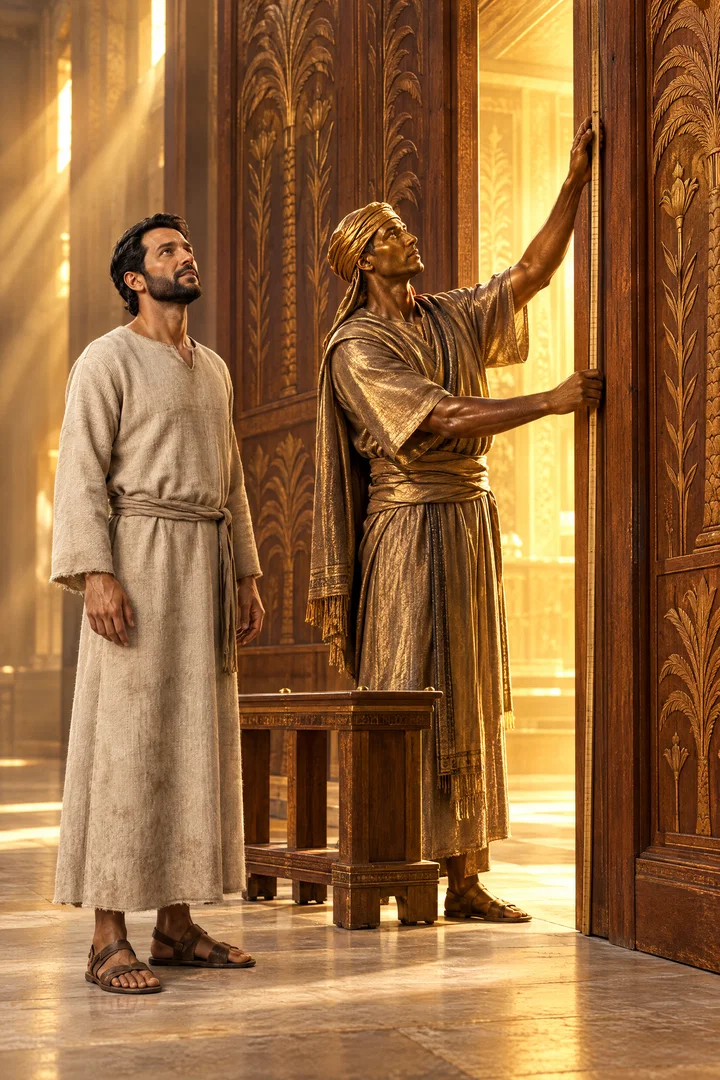
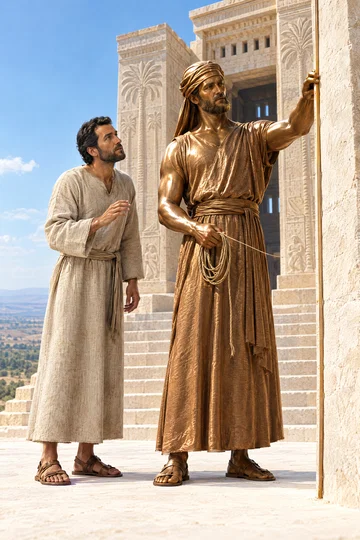
And he brought me thither, and, behold, there was a man, whose appearance was like the appearance of brass, with a line of flax in his hand, and a measuring reed; and he stood in the gate.
Translations
American King James Version, King James Version
And he brought me thither, and, behold, there was a man, whose appearance was like the appearance of brass, with a line of flax in his hand, and a measuring reed; and he stood in the gate.
KJV Cambridge Paragraph Bible, Webster Bible, Revised Version
And he brought me thither, and behold, there was a man, whose appearance was like the appearance of brass, with a line of flax in his hand, and a measuring reed; and he stood in the gate.
And he brought me thither; and, behold, there was a man, whose appearance was like the appearance of brass, with a line of flax in his hand, and a measuring reed; and he stood in the gate.
And He bringeth me in thither, and lo, a man, his appearance as the appearance of brass, and a thread of flax in his hand, and a measuring-reed, and he is standing at the gate,
And he brought me thither, and behold, there was a man whose appearance was like the appearance of brass, with a flax-cord in his hand, and a measuring-reed; and he stood in the gate.
And when he brought me thither, then lo! a man whose appearance was like the appearance of bronze, with a flax-cord in his hand and measuring reed,—and he was standing in the gate.
Berean Standard Bible, Majority Standard Bible
So He took me there, and I saw a man whose appearance was like bronze. He was standing in the gateway with a linen cord and a measuring rod in his hand.
He brought me there; and, behold, there was a man whose appearance was like the appearance of bronze, with a line of flax in his hand and a measuring reed; and he stood in the gate.
He took me there, and I saw a man, looking like brass, with a linen cord in his hand and a measuring rod: and he was stationed in the doorway.
And he brought me thither, and beholde, there was a man, whose similitude was to looke to, like brasse, with a linnen thread in his hand, and a reede to measure with: and he stoode at the gate.
Douay-Rheims (Challoner revision)
And he brought me in thither, and behold a man, whose appearance was like the appearance of brass, with a line of flax in his hand, and a measuring reed in his hand, and he stood in the gate.
Pictures
Cross-references
- Ezekiel 43:10-11
Thou son of man, shew the house to the house of Israel, that they may be ashamed of their iniquities: and let them measure the pattern.
Israel must be ashamed of its iniquities before the temple pattern is shown.
- Ezekiel 47:3
And when the man that had the line in his hand went forth eastward, he measured a thousand cubits, and he brought me through the waters; the waters were to the ankles.
The same guide measures the temple’s life-giving stream.
- Zechariah 2:1-2
I lifted up mine eyes again, and looked, and behold a man with a measuring line in his hand.
A man measures Jerusalem with a line.
- Revelation 11:1
And there was given me a reed like unto a rod: and the angel stood, saying, Rise, and measure the temple of God, and the altar, and them that worship therein.
Its symbolic measuring is contrasted with Ezekiel’s actual measurement of a material temple.
- 1 Kings 6:19-20
And the oracle he prepared in the house within, to set there the ark of the covenant of the LORD.
Compares the vision’s most holy place with Solomon’s temple.
- Revelation 22:1-5
And he shewed me a pure river of water of life, clear as crystal, proceeding out of the throne of God and of the Lamb.
God’s promises are fulfilled in the new creation and its capital city.
- Ezekiel 48:8-10
And by the border of Judah, from the east side unto the west side, shall be the offering which ye shall offer of five and twenty thousand reeds in breadth, and in length as one of the other parts, from the east side unto the west side: and the sanctuary shall be in the midst of it.
Sets out the sanctuary’s place in the restored land.
- Haggai 2:9
The glory of this latter house shall be greater than of the former, saith the LORD of hosts: and in this place will I give peace, saith the LORD of hosts.
Promises that the latter temple’s glory will surpass the former’s.
- Ezekiel 48:35
It was round about eighteen thousand measures: and the name of the city from that day shall be, The LORD is there.
The visionary city is named “The LORD is there.”
- Revelation 21:15-17
And he that talked with me had a golden reed to measure the city, and the gates thereof, and the wall thereof.
Both visions describe a heavenly figure measuring a sacred city with a measuring instrument.
Commentary
Each commentary is drawn from primary sources: the writings of Ellen G. White and Adventist pioneers and periodicals. Each commentary is separate. Its own words are not a quotation; follow the references to read the source passages.
Ellen G. White
1 source
The man whose appearance is like brass stands in the gate with a line of flax in his hand and a measuring reed.Ms 62, 1886, par. 27–29 He takes his place there to begin the exact measurement of the house and of all its parts.Ms 62, 1886, par. 27–29 The measurements are set down to the smallest detail.Ms 62, 1886, par. 27–29 They present God's precise measure, which is the standard for character and conduct.Ms 62, 1886, par. 27–29
Sources
Pioneers and periodicals
42 sources
The man like brass with a flax line and measuring reed in his hand stands in the gate to measure God's temple and city.ST Aug 2, 1910ST Aug 30, 1905ST Aug 30, 1905 He is God's representative and Ezekiel's guide through the vision to its end, measuring out its definite form and dimensions.ST Aug 30, 1905ST Aug 30, 1905 The vision was laid before captive Israel to show what Jerusalem and its sanctuary in Canaan could have become if they had left Babylon and returned.RH May 25, 1876RH Jan 20, 1853 It was offered only on condition that they be ashamed of their iniquities, turn from evil, obey God's voice and yield wholly to Him.ST Aug 12, 1875RH May 25, 1876RH Jan 19, 1860 Because most did not return and did not repent, the sanctuary as described was never built, being realized only partly and feebly in Zerubbabel's inferior temple.RH May 25, 1876ST May 30, 1911 It will never be built literally in the future, for its animal sacrifices and Levitical priesthood ended at Christ's once-for-all offering, and what failed for earthly Jerusalem will be grandly realized without its local conditions in the holy city at Christ's second coming.ST Oct 1, 1896RH Jan 19, 1860ST Apr 8, 1889ST Mar 3, 1909ST Aug 2, 1910
Vision Setting and Wording
The vision was given in the twenty-fifth year of the captivity, in 574 B.C., while Ezekiel was a captive in Babylon.RH May 25, 1876ST May 9, 1878ST Aug 13, 1894 It came fourteen years after Jerusalem and its temple were destroyed.RH May 25, 1876RH Sep 11, 1856 It offered the pattern of a remarkable new sanctuary to Israel while they were in captivity.RH May 25, 1876RH Sep 11, 1856
God brought Ezekiel to the land of Israel and set him on a very high mountain, where he was shown the frame of a city to the south.ST Nov 10, 1898 The description beginning here runs nine chapters to the end of the book.ST Nov 10, 1898ST Sep 13, 1905 It lays out what lay in prospect for Israel in Palestine after restoration to their own land.ST Nov 10, 1898
The verse opens a unified, detailed vision of a sanctuary, city, land, and grand temple at Jerusalem.ST Sep 13, 1905ST Nov 24, 1914ST Sep 17, 1902 The sanctuary has definite form and actual material dimensions that can be set out in a diagram.ST Nov 24, 1914 Its measuring with line and reed is for a material temple, unlike the symbolic measuring in Revelation 11.ST Apr 4, 1911 That temple would ultimately become a house of prayer for all nations.ST Sep 17, 1902
The account leaves open whether Ezekiel was transported bodily or was shown what he saw in vision. In this it is like Paul's uncertainty about whether he was bodily taken to the third heaven.
The Man Who Measures
The figure is a man whose appearance is like brass, with a line of flax in his hand and a measuring reed, standing in the gate to measure the temple and the city of God.ST Aug 2, 1910ST Aug 30, 1905ST Aug 30, 1905ST Sep 24, 1902 He is the representative of God and Ezekiel's guide through chapters 40-48, the same one who goes forth eastward with the line in his hand, measures a thousand cubits, and causes Ezekiel to pass through the waters.ST Aug 30, 1905ST Aug 30, 1905 The vision is the counterpart to Zechariah 2:1-2, belonging together with it, covering the same period and representing the same purposes of God toward Jerusalem, both setting forth the future of Jerusalem on condition that God's people put aside sins and come up to the full measure of children of God.ST Aug 2, 1910
His standing in the gate to measure shows God laying out a greater and more magnificent house than the inferior one Israel actually built in weak faith.ST Apr 15, 1903ST Sep 24, 1902 Even Herod's later enlargement fell short of God's design, yet Christ honored that inferior house with His personal presence and glory until His people rejected His counsel and crucified Him.ST Apr 15, 1903 Measuring the pattern was part of the call for Israel to face its iniquities, be ashamed of them, and repent and reform, with the blessings of Ezekiel 40-44 offered only on that condition.ST May 9, 1878
A Conditional Promise Lost
Ezekiel 40:3 opens the pattern of a sanctuary, city, and restoration in Canaan and Jerusalem offered to Israel while in captivity, fourteen years after Jerusalem and its temple were destroyed, and laid before them after the return from Babylonian captivity.RH May 25, 1876RH Jan 20, 1853RH Sep 11, 1856 It shows what Jerusalem could have become if Israel had answered the calls to leave Babylon, with the twelve tribes brought back and the building established.RH Jan 20, 1853ST May 30, 1911RH Feb 7, 1907 The return from Babylon was only partial, so the fuller plan was replaced by the inferior temple built by Zerubbabel, and God will instead prepare a holy city in heaven to descend to earth.ST May 30, 1911RH Feb 7, 1907 That promised restoration would have been literal, though it faintly points to the glorious restoration of the new earth.ST May 30, 1911
The sanctuary would have been built only on condition that Israel be ashamed of its iniquities, turn from sin and doing evil, put iniquities away, obey God's voice, and yield wholly to him.ST Aug 12, 1875RH May 25, 1876RH Jan 19, 1860RH Jan 20, 1853RH Sep 11, 1856 God builds and plants a nation when it obeys, and turns from the good he purposed toward it when it disobeys.RH Jan 19, 1860 The vision was given to call Israel to recognize and turn from iniquity, and because they did not repent God did not fulfill the promised restoration in the form described.ST Aug 12, 1875RH Jan 19, 1860ST Feb 27, 1907 Its city is not the New Jerusalem, and its sacrifices do not foretell a restored Levitical sacrificial system.ST Aug 12, 1875RH Jan 19, 1860
Because Israel did not repent, departed from God's ordinances, and most did not return when Cyrus offered the opportunity, with only about forty thousand returning, the sanctuary as described was never built.RH May 25, 1876ST Feb 27, 1907 It was realized only partly and feebly in the inferior temple built by Zerubbabel under Ezra, which was only a lesser likeness and shadow of the plan.ST May 30, 1911ST Nov 24, 1909ST Mar 3, 1909 Their unbelief prevented the rebuilding in its full form, and they obtained the more inferior sanctuary described in Ezra.ST Nov 24, 1909ST Mar 3, 1909 The vision does not describe a future sanctuary, since it includes sacrifices, and offering sacrifices now would nullify Christ's offering, though as a type its fulfillment for God's people is general rather than detailed.ST Nov 24, 1909ST Mar 3, 1909
If scattered Israel when gathered home to their own land had fully complied, forgiven their sins and given new hearts, with waste cities rebuilt as a holy flock, raised as the whole house of Israel in the dry-bones figure of resurrection, joined together as one nation under the seed of David, and with the northern Scythian nations of Gog and Magog destroyed before them, this sanctuary would have been built and God's glory would have rested on that city as never before.ST Apr 20, 1915 That city was to be named from that day Jehovah-shammah, meaning Jehovah is there.ST Apr 20, 1915 Because Israel failed to comply there was only the feeblest fulfillment: fewer than fifty thousand returned, the temple built was not at all equal in glory to Solomon's, the northern foes were not destroyed but persecuted Israel preeminently under Antiochus IV, and Israel fell under Rome until the nation was destroyed.ST Apr 20, 1915
No Literal Future Temple
The prophecy belongs to the Mosaic dispensation, when circumcision, offerings, the Levitical priesthood and other institutions of that order were in force, and it does not describe the future age.ST Aug 12, 1875 It sets forth a temple that was never built and will never be built as a built sanctuary, because its promise depended on Israel being ashamed of its iniquities, turning from them, and yielding wholly to God in faith and obedience, which Israel did not do.ST Aug 12, 1875ST Sep 3, 1902ST May 16, 1911ST Aug 2, 1905 It is part of the description of a sanctuary that would have been built if the people had been ashamed and repented, proclaiming that Jehovah is there and bringing healing and life, but God could not dwell among a half-hearted people and would not again ordain the sacrifices it includes.ST Sep 3, 1902ST Aug 26, 1913 Its fulfillment, including the temple and its attendant sacrifices, was offered provisionally to ancient Israel and will never be fulfilled as a built sanctuary because the conditions were not met.ST May 16, 1911ST Aug 2, 1905ST Aug 26, 1913
That promise is not to be fulfilled in a future and immortal state, for it is accompanied by marriages, divorces, disease and death which belong only to this mortal state.RH Sep 11, 1856 It was not for the present dispensation, for it is accompanied by all manner of offerings and a Levitical priesthood which ceased at the cross of Christ.RH Sep 11, 1856 It was not fulfilled in the past dispensation, for Israel did not fulfill the conditions on which the city and sanctuary were offered.RH Sep 11, 1856
Its sacrificial system, Levitical priestly work and attendant sacrifices are not to be restored literally.ST Oct 1, 1896RH Jan 19, 1860ST Apr 8, 1889ST Nov 24, 1909ST Dec 1, 1914 The sanctuary service assigns priestly work to the Levites and cannot describe a temple to be built after Christ's ministry began, because Christ became the everlasting High Priest in a priesthood that does not pass to another, and his priesthood and the everlasting gospel continue together.ST Apr 8, 1889 Renewed animal sacrifices would deny Christ's once-for-all offering and nullify his offering, returning to shadows that pointed forward to him and not backward, and offering sacrifices now would have that effect.ST Oct 1, 1896ST Nov 24, 1909ST Dec 1, 1914 The sacrifices it describes would have pointed to Christ's once-for-all offering, not replaced it, and do not foretell a restored Levitical system, while its city is not the New Jerusalem.RH Jan 19, 1860ST Dec 1, 1914 The sanctuary and its promises were only partly realized in the inferior temple built by Zerubbabel after the return from Babylon, which was only a shadow of the plan, and the prince in the vision who is commanded to offer particular offerings for himself is not the Prince who will reign forever.ST Nov 24, 1909ST Dec 1, 1914ST Aug 26, 1913
The temple-city vision of Ezekiel 40-48 has been taken to predict a literal rebuilt Jerusalem with restored offerings and sacrifices during the thousand-year reign of Christ.RH Sep 4, 1856 That application supersedes the heavenly Jerusalem John saw coming down from God out of heaven and which Paul says is above and is the mother of all.RH Sep 4, 1856 It makes Christ's reign a return to the ordinances of the first covenant for an undeveloped class, a state less glorious than the present dispensation.RH Sep 4, 1856 The offerings of the first covenant pointed year by year to Christ the great sin-offering, and Christ by one offering perfected forever them that are sanctified and sat down at the right hand of God, so restoring those year-by-year sacrifices would require a second Messiah at the end of the thousand years to expiate transgression.RH Sep 4, 1856
Because Israel failed to meet the conditions, God will not in the nature of the case carry out that sanctuary plan in detail.ST Oct 17, 1906 The vision was what God would have given to fleshly Israel then and there if Israel had permitted Him to fulfill His promises to them on obedience.ST Oct 17, 1906 It must not be applied as a literal description of new-earth conditions, for it is a great mistake to transfer all the Old Testament promises given to Israel to the new earth.ST Oct 17, 1906
Wider Fulfillment and Application
Had the people met God's conditions, the promises and figures in these closing chapters would have been literally fulfilled in greater glory than before, though in the event the restoration was fulfilled only in small degree and in part.ST Feb 22, 1910ST May 30, 1911ST Oct 1, 1896 The return from Babylon was only partial, so the lesser house raised by Zerubbabel replaced the fuller plan, standing as a mere shadow of what had been shown.ST May 30, 1911ST Oct 1, 1896 The promised restoration would have been literal, yet it faintly points to the glorious restoration of the new earth.ST May 30, 1911
The vision is a type of God's future work for His people, but its fulfillment is general rather than detailed.ST Mar 3, 1909ST Oct 26, 1904 What failed for old earthly Jerusalem because the people would not put aside sin and come up to the full measure of children of God will be grandly realized in the New City that awaits the true Israel of God.ST Aug 2, 1910ST Oct 26, 1904 The promised future glory will therefore be fulfilled for the true Israel through later revelations rather than in every detail of Ezekiel's description, in events connected with Christ's second coming without the local conditions of Ezekiel's day and under greater conditions, though much of its former detail will not remain.ST Oct 26, 1904ST Jan 31, 1911 The city shown during the captivity was what Jerusalem could have become if Israel had answered the calls to leave Babylon, and because Israel failed to do its part God will instead prepare a holy city in heaven to descend to earth.RH Feb 7, 1907
The vision shows first the possibilities before the restored kingdom of Judah after the captivity if they had laid hold on the promise by faith, and second and chiefly the new-earth kingdom under Him whose right it is to reign.ST Sep 13, 1905 Revelation 21-22 is its complement, especially its life-giving stream.ST May 30, 1911ST Sep 13, 1905 God's presence in the vision would bring healing and life to barren land, salt marshes, and impure waters, with His glory dwelling in the midst of a restored Jerusalem proclaimed as Jehovah is there.ST Sep 3, 1902ST Aug 2, 1910 Had His people heeded and been ashamed of their sins, He would have cut off all their enemies, resurrected those who had gone down in death, and made Israel a light indeed to the world.ST Aug 2, 1910 Because they refused to be ashamed and would not yield fully to God, Jerusalem was never so restored and the temple in the vision was never built and will never be built.ST Sep 3, 1902ST Aug 2, 1910
It does not point to a future age of probation, nor does it belong to the future reign of Christ and His saints.ST Nov 10, 1898RH Nov 3, 1863 The prince commanded in the vision to offer particular offerings for himself is not the Prince who will reign over Israel forever.RH Nov 3, 1863 Nor does the prophecy disclose the historical process by which the greater temple would have been built, for the circumstances of construction are secondary to the prophecy itself.
God brought the prophet in visions to a very high mountain and told him to look with the eyes, listen with the ears, take the message to heart, and report what he saw.ST Jul 17, 1901ST Aug 28, 1901 It was given so Israel could view its condition and circumstances as God viewed them, in their eternal importance.ST Jul 17, 1901 The high mountain is the sublime heights of prophecy, history in advance, from which the ground already traversed can be reviewed and coming perils beheld, and from which God's purpose in calling out the Israel of God, their victories, and their latter glory under King Immanuel can be seen.ST Aug 28, 1901 To rightly judge the past, understand the present, and discern the future a person must ascend to God's outlook and see in God's seeing, beholding His workings among earthly kingdoms despite their rulers through to the final consummation, for the prophets' visions convey God's word through human messengers.ST Jul 17, 1901ST Nov 28, 1900ST Aug 28, 1901
The vision was given to call Israel to recognize and turn from its iniquity, and because they did not repent the promised restoration was not fulfilled in the form described.ST Feb 27, 1907 The glorious prosperity and favor held out for Israel on return from Babylon depended on their faithfulness in representing truth in the earth.ST Nov 10, 1898
Sources