Ezekiel 40:2
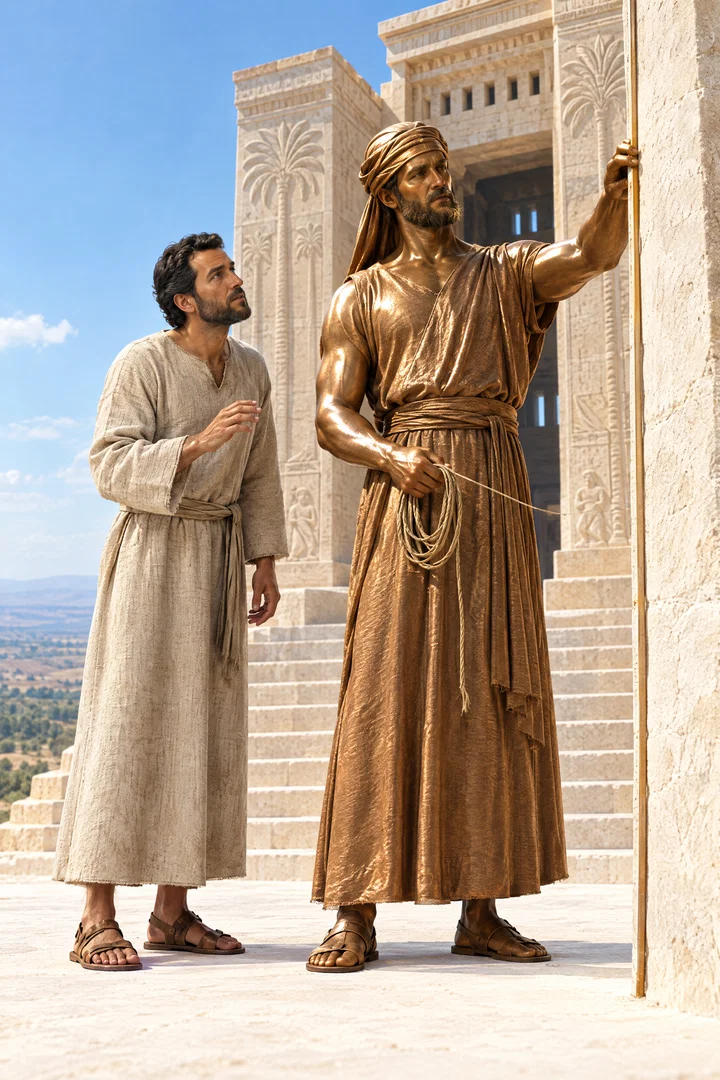
In the visions of God brought he me into the land of Israel, and set me upon a very high mountain, by which was as the frame of a city on the south.
Translations
In the visions of God brought he me into the land of Israel, and set me on a very high mountain, by which was as the frame of a city on the south.
King James Version, KJV Cambridge Paragraph Bible
In the visions of God brought he me into the land of Israel, and set me upon a very high mountain, by which was as the frame of a city on the south.
In the visions of God he brought me into the land of Israel, and set me upon a very high mountain, by which was as the frame of a city on the south.
Revised Version, American Standard Version
In the visions of God brought he me into the land of Israel, and set me down upon a very high mountain, whereon was as it were the frame of a city on the south.
in visions of God He hath brought me in unto the land of Israel, and causeth me to rest on a very high mountain, and upon it [is] as the frame of a city on the south.
In the visions of God brought he me into the land of Israel, and set me upon a very high mountain; and upon it was as the building of a city, on the south.
In the visions of God, he brought me into the land of Israel,—and set me down upon an exceeding high mountain, and thereupon, was, as it were the structure of a city, on the south.
Berean Standard Bible, Majority Standard Bible
In visions of God He took me to the land of Israel and set me on a very high mountain, on whose southern slope was a structure that resembled a city.
In the visions of God he brought me into the land of Israel, and set me down on a very high mountain, on which was something like the frame of a city to the south.
In the visions of God he took me into the land of Israel, and put me down on a very high mountain, on which there was, as it seemed, a building like a town opposite me.
Into the lande of Israel brought he me by a diuine vision, and set me vpon a very hie mountaine, whereupon was as the building of a citie, toward the South.
Douay-Rheims (Challoner revision)
In the visions of God he brought me into the land of Israel, and set me upon a very high mountain: upon which there was as the building of a city, bending towards the south.
Pictures
Cross-references
- Ezekiel 43:10-11
Thou son of man, shew the house to the house of Israel, that they may be ashamed of their iniquities: and let them measure the pattern.
shows plan to be shown to the people
- Revelation 21:2
And I John saw the holy city, new Jerusalem, coming down from God out of heaven, prepared as a bride adorned for her husband.
The holy city prepared in heaven descends to earth, complementing Ezekiel’s vision.
- Ezekiel 48:35
It was round about eighteen thousand measures: and the name of the city from that day shall be, The LORD is there.
Names the restored city “Jehovah is there.”
- Ezekiel 8:3
And he put forth the form of an hand, and took me by a lock of mine head; and the spirit lifted me up between the earth and the heaven, and brought me in the visions of God to Jerusalem, to the door of the inner gate that looketh toward the north; where was the seat of the image of jealousy, which provoketh to jealousy.
Both describe Ezekiel being transported in visions of God.
- Zechariah 2:1-2
I lifted up mine eyes again, and looked, and behold a man with a measuring line in his hand.
Both visions show Jerusalem being measured and reveal God’s purpose for its future.
- Ezekiel 1:1
Now it came to pass in the thirtieth year, in the fourth month, in the fifth day of the month, as I was among the captives by the river of Chebar, that the heavens were opened, and I saw visions of God.
Describes Ezekiel receiving a vision of God.
- Ezekiel 41
Afterward he brought me to the temple, and measured the posts, six cubits broad on the one side, and six cubits broad on the other side, which was the breadth of the tabernacle.
The vision continues with a detailed description of the sanctuary.
- Revelation 22:1-5
And he shewed me a pure river of water of life, clear as crystal, proceeding out of the throne of God and of the Lamb.
God fulfills his promises in the restored city of the new creation.
- 1 Kings 6
And it came to pass in the four hundred and eightieth year after the children of Israel were come out of the land of Egypt, in the fourth year of Solomon’s reign over Israel, in the month Zif, which is the second month, that he began to build the house of the LORD.
Describes Solomon’s temple, used as the comparison.
- Ezekiel 42
Then he brought me forth into the utter court, the way toward the north: and he brought me into the chamber that was over against the separate place, and which was before the building toward the north.
Describes the sanctuary and city in Ezekiel’s vision.
- Ezekiel 43:1-5
Afterward he brought me to the gate, even the gate that looketh toward the east:
The vision of the temple shows the glory of the LORD filling the house.
- Haggai 2:9
The glory of this latter house shall be greater than of the former, saith the LORD of hosts: and in this place will I give peace, saith the LORD of hosts.
Promises greater glory for the latter house.
- Revelation 4:1
After this I looked, and, behold, a door was opened in heaven: and the first voice which I heard was as it were of a trumpet talking with me; which said, Come up hither, and I will shew thee things which must be hereafter.
Both describe a divine call to see future things.
- Ezekiel 45:1-6
Moreover, when ye shall divide by lot the land for inheritance, ye shall offer an oblation unto the LORD, an holy portion of the land: the length shall be the length of five and twenty thousand reeds, and the breadth shall be ten thousand. This shall be holy in all the borders thereof round about.
The vision describes the sanctuary and city within Israel’s restored land.
- Ezekiel 47:1-12
Afterward he brought me again unto the door of the house; and, behold, waters issued out from under the threshold of the house eastward: for the forefront of the house stood toward the east, and the waters came down from under from the right side of the house, at the south side of the altar.
Both belong to Ezekiel’s vision of the restored temple and its life-giving river.
Commentary
Each commentary is drawn from primary sources: the writings of Ellen G. White and Adventist pioneers and periodicals. Each commentary is separate. Its own words are not a quotation; follow the references to read the source passages.
Ellen G. White
1 source
Ezekiel 40:2 belongs to a vision of a city and temple shown under measurement.Ms 62, 1886, par. 27–29 In that vision God's exact measure stands as the standard for all that is built.Ms 62, 1886, par. 27–29 Each part of the structure, down to the smallest detail, is measured and recorded.Ms 62, 1886, par. 27–29 The measuring shows that character and conduct are measured by God's law, and faithful, righteous dealing forms a life that matches His standard.Ms 62, 1886, par. 27–29
Sources
Pioneers and periodicals
52 sources
In the visions of God Ezekiel was carried into the land of Israel and set upon a very high mountain with what appeared as the frame of a city to the south, opening the single vision of chapters 40-48 concerning a measurable sanctuary and temple pattern, its offerings and worship, a city, and the division of the land.ST Oct 1, 1896RH Jan 19, 1860RH May 25, 1876ST May 30, 1911ST Nov 28, 1900 The vision was given in the twenty-fifth year of the Babylonian captivity, fourteen years after Jerusalem's sanctuary was destroyed, to console the captives with return and to show them explicit directions for rebuilding.RH Jan 20, 1853RH Sep 11, 1856ST May 9, 1878 The city, sanctuary and restoration were offered conditionally upon Israel being ashamed of sins, repenting and wholly yielding to God in faith and obedience, for God builds and plants what He promises only if the nation obeys His voice.RH Jan 20, 1853ST Aug 12, 1875ST Apr 20, 1915ST Aug 1, 1911 The sanctuary as described was never built and will never be built literally, because Israel remained unfaithful and only a part returned, receiving instead the inferior sanctuary of Zerubbabel, and it cannot belong to the gospel age or the immortal state with its Levitical priesthood and offerings which ceased at Christ's once-for-all sacrifice.ST Apr 8, 1889ST Aug 12, 1875ST Dec 1, 1914ST May 16, 1911 Though never fulfilled in detail, the vision faintly represents the general promises to be realized more gloriously at Christ's second coming and in the new earth for God's true Israel, while the very high mountain itself represents the higher, God-given outlook from which His heralds see and declare what must come to pass.ST Mar 3, 1909ST Nov 28, 1900ST Oct 26, 1904ST Aug 2, 1910
Wording and Vision Setting
In the visions of God Ezekiel was brought into the land of Israel and set upon a very high mountain, with what looked like the frame or outline of a city lying to the south of him.RH May 25, 1876ST May 30, 1911RH Jan 21, 1862ST Nov 10, 1898ST Oct 1, 1896 The verse opens the single vision that runs through chapters 40-48, describing a sanctuary and temple pattern with its offerings and worship, its glory, a city, and the division of the land and restoration of Canaan and Jerusalem.ST Oct 1, 1896RH Jan 19, 1860RH Aug 17, 1916RH Sep 11, 1856ST May 30, 1911 It belongs to the book's prophecies of restoration and covers the last nine chapters of Ezekiel, showing primarily the possibilities before the restored kingdom after the captivity and secondarily the new-earth kingdom.RH Aug 17, 1916ST Nov 10, 1898ST Sep 13, 1905
The vision was given fourteen years after Jerusalem's sanctuary was destroyed, in the twenty-fifth year of the captivity in Babylon when Ezekiel himself was a captive and the temple at Jerusalem lay in ruins, dated to 574 B.C.RH Jan 20, 1853RH Sep 11, 1856ST May 9, 1878ST Nov 10, 1898ST Aug 13, 1894 It was given to console the Jews with return to Jerusalem and restoration of the temple with its service, giving explicit directions for rebuilding to be shown to the people.RH Jan 20, 1853ST Aug 13, 1894 The proposed building was material and measurable, having two holy places, and its glory was to far exceed Solomon's temple.RH Jan 20, 1853ST Apr 4, 1911ST Sep 24, 1902
Ezekiel's language leaves open whether he was shown the place in vision or physically transported there, for his mind was transported to see what God revealed.ST Oct 25, 1905 This provides a precedent for John being transported in vision to see heavenly scenes.ST Oct 25, 1905 "Visions of God" means seeing through a vision with God's sight rather than merely human vision, from above the limits of ordinary sight, enabling Ezekiel to see and hear and to communicate those things to Israel.ST Jul 17, 1901ST Jan 24, 1911 In such vision he was taken to Jerusalem and shown the people's iniquities, for the prophets' visions are God's messages conveyed through human messengers.ST Jul 17, 1901ST Jan 24, 1911
Conditional Offer to Israel
The city, sanctuary, and restoration held out in the vision were offered to Israel only on condition that the people be ashamed of their sins and put them away, repenting, reforming, and wholly yielding themselves to God in faith and obedience.RH Jan 20, 1853ST Aug 12, 1875ST Feb 27, 1907ST Nov 24, 1909 If the returning Jews had so yielded, the sanctuary set before them would have been built, but their unbelief and continued apostasy prevented it, and they received instead the inferior sanctuary described in Ezra.ST Aug 12, 1875ST Nov 24, 1909 The vision was given so the people would recognize their iniquity and, if they repented, receive the revealed plan, yet because they did not repent God did not fulfill the promised restoration in that form.ST Feb 27, 1907ST Mar 3, 1909 Its fulfillment stood under the universal condition that God builds and plants what He promises only if the nation obeys His voice, and turns from the good He said He would do for them if they do evil in His sight.ST Apr 20, 1915ST Aug 1, 1911 Like all such prophecies it stands under the conditions of turning and mercy, and it could never be built afterward by returning to typical sacrifices, since those pointed forward to Jesus Christ and were fulfilled when the Lord Himself suffered.ST Aug 1, 1911
What God was prepared to do then and there, if Israel had permitted it, was to restore them from Babylonian captivity to their land and bring a fuller return of the twelve tribes.RH Jan 20, 1853ST Mar 3, 1909ST Oct 26, 1904 He would have rebuilt the temple more gloriously than before, with His glory resting as never before and Himself dwelling among them, divided Canaan, laid out priestly services and a city, and declared “Jehovah is there” over a restored Jerusalem.ST May 30, 1911ST Mar 3, 1909ST Oct 26, 1904ST Sep 3, 1902 From beneath that temple a river would have flowed bringing healing and life to barren land, salt marshes, and impure waters.ST May 30, 1911ST Sep 3, 1902 Those promises belonged originally to Israel in connection with the return from Babylonian captivity, describing the sanctuary, city, and land God would have given them if they had returned to Him and forsaken sin.ST May 30, 1911ST Feb 22, 1910ST Oct 26, 1904
If the conditions had been met the promises and figures would have been literally fulfilled.ST Feb 22, 1910 The glory God would have restored to Palestine and the Jews portrays a kingdom in which life would be lengthened, God’s presence would be continually manifest, and the people’s character would exert influence extending even to the animals.ST Feb 22, 1910ST Jan 31, 1911 The vision was given in order that the people might see their iniquity, and the last seven verses of chapter 39 show the Lord had in store for them on return from Babylon a glorious state of prosperity and favor.ST Feb 27, 1907ST Nov 10, 1898 That state was to be realized only as they were faithful in representing truth in the earth.ST Nov 10, 1898
History of Nonfulfillment
The sanctuary shown in chapters 40 to 48 was never built as described and will never be built as described, because its promise was conditional on Israel being ashamed of its sins, putting them away, repenting and reforming.ST Aug 12, 1875ST Dec 1, 1914ST May 16, 1911ST May 9, 1878 Israel did not meet those conditions but remained apostate and departed from God's ordinances, so what was promised to fleshly Israel then and there will not in the nature of the case be carried out in detail.ST Aug 12, 1875ST May 9, 1878ST Oct 17, 1906ST Aug 26, 1913 That promised sanctuary belonged to the Mosaic dispensation, when its prescribed offerings, Levitical priesthood and other ordinances were in force, and it was not a sanctuary for the future age nor a temple God would again ordain.ST Aug 12, 1875ST Aug 26, 1913
Only a part of the tribes went up at the restoration, about forty thousand returning, so the return was only partial and the full promises of a fuller return, God dwelling among them, and a new and greater sanctuary were not fulfilled in their fullness.ST Sep 21, 1915RH Nov 3, 1863 Instead of the glorious temple shown, the returning Jews through weak faith, complaints, fears and unbelief failed to wholly yield themselves to God and received the inferior sanctuary described in Ezra.ST Sep 20, 1910ST Apr 15, 1903 The temple built by Zerubbabel was only a smaller likeness, lesser shadow and feeble realization of the pattern set before them.ST May 30, 1911ST Nov 24, 1909ST Dec 1, 1914ST Sep 20, 1910 It was built instead of the greater house because Israel did not turn wholeheartedly to God, forsake sin and become ashamed of iniquities; had they done so the sanctuary Ezekiel set before them would have been built and would have surpassed Zerubbabel's temple, with a river flowing from beneath the temple bringing life to the land.ST May 30, 1911ST Sep 20, 1910
After the captivity Israel was to arise and build the much grander house to replace the house destroyed for unfaithfulness.ST Apr 15, 1903 Weak faith, complaints and fears led them to build a much inferior house, but King Herod, a man of the world, afterward took hold in their stead and made the house far greater and more magnificent.ST Apr 15, 1903 That house the Desire of all nations honored with His personal presence and filled with His glory, until His people again rejected His counsel and crucified Him.ST Apr 15, 1903
Those who held a different reading taught that the closing chapters predict the fact of the building of the greater temple, the temple rebuilt by Herod as a monument of his repentance. On that reading the prophecy gives the fact of the building without revealing the process by which the work was to be done, with the circumstances attending the work secondary to the fact itself.
No Future Literal Fulfillment
The vision opened in this verse does not establish a future restoration of the Jewish people with a future temple and Levitical sacrifices to be built after the Christian dispensation, during Christ's thousand-year reign, in the present dispensation, in the immortal state, or on this sin-cursed earth.ST Apr 8, 1889RH Jan 19, 1860RH Sep 11, 1856RH Sep 4, 1856ST Aug 2, 1905 Its city is not identical with the New Jerusalem, and its provisions do not authorize restoring the Levitical sacrificial system.ST Apr 8, 1889RH Jan 19, 1860 The sanctuary and city were offered conditionally and were not fulfilled in the past dispensation because the conditions were not met, and their provisions also rule out fulfillment in the immortal state or in the gospel dispensation.RH Sep 11, 1856ST Aug 2, 1905RH Sep 11, 1856 Because the conditions failed, that temple and its services will never be fulfilled as described.ST Aug 2, 1905RH Sep 11, 1856
It cannot belong to the immortal state because it is accompanied by marriages, divorces, disease, and death which belong only to this mortal state.RH Sep 11, 1856 It cannot belong to the present dispensation or gospel age because it prescribes all manner of offerings, a Levitical priesthood, and first-covenant ordinances which ceased at Christ's cross.ST Apr 8, 1889RH Sep 11, 1856RH Jul 21, 1910 Christ's priesthood replaced the Levitical priesthood and does not pass to another.ST Apr 8, 1889 Animal sacrifices belonged to a system that served as a shadow of things to come, not to the gospel way of expressing faith in Christ.RH Jul 21, 1910
Renewing its sacrificial offerings and returning to first-covenant ordinances would deny Christ's once-for-all offering by which by one offering of His body He perfected forever those sanctified.ST Oct 1, 1896RH Sep 4, 1856 It would deny His more excellent ministry as Mediator of a better covenant.RH Sep 4, 1856 It would require going back to typical sacrifices that pointed forward to Jesus and were fulfilled when the Lord Himself suffered, since offering sacrifices now would annul Christ's offering and God cannot go back to types already fulfilled.ST Nov 24, 1909ST Oct 17, 1906ST Aug 1, 1911 The law's yearly sacrifices were only a shadow pointing to Christ the great sin-offering, who by one offering of His body once for all perfected forever those sanctified and sat down at the Father's right hand till all His enemies are made His footstool, before coming as King of kings on David's throne.RH Sep 4, 1856
Its prince is not the Prince who reigns over Israel forever, but a mortal prince commanded to offer offerings for himself, unlike Jesus Christ.RH Nov 3, 1863 For that reason the prophecy does not belong to the future reign of Christ and His saints.RH Nov 3, 1863 Rebuilding that city during the thousand years in place of the heavenly Jerusalem would be less glorious than the present dispensation and would require a second Messiah at the end of the thousand years.RH Sep 4, 1856 The heavenly Jerusalem is a literal city with foundations whose builder and maker is God, coming down from God out of heaven upon the new earth, which is above, is free, and is the mother of all believers, not merely polity or government.RH Sep 4, 1856
The vision does not teach a future age of probation, and its river in chapter 47 is not the river of life.ST Nov 10, 1898 The city and all that pertained to it were in prospect for Israel in Palestine after restoration to their own land.ST Nov 10, 1898
Greater Final Fulfillment
Though never fulfilled in detail, the temple vision faintly represents the general promises God will fulfill for His people at the second coming.ST Mar 3, 1909 It belongs to the larger prophecy in chapters 36-48 originally given to Israel in connection with the return from Babylonian captivity, and to the book's prophecies of restoration showing the temple and its surrounding city.RH Aug 17, 1916ST Oct 26, 1904 If Israel had yielded to God and laid hold on the promise by faith, those promises would have been fulfilled then in the restored kingdom of Judah after the captivity, with the city and temple measured and rebuilt.ST Oct 26, 1904ST Aug 2, 1910ST Sep 13, 1905 Because the people did not truly repent and failed to meet the condition, they lost those earthly privileges, and what did not take place in the present earth will be realized more gloriously in the new earth.ST Oct 26, 1904ST Aug 2, 1910ST May 21, 1902 What was shown primarily as the possibilities before them is shown secondarily and principally as the new-earth kingdom under Him whose right it is, with the promised blessings instead realized in the New City for God's true Israel and the faithful receiving the full immortal inheritance without every detail being realized as described.ST Oct 26, 1904ST Aug 2, 1910ST May 21, 1902ST Sep 13, 1905
The prophecy will receive a greater fulfillment in the glory of Christ's second coming and related events, not through the local conditions of Ezekiel's time. Its promised grandeur depended on Israel's obedience after the return from Babylon, and Israel's failure left only a faint fulfillment in a lesser temple. The last-day fires will consume sin and melt the earth rather than people cleansing the land or burning weapons. The city in vision would have been built in Jerusalem if Israel had answered the calls to leave Babylon, and it was never built because Israel failed to do its part, not because God changed His purpose.RH Feb 7, 1907 God will instead prepare the holy city in heaven, and it will descend to earth.RH Feb 7, 1907
It is a great mistake to apply all the Old Testament promises given to Israel to new-earth conditions in detail, though God will give His people even more than human words can express.ST Oct 17, 1906 What was promised to fleshly Israel will not in the nature of the case be carried out in detail because the conditions were not met.ST Oct 17, 1906 The vision belongs to the peaceful Messiah's kingdom on earth had Israel met God's conditions, and to what God would have done for Israel even then if they had yielded to Him.ST May 21, 1902ST Aug 1, 1911 It describes a grand temple at Jerusalem as a house of prayer for all nations, a sanctuary to be built within Jerusalem as a building the returned people might construct.ST Aug 1, 1911ST Sep 17, 1902 That sanctuary was never built because Israel never yielded to God's plan, and it never will be built and never can be built because God cannot go back to the typical sacrifices that pointed forward to Jesus Christ, since the Lord Himself suffered and fulfilled all types, with all such prophecies standing under the universal conditions of turning and mercy.ST Aug 1, 1911
The chapter belongs to the part of the book that prophesies what the Lord would do for His people if they yielded to Him.RH Aug 17, 1916ST Aug 12, 1913
Elevated Outlook and Proclamation
The very high mountain is a higher, God-given outlook, a commanding viewpoint where God shows what is to be seen and reported, and where His perspective for understanding history, the present, and what lies ahead is gained.ST Nov 28, 1900ST God lifts the heralds of His gospel onto higher spiritual planes above earth's dusty deserts, sloughs and foglands so they can see in God's seeing, as He called Moses and John and as He showed the transfiguration on the mountain.ST Feb 4, 1903 Through visions in Scripture people are thus brought to the heights of God to get God's own view.ST Nov 8, 1905
From that high place, the watchtower of the sublime heights of prophecy which is history in advance, all the fast-fulfilling prophecies leading to the coming of Christ and His coronation can be seen together.ST Nov 8, 1905ST Aug 28, 1901 Only one step remains, one more act in the drama, and then the appearing of the Lord, with the next station on every prophetic road the New Jerusalem and the forever land.ST Nov 8, 1905 There the ground already traversed is reviewed and the past can be rightly judged, the present understood, and the future discerned.ST Aug 28, 1901
Through visions in Scripture people can see God's work among earthly kingdoms despite their rulers and their course toward their final outcome and final end, beyond the narrow perspective of immediate events.ST Nov 28, 1900 There coming perils, pitfalls, dangers and difficulties are beheld, and the Israel of God is seen with God's purpose in calling them out, their victories over opposing powers, and their latter glory under King Immanuel.ST Aug 28, 1901 The ascent is not to satisfy curiosity about heaven but to behold the things which must come to pass hereafter, to behold with the eyes and hear with the ears, to set the heart on all that is shown, and to declare all that is seen.ST Feb 4, 1903ST Aug 28, 1901 The prophets' visions are God's messages conveyed through human messengers, giving God's sight rather than merely human vision to enable seeing and hearing what God reveals and communicating those things to Israel.ST Jul 17, 1901
Sources