Ezekiel 40:5
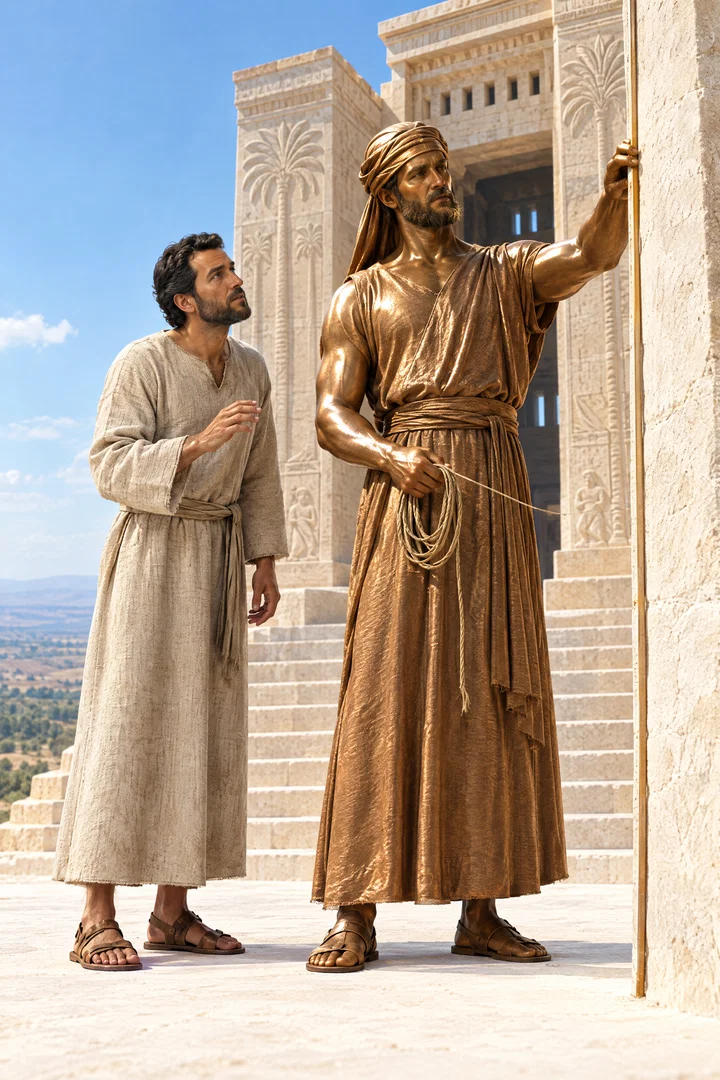
And behold a wall on the outside of the house round about, and in the man’s hand a measuring reed of six cubits long by the cubit and an hand breadth: so he measured the breadth of the building, one reed; and the height, one reed.
Translations
American King James Version, King James Version
And behold a wall on the outside of the house round about, and in the man’s hand a measuring reed of six cubits long by the cubit and an hand breadth: so he measured the breadth of the building, one reed; and the height, one reed.
And behold a wall on the outside of the house round about, and in the man’s hand a measuring reed of six cubits long by the cubit and a hand breadth: so he measured the breadth of the building, one reed; and the height, one reed.
And behold a wall on the outside of the house around, and in the man's hand a measuring reed of six cubits long by the cubit and a hand-breadth: so he measured the breadth of the building, one reed: and the hight, one reed.
And behold, a wall on the outside of the house round about, and in the man’s hand a measuring reed of six cubits long, of a cubit and an handbreadth each: so he measured the thickness of the building, one reed; and the height, one reed.
And, behold, a wall on the outside of the house round about, and in the man’s hand a measuring reed six cubits long, of a cubit and a handbreadth each: so he measured the thickness of the building, one reed; and the height, one reed.
And lo, a wall on the outside of the house all round about, and in the hand of the man a measuring-reed, six cubits by a cubit and a handbreadth, and he measureth the breadth of the building one reed, and the height one reed.
And behold, there was a wall on the outside of the house round about, and in the man's hand a measuring-reed of six cubits, [ each] of one cubit and a hand breadth. And he measured the breadth of the building, one reed; and the height, one reed.
And lo a wall on the outside of the house round about on every side,—and in the hand of the man, was the measuring reed six cubits by the cubit, and a handbreadth, so he measured the breadth of the enclosing-wall, one reed, and the height one reed.
Berean Standard Bible, Majority Standard Bible
And I saw a wall surrounding the temple area. Now the length of the measuring rod in the man’s hand was six long cubits ( each measuring a cubit and a handbreadth), and he measured the wall to be one rod thick and one rod high.
Behold, there was a wall on the outside of the house all around, and in the man’s hand a measuring reed six cubits long, of a cubit and a hand width each. So he measured the thickness of the building, one reed; and the height, one reed.
And there was a wall on the outside of the house all round, and in the man's hand there was a measuring rod six cubits long by a cubit and a hand's measure: so he took the measure of the building from side to side, one rod; and from base to top, one rod.
And beholde, I sawe a wall on the outside of the house round about: and in the mans hand was a reede to measure with, of sixe cubites long, by the cubite, and an hand breadth: so he measured the breadth of the buylding with one reede, and the height with one reede.
Douay-Rheims (Challoner revision)
And behold there was a wall on the outside of the house round about, and in the man’s hand a measuring reed of six cubits and a handbreadth: and he measured the breadth of the building one reed, and the height one reed.
Pictures
Cross-references
- Ezekiel 43:10-11
Thou son of man, shew the house to the house of Israel, that they may be ashamed of their iniquities: and let them measure the pattern.
Israel is shown the temple’s form so they may face their iniquities and keep its ordinances.
- Zechariah 2:1-2
I lifted up mine eyes again, and looked, and behold a man with a measuring line in his hand.
Both visions show a man measuring Jerusalem.
- Ezekiel 47:1-12
Afterward he brought me again unto the door of the house; and, behold, waters issued out from under the threshold of the house eastward: for the forefront of the house stood toward the east, and the waters came down from under from the right side of the house, at the south side of the altar.
same vision continued in the lesson
- 1 Kings 6:20
And the oracle in the forepart was twenty cubits in length, and twenty cubits in breadth, and twenty cubits in the height thereof: and he overlaid it with pure gold; and so covered the altar which was of cedar.
Gives the dimensions of Solomon’s most holy place, compared with Ezekiel’s.
- Ezekiel 41:4
So he measured the length thereof, twenty cubits; and the breadth, twenty cubits, before the temple: and he said unto me, This is the most holy place.
Describes the inner holy place of the same building.
- Revelation 21
And I saw a new heaven and a new earth: for the first heaven and the first earth were passed away; and there was no more sea.
complement to Ezekiel's vision
Commentary
Each commentary is drawn from primary sources: the writings of Ellen G. White and Adventist pioneers and periodicals. Each commentary is separate. Its own words are not a quotation; follow the references to read the source passages.
Ellen G. White
1 source
God measures His house by His own true measure, which is His law.Ms 62, 1886, par. 27–29 The man with the appearance like brass stands in the gate with the reed in his hand and measures the breadth and the height of the wall.Ms 62, 1886, par. 27–29 He measures every part of the building, including the little chambers and doorways and arches and pillars and the great gate facing east, with every least item recorded according to the reed.Ms 62, 1886, par. 27–29
The reed is the exact spiritual measure of character and works that God puts into even the least acts and dealings.Ms 62, 1886, par. 27–29 It requires faithfulness in the least things, even in a mere measure of wheat, and supreme love to God and love to neighbor as self.Ms 62, 1886, par. 27–29 Those who measure true by the reed are elevated, ennobled, and sanctified through the grace brought through Jesus Christ.Ms 62, 1886, par. 27–29 They are built up after the divine model into a righteous stature and structure by honest and faithful dealing, prepared for the glory to be revealed when the glory of God enters.Ms 62, 1886, par. 27–29 The measuring exposes iniquity to shame and declares the law of the house, that the whole boundary on the top of the mountain shall be most holy.Ms 62, 1886, par. 27–29
Sources
Pioneers and periodicals
48 sources
Ezekiel 40:5 opens the vision of the last nine chapters of Ezekiel with a wall on the outside of the house round about and a man holding a measuring reed six cubits long by the cubit and a handbreadth, with which he measured the breadth of the building one reed and the height one reed.RH Jan 19, 1860ST Aug 2, 1905RH Jan 21, 1862ST May 9, 1878ST Aug 12, 1913 It introduces the measure and plan of the temple, city, sanctuary and land with explicit directions for measuring and rebuilding, shown to Ezekiel as a captive in the twenty-fifth year of Israel's captivity when the sanctuary lay in ruins to console Israel with promise of return.RH Aug 17, 1916RH Sep 11, 1856RH Jan 20, 1853ST Nov 10, 1898ST Sep 13, 1905 It belonged to a sanctuary and restoration of Canaan and Jerusalem offered to Israel after the return from Babylon on condition of shame for iniquity, putting away sin and obeying God's voice, but because Israel continued in unbelief and only a small remnant returned, the building as described was never erected and will never be built literally.RH May 25, 1876RH Jan 20, 1853ST May 9, 1878ST Sep 21, 1915 It is not a sanctuary for the gospel era, the thousand years' reign, or the eternal state in detail, nor a literal city in Christ's reign that renews Levitical offerings under a mortal prince who offers for himself, for that prince is not Jesus Christ.RH Sep 11, 1856ST Apr 8, 1889RH Jan 19, 1860RH Sep 4, 1856RH Nov 3, 1863 Its thousands of sheep and oxen only foreshadowed the one effectual offering of Jesus Christ who by one offering has perfected forever them that are sanctified, so to renew them would make His once-for-all offering of no effect, while in broad outline the temple and restoration are a type fulfilled more gloriously for the true Israel of God in the New City and new earth where Jehovah is there.ST Oct 1, 1896RH Sep 4, 1856ST Mar 3, 1909ST Aug 2, 1910ST Sep 3, 1902
Setting and Measurements
Ezekiel 40:5 stands at the opening of the vision that fills the last nine chapters of Ezekiel, chapters 40-48, introducing the measure and plan of the temple, city, sanctuary, land and all that pertained to them, with explicit directions for measuring and rebuilding.RH Aug 17, 1916ST Nov 10, 1898ST Sep 13, 1905ST Aug 13, 1894 It belongs to Ezekiel's prophecies of restoration and promise, setting in prospect for Israel in Palestine after restoration to their own land a glorious state of prosperity and favor from the Lord on return from Babylon.RH Aug 17, 1916ST Nov 10, 1898 It shows first the possibilities before the restored kingdom of Judah after the captivity if the people had laid hold on the promise by faith, and secondly and principally the new-earth kingdom under Him whose right it is to reign.ST Sep 13, 1905
The verse describes a wall on the outside of the house round about and a man with a measuring reed in his hand, with which he measured the breadth of the building, one reed, and the height, one reed.RH Jan 19, 1860ST Aug 2, 1905RH Jan 21, 1862ST May 9, 1878ST Aug 12, 1913 The wall surrounds the temple building, and the reed is the instrument used to measure the building's breadth and height, each one reed.ST May 9, 1878ST Aug 12, 1913ST Sep 24, 1902 This temple in Jerusalem was to surpass Solomon's temple in glory, though the temple built after the return from Babylon fell far short of this plan.ST Sep 24, 1902
The measuring reed was six cubits long, counted by the cubit and a handbreadth, the cubit being a longer cubit that includes a handbreadth beyond the ordinary cubit.ST Aug 2, 1905ST May 9, 1878ST Aug 12, 1913ST Mar 13, 1893 With each cubit measured by that longer cubit, the reed was nearly eleven feet long, using a cubit of nearly twenty-two inches and a handbreadth of three and five-eighths inches.ST Mar 13, 1893RH Sep 15, 1868 The reed takes actual dimensions of a material temple, one reed wide and one reed high, unlike the symbolic measuring rod in Revelation 11, which serves as a standard for testing truth, light and character.ST Apr 4, 1911 The man with the line and measuring reed in his hand is the representative of God.ST Aug 30, 1905
The vision was given in the twenty-fifth year of Israel's captivity in Babylon, in 574 B.C., fourteen years after Jerusalem's sanctuary was destroyed, when Ezekiel himself was a captive and the temple lay in ruins.RH Sep 11, 1856RH Jan 20, 1853ST May 9, 1878ST Nov 10, 1898ST Aug 13, 1894 He was carried to the land of Israel, set upon a very high mountain, and shown the frame of a city lying to the south.ST Nov 10, 1898 He was charged to show the pattern to Israel, to console the Jews with the promise of return to Jerusalem and rebuilding of the temple and restoration of its priestly service.RH Sep 11, 1856RH Jan 20, 1853ST Aug 13, 1894
Conditional Offer to Israel
Ezekiel 40:5 opens the vision of a sanctuary, city, temple and restoration of Canaan and Jerusalem offered to Israel while captives in Babylon, for fulfillment in the past dispensation after the return from Babylon.RH May 25, 1876RH Jan 20, 1853ST May 30, 1911 It was a new and far greater and more glorious sanctuary than before, which the returned people might build and in which they would worship, with God's glory resting on the city.ST Mar 3, 1909ST Sep 21, 1915ST Apr 20, 1915 That promise would have been fulfilled in its fullness after the return if the Jews had met the stated conditions.ST Sep 21, 1915ST Apr 20, 1915
The promised fulfillment was conditional and provisional, requiring the people to examine the pattern, be ashamed of their iniquities, put away sins, yield wholly to God and obey His voice.RH May 25, 1876RH Sep 11, 1856RH Jan 20, 1853ST Feb 27, 1907 This condition is stated in Ezekiel 43:10-11, where Israel was to learn the sanctuary's design if ashamed, and in Jeremiah 18:7-10, where God builds and plants only if the nation obeys and withholds the good if it does evil.ST Feb 27, 1907ST Nov 24, 1909ST May 9, 1878 The establishment of the sanctuary and the return of the twelve tribes depended on that repentance and reform.RH Jan 20, 1853ST May 9, 1878
Because Israel did not truly repent but continued in apostasy and unbelief and disregarded the condition, the promises were not obligatory and the privileges were forfeited.ST Nov 24, 1909ST May 9, 1878RH Sep 11, 1856 Only a small part of the tribes went up when the decree for restoration went forth, about forty thousand returning, so the promises were not fully realized.ST Sep 21, 1915RH Nov 3, 1863 Their unbelief and failure to yield themselves wholly to God prevented the rebuilding as described.ST Sep 21, 1915
The building measured from Ezekiel 40 onward was therefore never erected as described.ST Aug 12, 1875ST Dec 1, 1914RH Nov 3, 1863 What was built under Zerubbabel and Ezra was a much smaller, inferior and weaker realization, only a lesser shadow of its promised greatness.ST Nov 24, 1909ST Dec 1, 1914ST Sep 20, 1910 This came about because the exiles' faith was weak and full of complaints and fears, and because Israel did not turn from wickedness or return wholeheartedly to God.ST Sep 20, 1910ST May 19, 1909 The temple built after the return was inferior to the new and larger city and temple promised.ST May 19, 1909
If Israel had met God's conditions and returned wholeheartedly, accepting God's plan and forsaking sin, the detailed sanctuary, city and land described, including the wall and building measurements, would have been literally fulfilled.ST Feb 22, 1910ST May 30, 1911 Because the conditions failed, the sanctuary described was never built and, under the conditions that followed, will never be built literally.ST Aug 12, 1875ST May 16, 1911ST Aug 2, 1910ST Aug 1, 1911
What Vision Does Not Mean
The opening measurement does not introduce a sanctuary for the future immortal state or for the gospel era, nor a temple to be built after the Christian dispensation began.RH Sep 11, 1856ST Apr 8, 1889RH Jan 19, 1860 It does not belong to the thousand years' reign of Christ, to a future age of probation, to the eternal perfect state, or as a detailed description of conditions in the new earth.RH Sep 4, 1856ST Nov 10, 1898ST Oct 17, 1906 Its promised restoration is not a prophecy of the New Jerusalem.RH Jan 19, 1860
The measuring of the wall round about does not foretell a literal city to be built on earth during the thousand-year reign of Christ, with the offerings and sacrifices of the first covenant carried on again.RH Sep 4, 1856 Such a city superseding the heavenly Jerusalem would be a state less glorious than the present dispensation.RH Sep 4, 1856 The prophecy does not belong to the future reign of Christ and His saints.RH Nov 3, 1863
Its ordinances of mortal rulers, circumcision, clean and unclean foods, offerings, and a Levitical priesthood belong to the first-covenant system, whose priesthood was superseded by Christ's unchangeable priesthood.RH Sep 11, 1856ST Apr 8, 1889 The prince in it is not Jesus Christ who reigns over Israel forever, but a mortal man commanded to offer sin offerings and other offerings for himself, proving he needs atonement unlike Christ.RH Nov 3, 1863 Its prescribed sacrifices show it was not a prediction of a future temple and not a temple God would ordain again, since offering sacrifices after Christ's offering would annul His sacrifice.ST Nov 24, 1909ST Aug 26, 1913
Sacrifices and Christ's Offering
Ezekiel 40:5 opens the vision of a new sanctuary with its offerings, its glory and the division of the land, yet no such city or sanctuary stands today, and it will never be fulfilled literally because renewing its thousands of sheep and oxen sacrifices would make Christ's once-for-all offering of no effect.ST Oct 1, 1896RH Sep 4, 1856 To restore them would be to rebuild what was destroyed and to return from sunlight to shadow, since the past offerings were only for the time then present to foreshadow the one effectual offering of Jesus Christ.ST Oct 1, 1896RH Sep 4, 1856 The measuring of the wall round about does not foretell a literal city to be built on earth during Christ's thousand-year reign with the offerings and sacrifices of the first covenant carried on again to supersede the heavenly Jerusalem, for such a state would be less glorious than the present dispensation.RH Sep 4, 1856 The offerings of the first covenant pointed to Christ the great sin-offering, and to repeat them would require a second Messiah to expiate sin, whereas Christ by one offering of His body once for all has perfected forever them that are sanctified and now mediates a better covenant with a more excellent ministry.ST Oct 1, 1896RH Sep 4, 1856
Its typical sacrifices pointed to Jesus and pointed forward rather than backward, and they were fulfilled by Christ's death.ST Oct 1, 1896ST Sep 20, 1910ST Aug 1, 1911 The glorious temple to which the verse belongs was part of a conditional prophecy to Israel, and because Israel did not turn from wickedness or meet the stated conditions that temple was not built, with Zerubbabel's temple only a lesser shadow of its promised greatness.ST Sep 20, 1910ST Aug 1, 1911 Because its animal sacrifices belonged to a system that foreshadowed good things to come, the arrangement cannot apply in the future where sacrifices would point backward.RH Jul 21, 1910
Future Hope and Lessons
Though never built as described because Israel did not become ashamed of its iniquities and yield wholly to God, the promised temple and restoration were to have been more glorious than before, and in broad outline rather than detail they are a type of what God will do for His people at the second coming.ST Mar 3, 1909ST Oct 26, 1904 The promises were offered in connection with the restoration from Babylonian captivity and depended on Israel's repentance, and because Israel failed the prophecy had only a limited fulfillment in Zerubbabel's much smaller work.ST Oct 26, 1904 Its greater fulfillment will come in the glory of Christ's coming and related events through later revelations, not under Ezekiel's local conditions nor through every detail as described.ST Mar 3, 1909ST Oct 26, 1904
Because the people would not put away sins and live up to their calling, the promised privileges were forfeited for earthly Jerusalem, which was never built as it could have been, yet God's purpose did not change and the vision's purposes will be realized for the faithful, the true Israel of God.ST Aug 2, 1910RH Feb 7, 1907ST Jan 31, 1911 He prepared the holy city in heaven to descend to earth, the New City in which the true-hearted people will have God's presence among them.ST Aug 2, 1910RH Feb 7, 1907ST Jan 31, 1911 What was shown is first the possibilities before the restored kingdom of Judah after the captivity if the people had laid hold on the promise by faith, and secondly and principally the new-earth kingdom under Him whose right it is to reign, where with some details left aside there will be peace and harmony more glorious than the peace and healing that would then have transformed the land and nature.ST Jan 31, 1911ST May 21, 1902ST Sep 13, 1905
The temple taught that Jehovah is there, for God's glory would have rested on the city and His presence would have healed barren land and impure waters and brought life, and the people would have worshiped there.ST Sep 3, 1902ST Apr 20, 1915ST May 21, 1902 If Israel had heeded the prophet and repented, God would have cut off their enemies, resurrected those who had died, rebuilt this glorious temple with its water of life and glory of God, made Israel a light to the world, and made the grand Jerusalem temple a house of prayer for all nations surpassing Solomon's temple in glory.ST Aug 2, 1910ST Sep 17, 1902 God's design in Ezekiel 40-43 was for a much grander temple than the inferior house the returned exiles built in weak faith with complaints and fears or than Herod's later enlargement of it, Herod as a man of the world making it in their stead far greater and more magnificent, yet even so the Desire of all nations honored that house with His personal presence and filled it with His glory until His people rejected His counsel and crucified Him.ST Apr 15, 1903
Sources