Ezekiel 40:6
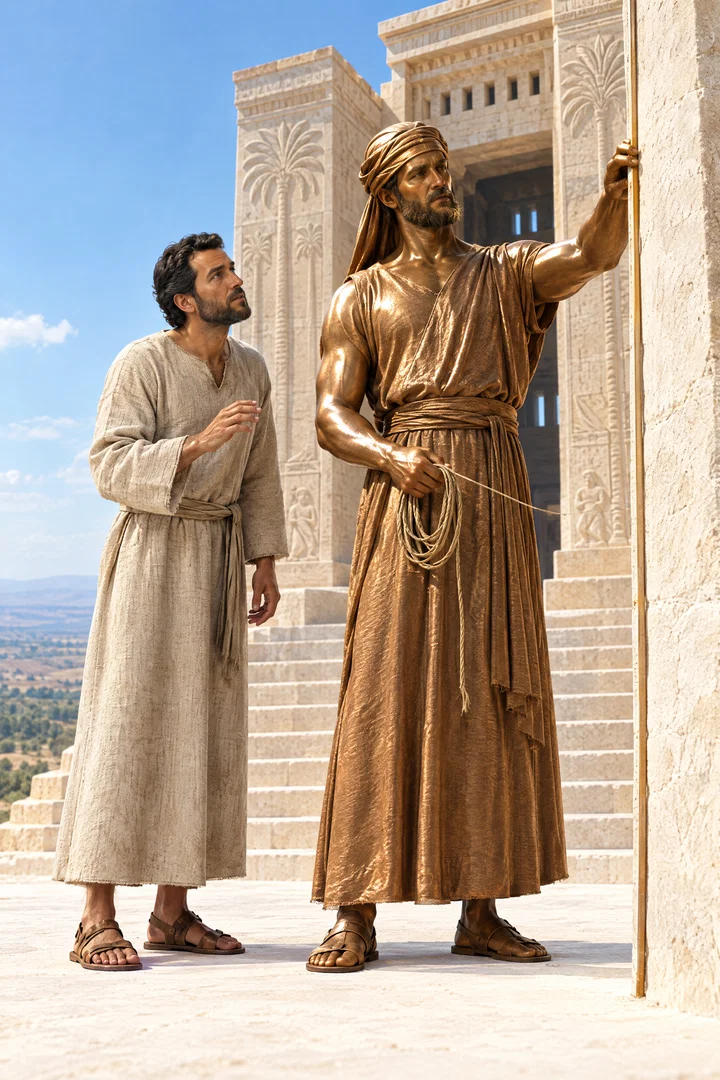
Then came he unto the gate which looketh toward the east, and went up the stairs thereof, and measured the threshold of the gate, which was one reed broad; and the other threshold of the gate, which was one reed broad.
Translations
Then came he to the gate which looks toward the east, and went up the stairs thereof, and measured the threshold of the gate, which was one reed broad; and the other threshold of the gate, which was one reed broad.
King James Version, KJV Cambridge Paragraph Bible
Then came he unto the gate which looketh toward the east, and went up the stairs thereof, and measured the threshold of the gate, which was one reed broad; and the other threshold of the gate, which was one reed broad.
Then he came to the gate which looketh towards the east, and ascended its stairs, and measured the threshhold of the gate, which was one reed broad; and the other threshhold of the gate, which was one reed broad.
Then came he unto the gate which looketh toward the east, and went up the steps thereof; and he measured the threshold of the gate, one reed broad: and the other threshold, one reed broad.
Then came he unto the gate which looketh toward the east, and went up the steps thereof: and he measured the threshold of the gate, one reed broad; and the other threshold, one reed broad.
And he cometh in unto the gate whose front [is] eastward, and he goeth up by its steps, and he measureth the threshold of the gate one reed broad, even the one threshold one reed broad,
And he came to the gate which looked toward the east, and went up its steps; and he measured the threshold of the gate, one reed broad; and the other threshold one reed broad.
Then came he unto the gate that looked toward the east, and went up by the steps thereof,—and measured the threshold of the gate one reed broad, and the other threshold one reed broad.
Berean Standard Bible, Majority Standard Bible
Then he came to the gate facing east and climbed its steps. He measured the threshold of the gate to be one rod deep.
Then he came to the gate which looks toward the east, and went up its steps. He measured the threshold of the gate, one reed wide; and the other threshold, one reed wide.
Then he came to the doorway looking to the east, and went up by its steps; and he took the measure of the doorstep, one rod wide.
Then came he vnto the gate, which looketh towarde the East, and went vp the stayres thereof, and measured the poste of the gate, which was one reede broade, and the other poste of the gate, which was one reede broade.
Douay-Rheims (Challoner revision)
And he came to the gate that looked toward the east, and he went up the steps thereof: and he measured the breadth of the threshold of the gate one reed, that is, one threshold was one reed broad:
Pictures
Cross-references
- Ezekiel 43:10-11
Thou son of man, shew the house to the house of Israel, that they may be ashamed of their iniquities: and let them measure the pattern.
prophet told to show temple plan
- Zechariah 2:1-2
I lifted up mine eyes again, and looked, and behold a man with a measuring line in his hand.
Both show a man sent to measure with a line.
- Ezekiel 43:1-5
Afterward he brought me to the gate, even the gate that looketh toward the east:
The glory of the LORD enters through the east gate and fills the temple.
- Ezekiel 46:12
Now when the prince shall prepare a voluntary burnt offering or peace offerings voluntarily unto the LORD, one shall then open him the gate that looketh toward the east, and he shall prepare his burnt offering and his peace offerings, as he did on the sabbath day: then he shall go forth; and after his going forth one shall shut the gate.
Describes the prince’s procedure for voluntary offerings and worship.
- Ezekiel 47:1
Afterward he brought me again unto the door of the house; and, behold, waters issued out from under the threshold of the house eastward: for the forefront of the house stood toward the east, and the waters came down from under from the right side of the house, at the south side of the altar.
brought there after general vision
Commentary
Each commentary is drawn from primary sources: the writings of Ellen G. White and Adventist pioneers and periodicals. Each commentary is separate. Its own words are not a quotation; follow the references to read the source passages.
Ellen G. White
1 source
The vision presents a man with an appearance like brass standing in the gate of the house with a reed in his hand to measure the whole building, beginning with the great gate looking toward the east whose threshold was one reed broad.Ms 62, 1886, par. 27–29 That measuring extends beyond the outer threshold to embrace the entire structure in its completeness.Ms 62, 1886, par. 27–29 It covers all the little chambers and doorways and arches and pillars, with every least item recorded according to measurement by the reed.Ms 62, 1886, par. 27–29
The measuring declares that true measure is everything, and that measure is the very law of God.Ms 62, 1886, par. 27–29 It is God's exact spiritual measure of man, put to the least of men's acts and dealings so that nothing is left untested.Ms 62, 1886, par. 27–29 The verse therefore requires faithfulness in the least, shown in honest and faithful dealing.Ms 62, 1886, par. 27–29 That faithfulness is loving God supremely and the neighbor as self.Ms 62, 1886, par. 27–29
Those who meet this measure are elevated and ennobled and sanctified through divine grace, by the power and grace brought through Jesus Christ.Ms 62, 1886, par. 27–29 By that grace they build character after the divine model into full righteous stature and structure.Ms 62, 1886, par. 27–29 They are thus fitted to live and rule among the greatest, entrusted with the divine cause.Ms 62, 1886, par. 27–29 They are prepared for the glory to be revealed.Ms 62, 1886, par. 27–29
Sources
Pioneers and periodicals
42 sources
He came to the gate facing east, went up its steps, and measured its two thresholds as one reed wide each.RH May 25, 1876ST Jan 31, 1911RH Feb 7, 1907 The measuring was shown to captive Israel fourteen years after the sanctuary was destroyed, as a conditional offer to be ashamed of sin, repent, and put sin away so the grand temple and restored Jerusalem could be built.RH Sep 11, 1856RH May 25, 1876RH Jan 20, 1853 Israel did not meet the conditions, so the glorious house described was never built and never will be built literally as described, and what rose instead was Zerubbabel's far inferior house.RH May 25, 1876ST Aug 12, 1875ST May 30, 1911ST Mar 3, 1909 It is not a prediction of a literal temple in the gospel age, in Christ's thousand-year reign, or in the immortal state, where marriages, death, animal offerings, circumcision, and a mortal prince offering for his own sin have no place.RH Sep 11, 1856ST Aug 12, 1875RH Sep 4, 1856ST Oct 17, 1906RH Sep 11, 1856 What failed for earthly Jerusalem will be more gloriously realized for true Israel in future glory and the earth made new, where God's presence brings life and healing and absolute peace.ST Oct 26, 1904ST Aug 2, 1910ST Sep 3, 1902ST May 21, 1902ST Sep 17, 1902
Gate Measurement and Setting
The eastward-facing gate is entered by ascending its stairs, and its two thresholds are then measured at one reed broad each.RH May 25, 1876ST Jan 31, 1911RH Feb 7, 1907RH Jan 21, 1862 The measuring of the east gate threshold opens the pattern of gates and thresholds shown for another sanctuary offered to Israel in captivity.RH Nov 3, 1863ST Aug 2, 1910 The threshold measuring belongs to the closing prophecy of restoration and to the wonderful structure presented for a glorious rebuilt temple.ST Aug 2, 1910
The vision was given fourteen years after Jerusalem's sanctuary was destroyed, to show the house of Israel its pattern.RH Sep 11, 1856RH Jan 20, 1853 It was made in 574 B.C. as a temple pattern in Ezekiel 40-44 whose blessings depended on repentance and reform.ST May 9, 1878 It came in the twenty-fifth year of Israel's captivity in Babylon, when Ezekiel was a captive and the temple of Jerusalem lay in ruins, showing the return to Jerusalem and restoration of the temple with its service.ST Nov 10, 1898ST Aug 13, 1894 In that year Ezekiel was carried to the land of Israel and set upon a very high mountain and shown the frame of a city lying to the south.ST Nov 10, 1898 That sight begins a description running from Ezekiel 40 to the end of the book, nine chapters in all, forming the general view preceding his being taken to the door of the house.ST Nov 10, 1898ST Aug 30, 1905
The measuring is done by a man with the appearance of brass holding a line of flax and a measuring reed, measuring the temple and the city of God in breadth and length.ST Aug 2, 1910 The reed here is a tool for giving the physical dimensions of the material temple, distinguished from the symbolic measuring in Revelation 11 where the reed is a standard for truth, light, and character.ST Apr 4, 1911 The pattern is for a temple at the center of a restored Jerusalem, a much grander temple than Israel built after the captivity whose promised glory surpassed Solomon's temple.ST Sep 3, 1902ST Apr 15, 1903ST Sep 24, 1902 Its construction details are given in the closing chapters without revealing how the building work was to be carried out. The verse must not be read hurriedly by itself but studied together with the whole nine chapters and in connection with the last seven verses of Ezekiel 39.ST Nov 10, 1898 It opens a measuring vision covering the same period and showing the same purposes of God toward Jerusalem as Zechariah 2:1-2, and the two are counterparts to be studied together.ST Aug 2, 1910
Conditional Offer to Israel
The sanctuary with its city and land and all their detailed specifications was a conditional promise offered to Israel in captivity and on the return from Babylon.RH Sep 11, 1856RH May 25, 1876RH Jan 20, 1853ST Nov 24, 1909ST Mar 3, 1909 It was to be shown to the house of Israel so that they would be ashamed of their sins, measure the pattern, repent, and put sin away.RH Sep 11, 1856RH Jan 20, 1853ST Feb 27, 1907ST Nov 24, 1909ST Mar 3, 1909 The vision was given as a provisional promise conditioned on being ashamed of iniquities and returning to God, not as a prediction of a sanctuary in the immortal state or in the gospel dispensation.RH Sep 11, 1856RH May 25, 1876ST Feb 27, 1907ST Nov 24, 1909ST Mar 3, 1909 Because Israel did not repent, God did not fulfill the promised restoration in the form described, and the sanctuary was never built.RH Sep 11, 1856RH May 25, 1876RH Jan 20, 1853ST Feb 27, 1907ST Mar 3, 1909
Fulfillment depended on Israel wholly yielding to God, believing, obeying, returning to God, turning from wickedness, accepting God's plan, representing truth, coming up to the full measure of children of God, and answering the calls to leave Babylon.ST May 30, 1911ST Oct 26, 1904ST Aug 2, 1910ST Sep 3, 1902 If the returned Jews had wholly yielded, repented, and believed, the sanctuary described would have been built in detail.ST May 30, 1911RH Feb 7, 1907 The return was only partial, so the pictured restoration did not take place and the temple built by Zerubbabel was the best they received instead.ST May 30, 1911ST Oct 26, 1904 The pattern set forth the future of Jerusalem on condition that God's people put aside sins and come up to the full measure of children of God, and because that condition was not met the promise failed for old earthly Jerusalem then and its privileges were forfeited.ST May 30, 1911ST Oct 26, 1904ST Aug 2, 1910ST Sep 3, 1902RH Feb 7, 1907
This conditional character follows the universal principle stated in Jeremiah 18:7-10, where God builds and plants a nation if it obeys and withholds promised good if it does evil.ST Apr 20, 1915ST Aug 1, 1911 The vision of Ezekiel 40-48 was a conditional prophecy whose fulfillment was based on those conditions.ST Apr 20, 1915ST Aug 1, 1911 The sanctuary within Jerusalem was part of what God would have done for Israel at that time if they had yielded to Him.ST Apr 20, 1915ST Aug 1, 1911
Israel did not meet the conditions, was not at all ashamed when committing abomination, persisted in apostasy, departed from God's ordinances, and disobeyed.ST Aug 12, 1875ST Nov 24, 1909ST May 9, 1878RH Nov 3, 1863 When restoration from captivity came not all went up to the land of promised blessing, but only a part of certain tribes.ST Aug 12, 1875ST Sep 21, 1915RH Nov 3, 1863 Only about forty thousand returned from Babylon, so the promises were not realized in their fullness and the pictured restoration did not take place.ST Aug 12, 1875ST May 30, 1911ST Sep 21, 1915 These promises would have been fulfilled in far greater measure if the people had met the conditions God set.ST Sep 21, 1915ST May 9, 1878RH Nov 3, 1863
If the conditions had been met, the sanctuary would have been built, God would have given peace and victory over enemies and cut off all enemies.ST Apr 20, 1915ST Aug 2, 1910 The people would have returned to their land, been united as one nation, and worshiped in this sanctuary, with God's glory resting on the city.ST Apr 20, 1915ST Aug 2, 1910 That obedience would have brought the resurrection of those gone down in death and made Israel a light to the world.ST Apr 20, 1915ST May 21, 1902ST Aug 2, 1910 With that sanctuary the marshes and deserts and salt lands would have been healed by the water of life and the wild beasts made mild under the power of righteousness, fulfilling the peaceful condition of Isaiah 11:6-9 where the smallest infant is safe.ST May 21, 1902ST Aug 2, 1910
Unbuilt Past and Lesser Substitute
Because of unbelief and failure the glorious temple shown in the entrance measurement was never built and never will be built literally as described.RH May 25, 1876ST Aug 12, 1875ST Mar 3, 1909ST Dec 1, 1914ST Sep 20, 1910 It was offered to Israel during the captivity on condition that they be ashamed of their iniquities, turn from wickedness and put sin away, but they were not at all ashamed when they had committed abomination.RH May 25, 1876ST Aug 12, 1875ST Mar 3, 1909ST Sep 20, 1910ST May 16, 1911 When restoration from captivity came not all went up to the land of promised blessing, so the pictured restoration did not take place.ST Aug 12, 1875ST May 30, 1911 Its literal restoration with animal sacrifices would make Christ's once-for-all offering of no effect, and though the vision is a type of God's future work for His people its details are not fulfilled literally.ST Nov 24, 1909ST Mar 3, 1909ST Dec 1, 1914
What Israel received instead was the less glorious sanctuary described in Ezra.ST May 30, 1911ST May 19, 1909 If the returned Jews had wholly yielded to God, repented, believed, accepted God's plan and turned from sin, the sanctuary described in Ezekiel would have been built with peace and victory over enemies, but their unbelief prevented this and the return was only partial.ST May 30, 1911 Because they persisted in apostasy the promise was only feebly realized in the sanctuary built by Zerubbabel, which was the best they received instead.ST May 30, 1911ST Nov 24, 1909ST May 19, 1909 That temple built by Zerubbabel was inferior, only a small fulfillment and a small, feeble, lesser shadow of the wonderful measured structure, whose greater glory would have been realized if Israel had met the conditions and which will have a greater fulfillment in events connected with Christ's second coming though not under the local conditions of Ezekiel's day.ST Nov 24, 1909ST Sep 20, 1910ST May 19, 1909
Through weak faith, complaints and fears Israel built a house much inferior to the one destroyed because of unfaithfulness, though the design beginning here was for a much grander temple than Israel built after the captivity.ST Apr 15, 1903 That inferior house King Herod, a man of the world, later took in hand and made far greater and more magnificent in their stead.ST Apr 15, 1903 The Desire of all nations honored that house with His personal presence and filled it with His glory until His people again rejected His counsel and crucified Him.ST Apr 15, 1903 The promises being conditional on turning from sins and forfeited through failure, they do not establish a future restoration of the Jewish people or a renewed sacrificial system.RH Jan 19, 1860
No Literal Future Fulfillment
The measured east gate belongs to a sanctuary plan offered to Israel on conditions, not to a prediction of a sanctuary in the immortal state or in the gospel dispensation, and it is a great mistake to apply all such Old Testament promises given to fleshly Israel to new-earth conditions in detail, for God will not in the nature of the case carry out in detail in the new earth what was promised then, though He will give His people even more than human words can express.RH Sep 11, 1856ST Oct 17, 1906 It was a conditional promise that God would have given and fulfilled then and there if Israel had permitted it and met the conditions, but because Israel failed to meet those conditions the sanctuary was not given.RH Sep 11, 1856ST Oct 17, 1906 It was never built and never will be built literally as described.ST Aug 12, 1875RH Sep 11, 1856
It cannot belong to the future glorified state, for there Christ is to be Prince and Shepherd over Israel, while here a poor frail mortal prince offers a sin offering for himself.ST Aug 12, 1875RH Sep 11, 1856 While marriage and death will be unknown in the age to come, here are marriages, divorces, widows, disease and death, which belong only to this mortal state.ST Aug 12, 1875RH Sep 11, 1856 It cannot belong to the present dispensation, because here are all manner of offerings of beasts, distinction in meats, circumcision, divorce, the Jubilee, and a Levitical priesthood which ceased at Christ's cross.ST Aug 12, 1875RH Sep 11, 1856 Had the conditions been met — that Israel would be ashamed of their iniquities and put them away — it would have been fulfilled in the Mosaic dispensation when those ordinances were in force, but they were not at all ashamed when they had committed abomination, and when restoration from captivity came not all went up to the land of promised blessing, so it was not fulfilled in the past dispensation because Israel did not fulfill the conditions on which it was offered.ST Aug 12, 1875RH Sep 11, 1856
It does not foretell a literal city to be built on this sin-cursed earth during the thousand-year reign of Christ with restored animal offerings for an undeveloped class, nor does it supersede the heavenly Jerusalem coming down from God out of heaven.RH Sep 4, 1856 Such a fulfillment would make the reign of Christ less glorious than the present dispensation, revive the ordinances of the first covenant that pointed to Christ as the great sin-offering and were taken away to establish the second, and require a second Messiah at the end of the thousand years.RH Sep 4, 1856 This cannot be, whereas Christ by one offering perfected forever them that are sanctified and sat down at the right hand of God until all His enemies are made His footstool.RH Sep 4, 1856 The prince spoken of by Ezekiel is not the Prince who is to reign over Israel forever, for Ezekiel's prince is a mortal man commanded to offer sin offerings and other offerings for himself, while Jesus Christ is sinless and has done away with those offerings, so this prophecy does not belong to the future reign of Christ and His saints.RH Nov 3, 1863
The vision was a provisional promise conditioned on the people being ashamed of their iniquities, repenting and returning to God and yielding to Him, but they persisted in apostasy and never yielded to God's plan, so it was only feebly realized in the sanctuary built by Zerubbabel and never erected as shown.ST Nov 24, 1909RH Nov 3, 1863ST Aug 1, 1911 That sanctuary was never built because only a part of Israel of certain tribes went up at the decree of restoration, thus failing to fulfill the conditions, subject to the universal conditions stated in Jeremiah 18:8-10.RH Nov 3, 1863ST Aug 1, 1911 It never will be built and never can be built, for its prescribed animal offerings belong to a system that foreshadowed good things to come and are not the gospel way of expressing faith in Christ.ST Aug 26, 1913RH Jul 21, 1910ST Aug 1, 1911 Its literal restoration with sacrifices would conflict with God's plan and annul Christ's offering, making His once-for-all offering of no effect, since God cannot go back to the typical sacrifices that pointed forward to Jesus Christ, for Jesus Himself suffered and fulfilled all types, showing God would not ordain that sanctuary again.ST Nov 24, 1909ST Dec 1, 1914ST Aug 26, 1913ST Aug 1, 1911 Ezekiel's measuring there with a reed is for giving the physical dimensions of the material temple, which is distinguished from the symbolic measuring in Revelation 11, where the reed is a standard for truth, light, and character rather than a tool for material measurement.ST Apr 4, 1911
Greater Spiritual Future Realization
The vision to which the measuring of the east gate belongs is a type of God's future work for His people, yet its details are not to be fulfilled literally as described.ST Mar 3, 1909ST Oct 26, 1904 Because Israel failed to yield to God, not all of those measured details will be fulfilled in the form given.ST Oct 26, 1904ST Jan 31, 1911 The promised kingdom was not fulfilled then for lack of meeting God's conditions, but it will be fulfilled under greater conditions with some of its former details left out.ST Jan 31, 1911 Its greater fulfillment will come in events connected with Christ's second coming, though not under the local conditions of Ezekiel's day.ST Jan 31, 1911
The promises to true Israel will instead be fulfilled in future glory and in the immortal inheritance given to the faithful.ST Oct 26, 1904 What failed for old earthly Jerusalem then, when its privileges were forfeited through failure to put away sin and come up to the full measure of children of God, will be grandly realized in the New City that awaits the true Israel of God.ST Oct 26, 1904ST Aug 2, 1910 What was not fulfilled then will be fulfilled more gloriously in the earth made new, where absolute peace presides over all nature so that no harm comes to the feeblest, where marshes and deserts and salt lands are healed by the water of life and wild beasts are made mild under righteousness after the peaceful condition of Isaiah 11:6-9.ST May 21, 1902 The temple at the center of the restored Jerusalem was meant to teach that Jehovah is present among His people and that His presence brings life and healing.ST Sep 3, 1902 It was presented as one they might build, and as ultimately becoming a house of prayer for all nations.ST Sep 3, 1902ST Sep 17, 1902
Its sacrifices would have continued until the Redeemer gave Himself.ST Oct 1, 1896 The nine chapters beginning here do not teach a future age of probation, nor do they describe the eternal river of life.ST Nov 10, 1898 It is a mistake to apply all such Old Testament promises given to Israel to new-earth conditions in detail, for God will not in the nature of the case carry out in detail in the new earth what was promised to fleshly Israel, though He will give His people even more than human words can express.ST Nov 10, 1898ST Oct 17, 1906 If Israel had met God's conditions, the promises in these chapters concerning sanctuary, city, and land would have been literally fulfilled then and there.ST Feb 22, 1910ST Oct 17, 1906 They set in prospect a glorious state of prosperity and favor in Palestine after restoration to their own land, dependent on faithfulness in representing truth in the earth.ST Feb 22, 1910ST Nov 10, 1898
Sources