Ezekiel 42:14
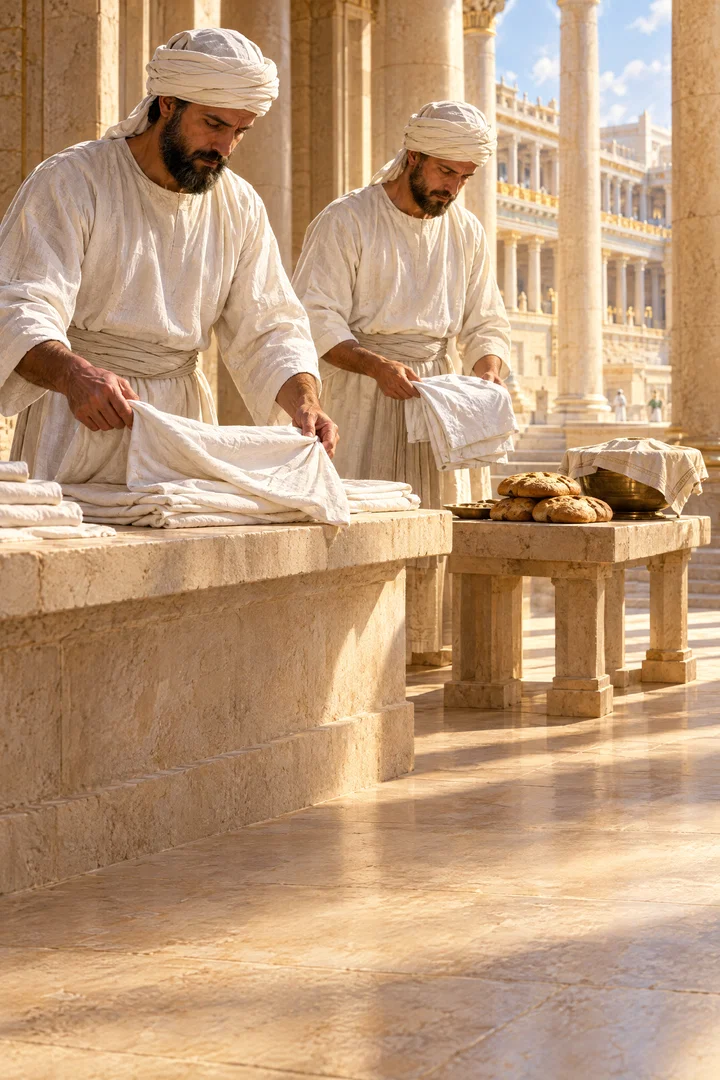
When the priests enter therein, then shall they not go out of the holy place into the utter court, but there they shall lay their garments wherein they minister; for they are holy; and shall put on other garments, and shall approach to those things which are for the people.
Translations
When the priests enter therein, then shall they not go out of the holy place into the outer court, but there they shall lay their garments wherein they minister; for they are holy; and shall put on other garments, and shall approach to those things which are for the people.
King James Version, KJV Cambridge Paragraph Bible
When the priests enter therein, then shall they not go out of the holy place into the utter court, but there they shall lay their garments wherein they minister; for they are holy; and shall put on other garments, and shall approach to those things which are for the people.
When the priests enter therein, then shall they not go out of the holy place into the outer court, but there they shall lay their garments in which they minister; for they are holy; and shall put on other garments, and shall approach to those things which are for the people.
Revised Version, American Standard Version
When the priests enter in, then shall they not go out of the holy place into the outer court, but there they shall lay their garments wherein they minister; for they are holy: and they shall put on other garments, and shall approach to that which pertaineth to the people.
In the priests' going in, they come not out from the sanctuary unto the outer court, and there they place their garments with which they minister, for they [are] holy, and have put on other garments, and have drawn near unto that which [is] for the people.'
When the priests enter in, they shall not go forth from the sanctuary into the outer court, but there they shall lay their garments wherein they minister, for they are holy; and they shall put on other garments, and shall approach to that which is for the people.
When the priests enter them, then shall they not go forth out of the holy place into the outer court, but there, shall they lay their garments wherein they minister for holy they are, and shall put on other garments, and so draw near unto that which pertaineth to the people.
Berean Standard Bible, Majority Standard Bible
Once the priests have entered the holy area, they must not go out into the outer court until they have left behind the garments in which they minister, for these are holy. They are to put on other clothes before they approach the places that are for the people.”
When the priests enter in, then they shall not go out of the holy place into the outer court until they lay their garments in which they minister there; for they are holy. Then they shall put on other garments, and shall approach that which is for the people.”
When the priests go in, they may not go out of the holy place into the outer square, and there they are to put the robes in which they do the work of the Lord's house, for they are holy: and they have to put on other clothing before they come near that which has to do with the people.
When the Priestes enter therein, they shall not go out of the holy place into the vtter court, but there they shall lay their garmentes wherein they minister: for they are holy, and shall put on other garmentes, and so shall approch to those things, which are for the people.
Douay-Rheims (Challoner revision)
And when the priests shall have entered in, they shall not go out of the holy places into the outward court: but there they shall lay their vestments, wherein they minister, for they are holy: and they shall put on other garments, and so they shall go forth to the people.
Pictures
Cross-references
- Ezekiel 40
In the five and twentieth year of our captivity, in the beginning of the year, in the tenth day of the month, in the fourteenth year after that the city was smitten, in the selfsame day the hand of the LORD was upon me, and brought me thither.
Both belong to Ezekiel’s sanctuary vision of restoration.
- Hebrews 8:1
Now of the things which we have spoken this is the sum: We have such an high priest, who is set on the right hand of the throne of the Majesty in the heavens;
Christ is the great High Priest, ministering in the heavenly sanctuary.
- Ezekiel 41
Afterward he brought me to the temple, and measured the posts, six cubits broad on the one side, and six cubits broad on the other side, which was the breadth of the tabernacle.
The sanctuary’s design forms the setting for its priestly worship.
- Ezekiel 44:15
But the priests the Levites, the sons of Zadok, that kept the charge of my sanctuary when the children of Israel went astray from me, they shall come near to me to minister unto me, and they shall stand before me to offer unto me the fat and the blood, saith the Lord GOD:
Both describe the priests ministering in the sanctuary.
- Hebrews 10:1-10
For the law having a shadow of good things to come, and not the very image of the things, can never with those sacrifices which they offered year by year continually make the comers thereunto perfect.
Contrasts temple sacrifices with Christ’s offering.
Commentary
Each commentary is drawn from primary sources: the writings of Ellen G. White and Adventist pioneers and periodicals. Each commentary is separate. Its own words are not a quotation; follow the references to read the source passages.
Ellen G. White
1 source
The text stands within a vision of a house recorded in exact detail, with every part set down according to the measuring reed.Ms 62, 1886, par. 27–29 The minuteness of the measurements shows that the divine standard reaches to every detail, making the measured house a pattern of holiness.Ms 62, 1886, par. 27–29 A righteous life marked by honest, faithful dealings reflects that exact measure given in the vision.Ms 62, 1886, par. 27–29
Sources
Pioneers and periodicals
29 sources
When priests have finished ministering in the holy place they must not go out into the outer court in those garments, but lay them aside there because they are holy, put on other garments, and only then go to what belongs to the people.ST Apr 8, 1889ST Mar 3, 1909ST May 9, 1878
The sanctuary, city, land and offerings of Ezekiel 40-48 were offered to Israel in captivity only on condition that they be ashamed of their iniquities, put them away and return with all the heart in faith and obedience.RH Sep 11, 1856ST Aug 12, 1875RH Jan 20, 1853
Because Israel was unwilling and did not truly repent, the sanctuary and city as described were never built and never will be fulfilled literally in fullest detail, and what Zerubbabel built was only a weak and inferior shadow of the pattern.ST Aug 12, 1875RH May 25, 1876ST Feb 27, 1907ST Nov 24, 1909ST Dec 1, 1914
All the promises will instead be more than made good in fullest measure and greater glory to God's true Israel in Christ, including the Gentiles, in the new heaven and new earth with the New Jerusalem and its healing peace.ST Feb 27, 1907ST Oct 26, 1904ST Aug 2, 1910ST Sep 3, 1902ST May 21, 1902
The vision cannot be the immortal state with its one Prince Jesus and no death or sin-offerings, nor the gospel age after circumcision, meats distinctions and animal offerings were abolished at the cross, nor does it warrant any revival of the Levitical sacrifices after Christ's once-for-all offering.RH Sep 11, 1856ST Apr 8, 1889RH Jan 19, 1860ST Oct 1, 1896RH Sep 4, 1856
Wording and Vision Setting
When the priests have ministered in the holy place they must not go out into the outer court in their ministering garments, but must lay those garments there in the designated holy place because they are holy, put on other garments, and only then approach what is set apart for the people.ST Apr 8, 1889ST Mar 3, 1909ST Aug 2, 1910RH Jan 21, 1862ST Apr 20, 1915 This changing of holy ministering garments before approaching things for the people belongs to the temple service in which Levites serve as priests.ST Apr 8, 1889ST May 9, 1878ST Aug 2, 1910 That priesthood was superseded when Christ became the eternal priest after the order of Melchizedek, so this temple service was not to be established after the Christian dispensation began.ST Apr 8, 1889
The verse belongs to the pattern of a city and sanctuary in Ezekiel 40-48, part of the promises from Ezekiel 36 onward calling Israel to return with the whole heart.RH Sep 11, 1856RH Jan 20, 1853ST Feb 27, 1907ST Feb 22, 1910ST Jan 31, 1911 It was shown to Israel in captivity fourteen years after the sanctuary was destroyed, to be shown to the house of Israel that they might be ashamed of iniquity, with its form to be made known only if they were ashamed.RH Sep 11, 1856RH Jan 20, 1853ST Feb 27, 1907 The building described has two holy places and is called a sanctuary, and the vision includes the division of the land and God's presence among the people.RH Jan 20, 1853ST Jan 31, 1911 It sets forth in detail the sanctuary, city, and land that God would have given Israel and fulfilled literally if they had met His conditions.RH May 25, 1876ST Feb 27, 1907ST Feb 22, 1910
The vision describes a mortal Levitical priestly system with distinctions of holy garments, clean and unclean meats, circumcision, marriage and divorce, and burnt-offerings and sin-offerings of bulls and goats.RH Sep 11, 1856RH Jan 19, 1860 Its prince offers sin-offerings for himself, has sons and servants and inheritance, and must not oppress or exact.RH Sep 11, 1856 Its priestly service is Levitical, not the priesthood of immortalized people from all nations in a future age.RH Jan 19, 1860
The pattern centers a glorious temple in a restored Jerusalem teaching that the Lord is present among His people.ST Sep 3, 1902ST Sep 17, 1902 That temple's presence would bring healing and life to barren land and impure waters.ST Sep 3, 1902 The grand temple the returned people might build is ultimately associated with becoming a house of prayer for all nations.ST Sep 17, 1902
Conditional Offer and History
The sanctuary, city, land, offerings, and restoration from Babylon after the seventy years were offered provisionally and not absolutely, on condition that Israel be ashamed of iniquities, put them away, return with all the heart, yield in faith and obedience, and truly and fully repent.RH Sep 11, 1856ST Aug 12, 1875RH Jan 20, 1853ST Oct 21, 1908ST Feb 27, 1907 The principle governing the offer is that of Jeremiah 18:7-10, by which a promised building and planting is withheld when the conditions are unmet.RH Sep 11, 1856ST Aug 2, 1905 The form itself was to be made known only if they were ashamed, for the vision was to be shown that they might be ashamed of iniquity.RH Sep 11, 1856RH Jan 20, 1853ST Feb 27, 1907 The promise belonged to Ezekiel 36 onward calling Israel to return and give themselves wholly to God, and to Ezekiel 40 onward describing the city and sanctuary that would have been built if Israel had been faithful.ST Oct 21, 1908ST Feb 27, 1907ST Feb 22, 1910 It was shown in captivity fourteen years after the sanctuary was destroyed, to be shown to the house of Israel, with the promise that they could possess it if they met its conditions and that God would bring back the twelve tribes.RH Sep 11, 1856RH Jan 20, 1853RH May 25, 1876
As God would have made Israel's days like the days of heaven upon the earth when they came out of Egypt into the promised land, so He would have fulfilled this temple promise when they came up from Babylon if they had been willing and had returned with all the heart.ST Oct 21, 1908ST Sep 21, 1915ST Aug 2, 1905 Had Israel met the conditions of faith and obedience, all promised in these chapters concerning sanctuary, city, and land would have been fulfilled literally, in fullest detail, more fully and in greater glory.ST Oct 21, 1908ST Feb 22, 1910ST Sep 21, 1915ST Aug 2, 1905
Because they were not willing, did not repent, were not ashamed, did not put away sin, continued in apostasy, departed from God's ordinances, and failed to answer the calls to leave Babylon, the promise of the city, the restoration of the land, and the rebuilding of the temple in the glorious form shown could not be fulfilled to them then.ST Aug 12, 1875ST Feb 27, 1907ST Nov 24, 1909ST Mar 3, 1909ST Aug 2, 1910 The sanctuary described was therefore never built and will never be built, the city was never built, and the details as described never will be fulfilled literally in that form.ST Aug 12, 1875RH May 25, 1876ST Feb 27, 1907ST Mar 3, 1909ST Aug 2, 1910 Its rule that priests change out of holy service garments before approaching things set apart for the people belonged to that sanctuary arrangement, which would have applied during the Mosaic dispensation when the Levitical priesthood and its ceremonies were in force, and its temple service with priests not leaving the holy place for the outer court in ministering garments belonged to Jerusalem's future only on condition that God's people put away their sins.ST Aug 12, 1875ST Mar 3, 1909ST Aug 2, 1910
What was built after the exile by Zerubbabel under Ezra was only a weak, feeble, diminished, inferior shadow and lesser reduced form of Ezekiel's pattern, far less grand than God's design, and the sanctuary and its service were never established in their intended fullness.ST Nov 24, 1909ST Dec 1, 1914ST Sep 3, 1902ST Sep 20, 1910 Jerusalem was never restored in the patterned way, with the Lord present among His people bringing healing and life.ST Aug 2, 1910ST Sep 3, 1902 The glory of Solomon's temple appeared there only in Jesus, whom the temple keepers rejected, and the design connects onward to the temple enlarged by Herod which Jesus honored with His presence.ST Sep 3, 1902 The promises received only a feeble fulfillment because Israel failed to yield fully to God and meet the conditions.ST Sep 3, 1902ST Sep 20, 1910ST Apr 20, 1915
Future Hope and Fulfillment
Ezekiel 42:14 stands as a great prophecy in its spiritual aspect of greater things the Lord will do for His people through Christ.ST Oct 21, 1908 The sanctuary plan with its ceremonies, rites, offerings, ministry garments kept in the holy place and change of clothing before approaching what is for the people was offered to Israel at restoration from Babylonian captivity on condition of returning with all the heart and being willing, as God would have made their days like the days of heaven upon the earth as when they came out of Egypt into the promised land.ST Oct 21, 1908ST Mar 3, 1909 Because they were not willing and did not repent, the sanctuary was never built and its promised glory was realized only in reduced form under Zerubbabel, and the plan points only faintly in broad promise rather than detail to what God will do at the second coming.ST Mar 3, 1909 That greater fulfillment at Christ's second coming will be without the vision's local conditions.
All those promises from Ezekiel 36 onward of city, restoration of the land, and rebuilding of the temple in glorious form, to be shown that they might be ashamed of iniquity and made known in form only if they were ashamed, could not then be fulfilled because sin was not put away, and the details as described never will be fulfilled literally to Israel according to the flesh.ST Feb 27, 1907ST Oct 26, 1904 They will be more than made good to God's Israel in Christ Jesus, the true Israel of faith including the Gentiles, not according to those details but according to later revelations.ST Feb 27, 1907ST Oct 26, 1904ST May 16, 1911 The temple vision with its holy garments laid in the designated holy place because they are holy and other clothes put on before approaching things set apart for the people belonged to Jerusalem's future on condition of putting away sins, and because they failed it will be fulfilled in the New City for God's true Israel in the new heaven and new earth with its capital the New Jerusalem.ST Feb 27, 1907ST Aug 2, 1910 To the faithful will come in fullest measure future glory and the fullness of the immortal inheritance, for God's purpose remains to redeem the true Israel and give the earth made new as a more glorious inheritance.ST Oct 26, 1904ST Aug 2, 1905
The pattern showed a glorious temple centered in a restored Jerusalem teaching that the Lord is present among His people, bringing healing and life to barren land and impure waters.ST Sep 3, 1902 Jerusalem was never restored in this way and the temple in that pattern was never built and will not be built, because Israel did not yield fully to God, and the temple built after the exile fell far short of the pattern with the glory of Solomon's temple appearing there only in Jesus whom the keepers rejected.ST Sep 3, 1902 The sanctuary would have been built as the Messiah's peaceful kingdom was established on earth if conditions had been met, that kingdom was not then established in this way, but its peace will be fulfilled more gloriously in the new earth.ST Sep 3, 1902ST May 21, 1902
God's purpose remains the same toward Gog and Magog representing the northern nations, who are punished in part in this world before and at the coming of Christ and in full at the end of the 1,000 years.ST Aug 2, 1905
Doctrinal Bearing and Proof
The changing of holy ministering garments belongs to a mortal Levitical priestly order marked by distinctions of holy garments, clean and unclean meats, circumcision, marriage and divorce, and burnt-offerings and sin-offerings of bulls and goats.RH Sep 11, 1856 That order cannot be the future immortal state, which has only one Prince and King over Israel, Jesus, with no oppression, no exactions, no disease and death, and no sin-offerings for Himself.RH Sep 11, 1856 Ezekiel's prince by contrast offers sin-offerings for himself, has sons and servants and inheritance, and must be charged not to oppress.RH Sep 11, 1856 It was not accomplished under the first covenant because it was offered on condition that Israel should be ashamed of iniquities and put them away, and they did not meet the conditions.RH Sep 11, 1856
The same temple service in which Levites serve as priests and change out of holy garments before approaching what is set apart for the people was not to be established after the Christian dispensation began.ST Apr 8, 1889 Literal circumcision, divorce, clean and unclean meats, animal offerings, and the Levitical priesthood were abolished at the first advent and cross.RH Sep 11, 1856 Christ became the eternal priest after the order of Melchizedek, superseding that priesthood.RH Sep 11, 1856ST Apr 8, 1889
The city and sanctuary vision of Ezekiel 40-48 is a conditional prophecy whose promises have been forfeited, and it does not describe the New Jerusalem of Revelation.RH Jan 19, 1860 It does not teach restoration of the Jewish people or revival of the Levitical sacrificial system as the priesthood of immortalized people from all nations in a future age.RH Jan 19, 1860 Similarity between Ezekiel and John does not prove identity, and dissimilarities forbid identity.RH Jan 19, 1860
The whole typical order of atonement cannot be revived after Christ's heavenly ministration closes before His coming, because a type cannot follow its fulfillment.RH Jan 19, 1860 The former offerings were temporary shadows of Christ's once-for-all effective offering pointing to Jesus who suffered, and to offer sacrifices now would undermine, annul, and make void His offering.RH Jan 19, 1860ST Oct 1, 1896RH Sep 4, 1856ST Nov 24, 1909ST Aug 9, 1910 Its prescribed sacrifices show it was not a sanctuary God would ordain again, and the sanctuary was never built and will never be built.ST Aug 26, 1913 The vision therefore gives no reason to restore the first covenant's ordinances in a future age and needs no renewed sacrificial system or second Messiah, but its sanctuary details belong to a covenant-conditional prophecy that must be read in light of the New Testament, where after Christ Israel means God's people of faith and the gospel promise includes the Gentiles.RH Sep 4, 1856ST May 16, 1911
Sources