Ezekiel 45:13
This is the oblation that ye shall offer; the sixth part of an ephah of an homer of wheat, and ye shall give the sixth part of an ephah of an homer of barley:
Translations
This is the oblation that you shall offer; the sixth part of an ephah of an homer of wheat, and you shall give the sixth part of an ephah of an homer of barley:
This is the oblation that ye shall offer; the sixth part of an ephah of an homer of wheat, and ye shall give the sixth part of an ephah of an homer of barley:
This is the oblation that ye shall offer; the sixth part of an ephah of a homer of wheat, and ye shall give the sixth part of an ephah of a homer of barley:
This is the oblation that ye shall offer; the sixth part of an ephah of a homer of wheat, and ye shall give the sixth part of an ephah of a homer of barley;
This is the oblation that ye shall offer; the sixth part of an ephah from an homer of wheat, and ye shall give the sixth part of an ephah from an homer of barley:
This is the oblation that ye shall offer: the sixth part of an ephah from a homer of wheat; and ye shall give the sixth part of an ephah from a homer of barley;
'This [is] the heave-offering that ye lift up; a sixth part of the ephah of a homer of wheat, also ye have given a sixth part of the ephah of a homer of barley,
This is the heave-offering which ye shall offer: the sixth part of an ephah out of a homer of wheat, and ye shall give the sixth part of an ephah out of a homer of barley;
This is the heave-offering which ye shall offer up,- the sixth of an ephah, out of a homer of wheat, and the sixth of an ephah, out of a homer of barley;
Berean Standard Bible, Majority Standard Bible
This is the contribution you are to offer: a sixth of an ephah from each homer of wheat, and a sixth of an ephah from each homer of barley.
“‘“ This is the offering that you shall offer: the sixth part of an ephah from a homer of wheat, and you shall give the sixth part of an ephah from a homer of barley,
This is the offering you are to give: a sixth of an ephah out of a homer of wheat, and a sixth of an ephah out of a homer of barley;
This is the oblation that ye shall offer, ye sixt part of an Ephah of an Homer of wheat, and ye shall giue the sixt part of an Ephah of an Homer of barley.
Douay-Rheims (Challoner revision)
And these are the firstfruits, which you shall take: the sixth part of an ephi of a core of wheat, and the sixth part of an ephi of a core of barley.
Pictures
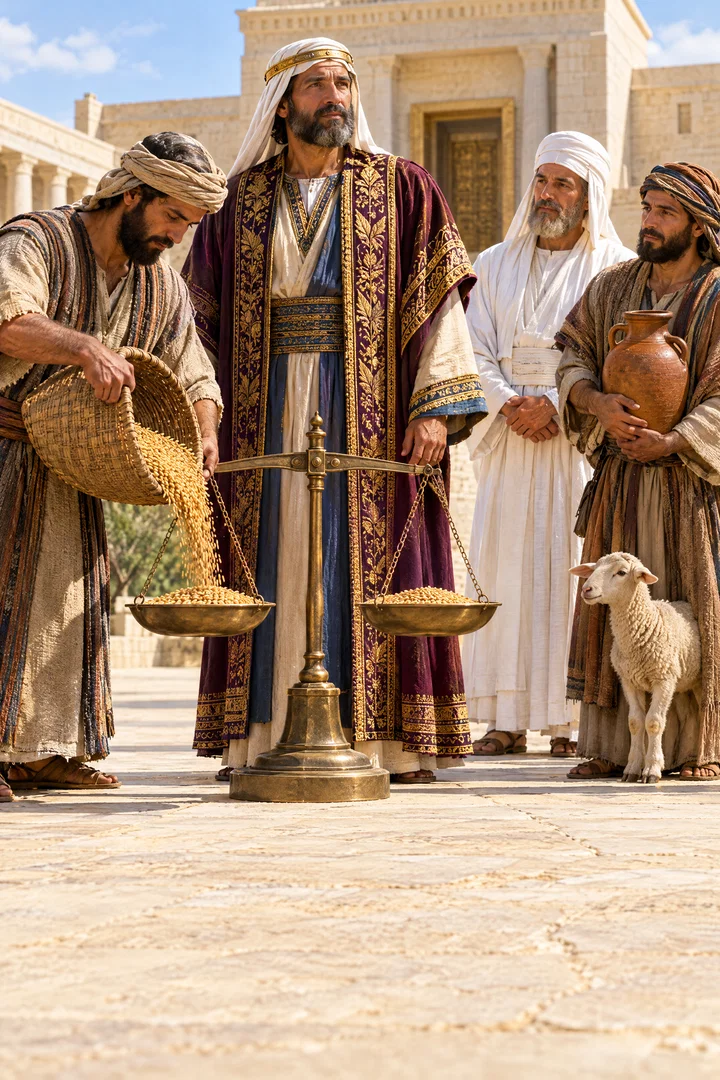
Cross-references
- Ezekiel 46:11
And in the feasts and in the solemnities the meat offering shall be an ephah to a bullock, and an ephah to a ram, and to the lambs as he is able to give, and an hin of oil to an ephah.
Both prescribe offerings for worship in Ezekiel’s sanctuary prophecy.
- Ezekiel 40:1-48
In the five and twentieth year of our captivity, in the beginning of the year, in the tenth day of the month, in the fourteenth year after that the city was smitten, in the selfsame day the hand of the LORD was upon me, and brought me thither.
Describes the sanctuary and worship system that includes this offering.
- Hebrews 8:3-5
For every high priest is ordained to offer gifts and sacrifices: wherefore it is of necessity that this man have somewhat also to offer.
Earthly offerings were shadows of Christ’s offering.
Commentary
Each commentary is drawn from primary sources: the writings of Ellen G. White and Adventist pioneers and periodicals. Each commentary is separate. Its own words are not a quotation; follow the references to read the source passages.
Pioneers and periodicals
21 sources
The verse sets the required grain offering at a sixth of an ephah out of every homer of wheat and the same proportion out of every homer of barley.RH Jan 20, 1853RH Jan 19, 1860RH Sep 4, 1856 It stands within the detailed temple and sanctuary pattern shown to Ezekiel in captivity, with its holy and most holy places, priests, prince, division of the land, city, and laws for offerings, Sabbaths and festivals.RH Jan 20, 1853RH May 25, 1876ST Apr 8, 1889 That whole service belonged to the mortal, historical setting of the first covenant before Christ met antitype, not to the immortal reign of Christ or the present gospel dispensation.RH Sep 11, 1856ST Aug 12, 1875RH Sep 4, 1856 The sanctuary, city, gathering, divine dwelling, victory, healing and peace were offered as a conditional promise to Israel after Babylon if they repented and returned wholeheartedly, but because they did not meet the conditions the glorious temple was never built and only a feeble shadow was raised by the few who returned.ST Aug 12, 1875ST Oct 21, 1908ST Feb 22, 1910ST Nov 24, 1909ST Dec 1, 1914 Its grain offerings and animal sacrifices will never be literally renewed as a continuing system, since Christ offered Himself once for all and replaced the Levitical priesthood, while wherein the prophecy failed for old Jerusalem it will be grandly realized in spiritual form through Christ at the second coming and in the new heavens and new earth.ST Apr 8, 1889ST Oct 1, 1896RH Jan 19, 1860ST Oct 21, 1908ST Mar 3, 1909
Measure and Sanctuary Context
This is the oblation to be offered, the sixth part of an ephah out of each homer of wheat and the same sixth part of an ephah out of each homer of barley.RH Jan 20, 1853RH Jan 19, 1860RH Sep 4, 1856ST Aug 9, 1910ST Aug 2, 1899 The grain contribution is thus measured as one-sixth of an ephah from each homer for wheat and one-sixth of an ephah from each homer for barley.RH Jan 20, 1853RH Jan 19, 1860RH Sep 4, 1856ST Aug 2, 1905ST Sep 20, 1910
It belongs to the sanctuary pattern shown to Ezekiel while in captivity in Ezekiel 40 to 48, with its offerings and sacrifices, city, division of the land, and laws for the prince and people.RH Jan 20, 1853RH May 25, 1876ST Oct 1, 1896RH Jan 19, 1860ST Aug 2, 1905 That pattern includes counted holy places with a most holy place of stated size, Levites serving as priests, and allusions to the Sabbath and festivals.ST Apr 8, 1889ST Oct 1, 1896RH Sep 11, 1856RH Jan 19, 1860 It is part of the temple service and temple arrangements of the unbuilt sanctuary and its former sacrificial service, belonging to the vision of the new sanctuary, its offerings, its glory, and the division of the land.ST Apr 8, 1889ST Oct 1, 1896ST Aug 9, 1910ST Aug 2, 1905ST Sep 20, 1910
That service belongs to the mortal, historical setting before Christ, when type met antitype, and to the Mosaic dispensation when grain and other offerings were in force under the first covenant.RH Sep 11, 1856ST Aug 12, 1875RH Sep 4, 1856ST Aug 2, 1899 It does not belong to the immortal reign of Christ or to the present gospel dispensation, nor does it describe the age to come.RH Sep 11, 1856ST Aug 12, 1875 Its offerings pointed to Christ, the great sin offering.RH Sep 4, 1856
Conditional Promise and Fulfillment
The sanctuary with its city and division of the land, the gathering of the scattered to Israel and restoration to their land, God's dwelling among them with glory never before seen, victory over enemies far and near, healing and life, lengthened life and peace, and even the raising of the righteous dead were offered as a conditional promise to Israel after Babylon if they became ashamed of iniquities, put away wickedness, repented, obeyed, returned wholeheartedly and answered the call to leave Babylon and come up to the full measure of children of God.ST Aug 12, 1875ST Oct 21, 1908ST Sep 21, 1915ST Sep 20, 1910ST Jan 31, 1911 The grain oblation of wheat and barley and the other prescribed ceremonies and offerings belonged to that conditional offer, dependent on obedience.ST Oct 21, 1908ST Sep 21, 1915ST Sep 20, 1910 Had the conditions been met the provisions and figures in Ezekiel 40-48 would have been literally fulfilled and the new and far greater sanctuary would have been built.ST Aug 12, 1875ST Feb 22, 1910ST Aug 2, 1910 The vision beginning in Ezekiel 40 covers the same period and represents the same purposes of God toward Jerusalem as Zechariah 2, and the two should be studied together as counterparts.ST Aug 2, 1910
Because Israel was unwilling, did not become ashamed, did not put away iniquities and did not return wholeheartedly, the glorious temple was never built, the vision failed for old earthly Jerusalem then, and its fullness was not realized.ST Aug 12, 1875ST Mar 3, 1909ST Aug 2, 1910ST Sep 20, 1910 Only about forty thousand returned from captivity, and what followed was fulfilled only in small part or feebly.ST Nov 24, 1909ST Sep 21, 1915 Only a lesser shadow of the temple with a shadow of its greatness was built by Zerubbabel, falling far short of the pattern shown to Ezekiel.ST Nov 24, 1909ST Dec 1, 1914ST Sep 3, 1902ST Sep 20, 1910 That restoration was to have been marked by God's presence bringing healing and life, but Jerusalem was never restored according to the vision.ST Sep 3, 1902
The sanctuary described in Ezekiel 40-48, with its ordinances, Levites serving as priests, grain oblation measured as one-sixth of an ephah from each homer of wheat and barley, and thousands of sheep and oxen sacrifices, belonged to the time then present and to the first covenant, shadowing forth the only effectual offering of Jesus Christ.ST Apr 8, 1889ST Oct 1, 1896RH Jan 19, 1860RH Sep 4, 1856ST Aug 9, 1910 That Levitical priesthood could not belong to a temple built after the Christian dispensation began, because Christ's priesthood replaced it and Christ offered himself once for all.ST Apr 8, 1889RH Sep 4, 1856 The sanctuary therefore never will be built and its grain offering and sacrifices will never be literally renewed or restored as a continuing system, for to do so would make Christ's offering of no effect, build again what was destroyed, annul his sacrifice, make his atonement and priestly ministry void, and return from sunlight to shadow.ST Oct 1, 1896RH Jan 19, 1860RH Sep 4, 1856ST Nov 24, 1909ST Aug 9, 1910
Wherein the prophecy failed for old Jerusalem it stands as prophecy in spiritual and typical form, pointing in general and not in detail to greater things God will do for His people through Christ.ST Oct 21, 1908ST Mar 3, 1909 Wherein it failed for old earthly Jerusalem then it will be grandly realized in the New City that awaits the true Israel of God, through Christ at the second coming and in the new heavens and new earth when God restores by His mighty power.ST Mar 3, 1909ST Aug 2, 1910ST Sep 20, 1910 There will be absolute joy and peace and harmony among all God's creatures in the new earth state, with the healing water of life and character taking hold upon the animals themselves so that wild beasts are made mild and nothing hurts or destroys in His holy mountain, with more or less of the former detail eliminated.ST Sep 20, 1910ST Jan 31, 1911
Sources