Ezekiel 45:12
And the shekel shall be twenty gerahs: twenty shekels, five and twenty shekels, fifteen shekels, shall be your maneh.
Translations
American King James Version, King James Version, KJV Cambridge Paragraph Bible, Webster Bible, Revised Version
And the shekel shall be twenty gerahs: twenty shekels, five and twenty shekels, fifteen shekels, shall be your maneh.
American Standard Version, Darby Translation
And the shekel shall be twenty gerahs; twenty shekels, five and twenty shekels, fifteen shekels, shall be your maneh.
And, the shekel [is] twenty gerah: twenty shekels, five and twenty shekels, fifteen shekels — is your maneh.
and the shekel shall be twenty gerahs,—twenty shekels five and twenty shekels and fifteen shekels, the weight shall be to you.
Berean Standard Bible, Majority Standard Bible
The shekel will consist of twenty gerahs. Twenty shekels plus twenty-five shekels plus fifteen shekels will equal one mina.
The shekel shall be twenty gerahs. Twenty shekels plus twenty-five shekels plus fifteen shekels shall be your mina.
And the shekel is to be twenty gerahs: five shekels are five, and ten shekels are ten, and your maneh is to be fifty shekels
And the shekel shalbe twentie gerahs, and twentie shekels, and fiue and twentie shekels and fifteene shekels shalbe your Maneh.
Douay-Rheims (Challoner revision)
And the sicle hath twenty obols. Now twenty sides, and five and twenty sides, and fifteen sides make a mna.
Pictures
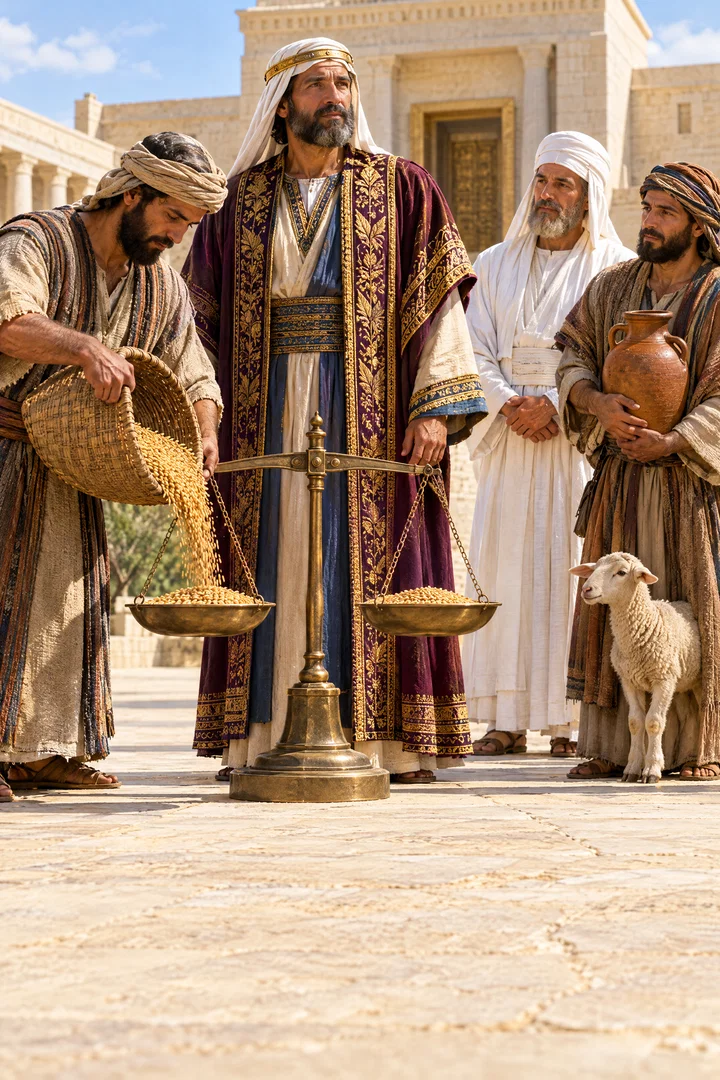
Commentary
Each commentary is drawn from primary sources: the writings of Ellen G. White and Adventist pioneers and periodicals. Each commentary is separate. Its own words are not a quotation; follow the references to read the source passages.
Pioneers and periodicals
25 sources
God sets exact standards for weight, fixing the shekel at twenty gerahs and defining the maneh by twenty shekels, five and twenty shekels, and fifteen shekels.RH Aug 24, 1916 It belongs to the closing vision from Ezekiel 40 to 48 giving the detailed pattern for a sanctuary with its ordinances and offerings, the city, the division of the land, and the promised glory for Israel.RH May 25, 1876RH Sep 11, 1856ST Oct 1, 1896 It was shown while Israel was captive in Babylon fourteen years after Jerusalem's sanctuary was destroyed, as God's offer to restore them with wonderful glory if they repented, put away evil, and returned to Him in full obedience.RH May 25, 1876RH Sep 11, 1856ST Aug 12, 1875RH Jan 21, 1862RH Feb 7, 1907 Because the people failed to meet that condition, the glory was never inherited and the sanctuary as described was never built, with only a lesser restoration erected by those who returned.ST Nov 24, 1909ST Dec 1, 1914RH Feb 7, 1907 Its provisions for sacrifices will never be restored literally, for they were fulfilled when Jesus died on the cross, yet wherein it failed for earthly Jerusalem it stands as faintly typical of the grander realization for the true Israel in the New City at the second coming and in the new heavens and new earth.ST Oct 1, 1896RH Jan 19, 1860ST Oct 21, 1908ST Nov 24, 1909ST Mar 3, 1909
Temple Vision and History
Ezekiel 45:12 belongs to the closing vision in Ezekiel 40-48, also described as extending from Ezekiel 36 or 37 to the end of the book, giving the detailed pattern for a sanctuary or temple, its ordinances and offerings, with the city, the division of the land, and the promised glory and blessings for Israel in the salvation of his people.RH May 25, 1876RH Sep 11, 1856ST Oct 1, 1896ST Apr 8, 1889RH Jan 19, 1860 That sanctuary was offered for the people to build in the past, not in the present or immortal future, and it was never built because the people did not meet the conditions for receiving it.RH May 25, 1876ST Aug 12, 1875RH Jan 19, 1860 It is not a description of the immortal state or the gospel dispensation, nor a temple to be built after the Christian dispensation, since Christ's unchangeable priesthood replaced the Levitical priesthood and its Mosaic time of animal offerings when type met antitype.RH Sep 11, 1856ST Apr 8, 1889ST Aug 12, 1875 Its promise was conditional on Israel being ashamed of its iniquities and putting them away, and being forfeited it stands as a prophecy of a temple that was never built and will never be built, whose sanctuary and sacrificial system are not to be restored as a future Jewish order.ST Oct 1, 1896ST Aug 12, 1875RH Jan 19, 1860
The vision was given to Ezekiel while Israel was in captivity in Babylon, fourteen years after Jerusalem's sanctuary was destroyed, as God's offer to restore them to their land with a city and temple of wonderful glory if they chose to return when the decree for restoration went forth.RH Sep 11, 1856RH Jan 21, 1862RH Feb 7, 1907RH Nov 3, 1863 It was a conditional offer to Israel, with the pattern of another sanctuary with its holy places, the size of its most holy, and what God would do if they fulfilled the conditions, tested when all who chose could have gone up.RH Sep 11, 1856RH Feb 7, 1907RH Nov 3, 1863 That offer contained several allusions to the Sabbath of the Lord and to the festivals, and the city in that vision would have been built if Israel had responded to the calls to leave Babylon.RH Jan 21, 1862RH Feb 7, 1907
The offer was conditional and provisional, depending on the people becoming ashamed of their iniquities, putting away wickedness and evil, repenting and returning wholeheartedly to God in faith and obedience and coming up to the full measure of children of God.RH May 25, 1876ST Aug 12, 1875ST Feb 27, 1907ST Oct 21, 1908ST Nov 24, 1909 It describes a provisional sanctuary with its ceremonies, rites, and offerings promised to Israel if they returned wholeheartedly from captivity, concerning what God was prepared to do for Israel after the return from Babylon from Ezekiel 36-48 onward.ST Oct 21, 1908ST Nov 24, 1909ST Mar 3, 1909 Because Israel did not turn from its sins and was unwilling, the promised restoration was not fulfilled.ST Feb 27, 1907ST Oct 21, 1908ST Mar 3, 1909
Because the people disregarded the condition and failed to repent and do their part, the promised glory was never inherited and the sanctuary as described was never built, not because God changed his purpose.ST Dec 1, 1914RH Feb 7, 1907ST Sep 20, 1910ST Sep 21, 1915 Only about forty thousand returned from captivity, so the promises in their fullness were not realized and the prophecies were fulfilled only in small part or weakly realized.ST Nov 24, 1909ST Sep 21, 1915 Only a lesser restoration and a shadow of its greatness was erected in the temple built by Zerubbabel after the Babylonian captivity.ST Nov 24, 1909ST Dec 1, 1914ST Sep 20, 1910
The measuring of the temple and city by the man with the appearance of brass with a line of flax and a measuring reed covers the same period and represents the same purposes of God toward Jerusalem as the measuring of Jerusalem in Zechariah 2, one being the counterpart of the other to be studied together.ST Aug 2, 1910
Future Fulfillment and Meaning
Ezekiel 45:12 belongs to the specifications for the sanctuary described in Ezekiel 40-48, and that sanctuary was offered for the people to build in the past, not in the present or in the immortal future, but it was never built because the people did not meet the conditions for receiving it.RH May 25, 1876ST Aug 12, 1875 The vision was given fourteen years after Jerusalem's sanctuary was destroyed as a conditional offer to Israel, not as a description of the immortal state or the gospel dispensation, and Israel did not fulfill its conditions so the promised sanctuary was not realized under the first covenant.RH May 25, 1876RH Sep 11, 1856 It is not a temple to be built after the Christian dispensation, for Christ's unchangeable priesthood replaced the Levitical priesthood.ST Apr 8, 1889ST Aug 12, 1875 It concerned the Mosaic dispensation when animal offerings and the Levitical priesthood were in force, when type met antitype, and it does not describe the future age.RH Sep 11, 1856ST Apr 8, 1889ST Aug 12, 1875
No such city or sanctuary stands today, so the vision has not been fulfilled, and it will not be fulfilled by literal renewal of the thousands of sheep and oxen sacrifices.ST Oct 1, 1896RH Jan 19, 1860 Those provisions for sacrifices in chapters 45 and 46 were fulfilled when Jesus Christ died upon the cross, for the offerings of the past were for the time then present, shadowing forth the only effectual offering of Jesus Christ.ST Oct 1, 1896ST Nov 24, 1909 To offer them again would make the once-for-all offering of Christ of none effect, building again the things destroyed and returning from sunlight to shadow, denying the sufficiency of his offering.ST Oct 1, 1896ST Nov 24, 1909ST Aug 9, 1910 The sanctuary and its sacrificial system are therefore not to be restored as a future Jewish order, since the promise was conditional and forfeited, only weakly realized in the temple built by Zerubbabel, and the literal details of the prophecy concerning Israel after the flesh will never be fulfilled.RH Jan 19, 1860ST Nov 24, 1909ST Aug 9, 1910ST Oct 26, 1904ST May 16, 1911
Wherein it failed for old earthly Jerusalem, the temple vision stands as a prophecy of greater spiritual things God would do for his people through Christ.ST Oct 21, 1908ST Mar 3, 1909ST Aug 2, 1910 These prophecies of what God was prepared to do for Israel after the return from Babylon serve as a general, incomplete type of what God will do for his people at the second coming, not a detailed prediction of its fulfillment.ST Oct 21, 1908ST Mar 3, 1909ST Sep 20, 1910 Wherein it failed then it will be grandly realized in the New City that awaits the true Israel of God, fulfilled to the true Israel not in those literal details but according to later revelation, in future glory and the fullest measure of the immortal inheritance to the faithful.ST Aug 2, 1910ST Oct 26, 1904ST Sep 20, 1910 All those promises are faintly typical of what God will restore by his mighty power in the new heavens and the new earth, and what was to be built on this present earth if the Jews had yielded to God as the gradual establishment of the peaceful condition of the Messiah's kingdom will be fulfilled more gloriously in the earth made new under the Spirit of absolute peace.ST Sep 20, 1910ST May 21, 1902
The central truth of the vision of a restored Jerusalem was that the Lord was present.ST Sep 3, 1902ST Aug 2, 1910 The conditional prophecy running from Ezekiel 36 onward promised Israel raising of their righteous dead, subjection of enemies far and near, a new temple, a new division of the land, and unprecedented life and healing power upon Palestine and the earth.ST Sep 20, 1910ST May 21, 1902 It envisioned a glorious temple with the water of life and God's glory, with healing of marshes and deserts and salt lands by the water of life and taming of wild beasts under righteousness.ST Sep 20, 1910ST May 21, 1902ST Aug 2, 1910 The offer contains several allusions to the Sabbath of the Lord and to the festivals of the Hebrews, and its last nineteen chapters are appealed to concerning the reign of Christ, the inheritance of the saints, and the return of the Jews in the Christian dispensation.RH Jan 21, 1862ST Sep 9, 1889
The verse fixes exact standards for weights, showing God is a God of order, with the shekel at twenty gerahs and the maneh defined by twenty shekels, five and twenty shekels, and fifteen shekels.RH Aug 24, 1916 Beyond that ordering of weights, the statement about weights and measures is left without further explanation.RH Sep 11, 1856ST Apr 8, 1889ST Oct 21, 1908ST Nov 24, 1909
Sources