Ezekiel 8:9
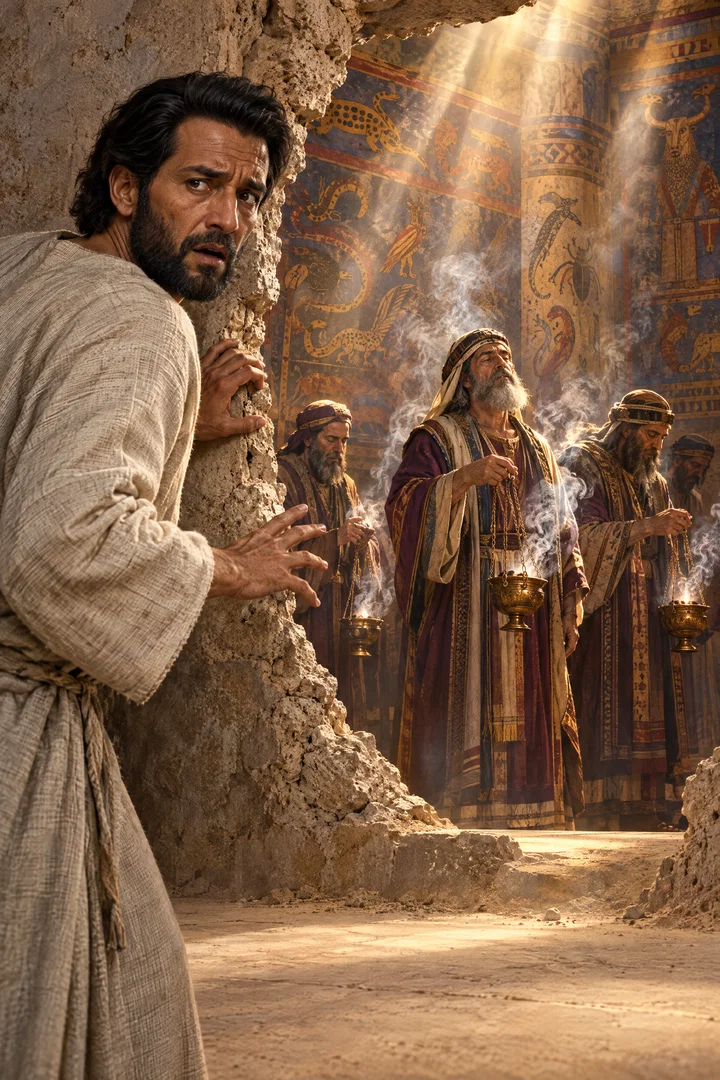
And he said unto me, Go in, and behold the wicked abominations that they do here.
Translations
American King James Version, Webster Bible
And he said to me, Go in, and behold the wicked abominations that they do here.
King James Version, KJV Cambridge Paragraph Bible, Darby Translation
And he said unto me, Go in, and behold the wicked abominations that they do here.
Revised Version, American Standard Version
And he said unto me, Go in, and see the wicked abominations that they do here.
And He saith to me, 'Go in, and see the evil abominations that they are doing here.'
Then said he unto me,— Go in, and see the wicked abominations. which they are committing here.
Berean Standard Bible, Majority Standard Bible
Then He said to me, “Go in and see the wicked abominations they are committing here.”
He said to me, “Go in, and see the wicked abominations that they do here.”
And he said to me, Go in and see the evil and disgusting things which they are doing here.
And he said vnto mee, Go in, and beholde the wicked abominations that they doe here.
Douay-Rheims (Challoner revision)
And he said to me: Go in, and see the wicked abominations which they commit here.
Pictures
Cross-references
- Ezekiel 9:4
And the LORD said unto him, Go through the midst of the city, through the midst of Jerusalem, and set a mark upon the foreheads of the men that sigh and that cry for all the abominations that be done in the midst thereof.
Those who grieve over the abominations receive a protective mark.
- Ezekiel 8:13-16
He said also unto me, Turn thee yet again, and thou shalt see greater abominations that they do.
Continues the vision with further forms of idol worship.
- Ezekiel 8:3
And he put forth the form of an hand, and took me by a lock of mine head; and the spirit lifted me up between the earth and the heaven, and brought me in the visions of God to Jerusalem, to the door of the inner gate that looketh toward the north; where was the seat of the image of jealousy, which provoketh to jealousy.
Introduces the image of jealousy worshiped in the vision.
- 2 Chronicles 33:1-9
Manasseh was twelve years old when he began to reign, and he reigned fifty and five years in Jerusalem:
Manasseh’s idolatry illustrates the abominations Ezekiel was shown.
- Jeremiah 7:9-10
Will ye steal, murder, and commit adultery, and swear falsely, and burn incense unto Baal, and walk after other gods whom ye know not;
Both describe Israel’s abominations, including idolatry and other disobedience.
- Deuteronomy 17:3
And hath gone and served other gods, and worshipped them, either the sun, or moon, or any of the host of heaven, which I have not commanded;
Both condemn idolatrous worship of other gods and heavenly bodies.
- Ezekiel 9:2
And, behold, six men came from the way of the higher gate, which lieth toward the north, and every man a slaughter weapon in his hand; and one man among them was clothed with linen, with a writer’s inkhorn by his side: and they went in, and stood beside the brasen altar.
Describes the agents of judgment that follow the vision of abominations.
Commentary
Each commentary is drawn from primary sources: the writings of Ellen G. White and Adventist pioneers and periodicals. Each commentary is separate. Its own words are not a quotation; follow the references to read the source passages.
Pioneers and periodicals
22 sources
God told Ezekiel to enter in and look closely at the wicked abominations being committed in Judah and Jerusalem, laying open their idolatry including weeping for Tammuz, portrayals of creeping things and beasts on the walls, and men with their backs to the temple worshiping the sun toward the east.ST Jul 26, 1910STSTST Nov 5, 1894 The hidden chambers of imagery show that idolatry is not only a carved image worshiped openly, but the pantheon cherished in the mind and heart, where evil motives, impure thoughts, and love for farms, houses, possessions, and one's own handiwork become false gods in breach of the second commandment.RH Mar 9, 1916RH Sep 3, 1857 Sun and nature worship deified the created means of light instead of God as Creator and Sustainer, turning away from His worship and His law, an apostasy to Baal that set the sun's first day against the Sabbath memorial of His creative power.STST Nov 5, 1894ST Aug 11, 1909ST Dec 24, 1896 This uncovering of abominations among God's professed people belongs to the same sealing work of Revelation 7 and Ezekiel 9:4, where those who sigh and cry over the wrongs have the seal of God's law set in the forehead, the mind.ST Jul 26, 1910ST Jan 10, 1900ST Jan 10, 1900
Vision's Setting and Detail
The command bids Ezekiel to go in and inspect the wicked abominations being done there in Judah and Jerusalem.ST Jul 26, 1910STST Sep 18, 1901 What is exposed is the people's idolatry, including sun worship, set forth as a graphic portrayal of their wrongdoing.ST Jul 26, 1910ST That idolatry is a departure from true worship, from which God seeks to call the people back, and Judah had already witnessed its harmful results in false worship.STST Sep 18, 1901
The abominations brought to light include images of creeping things and beasts and other idols portrayed upon the walls.STST Nov 5, 1894ST They include prominent men of Israel engaged in pagan worship, worshiping Tammuz and turning their backs upon the temple to worship the sun toward the east.STST Nov 5, 1894 They include women weeping for Tammuz with other heathen rites, and sun worship toward the east by those who have turned their backs on God and His worship.STST Nov 5, 1894RH Sep 21, 1905
The images are portrayed upon interior walls in the Babylonian manner, with vermilion and brilliant coloring.ST Jul 23, 1885 This means painted plaster and enameled brick decoration confined to the interior, rather than sculpture upon the exterior as in Egypt and Assyria and Persia and Greece, because Babylon lacked stone and used the brick-clay at hand.ST Jul 23, 1885 The detail belongs exactly to the captivity in Babylon in B.C. 604-561, when Nebuchadnezzar reigned and exerted himself in building and decorating his capital with blended brilliant colors upon palace walls, when Babylon sat as mistress of the world in pride and grandeur.ST Jul 23, 1885 At no later time could this be said, for shortly afterward the kingdom was overthrown by the Medes and Persians and these peculiarities were lost, proving the book true to its time and correctly dated.ST Jul 23, 1885
Ezekiel saw these visions while on the banks of the river Chebar, the Nar Kabari, the Euphrates of Nippur, the great canal running through Nippur and central Babylonia where a colony of Jewish exiles lived.RH Sep 21, 1905 The abominations he was told to behold were those done in Jerusalem, rites he knew from Nippur because Nippur was the center of Babylonian worship.RH Sep 21, 1905 The verse belongs to the vision in Ezekiel chapters 1-10, which is a visible representation of the heavenly sanctuary and true tabernacle.ST Jul 24, 1884
Idolatry Against God and Law
The command to go in and behold lays open wicked abominations done in secret, in the dark, in the chambers of imagery.RH Mar 9, 1916 Idolatry does not require a carved or molded or cast graven image bowed down to in the open, because the image concept exists in the mind before it is made in concrete form and a man may hold a pantheon of gods in the temple of his mind.RH Mar 9, 1916 God sees the cherished imaginings of sins and lusts in the soul.RH Mar 9, 1916
That same abomination includes worshiping farms, houses, automobiles, art, books, and a man's own handiwork.RH Mar 9, 1916 To whatever object a man daily bows rendering homage, that he worships even without making a caricature of a man or an ox or a goat, and he worships a false god and transgresses the second commandment of the decalogue.RH Mar 9, 1916 Yet the grace of Christ can save men from every species of false worship, open or in secret.RH Mar 9, 1916
The setting presents sun and nature worship as a grave perversion of true worship.STST Nov 5, 1894ST Sep 3, 1902 People deified the sun, a created means by which God gives light, instead of honoring God as Creator, Sustainer, and giver of light and life.ST Aug 11, 1909ST Sep 3, 1902 In turning their backs on God and His worship toward the east they supplanted worship of God, rivaled worship of God, and stood in sharp contrast to the worship required by God's law.STST Nov 5, 1894ST Aug 11, 1909ST This sun worship is apostasy to Baal, the Phoenician god Baal.ST Dec 24, 1896ST Sep 10, 1896 It was accompanied by violation and transgression of God's law and Sabbath, with the sun's special day, the first day of the week, set against the Sabbath which memorialized Jehovah's creative power.STST Aug 11, 1909ST Sep 10, 1896
The idolatrous worship involved feasts and revels, including practices forbidden by God's law.ST Dec 5, 1911 Because the people did not love God's righteousness they used worship of the sun and nature to serve sexual lust, consecrating and glorifying licentiousness as religion.ST Sep 3, 1902 The Judean youths understood that the Babylonian feasting and drinking were connected with this idolatrous religion and refused to take part.ST Dec 5, 1911
Sealing Work and Heart Search
The uncovering of sins commanded here is typical of and part of the same great sealing work described in Revelation 7 and Revelation 7:2-3.ST Jul 26, 1910ST Jan 10, 1900 It is joined to the command in Ezekiel 9:4 to place the mark upon God's servants, who are marked in their foreheads.ST Jan 10, 1900ST Jan 10, 1900 What is laid bare is wicked abominations done among God's professed people, for which the faithful sigh and cry, and the seal or mark is then set in the forehead, the seat of the mind with which the law of God is served.ST Jan 10, 1900ST Jan 10, 1900 The sealing message therefore goes not to a people that know not God, but to a people serving God whose practice on some point of faith or life is not right, to set them right on God's law and especially on that part of it which is the seal of His authority.ST Jan 10, 1900
The vision in chapters 8-10 presents striking prophecies of the future and uses Israel as a symbol of the last days.ST Nov 10, 1909 The abominations seen in the chambers of imagery are a picture of what is exposed within the heart when God searches it.RH Sep 3, 1857 There are laid open evil motives and self-interest, idolatrous affections and impure thoughts, and envy.RH Sep 3, 1857
The command pictures men cutting through wall after wall and going from one cavern to another into secret places where loathsome things are worshiped in darkness where the sun is not allowed to shine.ST Mar 11, 1913 It means corrupt schemers hide wicked abominations while plotting the downfall of the nation and the deceit of the people.ST Mar 11, 1913 Having forgotten the image of God, they try to frame men according to the image of the evil one until men forget God.ST Mar 11, 1913 Those hidden works must be laid open by the onward movement of reform rooted in the Bible and its charter of liberty.ST Mar 11, 1913
Sources