Genesis 12:11
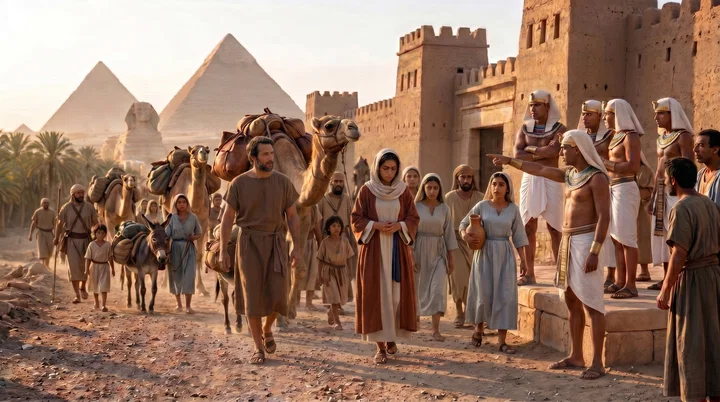
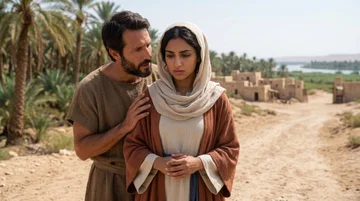
And it came to pass, when he was come near to enter into Egypt, that he said unto Sarai his wife, Behold now, I know that thou art a fair woman to look upon:
Translations
And it came to pass, when he was come near to enter into Egypt, that he said to Sarai his wife, Behold now, I know that you are a fair woman to look on:
King James Version, KJV Cambridge Paragraph Bible, Revised Version, American Standard Version
And it came to pass, when he was come near to enter into Egypt, that he said unto Sarai his wife, Behold now, I know that thou art a fair woman to look upon:
And it came to pass, when he had come near to enter into Egypt, that he said to Sarai his wife, Behold now, I know that thou art a fair woman to look upon:
and it cometh to pass as he hath drawn near to enter Egypt, that he saith unto Sarai his wife, 'Lo, I pray thee, I have known that thou [art] a woman of beautiful appearance;
And it came to pass when he was come near to enter into Egypt, that he said to Sarai his wife, Behold now, I know that thou art a woman fair to look upon.
And it came to pass when he had come near to enter into Egypt, that he said unto Sarai his wife: Behold! I beseech thee I know that a woman fair to look on, thou art:
Berean Standard Bible, Majority Standard Bible
As he was about to enter Egypt, he said to his wife Sarai, “ Look, I know that you are a beautiful woman,
When he had come near to enter Egypt, he said to Sarai his wife, “ See now, I know that you are a beautiful woman to look at.
Now when he came near to Egypt, he said to Sarai, his wife, Truly, you are a fair woman and beautiful to the eye;
And when he drewe neere to enter into Egypt, he said to Sarai his wife, Beholde nowe, I know that thou art a faire woman to looke vpon:
Douay-Rheims (Challoner revision)
And when he was near to enter into Egypt, he said to Sarai his wife: I know that thou art a beautiful woman:
Pictures
Cross-references
- Genesis 20:2
And Abraham said of Sarah his wife, She is my sister: and Abimelech king of Gerar sent, and took Sarah.
Abraham again passes Sarah off as his sister, an act linked to unbelief.
- Genesis 12:1-3
Now the LORD had said unto Abram, Get thee out of thy country, and from thy kindred, and from thy father’s house, unto a land that I will shew thee:
These verses introduce God’s dealings with Abraham and the promised line.
- Genesis 13:3-4
And he went on his journeys from the south even to Beth-el, unto the place where his tent had been at the beginning, between Beth-el and Hai;
Abraham returned to Bethel and called on the Lord at the altar.
Commentary
Each commentary is drawn from primary sources: the writings of Ellen G. White and Adventist pioneers and periodicals. Each commentary is separate. Its own words are not a quotation; follow the references to read the source passages.
Ellen G. White
4 sources
Abraham's words to Sarai belong to his going down into Egypt when severe famine lay upon the land, and that removal was another trial for him.Ms 19, 1886, par. 4 God gave him favor with the Egyptians, so that when he came out of Egypt he possessed more than he had possessed when he went in.Ms 19, 1886, par. 4 His time in Egypt also shows how his conduct and presence helped to reveal God to the people among whom he lived, for his fidelity and character served as a light to the nations of his sojourn.PP 368.2
The verse stands within the truthful record of his sin and failure under temptation, preserved as a lesson and warning for later generations.ST May 31, 19104T 12.1–3 It shows that even one favored by God, entrusted with great responsibilities, and faithful can sin, waver, struggle, and fall.ST May 31, 19104T 12.1–3 It encourages readers that through God's grace they can rise again, take heart, overcome, and continue the struggle.ST May 31, 19104T 12.1–3
Sources
Pioneers and periodicals
20 sources
As he came near to enter Egypt in his famine-driven sojourn, Abram told Sarai his wife that she was fair and beautiful to look upon, recognizing that her beauty could put him in danger.ST Jul 31, 1901AUST Jun 14, 1920RH Jan 2, 1913ST Mar 10, 1887RH Aug 29, 1912 Rather than trusting God to protect them, he lacked faith and schemed to pass her off as his sister and deny that she was his wife, trying to help God out by human planning instead of trusting the promise to bring the Seed through Sarah.AUST Jun 14, 1920RH Jan 2, 1913ST Sep 28, 1915 Sarah's consent to the falsehood shows that a wife's submission is counterfeit virtue when it joins in wrongdoing.RH Aug 22, 1865 The lie and failure, though by a man favored and entrusted by God, were honestly recorded not as approved by God but for instruction and warning, bringing reproach yet encouraging readers that through grace they can rise again.ST May 31, 1910ST Jan 29, 1885ST Apr 7, 1881 The episode belongs to God's providential dealings with Abram and his family as progenitors of the promised Seed, tracing his progress from his call toward full trust and standing at the beginning of the covenant of innumerable descendants, blessing to all nations, and inheritance of the land forever.ST Jan 2, 1912ST Dec 29, 1909ST Dec 20, 1910RH Nov 13, 1856
Setting in Abraham's Journey
Abram spoke these words as he came near to enter Egypt, telling Sarai his wife that he knew she was fair and beautiful to look upon.AUST Jun 14, 1920ST Mar 10, 1887RH Aug 29, 1912 He recognized that her beauty could put him in danger there.AUST Jun 14, 1920RH Aug 29, 1912 The words belong to his famine-driven sojourn and descent into Egypt.ST Jul 31, 1901RH Jan 2, 1913 That experience was later paralleled by his descendants, who also went down into Egypt because of famine.ST Jul 31, 1901
The verse falls within the account of God's providential dealings with Abram and his family as progenitors of the promised Seed.ST Dec 29, 1909ST It belongs to the account of Abram's sojourn in Egypt and the trials of his faith, amid repeated evidence of God's overruling providence.ST Jan 2, 1912ST Dec 29, 1909 The account traces his progress from his call toward full trust in God and reveals his character.ST Dec 20, 1910 Its chapter marks God's call to Abraham, dated to 1921 B.C., as the beginning of the 430-year sojourn of Abraham and his descendants in Canaan and Egypt.ST Aug 12, 1913 The verse supplies the chronological starting point from which Paul's 430 years are added to date the beginning of the dispensation of law, compared with the chronological year of Exodus 20.RH Oct 8, 1857
In the same account Pharaoh later sent Abraham's household onward with rich gifts and goodwill, and God blessed the household both materially and spiritually.RH Mar 18, 1915 The sojourn account is remarkably accurate in details as evidence its writer knew Egypt and its customs.RH Nov 9, 1916
Covenant, Failure, and Instruction
Genesis 12:11 stands at the beginning of the account of the covenant God made with Abraham, continued onward through Genesis 26, in which Abraham was chosen because he was righteous and was promised innumerable descendants, blessing to all nations through them, and inheritance of the land forever.RH Nov 13, 1856 Genesis 12 records part of the obedience to which Genesis 26:3-5 refers when it says God blessed because Abraham kept His commandments and laws, proving the keeping came first as cause and the covenant promises came afterward as effect and not the reverse.RH Mar 25, 1858 This refutes the claim that the commandments and laws were only the three commands to come out from his people, to walk through the land, and to offer Isaac.RH Mar 25, 1858
As they neared Egypt Abraham recognized that Sarah was beautiful, and the episode is an instance of imperfect faith and lack of trust, because he passed her off as his sister and denied she was his wife rather than trusting God to protect them.AUST Jun 14, 1920ST Mar 10, 1887RH Aug 29, 1912 Going to Egypt during a famine, he lacked faith and failed to give the Egyptians the light of God.RH Jan 2, 1913 The story from Genesis 12 to 21 is one in which Abraham tries to help God out by human scheming instead of trusting God's promise to bring the Seed through Sarah, and that human scheming leads only to bondage and trouble rather than to God's freedom.ST Sep 28, 1915 The denial in Egypt is an example of Egypt's corrupting influence, whose taint Abraham retained until he returned to Bethel and built an altar to God.RH Aug 29, 1912
The setting is Sarah's obedience to Abraham in consenting to tell a lie, which is a counterfeit virtue showing that a wife's submission is not virtuous when it involves wrongdoing.RH Aug 22, 1865 The account of Abraham's lie in Egypt is an example of sin by one of God's chosen servants, recorded for instruction and warning and not approved by God.ST Jan 29, 1885 His mistakes are honestly recorded in Scripture and brought reproach upon the truth, but did not destroy the cause of God in its purity.ST Apr 7, 1881 The record of his failure under temptation shows that even a man favored by God and entrusted with great responsibilities could sin and waver, and its truthful preservation warns readers while encouraging them that through God's grace they can rise again and continue the struggle.ST May 31, 1910
Sources