Genesis 12:1
Now the LORD had said unto Abram, Get thee out of thy country, and from thy kindred, and from thy father’s house, unto a land that I will shew thee:
Translations
Now the LORD had said to Abram, Get you out of your country, and from your kindred, and from your father’s house, to a land that I will show you:
Now the LORD had said unto Abram, Get thee out of thy country, and from thy kindred, and from thy father’s house, unto a land that I will shew thee:
Now the Lord had said unto Abram, Get thee out of thy country, and from thy kindred, and from thy father’s house, unto a land that I will shew thee:
Now the LORD had said to Abram, Depart from thy country, and from thy kindred, and from thy father's house, to a land that I will show thee:
Now the LORD said unto Abram, Get thee out of thy country, and from thy kindred, and from thy father’s house, unto the land that I will shew thee:
Now Jehovah said unto Abram, Get thee out of thy country, and from thy kindred, and from thy father’s house, unto the land that I will show thee:
And Jehovah saith unto Abram, 'Go for thyself, from thy land, and from thy kindred, and from the house of thy father, unto the land which I shew thee.
And Jehovah had said to Abram, Go out of thy land, and from thy kindred, and from thy father's house, to the land that I will shew thee.
And Yahweh said unto Abram: Come thou on thy way, Out of thy land and out of the place of thy birth and out of the house of thy father,—Unto the land that I will show thee;
Berean Standard Bible, Majority Standard Bible
Then the LORD said to Abram, “Leave your country, your kindred, and your father’s household, and go to the land I will show you.
Now the LORD said to Abram, “Leave your country, and your relatives, and your father’s house, and go to the land that I will show you.
Now the Lord said to Abram, Go out from your country and from your family and from your father's house, into the land to which I will be your guide:
For the Lord had said vnto Abram, Get thee out of thy countrey, and from thy kindred, and from thy fathers house vnto the land that I will shewe thee.
Douay-Rheims (Challoner revision)
And the Lord said to Abram: Go forth out of thy country, and from thy kindred, and out of thy father’s house, and come into the land which I shall shew thee.
Pictures
Cross-references 20 of 82
- Hebrews 11:8
By faith Abraham, when he was called to go out into a place which he should after receive for an inheritance, obeyed; and he went out, not knowing whither he went.
Abraham obeyed God’s call and left for an unknown land.
- Genesis 13:14-16
And the LORD said unto Abram, after that Lot was separated from him, Lift up now thine eyes, and look from the place where thou art northward, and southward, and eastward, and westward:
God renews the land promise to Abraham and his seed forever.
- Hebrews 11:16
But now they desire a better country, that is, an heavenly: wherefore God is not ashamed to be called their God: for he hath prepared for them a city.
Abraham left his country seeking a better, heavenly homeland.
- Acts 7:2-4
And he said, Men, brethren, and fathers, hearken; The God of glory appeared unto our father Abraham, when he was in Mesopotamia, before he dwelt in Charran,
Stephen recounts God’s call to Abraham in Mesopotamia and his departure toward Canaan.
- Galatians 3:17
And this I say, that the covenant, that was confirmed before of God in Christ, the law, which was four hundred and thirty years after, cannot disannul, that it should make the promise of none effect.
Says God’s covenant with Abraham was confirmed in Christ.
- Genesis 12:7
And the LORD appeared unto Abram, and said, Unto thy seed will I give this land: and there builded he an altar unto the LORD, who appeared unto him.
God promises the land to Abram’s seed after he arrives in Canaan.
- Galatians 3:8
And the scripture, foreseeing that God would justify the heathen through faith, preached before the gospel unto Abraham, saying, In thee shall all nations be blessed.
The promise to Abraham of blessing all nations is identified as the gospel preached beforehand.
- Genesis 15:13
And he said unto Abram, Know of a surety that thy seed shall be a stranger in a land that is not theirs, and shall serve them; and they shall afflict them four hundred years;
Its prophecy of 400 years is distinguished from the 430 years counted from Abraham’s call.
- Romans 4:13
For the promise, that he should be the heir of the world, was not to Abraham, or to his seed, through the law, but through the righteousness of faith.
Abraham’s promised inheritance of the world comes through faith, not law.
- Galatians 3:29
And if ye be Christ’s, then are ye Abraham’s seed, and heirs according to the promise.
Those who belong to Christ are Abraham’s seed and heirs according to the promise.
- Genesis 17:8
And I will give unto thee, and to thy seed after thee, the land wherein thou art a stranger, all the land of Canaan, for an everlasting possession; and I will be their God.
God promises Canaan to Abraham and his seed as an everlasting possession.
- Genesis 22:18
And in thy seed shall all the nations of the earth be blessed; because thou hast obeyed my voice.
God renews the promise that all nations will be blessed through Abraham’s seed.
- Galatians 3:16
Now to Abraham and his seed were the promises made. He saith not, And to seeds, as of many; but as of one, And to thy seed, which is Christ.
Identifies Abraham’s promised Seed as Christ.
- James 2:23
And the scripture was fulfilled which saith, Abraham believed God, and it was imputed unto him for righteousness: and he was called the Friend of God.
Abraham’s faith was counted as righteousness, and he was called God’s friend.
- Hebrews 11:9
By faith he sojourned in the land of promise, as in a strange country, dwelling in tabernacles with Isaac and Jacob, the heirs with him of the same promise:
Abraham lived as a sojourner in the land of promise.
- Romans 4:11
And he received the sign of circumcision, a seal of the righteousness of the faith which he had yet being uncircumcised: that he might be the father of all them that believe, though they be not circumcised; that righteousness might be imputed unto them also:
Abraham is called the father of all who believe.
- Genesis 15:5
And he brought him forth abroad, and said, Look now toward heaven, and tell the stars, if thou be able to number them: and he said unto him, So shall thy seed be.
covenant ratified obedience in leaving
- Acts 7:5
And he gave him none inheritance in it, no, not so much as to set his foot on: yet he promised that he would give it to him for a possession, and to his seed after him, when as yet he had no child.
Abraham received no inheritance in the land during his lifetime, though God promised it to him and his seed.
- Genesis 11:31
And Terah took Abram his son, and Lot the son of Haran his son’s son, and Sarai his daughter in law, his son Abram’s wife; and they went forth with them from Ur of the Chaldees, to go into the land of Canaan; and they came unto Haran, and dwelt there.
Terah’s household leaves Ur with Abram and stops at Haran before Abram’s departure.
- Genesis 26:3-4
Sojourn in this land, and I will be with thee, and will bless thee; for unto thee, and unto thy seed, I will give all these countries, and I will perform the oath which I sware unto Abraham thy father;
same promise repeated to Isaac
Commentary
Each commentary is drawn from primary sources: the writings of Ellen G. White and Adventist pioneers and periodicals. Each commentary is separate. Its own words are not a quotation; follow the references to read the source passages.
Ellen G. White
50 sources
God at seventy-five told Abram dwelling in his own country to leave his country, his relatives and his father's household for a strange unknown land God would show him, where he would live as pilgrim and stranger.GW92 23.1–2Ms 26, 1905, par. 10–11FE 504.4 The command came after the flood when idolatry had become widespread, and God had already kept Abraham from idols in his youth and now required complete separation because the pleasure-loving idolatrous influences around him in Mesopotamia endangered his knowledge of the true God and his character.FE 504.4Ms 65, 1906, par. 4Lt 188, 1903, par. 10–14SG3 98.11SP 93.1 He obeyed by faith without knowing his destination or asking about ease or fertility, resting wholly on God's promise to guide and protect him though the call was a severe trial amid Canaanites, poverty and famine.GW92 23.1–2FE 504.4GW 112.1–2Ms 19, 1886, par. 5–610MR 118.1 The call was joined to a covenant to make him a great nation with Canaan as an everlasting inheritance and to make him God's chosen witness and light-bearer to preserve truth and bless all families of the earth through the promised Messiah, not for selfish honor.GW92 23.1–2Ms 26, 1905, par. 10–11GW 112.1–2Ms 19, 1886, par. 1–2Lt 129, 1897, par. 8–10 That same call still requires those who serve God to leave hindering associations, plans and earthly hopes and follow His clear leading even into hardship, trusting Him to provide as Abraham did.GW 112.1–2COL 36.1–2ST Jan 26, 1915Ms 19, 1886, par. 5–6Lt 248, 1905, par. 1–3
Call's Words and Setting
The command came to Abram at seventy-five years old, while sojourning in his own country, to get out from his country and from his kindred and from his father's house and household to a land God would show and reveal to him.GW92 23.1–2Ms 26, 1905, par. 10–11Lt 129, 1897, par. 8–10 That land was unfamiliar, unknown and strange to him, where he was to live as a pilgrim and stranger apart from his ancestral home and graves.GW92 23.1–2Ms 26, 1905, par. 10–11GW 112.1–2 The call to leave home was a test and trial beyond measure.Ms 26, 1905, par. 10–11
It came after the flood when people had again increased, hundreds of years after the flood, when wickedness and well-nigh universal, widespread idolatry had increased and God left the hardened transgressors to their evil ways.FE 504.4Ms 65, 1906, par. 48T 207.1–2 It came to Abraham of the line of Shem, a descendant of Shem, chosen to keep God's law for future generations.FE 504.4Ms 65, 1906, par. 4Lt 188, 1903, par. 10–14RH Aug 16, 1906 God had already revealed Himself to Abraham in his youth, giving him understanding and preserving him from idolatry.SG3 98.11SP 93.1 With full sight of the dangers involved, He was calling him out from the gods his fathers served and from idol worship and degraded idolatrous living to serve Jehovah.SG3 98.11SP 93.1Ms 61, 1896, par. 5–7Ms 135, 1899, par. 10
The promise and command to leave Ur of the Chaldees begins a 430-year sojourning ending at the giving of the law at Sinai.PP 760.2–3 That sojourning includes Abraham, Isaac, and Jacob as strangers in Canaan and is not time in Egypt alone, where Israel was only about 215 years.PP 760.2–3 The 400 years of sojourning and affliction begins about 30 years later when Ishmael persecuted Isaac.PP 760.2–3
Reasons God Required Separation
God required Abraham to leave because the idolatrous and pleasure-loving influences surrounding him in Mesopotamia were unfavorable to right character and endangered his spiritual perception, his sense of the sacredness of truth, and his knowledge of the true God.Lt 109, 1899, par. 19–23Lt 248, 1905, par. 1–3HCSSP 34.2 God knew how strong the temptations would be if he remained, so the command was to separate His servant from every species of idolatry and to remove him from seductive influences.Lt 248, 1905, par. 1–3HCSSP 34.2 It was not for Abraham's best spiritual interest to remain where he could not exert a blessing influence over his relatives.Lt 109, 1899, par. 19–23
He could not introduce the new order of things in his household and cultivate home religion while surrounded by idolatrous kinsfolk and friends.SCE 13.1–2 Separation freed him from human influences, familiar associations, former ties, and earthly ties that could interfere with obedience and with receiving God's instruction and learning His purposes.GW92 23.1–24T 524.1–2GW92 24.1–2 His motives and actions were beyond the understanding of his idolatrous relatives and friends.GW92 23.1–2PP 126.1
God separated Abraham from the influences of his former life so He could educate, train, and qualify him for his work as keeper of the sacred oracles and of the law for future generations.GW92 23.1–2Ms 65, 1906, par. 4PP 126.1 Living among strangers would help form a distinctive character different from the world, and his simple obedience showed one to whom capabilities for service could be entrusted.PP 126.1Lt 109, 1899, par. 19–23 The call came after the flood when people had again increased and wickedness and well-nigh universal idolatry had increased, and God left the hardened transgressors to their evil ways, choosing Abraham of the line of Shem.Ms 65, 1906, par. 4
That separation enabled him to establish a new order in his household and cultivate home religion apart from corrupting influences.SCE 13.1–2FE 286.2–3PP 141.2–142.1 Going out meant listening to the voice of Christ, deciding to obey the law of God, and taking accountability to instruct his children and household to keep the way of the Lord and to do justice and judgment.SCE 13.1–2FE 286.2–3 This was God's providence opening a new method and a wise arrangement to cut off His people as far as possible from all connection with the heathen, making them a people dwelling alone and not reckoned among the nations.SCE 13.1–2HCSSP 34.2 In this way the knowledge of the true God and of His laws and commandments, and the true faith in its purity, would be preserved in the world from generation to generation by his descendants, who would exalt God's law.SCE 13.1–2HCSSP 34.28T 207.1–2
The Lord directed Abraham to leave his idolatrous country and separate from his relatives in order to carry out God's will.ST Mar 27, 1879 God called him away from his idolatrous relatives to live in Canaan and sent him to a country he did not know, where He established him so he could be an influence for good.PK 11.1Lt 179, 1903, par. 6–7 This served God's purpose of bringing Heaven's gifts to all peoples through a people who would preserve God's truth and bless every nation through the promised Messiah.PK 11.1
Abraham's Faithful Obedience
Abraham obeyed by faith, departing and going out without knowing where he was going or where he would go, moving out without seeing the future opened before him.GW92 23.1–2FE 504.4GW 112.1–2Ms 65, 1906, par. 4Lt 188, 1903, par. 10–14 His call exemplifies the sacrifice required of those called to sow the truth, leaving old associations and surrendering plans and earthly hopes to go forward into the unknown.GW 112.1–2COL 36.1–2 He had no outward evidence beyond God's promise that his descendants would possess Canaan, yet he went wherever God led, resting on faith that God would keep His word, guide him, and protect him, showing faith, reliance, and trust in God.4T 524.1–2GW92 24.1–2
He went at God's bidding with perfect confidence, without reasoning about or questioning God's purposes, without asking whether the land would be fertile and pleasant or whether he would have ease.Ms 19, 1886, par. 5–610MR 118.1 He grasped God's will with sanctified intellect and living faith at the command of a God he scarcely knew, pressing on in the narrow way while cultivating his capabilities and wisely employing his powers, with God disposing his heart to obey.Lt 162, 1903, par. 12 The call to leave home was no small trial but a severe test and trial beyond measure to his faith.Ms 26, 1905, par. 10–11Ms 19, 1886, par. 1–2 Obeying brought him into a land occupied by Canaanites whose idolatry he had to meet, where he could see no possession he could claim as his own, with poverty, hunger in famine, and other trials, yet his faith and confidence endured, and in that perplexity God preached the gospel to him and showed him the possession for an eternal inheritance.Ms 26, 1905, par. 10–11Ms 19, 1886, par. 1–2Ms 19, 1886, par. 17–19
Abraham trusted and obeyed the same divine voice that later told him to offer his son, requiring not only faith but trust, and his faith produced action and fruits.8MR 356.2Ms 46, 1891, par. 5 His integrity, generosity, hospitality, reverence and love for God, unselfishness, courage, kindness, and strict obedience in performing God's will commanded respect as a mighty prince.SG3 98.11SP 93.1PP 368.2 Through that righteous course people in Mesopotamia, Canaan, Egypt, and Sodom, with his servants, household, and neighbors, could see God's character and were led to fear, love, and reverence God.SG3 98.11SP 93.1PP 368.2 As a rich sojourner who took his possessions to use as God required he pleased God and showed one to whom capabilities for service could be entrusted.Lt 109, 1899, par. 19–23
Wherever he pitched his tent his first work was to build an altar for God and worship Him there with those accompanying him as pilgrims and strangers, showing by action that God came first, showing respect for God's holiness, and putting provision for worship first of everything.Lt 56, 1897, par. 713MR 357.1 Abraham and his descendants did not receive the promised possessions as a possession during their lifetimes, owning only a burial place bought from the Canaanites.Ms 26, 1905, par. 10–11PP 169.3 He died in faith looking for a better country, that is, an heavenly, not regarding this world as his home.Ms 26, 1905, par. 10–11PP 169.3
Promise and Worldwide Mission
The command to leave country and kindred and father's house for a land to be shown was joined to a covenant of promise to make Abraham a great nation and a blessing to all families of the earth.Ms 26, 1905, par. 10–11Lt 129, 1897, par. 8–10 In that perplexity of entering a land occupied by Canaanites where he could see no possession to claim, God preached the gospel to him and showed him the possession he would have for an eternal inheritance, with Canaan promised as an everlasting possession.Ms 26, 1905, par. 10–11Ms 19, 1886, par. 1–2PP 169.3 The call to leave home was a test and trial beyond measure through which God was revealing Himself to Abraham.Ms 26, 1905, par. 10–11Ms 19, 1886, par. 1–2 The promised possessions were not received during his lifetime, for he owned there only a burial place bought from the Canaanites, did not regard this world as his home, and died in faith looking for a better country, that is, an heavenly.Ms 26, 1905, par. 10–11PP 169.3
God had chosen Abraham as a witness to bear a message to many people and as His chosen representative to reveal His righteousness.Ms 26, 1905, par. 10–11 He was sent out as God's light-bearer to keep God's name alive on earth, becoming a light-bearer to the heathen and serving as God's messenger.GW92 23.1–2GW 112.1–24T 523.1GW 26.1 This call served God's purpose of bringing Heaven's gifts to all peoples, for Abraham was to become the father of a people set apart who would preserve God's truth, exalt His law, and bless every nation through the promised Messiah.PK 11.18T 207.1–2 That blessing was not a selfish end for Abraham or his descendants.PK 11.1 Hundreds of years after the flood God so called him away from his idolatrous relatives to live in Canaan.PK 11.18T 207.1–2
God designed to make Abraham an example of faith and true devotion for His people afterward living on the earth, having already revealed Himself to him in his youth to give him understanding and preserve him from idolatry.SG3 98.11SP 93.1 His integrity, generosity and hospitality, reverence and love for God, and strict obedience in performing the divine will commanded respect as a mighty prince.SG3 98.11SP 93.1 His godly example, righteous course, and faithful instruction led his servants and all his household and neighbors to fear, love, and reverence God.SG3 98.11SP 93.1 The call offered no promise of worldly honor or reward.GW92 23.1–24T 523.1
Claiming the promises made to Abraham does not by itself make a person Abraham's child or assure eternal blessings, but sharing in them is joined to the faith and piety Abraham showed.ST Mar 1, 1883 Abraham trusted and obeyed the same divine voice that later told him to offer his son, and his faith produced action and fruits.8MR 356.2Ms 46, 1891, par. 5 The call required not only faith but trust in God.Ms 46, 1891, par. 5 Abraham was saved by faith in Christ in exactly the same way sinners are saved today.8MR 356.2Ms 46, 1891, par. 5 The promise belongs with God's promises to Isaac and to Jacob, which Jacob remembered alongside the promise to himself.ST Dec 18, 1879 It marks the beginning of the history of God's chosen people leading to deliverance from Egyptian bondage and the exodus, recalled as part of God's covenant associated with the land God later gave Israel without their laboring for it.RH Jan 30, 1908Ms 135, 1899, par. 7 God is not dependent on Abraham's descendants for fulfilling His purpose, but as He called just and obedient Abraham out from a heathen people, He can call others to His service now, quickening hearts as lifeless as desert stones by His Spirit to do His will and receive the fulfillment of His promise.DA 106.4
Application to Believers Today
The call to leave country, kindred, and father's house for a land to be shown illustrates that those called to serve God and sow the seed of truth may have to leave old associations and surrender established plans and earthly hopes, going forward without knowing where they will go, as an example of sacrifice and separation required of God's light-bearers who live as pilgrims and strangers to keep His name alive on earth.GW 112.1–2COL 36.1–2ST Jan 26, 1915 God still calls people in the same way when surroundings and associates hinder right resolve and prove the worst spiritual enemies, commanding separation from every species of idolatry because He knows how strong the temptations are if they remain.Lt 248, 1905, par. 1–3 The call is to change surroundings and cut loose from associates at once without waiting too long lest they become earth-bound, obeying His warning in the strength of Christ who paid with His own life for their salvation.Lt 248, 1905, par. 1–3
Believers whose companionship and associations are unfavorable to spiritual health, where constant temptation works to destroy virtue and steadfast principle, should for their souls' sake remove at seventy-five years old as Abraham did when promised to be made a great nation, departing as commanded to a place with different associations, less pressing difficulties, and clearer light.Lt 129, 1897, par. 8–10Lt 129, 1897, par. 11–12 Such a different place and different associations can help escape some of Satan's snares and break some of the nets laid for the feet, as leaving the familiar home did for Abraham when he went where he was directed.Lt 129, 1897, par. 8–10Lt 129, 1897, par. 11–12 Yet such a move does not place anyone beyond Satan's temptations and does not alone make anyone a doer of the Word, and it must be made understandingly from the force of conviction with determination to win heaven at any cost, not hastily or in a haphazard way but thoughtfully.Lt 129, 1897, par. 8–10Lt 129, 1897, par. 11–12
When duty goes against personal wishes and inclination, people are to have faith in God and follow His clear leading with perfect confidence that He is leading, without reasoning about or questioning His purposes.Ms 19, 1886, par. 5–610MR 118.1Ms 19, 1886, par. 17–19 Abraham left country and friends without asking whether the land would be fertile and pleasant or whether he would have ease, and his endurance through poverty, hunger in famine, and other trials in a severe test teaches that obedience must not depend on convenience, personal preference, or expected outcomes, even when it brings hardship or requires giving up advantageous positions.Ms 19, 1886, par. 5–610MR 118.1Ms 19, 1886, par. 17–19 God may lead away from favorable circumstances and relatives because familiar surroundings can hinder the development of needed character that honors Him, while a new setting can help develop it.Ms 19, 1886, par. 5–6 That same faith that moved out without seeing the future opened before it is required when conviction of duty threatens livelihood and family support, as in keeping the Sabbath, trusting God to open the way and provide after obedience.Ms 5, 1872, par. 17
There is often wisdom in families separating so one called by God can see more clearly and exert a more healthful influence apart from familiar association, since it may not be for best spiritual interest to remain where idolatrous, pleasure-loving influences endanger spiritual perception, the sense of the sacredness of truth, and the knowledge of the true God, and where no blessing influence can be exerted over relatives.Lt 109, 1899, par. 19–23 Simple, contented obedience as a rich sojourner who takes possessions to use as God requires pleases God and shows one to whom capabilities for service can be entrusted, tested by whether God's voice will be heard and obeyed.Lt 109, 1899, par. 19–23 The call is election to become members of the Lord's family, requiring coming out from the world in speech and in action, with every truly converted soul maintaining a separate holy character under discipline to Christ while learning and teaching the most solemn message ever given, representing Christ in example despite full sight of the dangers.Ms 61, 1896, par. 5–7
The command to sojourn alone in a strange land shows God assigns to each person an individuality and a distinct work, calling Abraham into new territory to be a light-bearer to the heathen and to introduce a new order of things by listening to Christ, deciding to obey God's law, and taking accountability to instruct children and household to keep the way of the Lord and do justice and judgment.SCE 13.1–214MR 205.4–206.1Lt 60, 1901, par. 11–12 That separation was providence opening a new method to preserve from generation to generation the knowledge of the true God and of His laws and commandments, apart from idolatrous kinsfolk and friends where home religion could not be cultivated.SCE 13.1–2 Believers are therefore not to live to please themselves but to care for every sinner, serving beyond their own interests by going forward in the Lord's name to take up work in the home field or in regions beyond, depending on God for grace and strength so a small beginning will enlarge under His plan.14MR 205.4–206.1Lt 60, 1901, par. 11–12
Abraham's leaving home to go where he was directed without knowing his destination, obeying without questioning to carry light to the heathen, teaches Christ's servants to go where God calls and directs, trusting Him for guidance and success.GW 26.1 At the command of a God he scarcely knew he left for an unknown land and pressed on in the narrow way while cultivating capabilities and wisely employing powers, grasping God's will with sanctified intellect and living faith because God disposed his heart to obey.Lt 162, 1903, par. 12 His obedience proves that merely following conscience is not enough, for a person must have a conscience void of offense toward God and man, and conscience is a safe guide only when God has control of the whole being.Lt 162, 1903, par. 12
Sources
Pioneers and periodicals
154 sources
God commanded Abram to leave his country, his kindred and his father's house and go to a land God would show him.ST Feb 11, 1913ST Jun 2, 1881RH Dec 26, 1865 He was to depart without knowing the destination, trusting God to show it afterward.ST Apr 2, 1885ST Jan 22, 1894RH Dec 9, 1915 He obeyed promptly by faith alone, forsaking family ties, comfort and familiar prospects without demanding reasons or outcomes.ST Feb 11, 1913RH Dec 26, 1865ST Sep 25, 1901 God thus separated him from an idolatrous world to form a separate holy nation that would preserve His name, truth, law and worship and keep pure the promise of the Redeemer for the blessing of the world.RH Oct 8, 1903ST Jul 24, 1901RH Oct 25, 1853ST Aug 3, 1915RH Mar 16, 1916 That promise preached the gospel beforehand, that in his Seed who is Christ all families of the earth would be blessed with righteousness by faith, and its inheritance is ultimately the whole earth, the heavenly country and city fulfilled when the redeemed inherit the new earth.ST Jan 24, 1878RH Feb 25, 1858RH Jun 16, 1904RH Nov 25, 1902
Command and Promised Land
The Lord's word to Abram was an imperative command to get out from his country and from his relatives and from his father's household and to go to a land that God Himself would show him.ST Feb 11, 1913ST Jun 2, 1881RH Dec 26, 1865ST Jan 22, 1894ST Jul 24, 1901 Abram obeyed and departed from Haran and came into Canaan, where the Lord appeared to him and promised the land to his seed.ST Jun 2, 1881ST Jul 24, 1901 The command demanded great sacrifice, for it tore him from family ties and from a comfortable and prosperous life among his own people, from familiar places and memories and the family home, to go to an unfamiliar place.ST Feb 11, 1913RH Dec 26, 1865ST Jul 22, 1913 His simple faith and learned obedience followed God's voice even when leaving what was dear, and the call illustrates Christ's invitation to sinners to forsake sin and every hindrance and set the heart on the heavenly country.ST Feb 11, 1913RH Dec 26, 1865
The destination was undisclosed at the time of the call, for God said He would show the land afterward and Abram was to depart without knowing where he was going.ST Apr 2, 1885ST Jan 22, 1894RH Dec 9, 1915ST Feb 17, 1888 He went out by faith alone, not knowing whither he went, unto a place which he should afterward receive for an inheritance.ST Jan 22, 1894 He did not first investigate the land's resources but trusted that God knew what he needed and would care for him, and God blessed him and made him a great man and father of the faithful.RH Dec 9, 1915 The promise given while he was still in his native country reached beyond himself to people who would live on earth at a later time, who would be blessed and consequently keep God's commandments.ST Apr 2, 1885
The call was a plainly expressed command to be accepted as written, and his journey began in obedience to that command and not merely in response to an inward impulse or an uncertain sense of guidance.ST Mar 10, 1887 Its plain statements are to be accepted rather than replaced with conjectures that contradict the account.ST Mar 10, 1887 Grace met him in the land of the Chaldees in the very place of his idolatry and sin, proving that grace does not wait on a distant height for the sinner to climb up but comes down into the valley and into the very place of sin to seek him.RH Jun 16, 1863 His experience gives no ground for demanding that God speak on human terms or for refusing His authority unless He does so.ST Oct 25, 1883
Leaving his country meant becoming henceforth a man without a country on earth, belonging to neither Babylonia nor Egypt, a foreigner and pilgrim and stranger until given inheritance in the better heavenly country.ST Jun 14, 1899 Leaving his kindred meant refusing to stay clannishly with the tribe as if his own relatives were the best on earth, refusing to join in building a city and making a name to avoid being scattered abroad, and being without earthly kindred except so far as they are bound by the claims of God, for there is no clannishness in faith.ST Jun 14, 1899 Leaving his father's house was the third and hardest condition of blessing, for earthly fathers die and the house becomes too small for too many, and it meant giving up home for God's call to a greater work involving strong character building, leaving it to the weak and homesick and characterless.ST Jun 14, 1899 So he obeyed as the Lord had spoken and became a man without country, without kindred, without home, a stranger and pilgrim for Christ's sake, directed to leave family and homeland for a land God would show, and God is not ashamed to be called their God because He has prepared for them a city, a continuing city.ST Mar 27, 1879ST Jun 14, 1899 The verse gives almost the first introduction to Abraham and displays his faith, which is being fully persuaded that what God promised He is able to perform, making him father not by fleshly descent but by character, father of all who have that same faith, so that the promise is of faith that it might be by grace and might be sure to all who are of his faith.ST Jun 14, 1899
The land was the chief burden of the original promises and the first and grand object in the call, the place he would afterward receive for an inheritance, which he entered by obeying the call to go out.ST Apr 17, 1884 The promise was made to Abraham himself in person of a land to be shown to him, and because it was spoken personally to Abraham, Isaac, and Jacob its fulfillment cannot be the later possession of Canaan by their descendants alone but requires their own personal inheritance. The conquest under Joshua did not exhaust it, since Israel did not fully possess the land and drive out its enemies, leaving a future rest and inheritance still to come. That inheritance is altogether the gift of God and impossible for man to obtain in any other way, so everything that helps man reach it and fits him for it must also be altogether from God as gift, received only by faith. The blessing of God, the sacrifice and priesthood of Christ, eternal righteousness, and eternal life are the essentials to receiving it, and since all these are utterly beyond man's reach by anything he can do, they all come as the gift of God and are obtained only by faith in God.
Setting Date and Journey
Abram's home was Ur of the Chaldees near the mouth of the Euphrates in antiquity, and river deposits later shifted the geography so its ruins lie about 125 miles from the Persian Gulf and six miles from the Euphrates.ST Jan 13, 1887 Its oldest temples bear bricks naming Urukh, who called himself king of Ur and Accad and lived roughly a century or somewhat more before Abram left Ur.ST Jan 13, 1887 Ur was an opulent, luxurious, idolatrous city given to festivals and carnivals, where few families knew God.RH Oct 22, 1903 It was also a fertile and cultured center of learning, from which God called Abraham to go to Canaan to live among idolatrous and degenerate tribes.ST Jul 26, 1910RH Jan 16, 1913
The first call came in Mesopotamia in Ur before Abram dwelt in Haran, commanding him to leave country, kindred, and father's house for a land God would show.ST Mar 26, 1885ST Jan 22, 1894ST Feb 1, 1877 Obedience came in two removals, first out of the land of the Chaldeans into Haran, then from Haran after his father was dead into Canaan.ST Mar 26, 1885ST Feb 1, 1877 He departed out of Haran at seventy-five years old, after Terah died in Haran.ST Jan 22, 1894ST Jan 13, 1887 The wording of the command by itself does not say whether it was spoken after his father's death or whether Abram left before his father's death.
Terah went with Abram and the family stopped at Haran, and Terah's delay became an obstacle so that Abram might not have reached Canaan if Terah had not died.ST Oct 20, 1914 Stopping in Haran was obeying only partway, since Haran was not the promised land, and Abram went on to Canaan after his father died while relatives who remained in Haran kept their idolatry and did not reach it.RH Sep 19, 1912 Lot remained with him after his father's death, so while Lot was with him he was still with his kindred and had not met the condition of leaving kindred before God could show him the land.ST Jul 26, 1899RH Jan 9, 1900 After Lot separated from Abraham, God showed him the promised land, and Abraham did not receive the fullness of God's blessing until he was completely separated from Lot.ST Jul 26, 1899RH Dec 7, 1905 He had no blessing while he stopped partway, and received it after continuing to Canaan apart with God even among enemies.
The call is dated to 1921 B.C., also given as 1922 B.C., and marks the beginning of Abraham's journey into Canaan and the 430-year sojourning of Abraham and his descendants in Canaan and Egypt.RH Jan 2, 1913ST Aug 12, 1913RH Oct 8, 1857 That sojourning was 215 years in each land and ended with deliverance from Egypt in 1491 B.C.RH Jan 2, 1913ST Aug 12, 1913 Adding 430 years to the date of the call and promise reaches the giving of the law at Sinai in Exodus 20, showing the dispensation of law began at Sinai and not at Abram's time.RH Oct 8, 1857 The 400 years of affliction began 30 years after the promise, around Isaac's weaning when Isaac was about five years old and Ishmael mocked him, and ended with the exodus from Egypt.ST Aug 12, 1913ST Feb 4, 1889ST Jan 21, 1913 Isaac was born 25 years after the promise, and one reckoning counts 400 years from the offering of Isaac.ST Jun 18, 1902
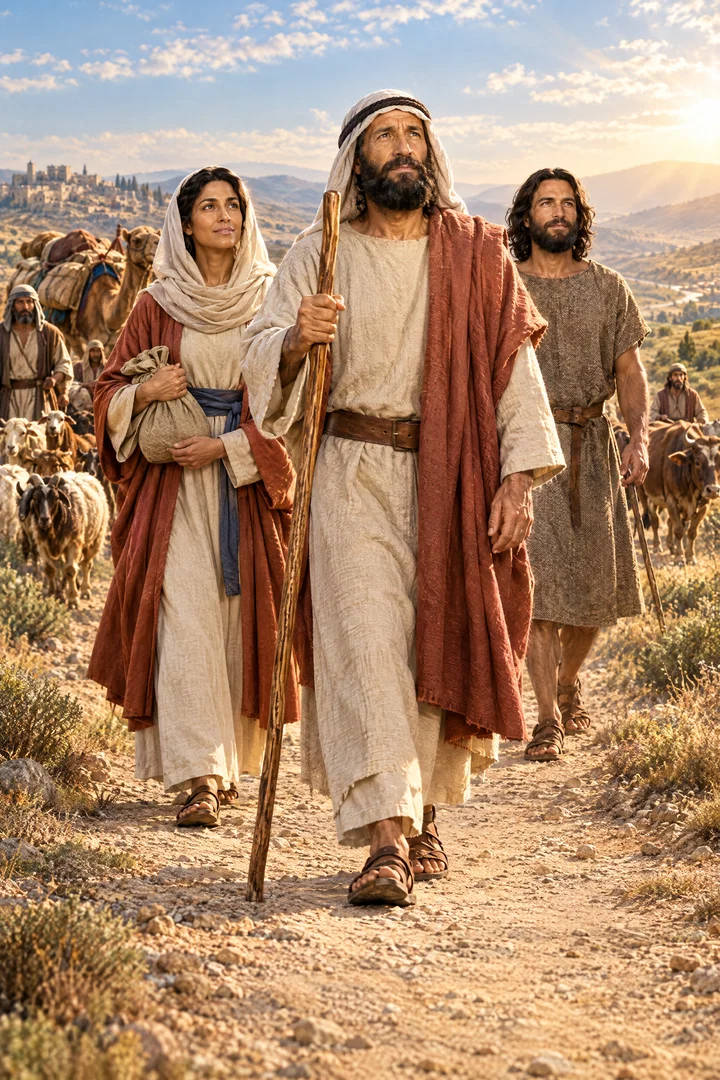
The migration was genuine history concerning a real person, not myth or mere tribal movement or a story explaining westward tribal movement.ST Apr 20, 1904RH Aug 12, 1909 It is pictured as a large nomadic migration with flocks, pack animals, tents, household goods, and people traveling together.ST Jan 20, 1887 It marks the beginning of genuine history and belongs to the same continuous narrative as the rest of Genesis.RH Jan 25, 1906ST Apr 7, 1914
The verse opens the account of Abraham's life extending through Genesis 12 to 20, introducing a man of faith and his call, tithing, and covenant.RH Dec 28, 1916ST Aug 9, 1905ST Aug 9, 1905 It begins God's providential dealings with Abraham's family, with Abraham as the chosen ancestor of the Seed promised after the Fall, with the Promised Seed in view.ST Dec 20, 1910ST It marks the beginning of God's dealings with the chosen race, in contrast with His dealings with the human race in Genesis 1 to 11.ST Mar 17, 1914 It begins the progressive course of His dealings with Abram, leading toward fuller trust in God.ST Dec 20, 1910
Abraham went forth from the land of Babylon, and the Lord's permitting Babylon to conquer Jerusalem because of transgression returned the temple vessels back to that same land. There they were placed in the idol temple at Babylon as tokens of triumph, giving Babylonian reasoning evidence of the superiority of Babylon's religion over Jerusalem's.
Faith and Obedience
Abram obeyed promptly by faith, and by faith alone he went out not knowing where he was going to a place he would afterward receive for an inheritance.RH May 9, 1907ST Jan 22, 1894 He departed without knowing the destination, how long the journey would take, the people, climate, or dangers, in a setting without established roads or safe travel, yet he did not wait for certainty about where he was going.RH May 9, 1907RH Mar 24, 1904 His greatness consisted in such obeying, for God's word was the basis of his faith and expectations, including his expectation of an inheritance.ST Sep 25, 1901 To really believe God's word is to obey everything learned from it without first demanding reasons, details, hardships, or outcomes, obeying a command without first knowing why it is given.RH Mar 24, 1904 Leaving familiar surroundings separated him from influences that could hinder his training to serve as God's messenger to other nations, and his trustful obedience made him an example of faithfulness, bringing faith, confidence, hope, and blessing.RH May 9, 1907RH Mar 24, 1904
The command required great sacrifice, for he left family ties and a comfortable, prosperous life among relatives, familiar places and people, his family home and its memories, prospects, support, wealth, property, and even life itself.ST Feb 11, 1913RH Dec 26, 1865ST Feb 11, 1913 He could have objected to leaving home and friends for an unknown destination among strangers, facing opposition, ridicule, wise advice, sneers, and objections with apparently no purpose, but he went in obedience with courage and simple learned faith, trusting the voice without asking about the prospects or conditions of the new country.ST Feb 11, 1913ST Feb 11, 1913 His sense of duty outweighed homesickness, and his future would be lived by faith without assured earthly prospects, walking with God day by day, trusting divine guidance through experiences he could not explain, and living as a stranger on earth.RH Oct 31, 1907ST Feb 11, 1913 He placed friendship with God above attachment to homeland and kindred, began life as a pilgrim and sojourner dwelling in tents as one attached to no particular place, did not return to his native land, and even when famine came in the land of promise continued onward rather than treating hardship as proof of a wrong choice.RH Dec 26, 1865 So the call illustrates the invitation to forsake sin and whatever hinders the journey toward salvation and to set the heart on the heavenly country, and the promise joined to obedience was fulfilled in making his name great.RH Dec 26, 1865
He waited until he was sure God had called before going, then went where directed with nothing turning him from the course.RH Jan 17, 1865 He did not know how to serve in the new land, but learned what to do through experience after he went.RH May 21, 1914 His call made him committed to the place God sent him, so when famine came he did not return to his old home but went to Egypt until the famine passed and then returned to the land where God had placed him.ST May 8, 1901
His faith was being fully persuaded that what God promised He is able to perform, admitting no rival, resting not on reason or his own wisdom, goodness, or ability but on God alone as the sole object and center of life, renouncing the idols around him for the true living God.ST Jun 14, 1899ST Apr 17, 1893 Converted in sovereign manner from the idolatry in which he was born and reared, given no map and no guide-book, he asked no questions but set out with his household and followed where the heavenly hand conducted him, certain only that the way God leads is right and safe.RH Jan 27, 1874 That going is the walk of faith, not aimless venture but going in God's way rather than the way self most covets, walking hand in hand with the Heavenly Father step by step over smooth or rough, up hill or down, moment by moment, the future being unmapped territory opened leaf by leaf as God unseals it.RH Jan 27, 1874 Therefore faith obeys today's orders, does only today's work, carries today's burden, and leaves tomorrow's journey, toil, and trials until tomorrow comes, trusting that today's help will come and unanticipated mercies will break as sweet surprises.RH Jan 27, 1874 By this he is father not by fleshly descent but by character, father of all who have that same faith, so that the promise is of faith that it might be by grace and sure to all of his faith.ST Jun 14, 1899
The blessings promised were conditional on forsaking all, for he was required to leave all behind in response to the call.ST Apr 30, 1902 Claiming the promises made to him does not by itself make one his child or assure eternal blessings, for sharing in them is joined to the faith and piety he showed.ST Mar 1, 1883 When trust failed, trying to help bring about fulfillment through human plans was not God's plan and led to bondage and trouble.ST Sep 28, 1915
Separation and Holy Purpose
God called when the world under Satan's form of organized government had again become nearly ruined, less than five hundred years after the Flood, after man's disloyalty at Babel and in Nimrod's rebellious kingdom through which Satan sought to rule the world.RH Oct 8, 1903ST Jul 9, 1894RH Dec 10, 1903 Noah's descendants had largely turned to idolatry, and widespread corruption and false worship prevailed, with all the nations around following Nimrod until society had passed away and only universally idolatrous states remained.ST Jul 24, 1901RH Oct 25, 1853 In that darkness of heathenism only one righteous man remained, humble and teachable in righteousness, dwelling in Mesopotamia in Ur.RH Oct 8, 1903ST Jul 24, 1901ST Jul 9, 1894 Instead of destroying all as in Noah's case, God removed that one man alone to a favored land, calling him out from country, relatives, and father's household to a land He would show, that he might become a keeper of God's truth and establish a family and nation that would obey it.RH Oct 8, 1903ST Jul 24, 1901RH Oct 25, 1853
God separated willing Abraham from an idolatrous country, family, associates and homeland because even his own ancestors and parents served other gods, and He saw in him the elements of a faithful character fit to serve Him.ST Apr 6, 1888RH Dec 24, 1867 The intermarriage of the sons of God with the daughters of men had broken the godly line and produced the worst apostasy, so separation was needed lest he be contaminated by their ways.RH Aug 16, 1906ST Apr 6, 1888 By setting him apart as a special subject of providence and bearer of divine truth, God trained him and his descendants in a separated spiritual life serving one supreme Master and kept the divine law and the promises of the Redeemer pure for future generations.RH Aug 16, 1906RH Dec 17, 1861 Through him all families of the earth would be blessed, ultimately including possession of the whole earth by his descendants.ST Apr 6, 1888
The call began the formation of a separate, holy people and the Hebrew nation, with Abraham as head, nucleus, and sub-ruler in God's kingdom for those who accepted the Saviour.ST Aug 3, 1915ST Jan 4, 1905 It was intended to keep the godly line from merging with idolatrous peoples, to preserve God's name, truth, law, oracles, worship and knowledge, and to provide a line through which the Deliverer would come.ST Aug 3, 1915ST Jul 26, 1910 Placed in Canaan where through worship of the true God and a holy life he could proclaim the gospel and gather people from idolatry, Abraham became father of all who believe and his descendants were to help evangelize the world.RH Mar 16, 1916ST Jan 4, 1905ST Jul 26, 1910 That nation was called to be the light and salvation of the whole world, to be exalted so it could fulfill that mission, with its dominion to spread until it filled the earth through missionary diffusion from Canaan rather than concentration, and its promised inheritance of the whole world depending on remaining obedient and loyal to God as King.RH Mar 16, 1916RH Dec 24, 1903
By this call God sought to establish His own form of organized government in territory claimed and usurped by Satan, so that its righteous and holy principles would prevail over all evil until His kingdom filled the whole world.RH Oct 8, 1903RH Dec 10, 1903 It was a stage in one unified divine plan concerning heaven and earth to restore the dominion lost through Adam, identified with the promise to the fathers.ST Jul 26, 1899ST Mar 26, 1894ST Dec 18, 1893 Israel's disloyalty to their King delayed the plan and made it necessary for it to be worked out in another way, but the original purpose will finally be accomplished despite man's unbelief, desolation of the earth, and apparent failure.RH Oct 8, 1903RH Dec 10, 1903
The command teaches for all time the separation of religion and the State and of Church and State, for Abraham represented the religion of God and the beginning of the church of God, and Abraham himself was then the church.ST Aug 9, 1899ST Jul 26, 1899 True separation of Church and State is therefore the separation of the individual believer, the individual church-member, from the State, since where the same person is a member of the Church and of the State at the same time there is at once in him a union of Church and State. Believers must not retain a worldly country in a way that joins religion with civil power, but are to be free as Abraham was brought from the Mesopotamian plain where monarchy had filled it into Canaan where he could be free and received no land in another country in this world, not even enough to set his foot on.ST Aug 9, 1899ST Jul 26, 1899ST Jul 26, 1899 The same call is applied to the church to leave the restraints of its past and enter the freedom of separation from state control, trusting its own divine strength.ST
Abraham was chosen because he was righteous, true and faithful among apostates, willing to obey and to command his children to follow the truth, and therefore was made father of the faithful, heir of the world, friend of God, and center of God's church in his time.RH Nov 13, 1856ST Nov 25, 1889RH Jun 27, 1871ST Apr 18, 1911 His call set him apart as the beginning of Israel as the people of God, distinguished from surrounding nations as alone worthy to become depositaries of divine truth, guardians of the knowledge of God and His will, of His lively oracles, truth, moral law, and word written by men from their tribes, with God proclaiming Himself their God.RH Jun 27, 1871 That distinct standing as a peculiar people and as descendants of Abraham already existed before they went down into Egypt and during their four hundred years' sojourn there, so no new distinction of Jew and Gentile was established at the exodus.RH Jun 30, 1874 These surpassing honors call for honoring their fidelity at a time when all others had enlisted in the devil's ranks, not for bitterness, hatred, envy, or abuse, and the temporary entrusting of truth to the only people worthy to have charge of it takes nothing away from that truth.RH Jun 27, 1871
The verse shows God's way of effecting great results by the smallest means through the weakest instruments, beginning to choose a special people to establish as a peculiar nation by calling one man dwelling among the heathen in Ur of the Chaldees.GSAM 33.3 From that one call sprang a numerous progeny later exalted to the dignity of a nation.GSAM 33.3
Covenant Seed and Inheritance
Genesis 12:1 begins God's covenant promise to the fathers, belonging to the birthright and renewed to Isaac and Jacob, spoken directly and audibly as special revelation.RH Oct 25, 1853RH Feb 23, 1911ST Jul 15, 1886ST Mar 1, 1905 It is the everlasting covenant for salvation, not forgotten when Israel sinned, and Jacob relied on it in prayer and valued it above worldly gain.ST Dec 18, 1879RH Oct 25, 1853ST Oct 4, 1905 The call began a series of promises that God would make Abram a great nation, bless him and make him a blessing, and bless all families of the earth through him, later formally confirmed as God's covenant and distinct from the covenant made at Sinai.RH Oct 25, 1853RH Feb 23, 1911ST Mar 1, 1905 These promises must come in God's way and by God's power, leading to Isaac as the child of promise and of the freewoman.ST Mar 1, 1905
After Abram departed God said the land would be given to his seed, and when he reached Canaan the Lord appeared promising that his descendants would possess it.ST Apr 24, 1893ST Jun 26, 1901 Abraham's separation from Lot, the last remaining relative of that household, completed the separation commanded in the call, and afterward the land was shown to belong to Abraham and his seed.RH Jan 27, 1910 Because the promise was spoken to Abraham, Isaac and Jacob personally, its fulfillment requires their own personal inheritance in the future and cannot be the later possession of Canaan by their descendants alone.ST Feb 1, 1877RH Dec 24, 1903 God gave Abraham no inheritance in that land, not even enough to set his foot on, yet promised to give it to him for a possession and to his seed after him, proving the promise was not fulfilled to him in his lifetime but remains for future fulfillment.ST Nov 28, 1878ST Feb 1, 1877RH Dec 24, 1903 That fulfillment was not exhausted by the conquest under Joshua, since Israel did not fully possess the land and drive out its enemies, leaving a future rest and inheritance still to come, and the promise renewed to Isaac after Abraham's death spoke of fulfilling the oath without suggesting delay.ST Apr 6, 1888
The promise that in Abraham all families of the earth would be blessed preached the gospel beforehand, proclaiming justification of the heathen through faith and the coming Seed.ST Jan 24, 1878RH Feb 25, 1858RH Jun 16, 1904 The promised Seed is Christ, and the blessing is righteousness by faith, forgiveness of sins, turning from iniquity, life forever, removal of sin's curse from the earth, and eternal life, shared by literal and spiritual seed who belong to Christ as heirs.ST Jan 24, 1878RH Feb 25, 1858RH Nov 25, 1902ST Jul 15, 1886 The promise is universal and reaches through all time, beginning a succession of promises fulfilled in Christ whose lineage includes the whole world, received through faith and not earned by works or through the law.ST Jan 24, 1878ST Jul 15, 1886 The greatness of Abraham and the Jewish nation lay in proclaiming the power of the gospel through the coming Seed, and by rejecting the promised Seed the nation sealed its own fate.RH Jun 16, 1904
The promised inheritance is ultimately the whole earth through the righteousness of faith, a heavenly country and the city God builds, whose essential substance is having God himself as reward.ST Jan 24, 1878RH Nov 25, 1902 Abraham, Isaac and Jacob lived as pilgrims and sojourners dwelling in tents, not returning to the native land and not treating famine as proof of a wrong choice, seeking God's reign of righteousness rather than a worldly nation.ST Sep 1, 1898 Abraham trusted God and went to Canaan, a foreign land with foreign language, giants and fortified cities, where he built altars and proclaimed the Lord, his tent-life expressing hope in God's city and heavenly Canaan as lasting inheritance.ST Feb 10, 1914RH Nov 17, 1910 The promises reach complete fulfillment when the redeemed inherit the new earth and New Jerusalem, where God has prepared a city for those who die strong in faith looking for a better, heavenly country.ST Feb 10, 1914ST Sep 1, 1898
The call proves God's moral law already existed before Sinai and was kept by Abraham through faith, so the temporary added law of Galatians 3 is distinct from the moral law.RH Oct 8, 1857RH Mar 25, 1858 Adding 430 years to the date of the call and promise reaches the giving of the law in Exodus 20 at Sinai, showing the dispensation of law began at Sinai and not in Abram's time.RH Oct 8, 1857 Abraham met obligations that already existed, obeying through faith rather than forced obedience to a written precept, and his keeping of God's commandments and laws involved more than leaving his people, traveling through the land, and offering Isaac.RH Mar 25, 1858 God's purpose and covenant began before possession of the Holy Land or the rite of circumcision and did not depend on sacred places or ceremonies.ST Jun 14, 1883
The promise is prophecy whose fulfillment Simeon awaited as part of the promise of a Saviour, begun at Christ's first coming and completed at His reign when God's purpose for His people is fulfilled.ST Oct 11, 1905ST Oct 13, 1909 Genesis 12:1 begins the line through which the promised Seed, the Messiah, would come, identified through the later choices of Isaac, Jacob, Judah, Jesse, David and Solomon, which did not mean other descendants were rejected for salvation nor that chosen descendants were guaranteed salvation.ST Oct 15, 1896 God kept His word under Babylon, Medo-Persia, Greece and Rome by preserving that genealogical line through Abraham, Isaac, Jacob and David through which Christ was to come according to the flesh, proving He rules the nations to fulfill His word and can preserve His chosen seed until the triumphant Saviour comes the second time to take them to Himself.ST Sep 29, 1898
The call made Abraham a prophet receiving visions of God's glory and revelations about his descendants.RH Aug 3, 1916 It founded a nation through a school, for Abram cherished truth and sought God amid opulent, luxurious, idolatrous Ur given to festivals, and in obedience his father's household disposed of property and moved out not knowing whither, guided by Jehovah.RH Oct 22, 1903 After halting at Haran, the call to come out into the country gathered ten or fifteen hundred souls to Abram's family, and upon Terah's death he led those united in the exodus from the cities across the Syrian desert and over the Jordan to a fertile valley in Palestine, where he established an industrial school training children and heads of families.RH Oct 22, 1903 God chose Abraham as a man of faith and courage to found a nation and establish its ideals, training him in God's school to become a true educator whose descendants would teach the true principles of government and serve as an example to all peoples after Noah's descendants failed.RH Oct 8, 1908RH Jun 25, 1914
Example for Believers
God called Abram to leave country, relatives and father's household for a land to be shown him, and that leaving is the pattern of what happens at conversion, when the believer leaves the world and its coming judgment and sets out for heavenly Canaan, continuing until death or Christ's second coming.RH Dec 26, 1865RH May 14, 1867RH Mar 12, 1861 It was a serious test of faith and attachment, requiring departure from familiar places, family home and memories for an unfamiliar land, and it illustrates Christ's invitation to forsake sin and whatever scenes, companions, pursuits, family claims, possessions, comfort or reputation hinder the journey toward salvation.RH Dec 26, 1865RH Dec 26, 1865 Every Christian does the same as Abraham in forsaking country, kindred and father's house to go to the land to be afterward received for an inheritance, receiving no inheritance in this world, not so much as to set foot on, but dying strong in faith looking for a better, heavenly country where God has prepared a city.RH Mar 12, 1861 The Christian's true country and citizenship are therefore beyond this world in heaven, and wherever placed in this world is only a field of labor until sent elsewhere.ST Sep 16, 1897 Tied to no race or land, the Christian is friend to all and prejudiced against none, working and praying for white and black, brown or yellow, American or Chinese, Armenian or Turk, since all are bought by Christ's blood, and owes all people the message of the better land, better city, better citizenship and better King.ST Sep 16, 1897
The call marks the beginning of God's plan for missions, begun with Abraham and continued through Israel and then entrusted to the twelve apostles after Israel rejected the Saviour, showing that God calls people to go and carry out His saving work.RH Jan 4, 1912RH Nov 16, 1916 It made Abram's departure a missionary calling requiring faith, courage, resignation and obedience, with promise to bless him and make him a blessing to all families of the earth, sending him and his family to carry truth to Canaan as God's light-bearer and messenger.RH Jan 4, 1912ST Feb 17, 1914 He voluntarily stayed away though opportunity to return remained, laying aside blessings he might have enjoyed in his own country to make known the true God, and what counts before God is not what costs nothing but what costs sacrifice of feelings, convenience and worldly interests. The same call sends workers to leave prosperous home, relatives and familiar surroundings for distant lands with less favorable conditions, as to the South, to Brazil, to Korea and to other needy fields, trusting God even when the work ends in death, without asking conditions or consequences, sustained by hope beyond the grave and confidence in the promised reward.RH Jul 30, 1914RH Nov 30, 1911ST Feb 17, 1914 Living among those who did not know God would have threatened the children's faith, while new surroundings and work for others gave better chance to grow in truth.RH Jul 30, 1914
The call is a pattern for separation from the world, corrupt communities and former associations rather than hope of reforming institutions for salvation, requiring a separate, distinctive character apart with God even among enemies.RH Apr 23, 1908 Abram had no blessing while stopping partway and received it after continuing to Canaan, showing safety in being apart with God. The call placed Abraham in the country where quiet in nature could help him listen to God, in contrast with Lot's choice of city life which brought ruin to his family.RH May 18, 1905 It teaches scattering rather than clustering around larger churches or established centers, carrying work into needy places such as the South, and Abraham's departure and pilgrim life helped spread light and knowledge of God among the nations, an outward mission contrasting with self-centered concentration and proving a means of blessing to him and his household.RH Jul 30, 1914RH Jul 30, 1914ST Oct 25, 1899 That missionary diffusion through which the world would receive blessing belongs to the call itself.RH Apr 23, 1908ST Oct 25, 1899
The change of life was a training school to develop trusting faith, separating Abram from familiar surroundings and influences that hindered preparation for usefulness as messenger to other nations.RH May 9, 1907RH Oct 31, 1907RH Jul 30, 1914 Leading him into a strange land to wander as a stranger relying solely on promise, it changed him from a doubting, wavering follower into a man of strong faith who believed the promise of countless descendants though he had no child.RH Jun 16, 1904RH Jul 30, 1914 He did not know people, climate or dangers, yet obeyed promptly without waiting for certainty where he was going, thereafter living by faith without assured earthly prospects, walking with God day by day, trusting divine guidance through inexplicable experiences, and living as a stranger on earth.RH May 9, 1907RH Oct 31, 1907 Those who serve with Christ may thus have to leave familiar ties, give up plans and earthly hopes, and sow truth through toil, tears, solitude and sacrifice, going without knowing where they go.ST Jan 6, 1904ST Jan 26, 1915 What appears hardship and sacrifice of easy life is no true loss when exchanging sin for holiness and knowing Christ, and consecration maintained after tasting self-denial and trials is precious in God's sight.RH Oct 31, 1907
Abraham's forsaking of Ur shows the religiously right course may be taken by a minority rather than the majority.RH Sep 10, 1872RH Nov 11, 1858 Becoming an exile and solitary emigrant while surrounding idolatrous nations stood on the other side, he stood alone against the world, opposed yet proved right, for greater number did not make them right or him wrong.RH Sep 10, 1872RH Apr 21, 1863RH Nov 11, 1858 It was Christ who called Abram out of country and kindred to the land to be shown and who personally led him onward, an example of tender watchcare as faithful shepherd to all who trusted Him.ST Apr 8, 1897 God chose to use Abram and made him an agent in His work, but power to accomplish His purposes did not depend on Abram's willingness or obedience.RH Apr 8, 1902
The call also pictures the good person's death, when God calls him to leave earthly life and trust that a better land awaits where sickness, sin and death cannot enter and God and the Lamb are its light, so that faith in the promise lets him face death calmly assured of prepared rest.RH Dec 26, 1865 It marks present truth to be obeyed at once, leaving father's house and kindred in trust in God's word and going where directed, even when relatives raise concerns about risks.RH Jun 18, 1867RH Oct 26, 1911 Abraham's separation from relatives and departure from native country took place under the Lord's special direction, not as independent choice.RH Apr 30, 1908 The call to get up and get, to leave country, kindred and father's house for the land to be shown, must not be made a sensational theme to draw a congregation, for preachers who pander to appetite for sensation disgrace the gospel and need to apply its command to themselves.ST Mar 9, 1888
Abraham's journey from the East toward a new country illustrates human life as a search for another country, not merely settling new territory for himself and descendants with a purer idea of God.ST Aug 31, 1882RH Nov 21, 1854 Forsaking his father's house to become a wandering pilgrim in many lands, building altar and pitching tent, talking with God and embracing promises from His lips, he began the history of the elect leading through descendants toward the promised land.RH Nov 21, 1854 Called away from heathen surroundings, idolatry and evil influences to receive greater light and have greater influence for good, he departed in faith, and God showed him Canaan and renewed the promise of land and great nation with extensive possessions and innumerable descendants, knowing he would be faithful and guide his children after him.ST Jul 22, 1908ST Sep 4, 1901 His teaching and example gave exalted ideas of God's greatness and goodness, so that long after his death idolatrous inhabitants coming to altars he erected worshiped the God of Abraham there, and his uplift through true faith brings spiritual, mental and true physical benefit through Christ alone, a benefit of Christianity that must come through its Author and His own, never through opposers or those who know Him not.
God's call made Abraham with Isaac and Jacob pilgrims and strangers in a strange land, marking them as the Lord's called in a special sense, distinguished from the world by characteristics, manners, customs and habits of life and joined to a special promise made and confirmed to them all.ST Dec 15, 1898 Abraham would not return to his former country and Isaac was not to return, for going back represented departure from God. Jacob's return there after treachery toward Esau drove him to flee Canaan, and the later carrying captive of his descendants to that country after falling into apostasy, illustrate that return. Living in the country was the best setting for Abraham's life work and helped him succeed spiritually and financially.ST Dec 22, 1914
The account beginning with the call is the account of Abraham the father of the faithful and his descendants through the second generation, part of God's care for the promised Seed involving demand for obedience, displaying providential dealings with His children and eventual consequences of sin.ST Dec 29, 1909 God called and blessed Abraham, choosing him for a place in working out the divine plan, and told him to leave his country so he might serve better, just as leaving former associates and surroundings can break retarding ties and help let light shine clearly for the present time.RH Jun 25, 1914RH Aug 28, 1913 His response of faith and obedience in leaving ancestral home and idolatrous practices to go where led became the beginning of Israel's history and of the history of God's chosen people leading to deliverance from Egyptian bondage and the exodus, a model for every race to follow God and serve in spirit and truth.RH Jan 30, 1908 That call, dimly revealing the eternal sovereign plan when Abraham was alone in a field in old Chaldea, began the carrying out of purpose through long slow centuries by prophets, by Christ, and by worldwide opening of ancient lands and mission advance, all converging toward God's kingdom coming and His will done in every land by everyone.RH Feb 1, 1912
The call was for Abraham's salvation and also an example to every race to follow God sincerely. Those called to sow the seed of truth must accept the sacrifice and separation it exemplifies, leaving country, relatives and father's household and going without knowing where, leaving familiar ties, giving up plans and earthly hopes, and sowing through toil, tears, solitude and sacrifice.ST Jan 6, 1904ST Jan 26, 1915 Obeying meant venturing much in faith as a stranger into a strange land, and that venturing proved a great blessing to Abraham himself and to others.ST Sep 17, 1896
Sources