Genesis 18:7
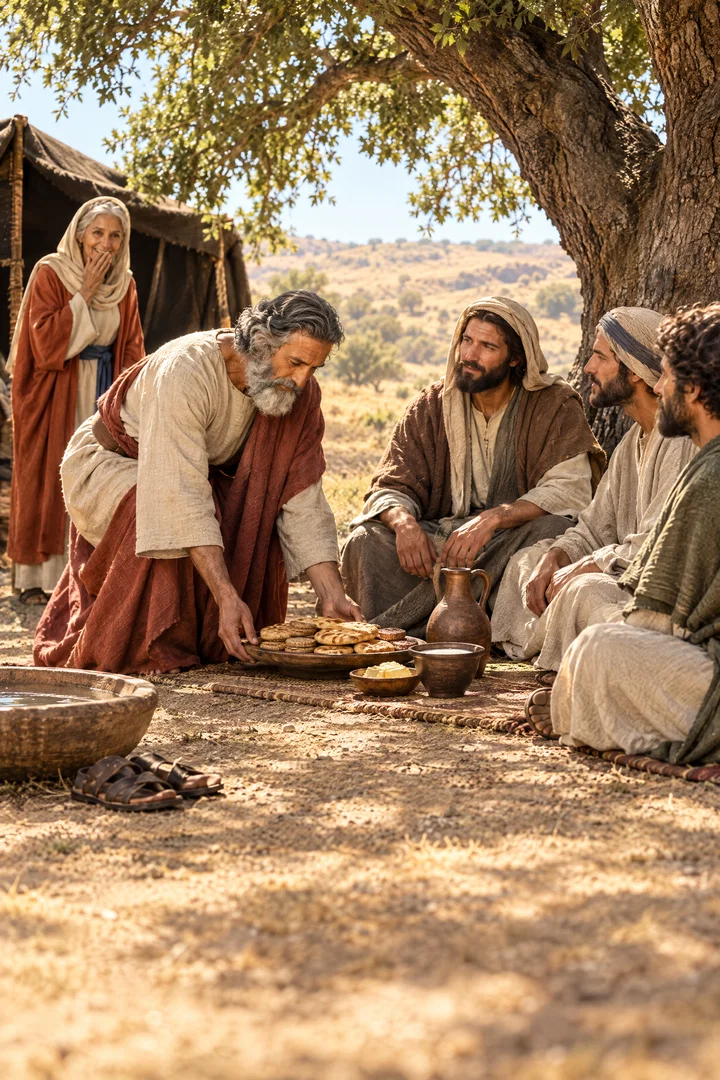
And Abraham ran unto the herd, and fetcht a calf tender and good, and gave it unto a young man; and he hasted to dress it.
Translations
And Abraham ran to the herd, and fetched a calf tender and good, and gave it to a young man; and he hurried to dress it.
King James Version, KJV Cambridge Paragraph Bible
And Abraham ran unto the herd, and fetcht a calf tender and good, and gave it unto a young man; and he hasted to dress it.
And Abraham ran to the herd, and brought a calf tender and good, and gave it to a young man; and he hasted to dress it.
Revised Version, American Standard Version
And Abraham ran unto the herd, and fetched a calf tender and good, and gave it unto the servant; and he hasted to dress it.
and Abraham ran unto the herd, and taketh a son of the herd, tender and good, and giveth unto the young man, and he hasteth to prepare it;
And Abraham ran to the herd, and took a calf tender and good, and gave [ it] to the attendant; and he hasted to dress it.
And unto the herd, ran Abraham,—and took a calf tender and good and gave unto the young man, and he hastened to make it ready.
Berean Standard Bible, Majority Standard Bible
Meanwhile, Abraham ran to the herd, selected a tender and choice calf, and gave it to a servant, who hurried to prepare it.
Abraham ran to the herd, and fetched a tender and good calf, and gave it to the servant. He hurried to dress it.
And running to the herd, he took a young ox, soft and fat, and gave it to the servant and he quickly made it ready;
And Abraham ranne to the beastes, and tooke a tender and good calfe, and gaue it to the seruant, who hasted to make it ready.
Douay-Rheims (Challoner revision)
And he himself ran to the herd, and took from thence a calf very tender and very good, and gave it to a young man: who made haste and boiled it.
Pictures
Cross-references
- Hebrews 13:2
Be not forgetful to entertain strangers: for there by some have entertained angels unawares.
Abraham’s welcome of heavenly visitors illustrates hospitality toward angels.
- Genesis 19:1-3
And there came two angels to Sodom at even; and Lot sat in the gate of Sodom: and Lot seeing them rose up to meet them; and he bowed himself with his face toward the ground;
Lot’s welcome of the two travelers echoes Abraham’s hospitality.
- Genesis 18:2
And he lift up his eyes and looked, and, lo, three men stood by him: and when he saw them, he ran to meet them from the tent door, and bowed himself toward the ground,
Abraham runs to meet the visitors and bows before them.
- Judges 6:19
And Gideon went in, and made ready a kid, and unleavened cakes of an ephah of flour: the flesh he put in a basket, and he put the broth in a pot, and brought it out unto him under the oak, and presented it.
Gideon follows Abraham’s example in preparing and presenting food to the Messenger.
- James 2:23
And the scripture was fulfilled which saith, Abraham believed God, and it was imputed unto him for righteousness: and he was called the Friend of God.
Hospitality led to Abraham being called the friend of God.
Commentary
Each commentary is drawn from primary sources: the writings of Ellen G. White and Adventist pioneers and periodicals. Each commentary is separate. Its own words are not a quotation; follow the references to read the source passages.
Ellen G. White
19 sources
Abraham himself hurried to provide for his guests, choosing a tender and good calf from the herd and giving it to a young man to dress in haste, while Sarah made it ready.Ms 23, 1911, par. 7–8ST Dec 1, 1909ST Nov 6, 18795MR 353.1–354.1 At hot summer noontide under the oaks of Mamre he ran to meet three unknown travelers, bowed to the ground, begged them to stay, washed their feet with his own hands, and stood respectfully beside them in the shade while they ate.6T 341.1–2 The strangers were holy angels in the garb of weary wayfarers, and One among them was more than an angel, the glorious Commander, Creator, Redeemer and King, the Son of God, come on a mission of mercy with promises of blessing.6T 341.1–24SP 447.3ED 304.3–4PP 546.1–547.2Ms 7, 1897, par. 6–7 His courteous, prompt, unselfish care for passing strangers is the finest example of true courtesy and Christian gentlemanliness, showing that welcoming strangers belongs to religious life and can open hearts to receive the truth and bring glory to God.ST Nov 6, 1879Lt 49, 1875, par. 21–2319MR 12.2–13.2PP 158.1–2Lt 108, 1901, par. 9–10 The act was recorded in God's word in the command not to forget to entertain strangers because some have entertained angels unawares (Hebrews 13:2), for by this hospitality Abraham received heavenly angels and the counsels of heaven and was called the friend of God, and by showing hospitality to God's children today people may still receive angels in human form who leave a blessing behind them.6T 341.1–26T 342.1–3 The record must be read carefully and represented fairly in all its bearings on the subject of meat eating, giving reason not yet to make meat eating a test question lest a positive presentation cause some to stumble.Ms 23, 1911, par. 7–8Ms 29, 1887, par. 57
The Meal and Visitors
Genesis 18:7 records Abraham preparing and serving a meal for his guests that included a tender and good calf, which he selected from the herd and gave to a young man to dress in haste.Ms 23, 1911, par. 7–8ST Dec 1, 19095MR 353.1–354.1 The account of Abraham welcoming his visitors and preparing food for them belongs to the larger visit in Genesis 18:1-15, when angels came to him with promises of blessing.Ms 23, 1911, par. 7–8ST Dec 1, 1909 It shows that heavenly beings can appear as human travelers and share a meal in a family's home.5MR 353.1–354.1
Abraham himself hastened to provide for their needs, choosing a good, tender calf and arranging for it to be prepared, with Sarah making it ready.ST Nov 6, 1879 The setting was hot summer noontide under the oaks of Mamre.6T 341.1–2 Though old, dignified, wealthy, highly honored, and accustomed to command, Abraham ran to meet three unknown passing travelers, bowed to the ground, and begged them to stay.6T 341.1–2 He brought water with his own hands to wash the dust of travel from their feet, himself selected their food, and stood respectfully beside them under the cooling shade while they ate.6T 341.1–2 He did this simply for passing wayfarers who might never come his way again, seeking nothing and knowing nothing of who they were.6T 341.1–2
The three strangers were holy angels appearing as men in the garb of wayfarers.4SP 447.3ED 304.3–4Ms 7, 1897, par. 6–7 They rested as if weary under the oaks at noon, communed with Abraham, and tarried to share his hospitality and accept his food, including the calf Abraham hasted to dress for them.4SP 447.3GC 631.1–632.1PP 546.1–547.2GC88 631.2–632.1 In accepting the hospitality of a human home they showed that celestial beings take an active part in the affairs of men by appearing in human form to a man of God.4SP 447.3ED 304.3–4GC 631.1–632.1 One of the three was more than an angel, the glorious Commander, his Creator, Redeemer, and King, the Son of God, whom Abraham served without knowing who they were.6T 341.1–2Ms 7, 1897, par. 6–7
They came on a mission of mercy with promises of blessing, resting and eating at Abraham's tent.ST Dec 1, 1909GC88 512.1 Their visit is one example of how in all ages holy angels have ministered to God's people for their succor and deliverance.4SP 447.3GC88 512.1GC 631.1–632.1GC88 631.2–632.1 God works through holy angels in this way, with celestial beings taking an active part in the affairs of men.4SP 447.3GC 631.1–632.1GC88 631.2–632.1 Gideon later followed this precedent when he desired a token that the one addressing him was the Covenant Angel who had wrought for Israel in time past, by entreating the divine Messenger to remain as his guest and hastening to his tent to prepare a kid and unleavened cakes from his scanty store and set them before him.PP 546.1–547.2
Hospitality's Lesson for Today
Abraham's welcoming of the messengers of God to his tent and entertaining them is the finest example of the power of true courtesy and the pattern of a true and Christian gentleman who knows what is due from man to fellow man in unselfish care and kindness toward others.ST Nov 6, 1879Lt 49, 1875, par. 21–2319MR 12.2–13.2 He hastened to provide for their needs, choosing a good, tender calf and arranging for it to be prepared, and his care in preparing food for his visitors illustrates that kindness and courtesy toward his fellow people.ST Nov 6, 1879Lt 80, 1894, par. 1 His personal, hurried care in selecting and preparing a good meal for passing strangers shows that Bible courtesy is expressed through considerate, prompt service.6T 342.1–3Lt 108, 1901, par. 9–10
His hurrying to provide a tender calf for his guests in practical action teaches that welcoming and caring for strangers can be part of religious life, and that small, willing acts of kindness matter.PP 158.1–2 Such considerate courtesy can open hearts to receive the truth and bring glory to God.Lt 108, 1901, par. 9–10 The act was important enough for God to record in His word and is included in the command not to forget to entertain strangers because some have entertained angels unawares.6T 342.1–3
By this hospitality Abraham received heavenly angels into his dwelling, and indeed ministered not only to heavenly angels but to their glorious Commander, his Creator, Redeemer, and King, seeking nothing and knowing nothing of who they were.6T 341.1–26T 342.1–3 Through it the counsels of heaven were opened to him and he was called the friend of God, showing that hospitality brings blessing.6T 341.1–2 The same privilege is not denied now, for by showing hospitality to God's children people today may still receive angels in human form into their homes, and the unseen angels who accompany Christians leave a blessing behind them.6T 342.1–3
As part of the call for believers to seek the Lord most earnestly and to take a more decided stand to be obedient to all of God's requirements and not only profess belief in the truth, the record of Abraham preparing and serving a meal that included a tender and good calf to his guests bears directly on the subject of meat eating.Ms 23, 1911, par. 7–8Ms 29, 1887, par. 57 It must be read carefully, given due consideration, and represented fairly in all its bearings.Ms 23, 1911, par. 7–8 It shows reason not yet to make meat eating a test question, since a positive presentation would cause some to stumble and others to make it a stone of stumbling.Ms 23, 1911, par. 7–8
Sources
Pioneers and periodicals
70 sources
Abraham at his tent door at Mamre welcomed three visitors and himself ran to the herd, chose a tender and good calf, gave it to a young man to hasten its dressing, and set it before them with cakes, butter and milk under the tree.ST Feb 3, 1887ST Oct 1, 1902ST Nov 29, 1910RH Mar 26, 1914 It was prompt, eager and generous hospitality to strangers, offered without knowing they were angels and without thought of payment or reward.RH Jan 9, 1908ST Oct 6, 1887RH Feb 9, 1869ST The visitors ate the real food he prepared, showing angels are real embodied persons with body and form rather than immaterial spirits, who appear in human form and share in ordinary physical acts.ST Jul 23, 1874RH Jul 12, 1864ST Jan 17, 1878ST Aug 15, 1916RH Apr 9, 1872 Among them was the Lord Himself in person, the Son of God meeting Abraham as a man and communing with His friend, together with two angels who afterward went on to Sodom.ST Jun 3, 1908ST Oct 17, 1895ST Nov 24, 1914ST Nov 29, 1910RH Apr 9, 1857 The meal belongs to the renewal of the promise that aged Sarah would bear Isaac, the miraculously begotten child of promise, and to the warning of Sodom's coming destruction for which Abraham pleaded in intercessory prayer.ST Nov 15, 1899ST Aug 28, 1901ST May 9, 1878ST Sep 8, 1898RH Feb 18, 1915
Historical Setting
The tender calf belongs to the visit at Mamre near Hebron, where Abraham sat at his tent door on a hot, fervid noonday and welcomed three visitors beneath a tree on a sultry summer day.ST Oct 1, 1902ST Nov 29, 1910RH Jan 23, 1855 The place was his dwelling place and place of worship, the plain of Mamre at Hebron.ST Oct 1, 1902ST Nov 29, 1910RH Jan 27, 1910 The three who came were God or Christ with two angels, appearing and conversing in the form of men.ST Oct 1, 1902ST Nov 29, 1910 They were wayfaring angels entertained on their way toward the cities of the plain.RH Jan 27, 1910RH Jan 23, 1855
He himself ran to the herd, chose a tender and good, choice calf, gave it to a young man or young servant, and had him hasten to dress and prepare it promptly.ST Feb 3, 1887RH Mar 26, 1914ST Aug 10, 1915 The preparation was hurried and the service was prompt arrangement of the meal as welcome and hospitality to the three visitors.ST Aug 10, 1915 It was real food for bodily eating, showing the heavenly visitors as real beings who could eat human food.ST Feb 3, 1887RH Mar 26, 1914ST Aug 10, 1915 With cakes and butter and milk it was set before them under the tree, and they ate.ST Feb 3, 1887
The visit came before the inquiry and judgment concerning Sodom and the cities of the plain, when the Lord met with Abraham and Abraham pleaded before Him.RH Jan 24, 1856 The destruction of Sodom occurred shortly before the birth of Isaac.ST Oct 4, 1883 Such a coming of God to people illustrates a special manifestation of His favor or judgment, not necessarily a personal descent.RH Jan 24, 1856 It stands in the span from B.C. 2247 to B.C. 1872, from Babel and the scattering of humanity through the genealogy of Abraham, God's call to Abram, and his sojourn and trials of faith.ST Jan 2, 1912 Within that span it belongs to God's providential dealings with Abraham's family as the chosen line through which the Seed would come, in the same year the covenant was formally established when the promises were renewed to him.STRH Oct 25, 1853 Throughout that life there were constant and remarkable evidences of God's overruling providence, in which faith did not come at once to fullness but came over and over lesson by lesson.ST Jan 2, 1912
Generous Hospitality
Abraham himself ran to the herd, chose a calf tender and good, gave it to a young man or servant, and had him hasten to dress and prepare it as practical service and courtesy to his guests.ST Oct 6, 1887RH Feb 9, 1869RH Feb 21, 1907ST Aug 25, 1898 His welcome was prompt, eager and generous, hurrying the meal for the three visitors beneath his tent as an attentive response to their presence.RH Feb 21, 1907ST Oct 31, 1895 It was willing, attentive and unselfish care, hastening to provide for the needs of travelers.RH Jan 9, 1908ST Nov 6, 1879ST Oct 31, 1895
He did this as ordinary kindness to strangers without knowing they were angels, receiving heavenly guests as if they were only tired wayfarers.RH Jan 9, 1908RH Feb 9, 1869ST Aug 14, 1901RH Feb 9, 1869 It was genuine hospitality without prior planning and not for payment or reward.RH Feb 9, 1869ST True hospitality is such willing service to strangers and to fellow saints in need, given without grudging according to one's ability and without expecting repayment, so wealth or lavish provision is not essential.ST Jan 11, 1905ST It excludes feeding and waiting on idle beggars who refuse to work for their own bread.ST Jan 11, 1905
Such welcome watches at the open door for heavenly visitors and invites them into fellowship, rather than postponing response until opportunity has passed.ST Dec 1, 1909ST Mar 11, 1903 The heart likewise should be opened and made ready to receive, rather than left cold through kindness never shown.RH Jun 29, 1911 His hospitality became an occasion of blessing for his household and home, illustrating the entertaining of angels.CO 75.1CO 75.2–76.3 It exemplifies the welcome owed even to strangers who may be divine messengers without the host knowing it, a duty Scripture repeatedly enjoins and a lesson Jesus taught by example.ST Jan 4, 1905ST Dec 7, 1904RH Feb 9, 1869
Nature of Angels
The three visitors ate the real food Abraham prepared for them, including the tender calf he fetched from the herd and had a young man or servant hasten to dress.ST Jul 23, 1874ST Jan 17, 1878ST Aug 15, 1916RH Mar 26, 1914ST Aug 10, 1915 Their eating was a bodily act of real beings able to eat human food and converse at the tent, not merely a spiritual appearance.ST Jan 17, 1878RH Mar 26, 1914ST Aug 10, 1915 The meal demonstrates that angels are real, embodied persons with bodies and form rather than immaterial spirits, and that spirits can be real persons with form and body.ST Jul 23, 1874ST Aug 15, 1916RH Apr 9, 1872RH Jun 8, 1869ST Aug 23, 1877 Though called spirits, they receive and eat prepared food, which proves they possess bodies as the instrumentality for manifestation of their powers.RH Apr 9, 1872ST Aug 23, 1877ST Feb 13, 1879
Heavenly beings appeared in human form as travelers and took part in ordinary physical actions, laying down, eating and drinking material food, and taking hold of Lot's hand.RH Jul 12, 1864RH Apr 10, 1913RH Jun 18, 1861ST Aug 17, 1876RH Oct 8, 1903 The chapter therefore shows personal presence, not merely influence or impulse.RH Jul 12, 1864RH Apr 10, 1913 These angels were distinct ministering beings from God, not spirits of dead people.ST Aug 15, 1916 Their communication with Abraham and Sarah gives an example of communication by beings who were not dead humans, and gives no support to communication with the dead.ST Aug 15, 1916ST Jan 9, 1893
Being spirit does not mean being without body and form, for angels who are spirit beings have bodily shape, always appearing in human shape.RH Apr 16, 1872RH Jun 18, 1861 As angels who are called spirits have bodies, so God as Spirit in the highest sense has personality and form with body and parts, and man can be physically in the image and likeness of God in bodily form.RH Apr 16, 1872RH Jun 18, 1861 The visit shows angels as friendly, sociable ministering servants sent to care for God's people, bearing messages and promises of blessing such as the warning of Sodom's overthrow and the promise to Abraham.ST Dec 1, 1909RH Aug 7, 1916RH Oct 29, 1901RH Apr 9, 1857 They are made servants for those who shall be heirs of salvation to secure human salvation, fulfilling the promise that the angel of the Lord encamps around those who fear Him and delivers them.RH Apr 9, 1857RH Nov 5, 1872
Identity of Visitors
Abraham hastened to provide the tender and good calf for visitors who included the Lord, whom he saw in person, together with two angels.ST Oct 17, 1895RH Apr 9, 1857 The meal illustrates the Son of God meeting Abraham as a man among men and entering into the everyday details of human life.ST Jun 3, 1908 God appeared and conversed in the form of man, coming to Abraham one fervid noonday as he sat at his tent door in Hebron on the plain of Mamre.ST Nov 29, 1910 There He communed together with Abraham as two persons, talking with His friend about the birth of Isaac.ST Nov 29, 1910 He deliberated with him upon the fate of Sodom, making magnanimous concessions to his requests, and when the purpose was settled He left off talking with Abraham.ST Nov 29, 1910
The same divine Being who later appeared to Jacob met Abraham, called Jehovah, and remained with Abraham while the two angels went on to Lot in Sodom. This visitor was Jesus Christ Himself receiving Abraham's plea for Sodom, the divine Son of God not losing His identity through it all.ST Nov 24, 1914 He had taken the form of an angel as God's special messenger among angels, as Michael the Archangel who is chief in service.ST Nov 24, 1914 He is the Angel sent before Israel with the Father's name in Him to keep them and bring them to the prepared place, the Angel of the presence who was afflicted with Israel and in love redeemed and bore them.ST Nov 24, 1914 In the fulness of time He was born of a woman under the law to redeem them under the law, and died and rose again.ST Nov 24, 1914
By contrast, those who held the other teaching held that the one frequently called Lord in the account was an angel acting only as servant or agent of the Lord.RH Nov 10, 1859
Promise and Warning
The preparation of the tender and good calf belongs to the visit at Mamre connected with the promised birth of Isaac.ST Nov 15, 1899ST Aug 28, 1901 The visitors had come with the renewal to Abraham that his seed would be perpetuated and favored above all other people and that his aged wife Sarah would be the mother of the child of promise.ST Aug 28, 1901ST Sep 8, 1898 The announcement seemed unbelievable to Abraham and Sarah and drew laughter, yet the word of the Lord proved true in Isaac, the son of their old age, miraculously begotten and born out of due time.ST Aug 28, 1901ST Sep 8, 1898 Isaac's name means laughter, and his birth by a miracle of God's Spirit showed that Abraham's true seed is spiritual and not merely descended from him by natural birth.ST Nov 15, 1899ST Aug 28, 1901
Abraham promptly chose the tender, good calf and gave it to a young man to hasten its preparation.RH Jun 13, 1912ST Aug 28, 1901 The calf was part of a peace-offering made in thanksgiving after receiving the promise of a son.RH Jun 13, 1912 The visitors ate of it, and the promise was then confirmed again.RH Jun 13, 1912 The same visit also carried the revelation beforehand of the coming destruction and overthrow of Sodom and the cities of the plain.ST May 9, 1878RH Jun 23, 1903RH Aug 7, 1916ST Oct 31, 1895RH Mar 30, 1916 Heavenly messengers bore that message from God as one way the Lord revealed His purposes to people.RH Jun 23, 1903RH Aug 7, 1916RH Mar 30, 1916
Warning was sent before the destruction so that those who feared His word could escape.ST May 9, 1878ST Oct 31, 1895 The Lord's visit to Abraham came before the inquiry and judgment concerning Sodom.RH Feb 18, 1915 Here Abraham's meeting with the visitors became the setting for his pleading before the Lord, his great intercessory prayer for Sodom.RH Feb 18, 1915 That prayer shows prayer manifested in the life of Abraham the friend of God, for prayer is the Christian's life and evidence of new life.RH Feb 18, 1915
Daily Life Teaching
Abraham was about one hundred years old when he ran to serve his unexpected guests, and his running shows physical vigor rather than bodily weakness as the mark of holiness.RH Mar 31, 1903 Sarah's preparing of food fit for angels to eat shows that women as well as men had employment, and holds her up as a model of a good housekeeper.RH Nov 13, 1900 Abraham ate veal from the tender and good calf, and eating flesh did not make him religiously insane, deluded, or unable to see things as they are.RH Jul 23, 1901 It did not produce his faith in sacrifices and the provision of the atonement as a hideous nightmare from a toxic diet, and true religion, sacrifice, atonement, and the cardinal truths of revelation for salvation remain precious and sound in those who eat meat.RH Jul 23, 1901
That sinless beings ate flesh food from the calf Abraham prepared proves that eating meat is not sin in itself.RH Sep 24, 1901 There are circumstances when it is better to eat flesh than to abstain.RH Sep 24, 1901 That Abraham served his visitors a tender, good calf which they ate, and that he himself ate meat, does not establish that meat is best for people or that everyone can eat it without harm.RH Jul 10, 1866 What is suitable depends on circumstances, for Abraham was physically strong, and the animals of his time are contrasted with the weaker, more disease-prone people and animals of the present, so his example does not justify eating meat freely or assuming that meat from unhealthy animals is safe.RH Jul 10, 1866 The calf is evidence that he served and ate clean animal flesh.ST Feb 13, 1893 His serving a calf to his heavenly guests along with butter and cakes is contrasted with Melchizedek, who served bread and wine even to earthly guests, presenting Abraham as a man of great moral worth but not as temperate in this respect.ST Feb 13, 1893RH Mar 12, 1867
Sources