Genesis 21:29
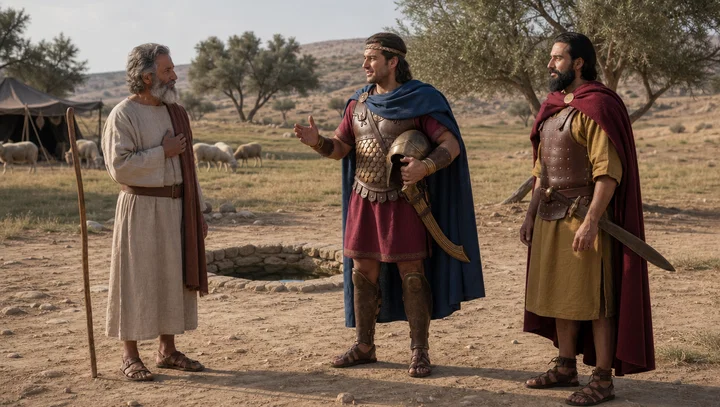
And Abimelech said unto Abraham, What mean these seven ewe lambs which thou hast set by themselves?
Translations
And Abimelech said to Abraham, What mean these seven ewe lambs which you have set by themselves?
King James Version, KJV Cambridge Paragraph Bible, Revised Version, American Standard Version
And Abimelech said unto Abraham, What mean these seven ewe lambs which thou hast set by themselves?
And Abimelech said to Abraham, What mean these seven ewe-lambs, which thou hast set by themselves?
And Abimelech saith unto Abraham, 'What [are] they — these seven lambs which thou hast set by themselves?'
And Abimelech said to Abraham, What [mean] these seven ewe-lambs, these which thou hast set by themselves?
And Abimelech said unto Abraham, What, then mean these seven young sheep here, which thou hast set by themselves?
Berean Standard Bible, Majority Standard Bible
and Abimelech asked him, “ Why have you set apart these seven ewe lambs?”
Abimelech said to Abraham, “ What do these seven ewe lambs, which you have set by themselves, mean?”
Then Abimelech said, What are these seven lambs which you have put on one side?
Then Abimelech said vnto Abraham, What meane these seuen lambes, which thou hast set by themselues?
Douay-Rheims (Challoner revision)
And Abimelech said to him: What mean these seven ewe lambs which thou hast set apart?
Pictures
Cross-references
- Genesis 21:23-24
Now therefore swear unto me here by God that thou wilt not deal falsely with me, nor with my son, nor with my son’s son: but according to the kindness that I have done unto thee, thou shalt do unto me, and to the land wherein thou hast sojourned.
Abraham and Abimelech agree to an oath of covenant peace.
- Genesis 20
And Abraham journeyed from thence toward the south country, and dwelled between Kadesh and Shur, and sojourned in Gerar.
The study connects their relations in Genesis 20 and 21.
- Genesis 26:1
And there was a famine in the land, beside the first famine that was in the days of Abraham. And Isaac went unto Abimelech king of the Philistines unto Gerar.
Isaac’s journey to Gerar during famine recalls Abraham’s earlier experience there.
Commentary
Each commentary is drawn from primary sources: the writings of Ellen G. White and Adventist pioneers and periodicals. Each commentary is separate. Its own words are not a quotation; follow the references to read the source passages.
Pioneers and periodicals
10 sources
Abimelech asked Abraham what was meant by the seven ewe lambs he had set apart by themselves, introducing their significance in the settlement between them.ST Mar 17, 1914ST Mar 4, 1886RH Apr 10, 1866ST Jul 1, 1875 The passage itself does not explain the seven ewe lambs.ST Aug 28, 1901 The verse belongs to the mutual agreement or covenant between Abraham and Abimelech at Gerar concerning the well at Beer-sheba.ST Mar 4, 1886ST Aug 28, 1901ST Aug 28, 1901 Beer-sheba means well of the oath and commemorates their agreement.ST Aug 28, 1901
The dealings were between two neighbors, in which Abraham made a covenant of friendship and then meekly raised the wrong done by Abimelech's servants over a well.RH Apr 10, 1866 The exchange is evidence that Abraham made an alliance with Abimelech as an equal and sovereign. The agreement being called a covenant shows that covenant is used in the sense of an agreement and that agreements are called covenants in the Bible.ST Sep 27, 1883RH Aug 13, 1872 The agreement was respected throughout Abraham's life, but after his death the Philistines stopped up the wells Abraham had dug.ST Aug 28, 1901 The verse falls within the account of God's providential dealings with Abraham's family, whose role was to preserve the chosen line of the Seed.ST The verse is part of the account of Abraham's household, which stands as an example of the unhappiness caused by polygamy.RH Mar 1, 1870
Sources