Genesis 8:4
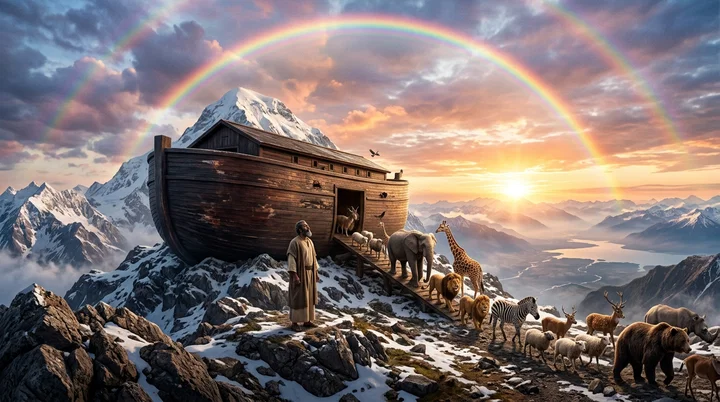
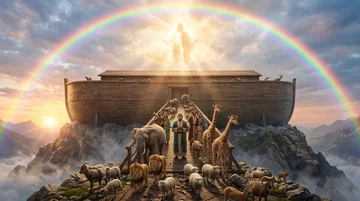
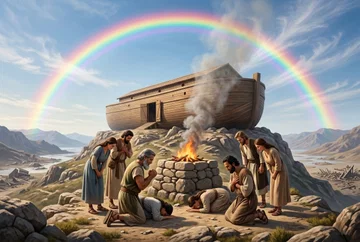
And the ark rested in the seventh month, on the seventeenth day of the month, upon the mountains of Ararat.
Translations
American King James Version, Darby Translation
And the ark rested in the seventh month, on the seventeenth day of the month, on the mountains of Ararat.
King James Version, KJV Cambridge Paragraph Bible, Webster Bible, Revised Version, American Standard Version
And the ark rested in the seventh month, on the seventeenth day of the month, upon the mountains of Ararat.
And the ark resteth, in the seventh month, in the seventeenth day of the month, on mountains of Ararat;
And the ark rested, in the seventh month, on the seventeenth day of the month,—on the mountains of Ararat.
Berean Standard Bible, Majority Standard Bible
On the seventeenth day of the seventh month, the ark came to rest on the mountains of Ararat.
The ship rested in the seventh month, on the seventeenth day of the month, on Ararat’s mountains.
And on the seventeenth day of the seventh month the ark came to rest on the mountains of Ararat.
And in the seuenth moneth, in the seuenteenth day of the moneth, the Arke rested vpon the mountaines of Ararat.
Douay-Rheims (Challoner revision)
And the ark rested in the seventh month, the seven and twentieth day of the month, upon the mountains of Armenia.
Pictures
Cross-references 20 of 22
- Genesis 7:24
And the waters prevailed upon the earth an hundred and fifty days.
States the 150-day duration used with the dates.
- Genesis 7:11
In the six hundredth year of Noah’s life, in the second month, the seventeenth day of the month, the same day were all the fountains of the great deep broken up, and the windows of heaven were opened.
Its date and the ark’s rest five months later support a thirty-day month reckoning.
- Genesis 7:19-20
And the waters prevailed exceedingly upon the earth; and all the high hills, that were under the whole heaven, were covered.
The floodwaters covered the mountains before the ark came to rest.
- Genesis 8:16-17
Go forth of the ark, thou, and thy wife, and thy sons, and thy sons’ wives with thee.
God commands Noah to leave the ark with his family and every living thing.
- Genesis 8:9
But the dove found no rest for the sole of her foot, and she returned unto him into the ark, for the waters were on the face of the whole earth: then he put forth his hand, and took her, and pulled her in unto him into the ark.
The dove found no rest and returned while the waters still covered the earth.
- Genesis 6:13-17
And God said unto Noah, The end of all flesh is come before me; for the earth is filled with violence through them; and, behold, I will destroy them with the earth.
God announces the Flood and commands Noah to build the ark.
- Jeremiah 51:27
Set ye up a standard in the land, blow the trumpet among the nations, prepare the nations against her, call together against her the kingdoms of Ararat, Minni, and Ashchenaz; appoint a captain against her; cause the horses to come up as the rough caterpillers.
Names the kingdom of Ararat, where the ark rested.
- Genesis 7:23
And every living substance was destroyed which was upon the face of the ground, both man, and cattle, and the creeping things, and the fowl of the heaven; and they were destroyed from the earth: and Noah only remained alive, and they that were with him in the ark.
Describes the Flood’s destruction and Noah’s family surviving in the ark.
- Genesis 8:10-11
And he stayed yet other seven days; and again he sent forth the dove out of the ark;
dove returns with olive leaf
- Genesis 8:13
And it came to pass in the six hundredth and first year, in the first month, the first day of the month, the waters were dried up from off the earth: and Noah removed the covering of the ark, and looked, and, behold, the face of the ground was dry.
Noah could remove the covering
- Genesis 9:1
And God blessed Noah and his sons, and said unto them, Be fruitful, and multiply, and replenish the earth.
Noah’s family begins humanity anew as God blesses them to fill the earth.
- Genesis 9:12-13
And God said, This is the token of the covenant which I make between me and you and every living creature that is with you, for perpetual generations:
The rainbow tradition about Fohi is linked to the rainbow given after the flood.
- Matthew 24:37-39
But as the days of Noe were, so shall also the coming of the Son of man be.
Christ compares the days of Noah and the flood with his coming.
- Hebrews 11:7
By faith Noah, being warned of God of things not seen as yet, moved with fear, prepared an ark to the saving of his house; by the which he condemned the world, and became heir of the righteousness which is by faith.
Noah’s faith led him to prepare the ark to save his family.
- Genesis 8:12
And he stayed yet other seven days; and sent forth the dove; which returned not again unto him any more.
dove sent again and stays away
- 1 Peter 3:20
Which sometime were disobedient, when once the longsuffering of God waited in the days of Noah, while the ark was a preparing, wherein few, that is, eight souls were saved by water.
both note only eight saved in ark
- Genesis 6:5-7
And GOD saw that the wickedness of man was great in the earth, and that every imagination of the thoughts of his heart was only evil continually.
Describes the wickedness that brought the flood.
- Genesis 9:15
And I will remember my covenant, which is between me and you and every living creature of all flesh; and the waters shall no more become a flood to destroy all flesh.
God promises Noah that a flood will never again destroy all flesh.
- 2 Peter 2:5
And spared not the old world, but saved Noah the eighth person, a preacher of righteousness, bringing in the flood upon the world of the ungodly;
Both concern Noah amid the flood and his preaching of righteousness.
- Genesis 7:16
And they that went in, went in male and female of all flesh, as God had commanded him: and the LORD shut him in.
God shut Noah in, keeping the ark safe.
Commentary
Each commentary is drawn from primary sources: the writings of Ellen G. White and Adventist pioneers and periodicals. Each commentary is separate. Its own words are not a quotation; follow the references to read the source passages.
Ellen G. White
10 sources
Before the ark rested, the waters had stood fifteen cubits above the highest mountains.1SP 80.1 As the waters decreased, God remembered Noah and caused the ark to rest on top of a cluster of mountains at Ararat, which He in His power had preserved and made to stand fast through the violent storm.1SP 80.1SG3 77.1 He guided it into a sheltered, quiet haven among them.1SP 80.1PP 105.2 Those mountains stood only a little distance apart.1SP 80.1SG3 77.1PP 105.2 The ark moved about and rested upon one and then another of them within that haven and was no more driven upon the boundless ocean, which gave great relief to the weary, storm-tossed Noah and all within the ark.1SP 80.1SG3 77.1PP 105.2
As the mountains and hills appeared they were in a broken, rough condition, and all around them looked like a sea of roiled water or soft mud.1SP 80.1SG3 77.1 When the ark was at rest, Noah and his family of eight remained shut up inside, anxiously watching the waters decrease and desiring to go forth upon the earth again.SG3 72.11SP 76.1 They waited and tested the waters by sending out a raven that flew back and forth to and from the ark without bringing the information desired.SG3 72.11SP 76.1 Then they sent a dove that finding no rest returned to the ark, and after seven days the dove sent again returned with an olive leaf in its mouth, causing great rejoicing after being so long shut up.SG3 72.11SP 76.1
Though Noah could remove the top of the ark, he could not open the door that God had shut.SG3 72.11SP 76.1 They stayed until an angel opened the door and God spoke through the angel bidding Noah and his family to go forth out of the ark and bring forth every living thing with them.SG3 72.11SP 76.1 The mountains where the ark rested are where Noah's descendants continued to dwell for a time after the Flood.PP 118.4 They remained there until their numbers increased, when apostasy brought division and those who wanted to forget their Creator left for the plain of Shinar.PP 118.4
The verse belongs to the inspired record of a real history: Noah was a literal person and the Flood was an actual event.ST Sep 8, 1881 The Flood history explains that remains found in the earth come from conditions before the Flood, when people, animals, and trees much larger than those now living were buried and preserved when its inhabitants perished.CE 191.2–3 The account identifies when those conditions existed; geology alone cannot establish their time.CE 191.2–3 The Flood was a judgment God brought because of human sin and iniquity.5T 601.1Lt 38, 1906, par. 4–7 Growing wickedness still brings certain judgment.5T 601.1
The ark was the massive boat God used to save all who would hear the warning and turn from unrighteousness, but only eight persons were saved.Lt 38, 1906, par. 4–7 All were tested by the truth that Noah preached, and those who believed were saved.Lt 38, 1906, par. 4–7 The days of Noah prefigure the age before Christ's return, because human nature apart from the Spirit of God is the same in both ages.ST Sep 8, 1881
Sources
Pioneers and periodicals
86 sources
The ark came to rest on the mountains of Ararat in the seventh month on the seventeenth day, exactly five months after the Flood began in the second month on the seventeenth day.RH May 14, 1867ST Aug 4, 1898ST Sep 19, 1911 The five months covering 150 days shows months of thirty days each, making a regular year of twelve months and 360 days.ST Mar 23, 1904ST Mar 18, 1880RH Apr 8, 1873 That reckoning measures prophetic times, so that a time, times and half a time and forty-two months give 1,260 days, understood as 1,260 years.RH Oct 24, 1871ST Oct 31, 1916RH Feb 21, 1865 The resting records true literal history of a real worldwide supernatural Flood, not myth or borrowing, affirmed against denial and evolution.ST Dec 7, 1915RH Aug 23, 1906ST Nov 18, 1880ST Nov 13, 1893RH Aug 20, 1914 God guided the ark safely through the storm to rest, and as the ark was lifted to its Ararat so His church will be carried safely through shaking to rest and triumph.ST Mar 6, 1879RH Nov 10, 1863RH Feb 4, 1915
Place of Resting
The ark came to rest on the mountains of Ararat, which is Armenia, Ararat denoting a mountainous region rather than necessarily a single peak.RH May 14, 1867 Ancient tradition located the resting in the mountains of Gordiene or on Mount Baris, while later tradition named Mount Macis near Erivan, and accounts of the landing and the Flood were preserved among many peoples.RH May 14, 1867
Ararat means holy land or high land, a mountain or range of mountains in Armenia north of Assyria.ST Aug 4, 1898 Its highest elevation is a volcano 17,750 feet high and covered with perpetual snow.ST Aug 4, 1898 It stands in Armenia in Western Asia, a country of plateaus, high mountains, and deep valleys, and Mount Ararat is half a mile higher than Pike's Peak.ST Mar 26, 1896
Those mountains are identified with Mount Ararat near Erivan or Erevan in the Transcaucasus.RH Feb 8, 1906RH May 17, 1906 That region lies among the borders of Turkey, Russia, and Persia.RH May 17, 1906 The plain of that hoary mountain is associated with the place where Noah planted his vineyard.RH Sep 21, 1911
Against this identification, the identity of biblical Ararat with the mountain now called Ararat is questionable.ST Jan 2, 1893 Claims that the ark is still preserved there and has been seen are untrue and worthy of no credit, arising from superstition and imagination mistaking an overhanging snow cap for a ship.ST Jan 2, 1893
Ararat is the first mountain named in Bible history.RH May 1, 1879 God honors mountains above all other conformations of nature, and Ararat where the ark of the Deluge found rest stands first among mountains made honorable by the footsteps of His presence.ST Aug 27, 1896 It stands as sentinel of a restored earth after the flood that became the grave of the old world while bearing on its waters the ark of the new.RH May 1, 1879
This resting gives the Caucasian region a special historical and religious interest for peoples throughout the world.RH Dec 10, 1908 It is the region where Noah began the renewed history of the human race.RH May 13, 1909 It is a place the gospel message later reached.RH May 13, 1909 Mount Ararat and the people living near it are also mentioned in Genesis 10.RH Sep 21, 1911
Date and Chronology
After the waters decreased at the end of one hundred and fifty days, the ark came to rest upon the mountains of Ararat on the seventeenth day of the seventh month.ST Aug 4, 1898ST Sep 19, 1911 That resting was exactly five months after the Flood began in the second month on the seventeenth day, those five months equaling the one hundred fifty days during which the waters prevailed and then decreased.ST Aug 4, 1898ST Sep 19, 1911 The resting came just five months after the Deluge began its work upon the earth, two and a half months before the tops of the mountains were seen.ST Jul 17, 1901 Forty days later Noah began sending forth the raven and the dove, and Noah remained in the ark a year and seventeen days until God told him to go out.ST Jul 17, 1901 About a year after the resting Noah's family came out of it onto a new world, with the towering summit and the marine remains scattered across the landscape testifying that the floodwaters had covered even the highest mountains and transformed the world.RH Nov 14, 1854
Genesis already describes time by numbered months before Israel came out of Egypt, which challenges the claim that Israel previously reckoned time only by the sun's equinoxes.RH Aug 14, 1860 The resting in the seventh month is one of Scripture's emphases on the number seven and part of the biblical pattern of events associated with seven.RH Jan 22, 1857RH Sep 15, 1874 Before resting, the ark was driven for five months by fierce winds over waters that covered the whole earth to a depth of at least fifteen cubits, about twenty-two feet.ST Sep 12, 1911 When Noah and his family left the ark they could not know where they had landed and might have been ten or twelve thousand miles from home, so a river they later encountered could have been named Euphrates after the river they knew before the Flood.ST Sep 12, 1911
The ark drifted northward from Noah's settlement to the mountains of Ararat, meaning the main current of the flood waters came from the south, rushing northward with great fury at first and growing less violent toward the end.RH Oct 29, 1861 The claim that Noah's counting of days by sevens was reckoned from the ark's resting is rejected, for the Sabbath sanctified at creation already bound people in Noah's time, so the day Noah observed was the same seventh-day Sabbath later commanded at Sinai. The ark's resting on Mount Ararat was close enough in time to the early Pharaohs that its wooden timbers might still have been present during their era.RH Apr 28, 1868
Thirty-Day Month Proved
The flood began on the seventeenth day of the second month and the ark came to rest on the seventeenth day of the seventh month, exactly five months later.ST Mar 23, 1904RH Apr 8, 1873RH Jul 16, 1901ST Jun 27, 1911ST Apr 6, 1915 That five-month interval is counted as 150 days in the surrounding flood chronology in Genesis 7:11, 7:24 and 8:3, proving that the months in this reckoning had thirty days each.ST Mar 23, 1904RH Jul 16, 1901ST Nov 19, 1896ST Jun 27, 1911ST Apr 6, 1915 Read together, these dates establish the Bible's reckoning of a month as thirty days.ST Mar 18, 1880RH Jul 16, 1901ST Nov 19, 1896ST Jun 27, 1911 Twelve such months made a twelve-month year of 360 days.ST Mar 23, 1904RH Jul 16, 1901ST Nov 19, 1896ST Jun 27, 1911
The 360-day year was the regular year, while the remaining time was handled as an intercalated, variable-length month.RH Apr 8, 1873ST Apr 6, 1915 The reckoning of months as thirty days applied when making general statements about time.RH Apr 8, 1873 An extra month was added periodically to keep the calendar aligned with the seasons.RH Apr 8, 1873ST Apr 6, 1915
This thirty-day month and 360-day year establish the calculation of prophetic periods.RH Oct 24, 1871RH Feb 21, 1865ST Nov 26, 1896RH Sep 18, 1900RH Mar 31, 1874 A time, times and half a time and forty-two months yield 1,260 days, and by the day-for-a-year principle 1,260 years of papal continuance for the little horn and the leopard beast.RH Oct 24, 1871RH Feb 21, 1865ST Nov 26, 1896RH Sep 18, 1900RH Mar 31, 1874 Five prophetic months equal 150 prophetic days, or 150 literal years under the day-for-a-year principle.RH Oct 24, 1871ST Oct 31, 1916
True History Vindicated
Genesis 8:4 belongs to the Deluge account spanning Genesis 6 to 9, within the first ten chapters of Genesis that give an outline of the world's early history.ST Aug 9, 1905 Genesis 8 is one of the foundational events in Genesis that runs throughout the Bible, and the Flood account presents God's salvation as a type of Christ.ST
The verse records true, literal history, not a story copied from Babylonian sources but inspired history inspired by the Creator of the universe.ST Dec 7, 1915 It belongs to primeval traditions common to all civilized nations of antiquity, pointing to a time when the human race occupied a common home and held a common faith.ST Dec 7, 1915 Early races took these traditions with them wherever they wandered, so one ancient religion did not borrow them from another but each possessed them primitively in original form.ST Dec 7, 1915 The Genesis record of them is the purest, the least colored by extravagances, and the nearest to the original form.ST Dec 7, 1915 Voices out of ancient tombs confirm the historical accuracy of Moses in the first fourteen chapters of Genesis and demolish the criticism that this portion is impossible of truth and pure imagination.ST Dec 7, 1915
The deluge narrative is the part of Mosaic history most ridiculed by opposers of revelation, yet no fact that ever occurred in the world is so well attested both by natural and civil history.RH Oct 29, 1861 Its historical truth is affirmed against objections and confirmed the more closely Bible history is studied.RH Oct 6, 1859
The Flood was a real, supernatural, worldwide catastrophe that really took place, with the account infallibly inspired and rigidly accurate in all its details.ST Nov 18, 1880ST Nov 13, 1893ST Nov 18, 1880 Rejecting the Flood means rejecting the book of Genesis, and rejecting that supernatural account because it is supernatural means rejecting the whole book of Genesis.ST Nov 18, 1880ST Nov 18, 1880
Noah was a literal person and the Flood was an actual event, which Christ affirmed when He affirmed that the Flood destroyed the human race except for those saved in the ark.ST Sep 8, 1881ST Mar 9, 1888 The Flood was a stupendous physical event that buried immense numbers of animals beneath water-deposited sands and clays across the globe, in harmony with geological evidence and explaining geological findings that other theories cannot adequately account for.ST Apr 28, 1914 The days of Noah also prefigure the age before Christ's return, because human nature apart from the Spirit of God is the same in both ages.ST Sep 8, 1881
The Bible gives a straightforward and sensible account of a Flood that came quickly and subsided quickly, whose historic character is denied when the account in the first ten chapters of Genesis is reshaped to fit evolution.RH Aug 23, 1906ST Jun 19, 1907 The ark coming to rest on the mountains of Ararat happened as written as literal history from the worldwide Flood portrayed in the Bible, and modern discoveries affirm its historical reality.RH Aug 20, 1914ST Oct 7, 1930 That historical fact supports the doctrine of creationism against the theory of evolution and against measuring the age of the earth by long geological periods.ST Oct 7, 1930 It affirms God as Creator and active cause of natural phenomena and continued maintainer of the universe, not self-operating laws or resident forces in nature, and stands together with literal creation in six twenty-four-hour days and the seventh-day Sabbath as the memorial of creation, indirectly supporting the reality of a literal creation at the beginning.RH Aug 20, 1914ST Oct 7, 1930
The Flood is a real event, not a story, legend, pious myth or fable.RH Apr 6, 1916ST Jan 24, 1906ST Oct 21, 1930 Scientific discoveries and observations substantiate the Bible story of the Flood, showing the Pentateuch trustworthy, written by Moses, and to be accepted in its entirety rather than rejected.ST Oct 21, 1930 Discoveries in ancient lands adjoining Israel confirm the Bible's account of the Deluge, whose testimony is far clearer and more consistent than very incomplete and uncertain archaeological fragments which must not be set over against it.ST Mar 10, 1909 By contrast the Babylonian legends claiming 432,000 years before the Deluge during which only ten kings ruled are utterly preposterous, and their boastful claims of long existence are not conclusive.ST Mar 10, 1909
The verse is invoked where the Flood's chronology is challenged by the claim that human history and present barbarism extend farther back than four or five thousand years.ST Jan 9, 1879 The defense of the received account points to the changed condition of places that were centers of learning in ancient times.ST Jan 9, 1879
Nations Remember Flood
The universal Deluge recorded in Genesis 6 to 8 is a real historical event whose memory is preserved in traditions among tribes and nations all over the world, and the resting of the ark where and when stated belongs to that remembered event.ST Dec 29, 1909ST Jan 25, 1905 The ark came to rest on the mountains of Ararat on the seventeenth day of the seventh month.RH May 7, 1867 Ancient writers in several regions preserved traditions of Noah, the ark, and the mountains where it rested, supporting the widespread historical memory of the Flood.RH May 7, 1867
The coming of the ark to rest on a mountain after the Flood is preserved in the Chaldean account of the ship of Xisuthrus striking the top of a great mountain, with Xisuthrus corresponding to Noah.RH Mar 26, 1861 An ancient Chaldean account preserves a parallel report that the vessel carrying the surviving family landed in Armenia on the mountain called Ararat.RH Sep 4, 1860 The landing of the ark on a mountain is also part of the Babylonian flood account, though that account presents the story in a corrupted, polytheistic form. The Deluge story was preserved in clay books in libraries throughout the civilized world alongside official letters and records of the past, and studied in schools all over the civilized world where the Babylonian language and script were taught, so it was well known in Canaan and the West long before the days of Moses.
An early Chaldean cuneiform tradition from Erich, put into the mouth of Xisuthrus, substantially preserves the deluge account in its telling of the wickedness of the world, the command to build the ark, its building and filling, the deluge, the resting of the ark on a mountain, and the sending out of the birds.RH May 20, 1873 That Chaldean account agrees materially with the Bible and resembles more closely the Greek transmission from Berosus.RH May 20, 1873 It differs principally on the duration of the deluge, the name of the mountain on which the ark rested, and the sending out of the birds, while being much longer and fuller than Berosus and containing several details omitted by both.RH May 20, 1873
Details of Noah's flood are echoed in the ancient Greek accounts of Deucalion, in which a remnant survived in an ark while the floodwaters prevailed.RH Nov 5, 1861 The biblical account of the Flood stands alongside ancient accounts of the Deluge found on tablets. The account of Noah and the flood is linked with the Chinese tradition of Fohi drawing off the waters that had deluged the earth.ST Apr 8, 1875 The Karen traditions resembled the biblical flood account, preserving knowledge of the Flood and of God from a remote time when the Karen people knew Jehovah.RH Aug 10, 1905
Earth Changed Repopulated
The resting upon the mountains of Ararat points to a terrible upheaval that formed the great rocky mountain ranges and buried great ancient forests, birds, animals, and men.ST Sep 9, 1930 That same overturn explains buried forests, beds of coal, stores of oil, internal fires, earthquakes, and volcanoes.ST Sep 9, 1930 The abundant animal and plant matter buried by the Flood's waters and storm was transformed over time into oil, coal, and gas.ST Nov 9, 1915
When the entire surface of the earth had been changed, the waters began to subside with hills and mountains standing in a vast turbid sea and the dead bodies of men and beasts strewn everywhere.ST Feb 12, 1902 God would not leave them to decompose and pollute the air, so He made the earth a vast burial ground by a violent wind sent to dry up the waters, moving them with great force so that in places the tops of mountains were carried away and trees, rocks, and earth were heaped over the dead.ST Feb 12, 1902 By that same action the silver and gold, choice wood and precious stones that had enriched the world before the Flood and that sinful men had idolized were hidden from sight and search, with earth and rocks piled upon them and in places mountains formed above them, because prosperity only made sinful men more corrupt.ST Feb 12, 1902 The earth was left confused and desolate, mountains once beautiful in perfect symmetry broken and irregular, with stones, ledges, and ragged rocks scattered on the surface, hills and mountains in many places gone without trace and plains turned into mountain ranges.ST Feb 12, 1902 The heaviest marks of the curse fell where the richest treasures of gold, silver, and precious stones had been and where crime had been greatest, while the curse rested more lightly on uninhabited lands and where there had been least crime.ST Feb 12, 1902
The Flood reshaped the earth, depositing layers of earth and burying animals that had lived in different regions.ST Oct 24, 1900 About a year after the resting Noah's family came out onto a new world, and the towering summit with marine remains scattered across the landscape testifies that the floodwaters had covered even the highest mountains and that the world had been transformed.RH Nov 14, 1854 The subsiding waters were brought down at an appointed time, and the earth again became beautiful, though it had lost its former magnificence.ST Oct 7, 1880 The ark coming to rest as the waters subside is a picture of life and joy returning after the waters have covered the earth.ST May 27, 1875 That resting marks the opening of a new age after the Deluge, and that new age was preceded by the most terrible convulsion on record.ST Sep 28, 1904
The ark carried representatives of the earth's animal kinds, and after the Flood those animals multiplied and spread from the Eastern continent, possibly reaching America across the Bering region.ST Sep 23, 1908 Only Noah's family was saved alive through the Deluge, so all of Cain's posterity perished and the mark put on Cain did not continue in any later people.ST Apr 1, 1913 After the Flood all the various nations sprang from Noah's three sons, with Ham and his son Canaan inhabiting Africa and giving rise to the dark tribes.ST Apr 1, 1913 From Mount Ararat the earth was repopulated and began to be occupied again by humanity after the Flood.ST Aug 7, 1879RH Jul 4, 1907 The resting in western Asia is where Noah's descendants spread across the earth carrying the weekly day count with them, and from there the course of empire and revelation is traced westward.STST Aug 7, 1879
Type Warning Safety
The Flood account presents God's salvation as a type of Christ, with Noah as priest-king typing the coming Seed as priest-king, one of the greatest types of Christ.ST Dec 11, 1928 The events of the Flood around the resting of the ark prefigured particulars in the life of Christ, peculiarly shadowing His birth, death, and resurrection.ST Dec 11, 1928 The ark's coming to rest on the seventeenth day of the seventh month was noted because that month's Jewish observances were viewed as possible chronological types of events connected with the Second Advent.RH Aug 27, 1857 It was offered as a point for prayerful consideration, not as conclusive evidence of the Advent's time of year.RH Aug 27, 1857
The days of Noah prefigure the age before Christ's return, because human nature apart from the Spirit of God is the same in both ages.ST Sep 8, 1881 Noah was needed by the antediluvians to warn of events appalling in nature and eternal in consequence, just as Lot was needed by Sodom and Jonah was needed by Nineveh.RH Jun 8, 1911 So prophecies showing what lies between Calvary and the marriage supper of the Lamb are much more needed now.RH Jun 8, 1911 As the floodwaters began to recede, God caused the ark to rest on a cluster of mountains preserved through the storm.ST Mar 6, 1879 It came to rest on one mountain and then another, no longer driven across the open waters, bringing relief to Noah and his family under God's care through the storm.ST Mar 6, 1879 God guided the ark through the flood and brought it safely to rest on the mountains of Ararat, illustrating that Christ the Pilot remains at the helm through every storm and will guide His people safely to deliverance.ST Mar 6, 1879RH Feb 4, 1915
Noah was safe in the ark borne upon the billows while the waters covered valleys and mountains and highest trees, so that there was not a resting place for his dove, and all outside died in consequence of slighted mercy, his safety being because God had shut him in.RH Jan 20, 1874 The ark was God's provision, and those outside it were not saved by sincerity or professed faith.RH Aug 4, 1903 The account illustrates that God gives truth that separates His people from the world and must be accepted and obeyed.RH Aug 4, 1903 Its resting there marks the outcome of Noah's costly act of faith to save his family, the ark he had invested in being of little value afterward once the waters had dried.ST Jan 10, 1878
As the ark was safe through the storm and the convulsions around it lifted it to its Ararat, so the church is safe through the terrible shaking of this hour and these convulsions will lift it to its place of rest and triumph.RH Nov 10, 1863 Therefore this is no time for timid faith but for launching out upon the waters in bold action for the gospel, because God is in the storm.RH Nov 10, 1863 The ark resting upon Ararat after the deluge is the pattern for what must happen to the church: after a furnace of torture and deluge of judgment settling God's controversy, the church must come down from her Ararat as only a fragment of what she was, stripped yet awed and grateful, chastened and eager to meet her Lord.ST Dec 2, 1897 That chastened fragment is the remnant church developed by God's great threefold message, while the same image of coming to rest on Ararat is also applied figuratively to bringing a country safely to a place of peace.ST Dec 2, 1897
Genesis 8 shows clean and unclean animals distinguished before the Levitical law, with seven pairs of clean animals and one pair of unclean preserved in the ark. The distinction is based on the animals' nature, not created by arbitrary rule, and is relevant to their suitability for food. After the resting, the stream of history narrows again within its banks and pours down the sides of Ararat before moving on with rapid current over the plain of Shinar to the tower of Babel.RH May 1, 1879
Sources