Translations
American King James Version, Webster Bible, Darby Translation
And God spoke to Noah, and to his sons with him, saying,
King James Version, KJV Cambridge Paragraph Bible, Revised Version, American Standard Version
And God spake unto Noah, and to his sons with him, saying,
And God speaketh unto Noah, and unto his sons with him, saying,
And God spake unto Noah, and unto his sons with him saying:
Berean Standard Bible, Majority Standard Bible
Then God said to Noah and his sons with him,
God spoke to Noah and to his sons with him, saying,
And God said to Noah and to his sons,
God spake also to Noah and to his sonnes with him, saying,
Douay-Rheims (Challoner revision)
Thus also said God to Noe, and to his sons with him,
Pictures
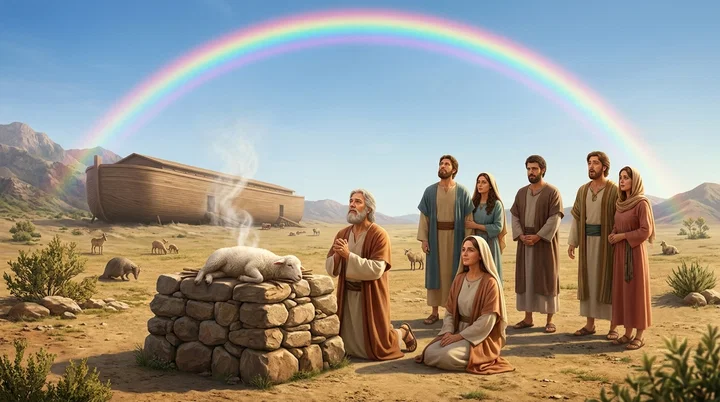
Cross-references
- Genesis 9:13
I do set my bow in the cloud, and it shall be for a token of a covenant between me and the earth.
The rainbow is the sign of God's covenant promise after the flood.
- Isaiah 54:9-10
For this is as the waters of Noah unto me: for as I have sworn that the waters of Noah should no more go over the earth; so have I sworn that I would not be wroth with thee, nor rebuke thee.
God compares his enduring covenant of peace to the promise made after Noah’s flood.
- Genesis 6:13-18
And God said unto Noah, The end of all flesh is come before me; for the earth is filled with violence through them; and, behold, I will destroy them with the earth.
God warned Noah of the flood and commanded him to build the ark.
- Matthew 24:37-39
But as the days of Noe were, so shall also the coming of the Son of man be.
Jesus compares his coming with the days of Noah and the flood.
- Genesis 9:15
And I will remember my covenant, which is between me and you and every living creature of all flesh; and the waters shall no more become a flood to destroy all flesh.
Restates the promise that the flood will never again destroy all flesh.
- Genesis 7:23
And every living substance was destroyed which was upon the face of the ground, both man, and cattle, and the creeping things, and the fowl of the heaven; and they were destroyed from the earth: and Noah only remained alive, and they that were with him in the ark.
The Flood destroyed all life except Noah and those with him in the ark.
- Revelation 4:3
And he that sat was to look upon like a jasper and a sardine stone: and there was a rainbow round about the throne, in sight like unto an emerald.
The rainbow around God’s throne is the heavenly counterpart of the covenant sign.
- Exodus 19:5-8
Now therefore, if ye will obey my voice indeed, and keep my covenant, then ye shall be a peculiar treasure unto me above all people: for all the earth is mine:
The conditional covenant contrasts with God’s covenant with Noah.
- Genesis 9:12
And God said, This is the token of the covenant which I make between me and you and every living creature that is with you, for perpetual generations:
God continues speaking to Noah about his covenant.
- Genesis 9:17
And God said unto Noah, This is the token of the covenant, which I have established between me and all flesh that is upon the earth.
God again addresses Noah about the covenant sign.
- Genesis 9:1
And God blessed Noah and his sons, and said unto them, Be fruitful, and multiply, and replenish the earth.
God blesses Noah and his sons and gives them instructions after the flood.
- Hebrews 11:7
By faith Noah, being warned of God of things not seen as yet, moved with fear, prepared an ark to the saving of his house; by the which he condemned the world, and became heir of the righteousness which is by faith.
Noah’s faith and the flood’s destruction affirm the account’s historicity.
- Genesis 8
And God remembered Noah, and every living thing, and all the cattle that was with him in the ark: and God made a wind to pass over the earth, and the waters asswaged;
Continues the Deluge account Jesus learned.
- 2 Peter 3:6-7
Whereby the world that then was, being overflowed with water, perished:
contrasts world then was with now is
- Genesis 6:9
These are the generations of Noah: Noah was a just man and perfect in his generations, and Noah walked with God.
The Karen traditions resembled the biblical account of the flood.
- Genesis 7:12
And the rain was upon the earth forty days and forty nights.
forty days rain destroyed the race
- Genesis 7:16
And they that went in, went in male and female of all flesh, as God had commanded him: and the LORD shut him in.
God shut the door and kept Noah safe.
Commentary
Each commentary is drawn from primary sources: the writings of Ellen G. White and Adventist pioneers and periodicals. Each commentary is separate. Its own words are not a quotation; follow the references to read the source passages.
Ellen G. White
3 sources
And God spake unto Noah, and to his sons with him, is part of the inspired, divine words of Genesis and records literal history in which God actually spoke to a real Noah and his sons in connection with a real flood.ST Sep 8, 1881 That speaking introduces His gracious covenant with Noah and his sons with him after the flood and reveals His mercy and grace.PP 120.3Ms 94, 1899, par. 29–30
The generation at Babel afterward should have gratefully remembered that covenant, but instead they murmured against God as arbitrary and severe for destroying the world by a flood.PP 120.3 That covenant still restrains judgment, for although sin has kept increasing since Adam and Eve were shut out of Paradise and rebellious people now trample God's law and His Sabbath under foot, God does not come out of His place to punish the inhabitants of the world for their iniquity or sweep them away by a flood as in Noah's day.Ms 94, 1899, par. 29–30 He spares them because of the covenant made with Noah, and this sparing proves His benevolence has not been cut off but His love and care still flow earthward, for He is full of compassion, mercy, and love.Ms 94, 1899, par. 29–30
Noah's day prefigures the present age before Christ's appearing in the clouds of heaven, since human nature uninfluenced by the Spirit of God remains the same now as then, so the character of that generation marks this age.ST Sep 8, 1881 Christ points all generations to this Old Testament history, showing the Old and New Testaments cannot be divorced and settling doubt about the Old Testament by pronouncing it divine.ST Sep 8, 1881
Sources
Pioneers and periodicals
44 sources
God spoke directly and audibly to Noah and to his sons with him after they came out of the ark, when they were the only people on earth, opening His covenant announcement to them, their descendants, and every living creature.RH Dec 30, 1915 The covenant promises that all flesh will never again be cut off by the waters of a flood to destroy the earth. The bow in the cloud, formed as sunlight shines through falling rain, is its sign and token, on which God looks and remembers His promise.RH Aug 4, 1874ST Mar 25, 1903RH Oct 18, 1853 It is a divine promise only, laying down no law and making no mutual agreement, yet it pledges more than safety from waters, even mercy, everlasting kindness, peace, a new probation to the fallen race, and salvation to all through Christ from eternal death.ST Mar 25, 1903RH Jul 18, 1854ST Mar 4, 1886RH Apr 12, 1860ST Mar 12, 1894 It records literal history of a real worldwide Deluge, and Noah in its setting is a type of Christ, with his day prefiguring the present age before Christ's appearing.ST Sep 8, 1881RH Oct 29, 1861ST Jan 25, 1905ST Dec 11, 1928
Speaking and Setting
God spoke directly and audibly to Noah and to his sons with him after they came out of the ark, when they were the only people on earth, and His words open the covenant announcement He then established with them, their descendants, and every living creature.RH Jan 13, 1852RH Oct 18, 1853RH Jun 23, 1903 That speech introduces the covenant lesson whose sign is the bow in the cloud, and it forms part of God's covenant words to Noah and his sons.RH Dec 30, 1915RH Jan 13, 1852 Its meaning as a sign of promise would have been clear to Noah's family and could be passed down through generations as an example of God instructing people by speaking to them.RH Oct 18, 1853RH Jun 23, 1903
The word belongs to the account of the Deluge, the ark, and the work and salvation of Noah in Genesis 6 to 9, which presents the Flood as part of the Bible's early history of God's dealings with the promised Seed.ST Dec 20, 1910ST Mar 17, 1914ST Genesis 1-11 covers His dealings with the human race as distinct from Genesis 12-50 on the chosen race, and Genesis 9 is the chapter of law, commandment, and prophecy coming after Noah left the ark and built the altar and before the genealogy of his sons.ST Dec 20, 1910ST Mar 17, 1914 It distinguishes the world that then was from the world that now is and stands connected with the character of Noah's sons.ST Dec 20, 1910ST Mar 17, 1914
Its setting follows the assuaging of the waters, the resting of the ark on Ararat, the dove and olive leaf as token of returning favor, and the erected altar with sacrifice, with the rainbow spanning the heavens as the arch of glory to seal the covenant and grant a new probation to the fallen race.RH Jan 23, 1855RH Sep 26, 1907 The same chapter that begins God's blessing and covenant speech to Noah and his sons, whose sign is the rainbow set in the cloud, also includes the sin of Ham and the death of Noah.RH Jan 23, 1855RH Sep 26, 1907
Noah stands as the second head of the human race, coming forth from the ark as the one family alone remaining on earth, a family instructed in divine truth and warned by the terrible judgment that destroyed every wicked person to prevent the extinction of piety.ST Feb 15, 1883 They might all have remained the heritage of the Almighty if they would, but when men began again to multiply they did not retain God in their knowledge, forgot God, and plunged into sin.ST Feb 15, 1883 They united under Nimrod to build Babel and had their language confounded, so that by the fourth century after the Flood only a handful of godly persons remained, requiring God to adopt Abraham's faithful family to preserve true piety and worship in the earth.ST Feb 15, 1883
The chronology around the verse shows overlapping lives by which divine truth was handed down, proved with Genesis 5, 11, and 21: Shem was instructed by Noah his father during 448 years, by Lamech during 93 years, and by Methuselah during 98 years, then conversed with Abraham during 150 years and with Isaac during 50 years.ST Oct 4, 1883 By that instruction from Shem, Abraham received all the knowledge of divine truth possessed by Noah and Enoch, and Abraham and Isaac were well instructed concerning Enoch's prophecy, translation, and the second advent of Christ.ST Oct 4, 1883
The Flood account to which the verse belongs shows clean and unclean animals distinguished before the Levitical law, with seven pairs of clean and one pair of unclean preserved in the ark based on their nature rather than created by that later law. It also shows Ham punished for breaking the law to honor father and mother, proving that command existed before Sinai.ST Dec 17, 1902
Covenant Promise and Sign
God spoke to Noah and to his sons with him to announce and establish His everlasting covenant of grace. That covenant was made with them and with their seed after them and with every living creature with them, with all flesh. Its promise is that all flesh shall never again be cut off by the waters of the flood and there shall never again be a flood to destroy the earth. Because He had pledged never again to bring a flood of waters upon the earth, He would not later command Abram to build an ark to be saved from another destruction by flood, but instead called Abram out from his country and kindred and father's house to make of him a great nation.
That covenant means more than safety from another flood of waters.ST Mar 25, 1903ST Mar 12, 1894 It is the pledge of His mercy and everlasting kindness, His sworn promise not to be angry with His gathered people nor rebuke them, His covenant of peace that shall not be removed even when mountains depart and hills are removed, with establishment in righteousness far from oppression and fear and terror.ST Mar 25, 1903 It granted a new probation to the fallen race and presented the plan of redemption and salvation under which the patriarchs lived, a covenant of peace intended for every creature and for generations to come.ST Mar 12, 1894RH Jan 23, 1855ST Jan 25, 1905ST Dec 15, 1898
The bow in the cloud is the sign and token of that covenant, formed as the sun shines through falling raindrops against a background of clouds, on which God looks and remembers His promise never again to destroy the earth with a flood.ST Mar 25, 1903RH Oct 18, 1853 God uses the language of remembering to assure people that the promise is before Him. Its meaning would have been clear to Noah's family, who were then the only people on earth, and could be passed down through generations.RH Oct 18, 1853 Its repeated appearance when a rainbow appears in the cloud fulfills prophecy given in plain language, so that people who see it may witness the fulfillment without knowing it was foretold.RH Aug 4, 1874 Every sight of the bow of promise should recall both promises and picture the transcendent beauty of the eternal home.ST Mar 25, 1903
The rainbow promises pardon to every penitent soul and assures the humble, contrite believer of God's mercy toward fallen humanity.RH Nov 6, 1900 It is a sure sign of God's mercy toward the repentant sinner and signifies His everlasting covenant in Christ's blood promising salvation to all.ST Mar 12, 1894 Its promise points to salvation through Christ, who saves not only from temporal destruction but from eternal death.ST Mar 12, 1894
Meaning of Covenant
In this verse covenant means a divine disposition and promise only, its precise sense being fixed by its connection.RH Jul 18, 1854ST Mar 4, 1886RH Apr 12, 1860 God's word to Noah and to his sons with him lays down no law and makes no mutual agreement, but gives a promise.RH Jul 18, 1854ST Mar 4, 1886RH Aug 13, 1872 This use stands as an example of covenant expressed as a promise or mutual agreement, distinct from covenant understood as God's law or commandments to be performed.RH Jul 18, 1854ST Jun 17, 1875RH Nov 8, 1853 God's promise to Noah never to drown the world again is called a covenant, with the bow in the clouds placed as its token, proving promise is one sense of covenant distinct from an agreement between parties and from a law commanded.ST Mar 4, 1886RH Aug 13, 1872
The word has broad application to mean a promise, a mutual agreement, a conditional agreement, or a commanded law.ST Mar 4, 1886RH Aug 13, 1872 So a law is always a covenant while a covenant may or may not be a law.ST Mar 4, 1886 The covenant in verses 8-17 consists solely of promises, in contrast to a covenant that commands a law on which promises are based.ST Mar 4, 1886RH May 26, 1853
The covenant spoken to Noah and his sons is distinct from the covenant made at Sinai and from the Ten Commandments.RH Apr 16, 1861RH Oct 21, 1873 Though the Ten Commandments are sometimes called covenant, the varied use of the word in different senses proves they are not the first covenant.RH Apr 16, 1861RH Oct 21, 1873 This covenant is the renewed new covenant, God's relation with men through the Gospel for their salvation.ST Jun 4, 1902 It is the same everlasting covenant of the everlasting Gospel begun with the promise to put enmity between man and Satan and to destroy Satan, renewed to Abraham by repeated promise and oath, and finally confirmed by Christ Jesus upon the cross, by which every soul who is saved is saved.ST Jun 4, 1902 It establishes His everlasting covenant of grace with them and with their seed after them and with every living creature and all flesh, promising that all flesh shall never again be cut off by the waters of the flood and that there shall never again be a flood to destroy the earth, which is another aspect of that everlasting covenant, with God's bow in the cloud as its token.ST Jun 4, 1902
Flood History Defended
God spoke in real, literal history to a literal Noah and to his literal sons with him after a real, historical, worldwide, supernatural Deluge.ST Sep 8, 1881ST Jan 25, 1905ST Nov 13, 1893ST Nov 18, 1880ST Nov 18, 1880 This word belongs to the inspired, divine words of Genesis and to the Mosaic account of the Flood, whose historical truth stands against ridicule, idle objections, and denial.ST Sep 8, 1881RH Oct 29, 1861ST Nov 18, 1880 To reject the Flood as untrue is to reject the testimony of Genesis as a whole.ST Nov 18, 1880ST Nov 18, 1880 Jesus’ pointing to the days of Noah affirms the Flood as a real event, settles doubt about the Old Testament by pronouncing it divine, and shows that the Old and New Testaments cannot be divorced.ST Sep 8, 1881ST Nov 18, 1880
The word belongs to the first ten chapters of Genesis, which are literal historic fact, fundamental truths of Christianity, and part of revelation.RH Aug 23, 1906 Those chapters confirm a literal creation at the beginning.RH Aug 23, 1906RH Aug 20, 1914 To deny their historic character in order to harmonize with the unproved hypotheses of evolution overthrows faith in the Bible as a whole, because evolution and revelation exclude each other with no compromise between them.RH Aug 23, 1906 Surrender to evolution leads away from Christianity toward pantheism and heathenism.RH Aug 23, 1906
The Flood was a great catastrophe that overtook the world and left widespread geological evidence in water-deposited remains and formations across many regions. Remains of men who lived before the Flood are found in caves in southern France and elsewhere.ST Jan 25, 1905 The historical reliability of this Pentateuchal Flood story is supported by scientific discoveries and observations.ST Jan 25, 1905ST Oct 21, 1930
The Deluge burned itself into the memory of all the early races of the world and is preserved in worldwide traditions and in the Chaldean tablets.ST Jan 25, 1905 It was preserved in Babylonian literature and was known in the West long before the days of Moses, while tablets from Assur-bani-pal’s palace contain a creation account resembling Genesis in a remarkable degree. The Karens preserved the flood among traditions akin to the biblical accounts of creation, fall, and flood, suggesting that at some remote time they knew Jehovah, and traces of the Bible’s flood narrative appear even in Aztec mythology.RH Aug 10, 1905RH Apr 30, 1901 Discoveries in ancient lands adjoining Israel that had dealings with that people confirm the Bible narrative including God’s word to Noah and his sons after the Deluge.ST Mar 10, 1909 Against Babylonian legends claiming 432,000 years before the Deluge during which only ten kings ruled, which is utterly preposterous, and against claims for the great antiquity of man argued from tablets, from assumed uniform accumulation of debris over buried objects, from advanced culture and refinement, and from degeneration denied, the Bible’s testimony is far clearer and more consistent than very incomplete, uncertain, and fragmentary archaeological records and is not to be set aside for them.ST Mar 10, 1909
Prophecy Type and Warning
Noah in the wider setting of this speaking stands as a type of Christ, with events in his life surrounding the Flood prefiguring aspects of Christ's birth, death, and resurrection.ST Dec 11, 1928 The speaking belongs to literal history with a literal Noah and a literal flood, part of inspired divine words that Christ holds before all generations.ST Sep 8, 1881 Noah's day prefigures the present age before Christ's appearing in the clouds of heaven, because human nature uninfluenced by the Spirit of God is the same now as then.ST Sep 8, 1881 The character of that generation therefore marks this age, and the Old and New Testaments cannot be divorced, with doubt about the Old Testament settled by pronouncing it divine.ST Sep 8, 1881
When men in ancient times reached the point that nothing was restrained from them that they imagined to do, God came down and confounded them.RH Apr 3, 1855 The present generation, with its unprecedented increase of knowledge and power over the elements, bids fair to occupy the same position if it does not already.RH Apr 3, 1855 It is in danger of being deceived by its wonders into expecting better days and a temporal millennium.RH Apr 3, 1855 The addressing of Noah and his sons illustrates the need for prophetic warning about coming events and their consequences.RH Jun 8, 1911
God's message to Noah about building the ark and the coming flood was a distinct truth that called people apart from the world.RH Aug 4, 1903 Safety from the flood was found inside the ark, not in sincerity or professed faith outside it.RH Aug 4, 1903
Sources