Isaiah 10:32
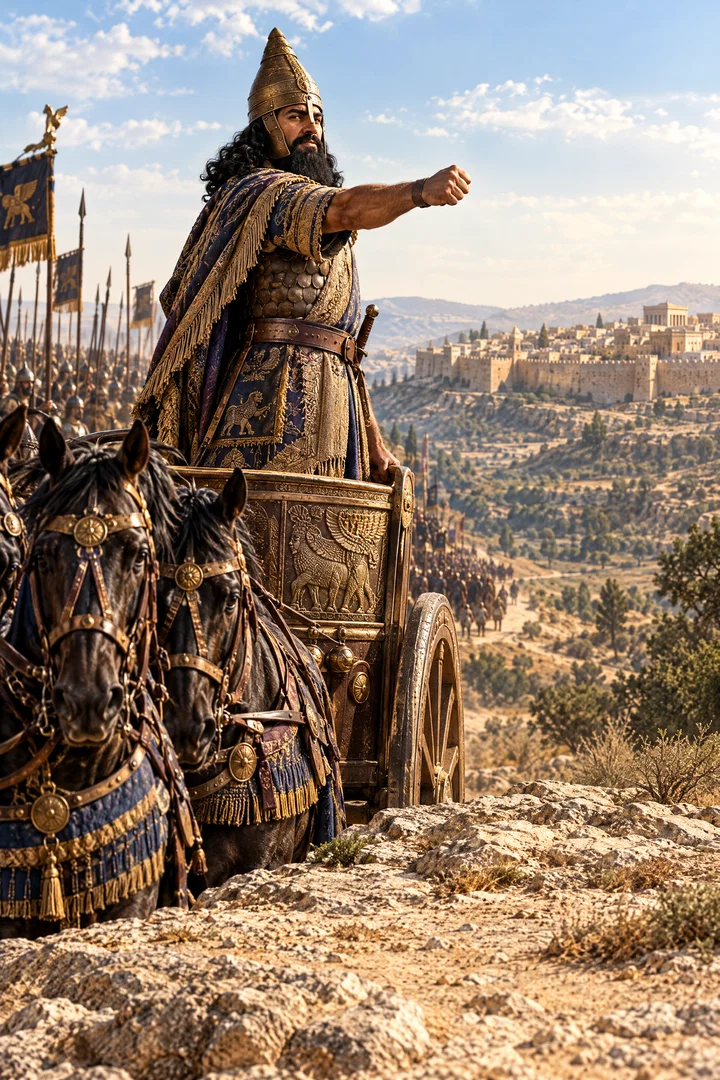
As yet shall he remain at Nob that day: he shall shake his hand against the mount of the daughter of Zion, the hill of Jerusalem.
Translations
American King James Version, King James Version, Webster Bible
As yet shall he remain at Nob that day: he shall shake his hand against the mount of the daughter of Zion, the hill of Jerusalem.
As yet shall he remain at Nob that day:
He shall shake his hand against the mount of the daughter of Zion,
The hill of Jerusalem.Revised Version, American Standard Version
This very day shall he halt at Nob: he shaketh his hand at the mount of the daughter of Zion, the hill of Jerusalem.
Yet to-day in Nob to remain, Wave its hand doth the mount of the daughter of Zion, The hill of Jerusalem.
Still a day of halting at Nob; he shaketh his hand [ against] the mount of the daughter of Zion, the hill of Jerusalem....
While yet to-day, in Nob, he tarrieth, He brandisheth his hand toward The mount of the daughter of Zion, The hill of Jerusalem.
Berean Standard Bible, Majority Standard Bible
Yet today they will halt at Nob,
shaking a fist at the mount of Daughter Zion,
at the hill of Jerusalem.This very day he will halt at Nob. He shakes his hand at the mountain of the daughter of Zion, the hill of Jerusalem.
This very day he is stopping at Nob; he is shaking his hand against the mountain of the daughter of Zion, the hill of Jerusalem.
Yet there is a time that he will stay at Nob: he shall lift vp his hand towarde the mount of the daughter Zion, the hill of Ierusalem.
Douay-Rheims (Challoner revision)
It is yet day enough, to remain in Nobe: he shall shake his hand against the mountain of the daughter of Sion, the hill of Jerusalem.
Pictures
Commentary
Each commentary is drawn from primary sources: the writings of Ellen G. White and Adventist pioneers and periodicals. Each commentary is separate. Its own words are not a quotation; follow the references to read the source passages.
Pioneers and periodicals
4 sources
Isaiah 10:32 belongs to the first part of Isaiah, chapters 1 to 39, which consists of prophecies and historical accounts given while Isaiah was actively involved in public affairs as God's messenger to the nation.RH Jul 6, 1916 This part was formed from separate prophecies issued at different times and on different occasions and later gathered into one collection, with chapters sometimes placed out of chronological order.RH Jul 6, 1916 It is distinct from the second part, chapters 40 to 66, which belongs to his later years apart from active work and looks wholly to the future, to deliverance from Babylonian captivity and to deliverance from sin and error through the Messiah.RH Jul 6, 1916
The verse is part of a prophecy against Assyria describing an Assyrian invasion of Judah.ST Jan 4, 1916ST Jun 4, 1912 The account gives no clear clue to the identity of the king who carried out the deeds, which has led critics to describe the invasion and its Assyrian king as ideal rather than historical.ST Jan 4, 1916 Its chapter is marked by strife, war, and wickedness, in contrast with Isaiah 11, which presents the rest, peace, and righteousness of Christ's kingdom.ST Oct 3, 1906
Sources