James 3:6
And the tongue is a fire, a world of iniquity: so is the tongue among our members, that it defileth the whole body, and setteth on fire the course of nature; and it is set on fire of hell.
Translations
And the tongue is a fire, a world of iniquity: so is the tongue among our members, that it defiles the whole body, and sets on fire the course of nature; and it is set on fire of hell.
And the tongue is a fire, a world of iniquity: so is the tongue among our members, that it defileth the whole body, and setteth on fire the course of nature; and it is set on fire of hell.
And the tongue is a fire, a world of iniquity: so is the tongue amongst our members, that it defileth the whole body, and setteth on fire the course of nature; and it is set on fire of hell.
And the tongue is a fire, a world of iniquity: so is the tongue among our members, that it defileth the whole body, and setteth on fire the course of nature; and it is set on fire from hell.
Revised Version, American Standard Version
And the tongue is a fire: the world of iniquity among our members is the tongue, which defileth the whole body, and setteth on fire the wheel of nature, and is set on fire by hell.
and the tongue [is] a fire, the world of the unrighteousness, so the tongue is set in our members, which is spotting our whole body, and is setting on fire the course of nature, and is set on fire by the gehenna.
and the tongue [ is] fire, the world of unrighteousness; the tongue is set in our members, the defiler of the whole body, and which sets fire to the course of nature, and is set on fire of hell.
And, the tongue, is a fire,—[as], the world of unrighteousness, the tongue, becometh fixed among our members, that which defileth the whole body and setteth on fire the wheel of our natural life, and is set on fire, by gehenna!
Berean Standard Bible, Majority Standard Bible
The tongue also is a fire, a world of wickedness among the parts of the body. It pollutes the whole person, sets the course of his life on fire, and is itself set on fire by hell.
And the tongue is a fire. The world of iniquity among our members is the tongue, which defiles the whole body, and sets on fire the course of nature, and is set on fire by Gehenna.
And the tongue is a fire; it is the power of evil placed in our bodies, making all the body unclean, putting the wheel of life on fire, and getting its fire from hell.
And the tongue is fire, yea, a worlde of wickednesse: so is the tongue set among our members, that it defileth the whole body, and setteth on fire the course of nature, and it is set on fire of hell.
Douay-Rheims (Challoner revision)
And the tongue is a fire, a world of iniquity. The tongue is placed among our members, which defileth the whole body, and inflameth the wheel of our nativity, being set on fire by hell.
Pictures

Cross-references 20 of 60
- Matthew 12:36-37
But I say unto you, That every idle word that men shall speak, they shall give account thereof in the day of judgment.
Words reveal the heart and bring accountability in judgment.
- Matthew 5:22
But I say unto you, That whosoever is angry with his brother without a cause shall be in danger of the judgment: and whosoever shall say to his brother, Raca, shall be in danger of the council: but whosoever shall say, Thou fool, shall be in danger of hell fire.
Both use Gehenna for hell fire and punishment.
- James 3:2
For in many things we offend all. If any man offend not in word, the same is a perfect man, and able also to bridle the whole body.
Restraint in speech is linked with maturity and bridling the whole body.
- Luke 12:5
But I will forewarn you whom ye shall fear: Fear him, which after he hath killed hath power to cast into hell; yea, I say unto you, Fear him.
Both texts use Gehenna for the place of divine punishment.
- Ephesians 4:29
Let no corrupt communication proceed out of your mouth, but that which is good to the use of edifying, that it may minister grace unto the hearers.
Both warn against harmful words and favor speech that builds others up.
- Matthew 10:28
And fear not them which kill the body, but are not able to kill the soul: but rather fear him which is able to destroy both soul and body in hell.
Both use Gehenna for the punishment of the wicked.
- Proverbs 18:21
Death and life are in the power of the tongue: and they that love it shall eat the fruit thereof.
Both describe the tongue’s power to bring death and harm.
- Matthew 12:34
O generation of vipers, how can ye, being evil, speak good things? for out of the abundance of the heart the mouth speaketh.
The tongue’s speech reveals the abundance of the heart.
- James 1:26
If any man among you seem to be religious, and bridleth not his tongue, but deceiveth his own heart, this man’s religion is vain.
Both texts warn that an unbridled tongue reveals worthless religion.
- Mark 9:43-48
And if thy hand offend thee, cut it off: it is better for thee to enter into life maimed, than having two hands to go into hell, into the fire that never shall be quenched:
Both texts connect Gehenna with the punishment of the wicked.
- Matthew 23:33
Ye serpents, ye generation of vipers, how can ye escape the damnation of hell?
Both texts use the Greek term Gehenna for hell.
- Matthew 12:36
But I say unto you, That every idle word that men shall speak, they shall give account thereof in the day of judgment.
Even idle words will be accounted for on Judgment Day.
- Psalms 39:1
I said, I will take heed to my ways, that I sin not with my tongue: I will keep my mouth with a bridle, while the wicked is before me.
Both call for guarding the tongue to avoid sin.
- Proverbs 21:23
Whoso keepeth his mouth and his tongue keepeth his soul from troubles.
Guarding the mouth and tongue protects a person from trouble.
- 1 Peter 3:10
For he that will love life, and see good days, let him refrain his tongue from evil, and his lips that they speak no guile:
Good days are linked with restraining the tongue from evil and deceit.
- Revelation 14:5
And in their mouth was found no guile: for they are without fault before the throne of God.
The faithful are described as having no guile in their mouths.
- Psalms 34:13
Keep thy tongue from evil, and thy lips from speaking guile.
Commands restraint from evil and deceitful speech.
- Romans 3:13
Their throat is an open sepulchre; with their tongues they have used deceit; the poison of asps is under their lips:
Both describe corrupt, poisonous speech.
- Psalms 12:3
The LORD shall cut off all flattering lips, and the tongue that speaketh proud things:
Condemns flattering lips and proud speech.
- Luke 6:45
A good man out of the good treasure of his heart bringeth forth that which is good; and an evil man out of the evil treasure of his heart bringeth forth that which is evil: for of the abundance of the heart his mouth speaketh.
Speech reveals what fills the heart.
Commentary part 1 of 2
Each commentary is drawn from primary sources: the writings of Ellen G. White and Adventist pioneers and periodicals. Each commentary is separate. Its own words are not a quotation; follow the references to read the source passages.
Ellen G. White
95 sources
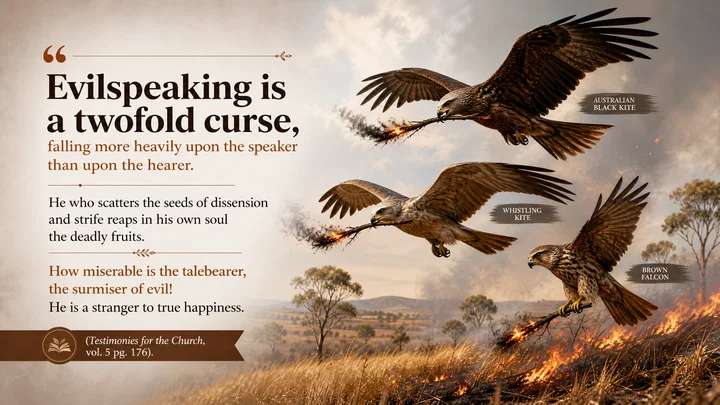
The tongue is a destructive fire placed among the members of the body, corrupting the whole person and setting the entire course of life ablaze.Ms 24, 1902, par. 17Lt 64, 1888, par. 20–21Ms 75a, 1900, par. 10 Though very small it claims great power, and like a tiny spark it can kindle widespread ruin.Lt 4, 1861, par. 6–919MR 32.1–33.1Ms 40, 1896, par. 11 Its burning power comes from a hellish source, for Satan furnishes the mind with bitter, scornful, accusing and divisive thoughts to be spoken.Ms 24, 1902, par. 17Lt 64, 1888, par. 20–21ST Apr 5, 1905Lt 124, 1893, par. 13–17RH May 12, 1910 No human strength can tame it by itself, for it is unruly and poisonous, and only divine help can bring thoughts and words into subjection.Ms 75a, 1900, par. 10Lt 4, 1861, par. 6–9RH Oct 29, 1901Lt 30, 1868, par. 4–5 Left to itself it wounds speaker and hearer, takes lasting root and spreads outward to homes, churches and nations, but consecrated to God it becomes a blessing that builds up, cheers, comforts and conveys redeeming love.ST Apr 5, 1905Lt 124, 1893, par. 13–17RH May 12, 1910Ms 11, 1868, par. 518MR 368.5–369.1
Words and Imagery
The tongue is a fire, a world of iniquity placed among the members, that defiles the whole person and sets the whole course of life ablaze.Ms 24, 1902, par. 17Lt 64, 1888, par. 20–21Ms 75a, 1900, par. 10RH Oct 29, 1901Ms 29, 1887, par. 64 Its influence spreads sin and harm and puts a destructive course in motion, so that speech must be guarded and governed for peaceful relations, while speech used wisely and at the right time carries strong influence for good.Ms 29, 1887, par. 64Ms 158, 1902, par. 37–38 Perfect control of speech would mean a perfect man able to bridle the whole body, but no man can tame the tongue by himself, and only by the Lord's help can thoughts and words be brought into subjection to Christ.Ms 75a, 1900, par. 10RH Oct 29, 1901
Though a little member it boasts great things, like a little fire kindling a great matter.Lt 4, 1861, par. 6–919MR 32.1–33.1 Though small it does a weight of mischief, revealing what is stored in the heart and carrying great power for evil to kindle destructive conflict, set people and nations against one another even to bloodshed and cause harm, or to bring joy and gladness, so that speech is a gift carrying serious responsibility and must be carefully guarded and watched with the spirit prompting it guarded.Ms 40, 1896, par. 11Lt 34, 1899, par. 1–5Ms 73, 1897, par. 17–19 A heart filled with Christian tenderness, sympathy, and politeness produces fitting words, while cherished jealousy, evil suspicion, and selfishness produce corrupt speech that cripples the church and dishonors Christ, whereas good works joined with good words show consecration to God.Ms 73, 1897, par. 17–19 Careless critical speech sows bitterness and suspicion in hearts, makes crooked paths, proves a stumbling block to weak brethren for whom Christ died, turns their feet out of the way of life, and wrecks them to eternal loss, and a coming day of revealing will expose every case, showing the plague spot and rock of offense that caused the wreck, when the lost in despair will reproach those who harmed them by the tongue.Ms 40, 1896, par. 11
"Set on fire of hell" means its destructive power is kindled from hell and comes from a hellish source.Ms 24, 1902, par. 17Lt 64, 1888, par. 20–21Lt 124, 1893, par. 13–17 A man is greatly under the influence of his own words, for thoughts produce words and words react upon thoughts, so that accustomed ways of speaking shape thoughts, belief, and actions.Lt 124, 1893, par. 13–17 Words act upon the speaker and still more powerfully upon others, and careless, exaggerated, exasperated speech spoken in excited feeling does great mischief whose full result only God knows and measures.Lt 124, 1893, par. 13–17 Reckless, false, and unjust words inflame another person's passions, distort faults, and sow envy, jealousy, hatred, and strife, and rebellious words poison the soil of others' hearts, creating in them a course of thought that leads into false paths and reproduces the speaker's own wrong character in them as a harvest to be reaped.Lt 124, 1893, par. 13–17Lt 64, 1888, par. 2–3 The tongue was to be consecrated to God to adorn truth, to vindicate light, and to be a cheerful, uplifting, sanctified influence upon all around, and fiery speech perverts that calling.Lt 124, 1893, par. 13–17 A wife's destructive speech of this unruly and deadly evil kind makes both her and her husband miserable and undermines his Christian life, and her impatience also breeds impatience in him.Lt 15, 1859, par. 5
No man can tame it by himself, for it is an unruly member, untamed and untamable, an unruly evil full of deadly poison.Ms 75a, 1900, par. 10Lt 4, 1861, par. 6–9Lt 30, 1868, par. 4–5 When the heart is not sanctified by the truth, speech breaks out in a multitude of words, exaggeration, and false witness, which transgresses the commandment of God even in one who professes to keep the commandments and does not intend to do wrong, and the careless talker's tongue is frequently inflamed from hell.4T 331.1–2 Uncontrolled speech is a destructive evil, and a Christian must bridle it, talk less, and avoid exaggeration, treating the tongue as a diseased member and bringing it under control, for careless excessive talk separates close friends and drives joy from the church and can do unholy work.Lt 4, 1861, par. 1–3Lt 23, 1903, par. 8
The chapter exposes the danger of the tongue and calls for careful attention to the wisdom and conduct of those who lead God's work, and it is an eye-opener for anyone willing to examine these matters.SPBC 181.3 The whole third chapter must be read and studied to see this evil speaking among brethren, and the words of the fourth chapter practiced to create a different atmosphere about the soul.Lt 97, 1896, par. 27–33 It should be read prayerfully as instruction for overcoming chronic spiritual maladies, as part of a remedy affecting spiritual, mental, and physical well-being.Ms 49, 1895, par. 7–9 It expresses the same principles spoken by the voice of God from the pillar of cloud about the acts to do and the actions not to do, recorded in Deuteronomy 4, requiring humbling of spirit and a changed heart to be acted out in all religious service toward God and toward one another.Ms 40, 1891, par. 42–45 Those principles mean to love as brethren, to do no injustice, and always to show liberality, tenderness, compassion, and true courtesy, for they are the principles of the law of God and expressions of the mind of the infinite God whose specifications never lose force, so that every word is to be cherished, preached, and obeyed, while all who depart from them in action misrepresent the character of God.Ms 40, 1891, par. 42–45
Satanic Source and Agency
The unsanctified tongue is a destructive fire full of evil that pollutes the whole person and sets the whole course of life burning from a hellish source, spreading evil like fire to defile and awaken destructive passions.ST Apr 5, 1905RH May 12, 1910 Satan supplies the mind with thoughts a Christian should never speak, and the scornful retort, the bitter passionate outburst, and the cruel suspicious accusation come from him.ST Apr 5, 1905RH May 12, 1910 Words of this kind harm both speaker and hearer, for harsh words strike the heart and stir its worst passions to life, and doing evil with the tongue and sowing discord by selfish jealous words grieves the Holy Spirit because it works against God.ST Apr 5, 1905RH May 12, 1910 Those who hold the theory of truth without practicing it, with love eclipsed in the soul and self as supreme idol, give themselves over to do his work by speech that kindles a fire not easily quenched, repeating words spoken in confidence and betraying friends and treating anything that cuts the threads of union between brother and brother and sister and sister as worthy, while he stands by laughing that he can so easily inspire tongues to such speech.Ms 43a, 1898, par. 32–33
A tongue devoted to gossip and mischief is set on fire of hell, spreading destructive words like firebrands that defame innocent people and destroy the hope and courage of those already burdened.5T 57.2 Separated from God it proves a world of iniquity and brings fearful condemnation because souls are lost through it, whereas living with the constant sense that God sees and hears all that is done and said and keeps a faithful record of all words and actions that must be met, adding grace to grace and following an enlightened and wakeful conscience, turns the tongue to the glory of God as a source of blessing to self and others.4T 244.1 It sows dissension, misrepresents others, and falsifies what God approves, for words reveal the character of the treasure stored in the heart, and when holy things are not cherished the tongue runs without restraint and expresses his attributes, harming His work, for the Lord does not work with unruly hearts or tongues.Lt 77, 1897, par. 11–13
A tongue set on fire from hell is a hidden, constantly burning malice ready to burst out on any occasion, shown in listening to gather all that can be heard, reporting it with false coloring, readily uttering falsehoods, delighting to instigate quarrels among those connected with the family, and sending out a malignant influence detrimental to the household and to faith that brings darkness and encourages evil angels in and around the dwelling.Lt 18, 1868, par. 2–4 In a health institution such tongues belong to those who have become his own agents to do evil, controlled by him so that they possess his spirit and act out his suggestions while evil angels surround them and make them channels to speak through, and their work is to leaven with distrust, faultfinding, complaining, and murmuring, so that even one such sinner does much harm by biting and devouring those who try to help.Lt 44, 1891, par. 10–11 Those placed in trust must keep living connection with God to receive discernment and wisdom to understand them, listen to His voice and not listen to or follow the voice of a stranger, close every door possible to murmurers and complainers, let those whose hearts are opened to Satan and closed to Christ go to their own company as soon as possible, and while present treat them as kindly as possible but give no place to the devil working through them and not sympathize with them, for sympathy encourages him.Lt 44, 1891, par. 10–11 A strong, fractious tongue is such a fire, kindling fire in the home, controlling matters there, stirring up the mind of a husband, confusing and irritating him, wholly unfitting him to occupy any responsible place in the church, swaying his judgment from the right and perverting it, and leading him into a wrong, inconsistent course that is overbearing, exacting, and provoking to others.Lt 21, 1862, par. 2 The same destructive, defiling power appears when speech in a church meeting lies and accuses others of theft, harming the reputation of the church.Ms 57, 1886, par. 14
Forms of Evil Speech
Faultfinding, gossip, backbiting, tattling and false or exaggerated reports defile character and harm the neighbor, for the tongue though a small member boasts great things and like a little fire kindles a great matter.Lt 4, 1861, par. 6–919MR 32.1–33.1Ms 26, 1902, par. 37–39 Talking against brethren and sisters, influencing others who do not know them, reporting incorrect things about them, with impatience, fretfulness and jealousy, puts a spot in the Christian character that must be reformed and overcome to bring forth fruit meet for repentance and to be presented without spot or wrinkle as one who backbites not nor takes up a reproach against a neighbor.Lt 4, 1861, par. 6–919MR 32.1–33.1 Repeated gossip magnifies a small or imagined fault, creates suspicion and distrust, imperils the reputation of God's servants and sets many untrue reports in motion, so that silence is better than circulating scandal.Ms 26, 1902, par. 37–39TBC1882 33.3–34.2Lt 29, 1882, par. 5–6 Such constant accusing, questioning and finding fault with everything and every man's teaching defiles the speaker and gives no greater evidence of his own imperfection of character, requiring severe self-criticism instead of judging others.19MR 32.1–33.1Lt 98, 1896, par. 1–3 Malicious gossip and scandalous speech spread like fire to defame the innocent and can destroy hope, courage, reputation and usefulness, and even a factually true report presented so as to create a false impression does not justify using it to ruin someone.TBC1882 33.3–34.2Lt 29, 1882, par. 5–6
Hasty, angry, impatient, fretful, passionate, resentful and retaliatory words express an ungoverned temper and quick overbearing passion ready to resent, complain, condemn, defend self and retaliate for every slight.2T 424.3–426.22T 51.31T 310.1 Speaking against those who displease, recounting their errors, failings and sins to gratify hurtful desires, expecting too much from others and arousing dissatisfaction where none existed, indulges anger, resentment and all unkind tempers and sets the tongue ablaze with evil.2T 424.3–426.22T 51.3Lt 30, 1868, par. 4–5 Giving vent to a bitter resentful spirit in reproach and censure against a husband and others who have done injustice makes matters worse by one's own wrong course, gives only momentary relief to a burdened heart and leaves a lasting scar upon the soul.4T 139.12T 82.1 Feeling and talking about grievances with a spirit of retaliation and offense and cherishing bitter feelings foreign to the spirit of Christ is a greater sin, and passionate words dishonor God, injure the speaker's soul, bring reproach on God's cause and stand recorded unless washed away by Christ's blood.2T 82.1Lt 30, 1868, par. 4–51T 310.1 Uncontrolled hasty words serve Satan, destroy peace and happiness, damage health and can lead to loss of eternal life.2T 424.3–426.21T 310.1
Harsh, censorious, discouraging, careless and doubt-producing words deeply wound minds and hearts, remain in minds for years, surround believers with darkness and sow seeds that later produce unbelief, apostasy and stumbling.Ms 11a, 1895, par. 11–13Lt 2, 1895, par. 25–284T 236.2–237.1Ms 115a, 1897, par. 8 Doubtful words take root and spread from one person to others like poisonous seed to poison another soul and contribute to a soul's loss, even after the speaker has overcome his own error, repented, forgotten what he said or become unaware of the damage.Ms 11a, 1895, par. 11–13Lt 2, 1895, par. 25–28Ms 115a, 1897, par. 8 Continual words of doubt, questioning and much talk heard almost continually leave no light or strength in the truth, and if faith is allowed to be affected it soon becomes all darkness and doubt and unbelief.4T 236.2–237.1Ms 106, 1904, par. 9–10 Words spoken rashly in distrust of God destroy Christian confidence and brotherly unity, and guarding against cherishing unbelief or expressing it, refusing to plant seeds of doubt, backbiting and evil speaking, and speaking only words pleasing to God is as solemn a duty as abstaining from intoxicating liquor.Ms 115a, 1897, par. 8Ms 106, 1904, par. 9–10Ms 115a, 1897, par. 22
Multitude of words, exaggeration, false witness, idle jesting and joking, talkativeness, whispered secrets, insinuations and perverse or vulgar talk transgress God's commandment even in one who professes to keep the commandments and does not intend to do wrong.ST Nov 20, 18844T 331.1–2Ms 175, 1903, par. 1–2 When the heart is not sanctified by the truth the tongue breaks out in vain, unwise, false, unjust and untrue speech, and jesting, joking and careless talk at random dishonor Christ and reveal a heart in need of cleansing and purification for God's glory.4T 331.1–2Ms 175, 1903, par. 1–2Lt 2, 1895, par. 15–18 Such free use of the tongue pierces heart and brain and bruises wounded and confused minds, bringing sadness and pain to souls who love God and are trying to do His will, and makes the speakers tools for Satan's devising with whom the Lord has a controversy.Ms 175, 1903, par. 1–2Lt 75, 1894, par. 5 Dishonesty, exaggeration and other idle words bring accountability before God, for speech is a sacred trust to be used to honor God, share redemption, comfort the discouraged and strengthen others with kind words.ST Nov 20, 1884Lt 4, 1861, par. 1–3
Accusing, suspicious and distrustful speech watches for evil, creates unjust suspicion, catches at supposed evil and feeds upon it and rolls it as a sweet morsel under the tongue, presenting every act in a distorted perverted light.Lt 97, 1896, par. 27–33Ms 68, 1896, par. 9–1011MR 261.3 It misinterprets words and deeds from a finite standpoint under imagination and feeling, magnifies a mote into a mountain while blind to its own beam, and in trifling matters that arise wherever people live together talks over grievances with words full of bitterness.Lt 97, 1896, par. 27–33Ms 68, 1896, par. 9–1011MR 261.3 Words of suspicion and criticism repeated and enlarged by others grow into false reports, injustice and discord, leavening whole neighborhoods and churches, alienating brother from brother and hindering the work God desires to be done.Ms 32, 1902, par. 8–9Lt 97, 1896, par. 45–50Ms 68, 1896, par. 9–10 This misuse produces envy, evil thinking, evil speaking, faultfinding, watching and evil surmising, striving for supremacy and tearing others down to build self up, sowing seeds that grow into a harvest of evils for which every thought, word and action will be brought into judgment.Lt 107a, 1900, par. 5–7Ms 32, 1902, par. 8–9 So employed the tongue is unholy and unlike Christ, spreading dissatisfaction, dividing brethren and serving Satan as accuser of the brethren day and night, making men his best agents, allies and missionaries.Lt 97, 1896, par. 27–33Ms 68, 1896, par. 9–1011MR 261.3
Talebearing, betraying confidence, blackening character, inspiring malice and fanning a small spark into an uncontrollable flame divide brethren and do Satan's work with a fire not easily quenched.TBC1882b 18.1–215MR 161.3Ms 66, 1886, par. 13–18 The accusing tongue neglects its own heart work by dwelling on the wrongs of another with suspicions, dark hints, venom, bitterness, tattling, magnifying faults, condemning another and justifying self.Ms 7, 1882, par. 17–19Ms 66, 1886, par. 13–18 Going up and down carrying words to neighbors' doors and listening to them, sparing no one not even the messenger bringing truth, it accuses, condemns, bears false witness and slander.TBC1882b 18.1–2Ms 66, 1886, par. 13–18 Such speech is a root of bitterness defiling many that weakens the church and keeps away God's blessing, and the grace of Christ must control it through building up one's own house, repenting of one's own sins and being converted and overcoming the disposition to accuse.TBC1882b 18.1–2Ms 7, 1882, par. 17–19Ms 66, 1886, par. 13–18
How Harm Spreads
A person is greatly under the influence of his own words, for thoughts produce words and words react upon thoughts, so that accustomed ways of speaking shape thoughts, belief and actions.Lt 124, 1893, par. 13–17Lt 45, 1894, par. 7–8 Words do more than express thought, they shape the speaker's thoughts and actions and act still more powerfully upon others, and careless, exaggerated, exasperated speech spoken in excited feeling does great mischief whose full result only God knows and measures.Lt 124, 1893, par. 13–17Lt 45, 1894, par. 7–8 Unwise, hastily spoken words can lead to wrong decisions, wound people for whom Christ died, and bring ruin, and pride may keep one from retracting a wrong decision even after careful thought shows it was wrong, allowing its harmful effects to continue.Lt 45, 1894, par. 7–8 The tongue's freedom to act can sway inexperienced minds and lead them into harmful actions.Lt 182, 1897, par. 5–7
Evil words harm both speaker and hearer, for harsh words strike the heart and stir its worst passions to life, while scornful retort, bitter passionate outburst, and cruel suspicious accusation supplied to the mind work against God and grieve the Holy Spirit.ST Apr 5, 1905RH May 12, 1910 The unsanctified tongue as a destructive fire full of evil pollutes the whole person and sets the whole course of life burning from a hellish source, dishonoring God, injuring the speaker's soul, and bringing reproach on God's cause.ST Apr 5, 19052T 82.1 A passionate word gives Satan an advantage, wounds the speaker's soul, and turns others away from the light, so words must be carefully guarded and the mouth closed in prayer before speaking.2T 82.1Lt 187, 1902, par. 4 Even a small trait of selfishness, whether inherited or cultivated, can grow in the heart and produce defiling words whose harmful influence may never be erased, building crooked and unsound character for eternity that must bear the divine imprint and be built on doing God's Word.19MR 197.3–4
The harm lasts, for doubtful, harsh, censorious, careless and discouraging words can deeply wound others, damage the spiritual life of the tempted, cause them to stumble, and contribute to their loss.Ms 11a, 1895, par. 11–13Lt 2, 1895, par. 25–28 Such words can take root, spread from one person to others like poisonous seed, and poison another soul even after the speaker has overcome his own error, repented, forgotten what was said, or become unaware of the damage, remaining in minds for years.Ms 11a, 1895, par. 11–13Lt 2, 1895, par. 25–28 Words and actions leave lasting impressions, and evil thoughts planted in others can set events in motion that cannot be recalled or stopped, like a fire spreading evil and destruction.PK 348.2–3 Words of suspicion and criticism, repeated and enlarged by others, can grow into false reports, injustice, and discord in the church, sowing seeds that produce an evil harvest, and every thought, word, and action will be brought into judgment.Ms 32, 1902, par. 8–9
Like fire it spreads outward, for a tongue left free to talk too much contains a world of evil and kindles a fire that alters the course of nature not only for the speaker but for others.Ms 11, 1868, par. 518MR 368.5–369.1 It stirs up strife and combativeness and brings evil results that the speaker can even enjoy, provoking opposition and conflict rather than expressing peace and humility.Ms 11, 1868, par. 518MR 368.5–369.1 Reckless, false, and unjust words inflame another person's passions, distort faults, and sow envy, jealousy, hatred, and strife, and though a small member the tongue has great power to kindle destructive conflict, set people and nations against one another, and cause bloodshed.Lt 64, 1888, par. 2–3Lt 34, 1899, par. 1–5 Criticism and evil speaking spread harm by exaggerating faults and planting doubt and mistrust in other minds, leavening whole neighborhoods and churches by a destructive work that is satanic.Lt 97, 1896, par. 45–50Ms 68, 1896, par. 9–10 Such tongues draw out planted opinions, treasure up disagreeable things, exaggerate evil, scatter doubts and mistrust, falsify by viewing everything in false light, join with the disaffected and those feeling misused, feed envy, jealousy, and self, and magnify a mote into a mountain while blind to the beam in their own eye.Ms 68, 1896, par. 9–10
Rebellious words poison the soil of the hearts of others, creating in them a course of thought that leads them into false paths and reproduces the speaker's own wrong character in them, a harvest that must be reaped.Lt 124, 1893, par. 13–17 Evil speaking among brethren over trifling matters, talking over grievances with words full of bitterness, watching for evil, creating unjust suspicion, catching at supposed evil and feeding upon it as a sweet morsel and presenting every act in a distorted, perverted light, plants bitter, fibrous roots in the hearts of others that poison faith and defile the souls of many.Lt 97, 1896, par. 27–33 That fire creates suspicion and distrust, alienates brother from brother, hinders the work God desires to be done, and makes men accusers of the brethren day and night.Lt 97, 1896, par. 27–33 Careless critical speech sows bitterness and suspicion in hearts, makes crooked paths, proves a stumbling block to weak brethren for whom Christ died, turns their feet out of the way of life, and wrecks them to eternal loss.Ms 40, 1896, par. 11 A coming day of revealing will expose every case, showing the plague spot and rock of offense that caused the wreck, when the lost in despair will reproach those who harmed them by the tongue.Ms 40, 1896, par. 11
Need for Divine Control
If the speech were perfectly controlled the whole person would be perfect, able to bridle the entire body, but no human strength alone can tame the tongue, and only the Lord's help can bring thoughts and words into subjection to Christ.Ms 75a, 1900, par. 10RH Oct 29, 1901
The unruly member must be entirely controlled and kept as with a bridle through education in carefulness of words and acts, restraining and gauging the course of action rather than acting unfettered and forming the character accordingly.Ms 11, 1868, par. 1–418MR 368.1–4Lt 75, 1894, par. 5 Keeping God's precepts is impossible without especially regarding this, requiring careful study of the Word carried out into daily life, disciplining the mind since out of the abundance of the heart the mouth speaks, guarding the spirit that prompts words, and treating the tongue as a diseased member to be brought under control.Ms 11, 1868, par. 1–4Ms 106, 1904, par. 9–10Lt 23, 1903, par. 8 Unadvised words do great mischief by reporting conversation falsely, leaving false impressions, putting wrong interpretations on words, picking out a few sentences from their connection to carry a point, doing injustice, injuring souls, separating close friends, driving joy from the church, and hindering the sacred cause, so private conversation that falsifies must be refused and keeping silence becomes eloquent and necessary.Ms 21, 1901, par. 12–14Lt 23, 1903, par. 8 Bridling and disciplining the tongue means guarding against discouraging words, evil speaking and backbiting, planting seeds of doubt, and cherishing unbelief or expressing it to others, resolving with the solemn seriousness of abstaining from intoxicating liquor to speak only words pleasing to God, a control learned through Christ's help.Ms 106, 1904, par. 9–10
Temper must be wholly subdued and not merely outwardly restrained, by dying to self, strength of principle, meekness and humility, patience and forbearance, slowness to speak and to wrath, sparing words, and passing over transgression.2T 424.3–426.2 The pattern is Christ, who when reviled and abused did not revile or threaten in return, and who though sorely tried on the point of hasty and angry speech never once sinned with His lips but met sneers, taunts, and ridicule with patient calmness.2T 424.3–426.2Ms 106, 1904, par. 9–10
Sanctification of speech must begin in the heart where the affections are rooted, for words reveal what fills the heart.Ms 17, 1895, par. 4–5Lt 75, 1894, par. 7Ms 73, 1897, par. 17–19 When Christ abides within and the heart is filled with the Spirit, Christian tenderness, sympathy, and politeness produce fitting words that can persuade, pray, praise God, convey redeeming love, and spread truth, while an unsanctified heart cherishing jealousy, evil suspicion, selfishness, and corruption produces careless, exaggerated, perverse, vulgar, and excitable talk that dishonors God, confuses others, shows need of transformed character, and cripples the church.6T 336.2–4Ms 17, 1895, par. 4–5Ms 73, 1897, par. 17–19Lt 86, 1897, par. 26–27 Suspicion, distrust, talkativeness, insinuations, and whispered secrets make speech harmful, foster an evil alliance, and lead to twisting innocent words into accusations, while abusing speech dishonors God and right words of praise, gratitude, help, and encouragement use it for good.MYP 424.1Lt 75, 1894, par. 7
Practical control means closing the mouth and praying before speaking, since passionate words injure the speaker's soul, dishonor God, bring reproach on His cause, and stand recorded to be faced unless washed away by Christ's blood.2T 82.1 It means talking less, avoiding exaggeration, and reflecting before speaking, with speech serving a purpose to cheer, encourage, or elevate, remembering that even good conversation can become excessive and weary listeners, and that silence and reflection can honor God more than talking.Lt 4, 1861, par. 1–3Lt 2, 1870, par. 19–21 It means refusing private falsifying conversation and keeping silence rather than replying when unjustly treated, praying for strength in trial to overcome temptation and remain victorious, since hasty speech gives the enemy victory.Ms 155, 1902, par. 37–38Ms 21, 1901, par. 12–14 It means not answering every accusation but continuing the work without being turned aside, since malicious words are sparks that die out if not fed, while arguing with an evil speaker invites further abuse and silence may heal difficulties.Ms 159, 1902, par. 10
Guarding the tongue preserves peace, because harsh words cause wounds that are hard to heal and bringing divisive matters into conversation hurts one's own soul and the souls of others.Ms 60, 1903, par. 7–85MR 363.2–4 Even gaining one's point by argument places a burden on another far outweighing any advantage gained by winning.Ms 60, 1903, par. 7–85MR 363.2–4 Unless a question of vital importance is involved, personal opinions, preferences, and differences are to be yielded rather than disputed, left unexpressed and kept to oneself and told only to God, rather than insisted upon in a way that creates strife and discord.Ms 60, 1903, par. 7–85MR 363.2–4
Consequences for People
Uncontrolled speech enslaves, leading its speaker captive under Satan's control and presenting him an offering costlier than any ever laid on God's altar.1T 310.1RH Apr 22, 1862ST Apr 17, 1884 Separated from God the tongue proves a world of iniquity that brings fearful condemnation because souls are lost through it.4T 244.1Ms 40, 1896, par. 11 Though a little member it does a weight of mischief, making crooked paths and proving a stumbling block to weak brethren for whom Christ died, turning their feet out of the way of life and wrecking them to eternal loss.4T 244.1Ms 40, 1896, par. 11 The only safeguard is living with the constant sense that God sees and hears all that is done and said, keeps a faithful record of words and actions that must be met, following an enlightened and wakeful conscience, adding grace to grace, and using the tongue to God's glory as a blessing to self and others.4T 244.1RH Apr 22, 1862
In the home hasty, jangling, unpleasant, impatient, fretful and angry words destroy peace and happiness, damage health, and at last forfeit an eternal life of happiness.1T 310.1RH Apr 22, 1862ST Apr 17, 1884SG4 255.2 Such speech disturbs whole families, controls household matters, perverts judgment, and unfits a man for a responsible place in the church.1T 310.1RH Apr 22, 1862SG4 255.2 A wife's unsanctified tongue, though her chief talent, does great harm rather than any benefit, making both herself and her husband miserable, undermining his Christian life, and breeding impatience in him that teaches children to speak likewise.Lt 15, 1859, par. 5Lt 214, 1897, par. 3Ms 21, 1903, par. 11 Restraint of word and temper through continual abiding faith and trust in God gains great victories, bringing peace, humility, growth in grace, refinement of taste, sanctified judgment, peace of mind, and everlasting life, with an indwelling Saviour strengthening every hour and angels lingering in the dwelling.1T 310.1RH Apr 22, 1862ST Apr 17, 1884
In the church the undisciplined tongue defiles the whole body of believers as it defiles the whole person, spreading like fire.Lt 107a, 1900, par. 5–7Ms 57, 1886, par. 7Ms 52, 1898, par. 38–41 It produces envy, evil thinking, evil speaking, faultfinding, watching and evil surmising, striving for supremacy, and tearing others down to build self up, sowing seeds that grow into a harvest of evils.Lt 107a, 1900, par. 5–7Ms 52, 1898, par. 38–41 This gives place to Satan as originator of evil and his striving for the highest place, damages and demoralizes congregations, counterworks the minister of Christ, breaks unity by sowing doubt, infidelity, irritation and evil-surmising from house to house, closes mission fields, and keeps God from working with workers and churches.Lt 107a, 1900, par. 5–7Ms 57, 1886, par. 7Ms 52, 1898, par. 38–41 Every church therefore needs careful discipline in the use of the imaginative faculties and the tongue, with humbling of heart and confession of sin by those guilty.Lt 107a, 1900, par. 5–7Ms 52, 1898, par. 38–41
Persistent talebearing that goes up and down blackening character, inspiring malice, accusing and condemning, bearing false witness and slander, carrying words to neighbors' doors and listening there, sparing no one, is a root of bitterness defiling many that weakens the church and keeps away God's blessing.Ms 66, 1886, par. 13–18Ms 52, 1898, par. 38–41 Such sowing of disaffection must not have the church's sanction but must be met by faithful personal labor, reproof, correction, and instruction according to Bible rules and the steps required by Christ.Ms 66, 1886, par. 13–18Ms 52, 1898, par. 38–41 If after patient instruction there is no hearing, change, repentance and reform, the talker must be separated from fellowship, sympathizers who choose the wrong side must also be suspended, and those who will not harmonize must either keep the tongue as with a bridle or find some other place to worship.Ms 66, 1886, par. 13–18Ms 52, 1898, par. 38–41
Words are sacredly accountable, for God sees and hears all, keeps a faithful record, and requires meeting it all.4T 244.12T 82.1Ms 32, 1902, par. 8–9 Passionate words stand recorded to be faced unless washed away by Christ's blood, and dishonesty, exaggeration, and other idle words bring judgment.2T 82.1ST Nov 20, 1884Ms 32, 1902, par. 8–9 Words of suspicion and criticism repeated and enlarged grow into false reports, injustice and discord, and cannot be taken back but sow seed producing an evil harvest.Ms 40, 1896, par. 11Ms 32, 1902, par. 8–9 A coming day of revealing will expose every case, showing the plague spot and rock of offense that caused the wreck, when every thought, word and action is brought into judgment and the lost in despair reproach those who harmed them by the tongue.4T 244.1Ms 40, 1896, par. 11Ms 32, 1902, par. 8–9
Use of the tongue carries everlasting consequences, for character is built for eternity on doing God's Word and must bear the divine imprint.Ms 110, 1909, par. 6–9Ms 21, 1903, par. 1119MR 197.3–4 Even a small trait of selfishness, inherited or cultivated, can grow and produce defiling words whose harmful influence may never be erased, making character crooked and unsound.Ms 110, 1909, par. 6–919MR 197.3–4 Hasty, harsh, dictatorial, aggravating and discouraging words that tear down fellow workers defile and wound and leave obstructions that corrode and break forth, and vindicating such a course never improves character.Ms 110, 1909, par. 6–9Ms 21, 1903, par. 11 Cross words at home reveal what will be spoken in the church and would be spoken even in heaven if unchanged, dishonoring God no matter how high the speaker's position, and without change through Christ formed within and prayer for grace when tempted, the speaker will never enter heaven nor be worthy of the unfading crown of life.Ms 110, 1909, par. 6–9Ms 21, 1903, par. 11
Right Use of Speech
The tongue and voice are gifts from God and a sacred trust, to be consecrated to Him rather than kindled from below to defile the whole person and set the course of life ablaze.Lt 124, 1893, par. 13–17ST Nov 20, 1884Ms 40, 1896, par. 3 Words reveal the sentiments of the heart and act powerfully upon both speaker and hearers, for thoughts produce words and words react upon thoughts to shape belief and action, so that careless, exaggerated and exasperated speech does mischief whose full measure only God knows.Lt 124, 1893, par. 13–17Ms 40, 1896, par. 3 Misused, the tongue becomes a world of iniquity, a savor of death unto death that dishonors God and spreads corruption, while rightly used it becomes a world of blessing, a savor of life unto life expressing love, devotion, praise and melody to God.Lt 124, 1893, par. 13–17Ms 40, 1896, par. 3MYP 424.1 So consecrated, it adorns truth, vindicates light, and exerts a cheerful, uplifting, sanctified influence; it persuades, prays, praises, conveys redeeming love, shares the plan of redemption, comforts the discouraged, strengthens others with kind words, and spreads truth with gratitude and helpful encouragement.Lt 124, 1893, par. 13–17ST Nov 20, 18846T 336.2–4MYP 424.1
Instead of tearing one another down by faultfinding, speech is to build one another up in the most holy faith and help one another grow day by day to the full stature of men and women in Christ.Ms 110, 1909, par. 6–9Ms 26, 1886, par. 6–7 To find fault with this one and that one is to do Satan's work and open the door to the enemy, while to represent Christ's character by upbuilding speech is to close that door.Ms 110, 1909, par. 6–9Ms 26, 1886, par. 6–7 Hasty, harsh words that dictate, aggravate and discourage wound fellow workers and leave corroding obstructions that break forth again, and vindicating such a course never improves character.Ms 110, 1909, par. 6–9Ms 26, 1886, par. 6–7 The remedy is words spoken under the Holy Spirit that soften and subdue, heal old wounds, remove the rubbish of disunion, unite rather than alienate, and bring blessing through humbled souls, confession, reconciliation with brother and sister, clearing the King's highway, and yielding to the Spirit's conviction.Ms 110, 1909, par. 6–9Ms 26, 1886, par. 6–7Lt 29, 1903, par. 9–12 Neglect of this work leaves the precious soul uncared for, and to see faultfinding in the church and let it go on unrebuked as if it were the appointed work brings accountability for injury to the brethren, while unrestrained careless and excessive talk with suspicion and evil speech magnifies small faults into serious division and robs the church of the Lord's joy.Ms 26, 1886, par. 6–7Lt 29, 1903, par. 9–12
Right speech must serve a purpose to cheer, encourage, elevate, comfort and bless, with saving words that encourage faith and hope rather than weakness, alienation and strife.ST Nov 20, 18846T 336.2–4Lt 2, 1870, par. 19–21Lt 23, 1901, par. 9–11Lt 117, 1896, par. 18–19 Even good conversation can become excessive and weary listeners, so reflection before speaking, carefulness about what is heard and said, and at times silence and reflection honor God more than talking.ST Nov 20, 1884Lt 2, 1870, par. 19–21 Those who visit from house to house are not to unsettle the little faith many have by an unruly tongue sowing seeds of doubt, but to diffuse faith and piety by words that encourage faith and hope.Lt 23, 1901, par. 9–11Lt 117, 1896, par. 18–19 To use the talent of speech to report what hurts souls, to make mischief, stir up strife and circulate scandal is wanton sin that greatly displeases God and pleases the enemy, and cleansing the heart from all that lessens influence for good requires saving words that comfort, encourage and bless, bringing more charity which is love, more true elevation, and a more favorable Christian experience at the right time.ST Nov 20, 1884Ms 158, 1902, par. 37–38Lt 23, 1901, par. 9–11
Holy restraint of speech is for human good, increasing the happiness of families and all around, refining taste, sanctifying judgment, bringing peace of mind, and ending in everlasting life.1T 310.1RH Apr 22, 1862ST Apr 17, 1884 Subduing a hasty, jangling, unpleasant, impatient and fretful temper that destroys peace and happiness, damages health and forfeits eternal happiness gains great victories through continual abiding faith and trust in God for His salvation in the family.1T 310.1RH Apr 22, 1862ST Apr 17, 1884SG4 255.2 Under that restraint grace and humility increase, growth in grace follows, right speech becomes easy, and an indwelling Saviour strengthens hour by hour.1T 310.1RH Apr 22, 1862ST Apr 17, 1884 Then ministering angels linger in the dwelling and carry joyful tidings of advance in the divine life heavenward to make a cheerful, happy record, and speech wisely used at the right time keeps peaceful relations and exerts a strong influence for good.RH Apr 22, 1862SG4 255.2Ms 158, 1902, par. 37–38
There must be an entire transformation of character in which the tongue is tamed, for a tongue left free to talk too much kindles a fire that alters the course of life for speaker and others, stirring up strife and combativeness and even delighting in the evil conflagration, which has no part in the truth.Ms 11, 1868, par. 518MR 368.5–369.16MR 90.3–91.3 Touched as with hot coals of juniper and cleansed in heart, words become select and well chosen, spoken with peace and true humbleness of mind instead of reckless, random, jesting, coarse and careless talk.Ms 11, 1868, par. 5Lt 23, 1901, par. 9–116MR 90.3–91.3Ms 62, 1910, par. 4 Such tamed speech bears fruit unto righteousness when Christ is formed within, carrying a solemn, weighty, refined influence that represents Christ, wins souls, guards the Christian witness from dishonoring the Spirit of God, and lets God be glorified in His people.Ms 11, 1868, par. 56MR 90.3–91.3Ms 62, 1910, par. 4
Sources