Jeremiah 48:11
Moab hath been at ease from his youth, and he hath settled on his lees, and hath not been emptied from vessel to vessel, neither hath he gone into captivity: therefore his taste remained in him, and his scent is not changed.
Translations
Moab has been at ease from his youth, and he has settled on his lees, and has not been emptied from vessel to vessel, neither has he gone into captivity: therefore his taste remained in him, and his scent is not changed.
King James Version, Webster Bible
Moab hath been at ease from his youth, and he hath settled on his lees, and hath not been emptied from vessel to vessel, neither hath he gone into captivity: therefore his taste remained in him, and his scent is not changed.
Moab hath been at ease from his youth,
And he hath settled on his lees,
And hath not been emptied from vessel to vessel,
Neither hath he gone into captivity:
Therefore his taste remained in him,
And his sent is not changed.Revised Version, American Standard Version
Moab hath been at ease from his youth, and he hath settled on his lees, and hath not been emptied from vessel to vessel, neither hath he gone into captivity: therefore his taste remaineth in him, and his scent is not changed.
Secure is Moab from his youth, And at rest [is] he for his preserved things, And he hath not been emptied out from vessel unto vessel, And into captivity he hath not gone, Therefore hath his taste remained in him, And his fragrance hath not been changed.
Moab hath been at ease from his youth, and hath settled on his lees; he hath not been emptied from vessel to vessel, neither hath he gone into captivity: therefore his taste hath remained in him, and his scent is not changed.
Moab, hath been at ease from his youth, And settled is he upon his lees, And hath not been poured out from vessel to vessel, Nor into captivity, hath gone,—For this cause, hath his flavour stood still within him, And his scent is unchanged.
Berean Standard Bible, Majority Standard Bible
Moab has been at ease from youth,
settled like wine on its dregs;
he has not been poured from vessel to vessel
or gone into exile.
So his flavor has remained the same,
and his aroma is unchanged.“ Moab has been at ease from his youth,
and he has settled on his dregs,
and has not been emptied from vessel to vessel,
neither has he gone into captivity;
therefore his taste remains in him,
and his scent is not changed.From his earliest days, Moab has been living in comfort; like wine long stored he has not been drained from vessel to vessel, he has never gone away as a prisoner: so his taste is still in him, his smell is unchanged.
Moab hath bene at rest from his youth, and he hath setled on his lees, and hath not bene powred from vessell to vessell, neither hath he gone into captiuitie: therefore his taste remained in him and his sent is not changed.
Douay-Rheims (Challoner revision)
Moab hath been fruitful from his youth, and hath rested upon his lees: and hath not been poured out from vessel to vessel, nor hath gone into captivity: therefore his taste hath remained in him, and his scent is not changed.
Pictures
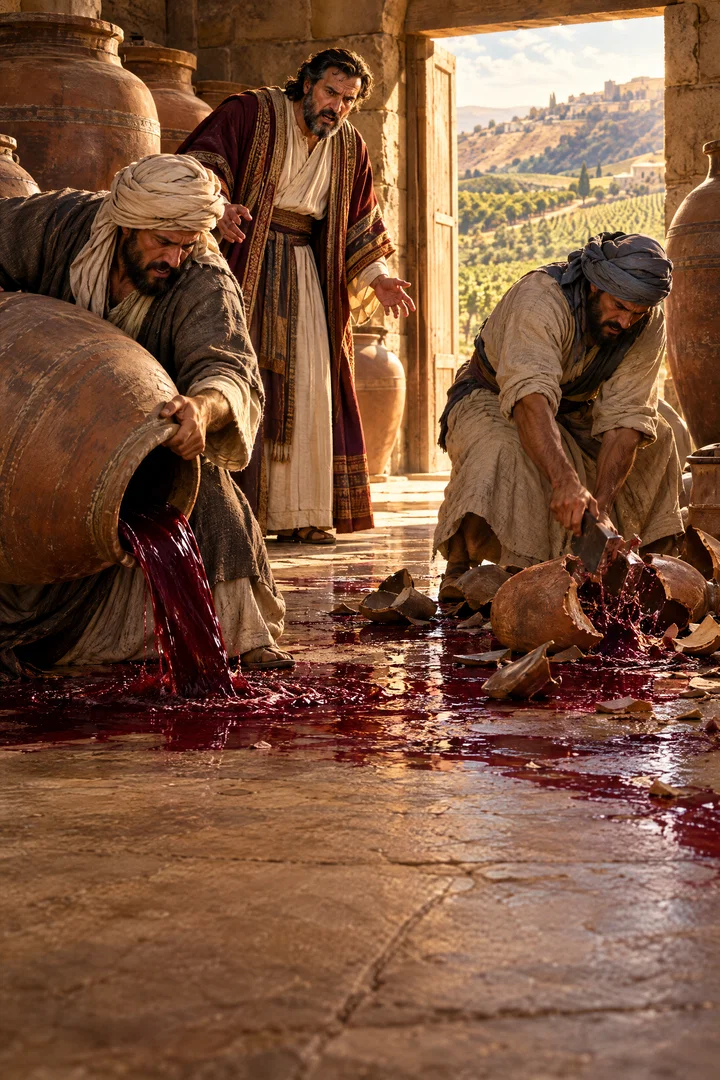
Cross-references
- Zephaniah 1:12
And it shall come to pass at that time, that I will search Jerusalem with candles, and punish the men that are settled on their lees: that say in their heart, The LORD will not do good, neither will he do evil.
Both texts warn of punishment for those settled on their lees.
- 2 Timothy 2:21
If a man therefore purge himself from these, he shall be a vessel unto honour, sanctified, and meet for the master’s use, and prepared unto every good work.
Being emptied and changed prepares a vessel for honorable use.
Commentary
Each commentary is drawn from primary sources: the writings of Ellen G. White and Adventist pioneers and periodicals. Each commentary is separate. Its own words are not a quotation; follow the references to read the source passages.
Ellen G. White
24 sources
Moab had long lived undisturbed from youth, never poured from vessel to vessel and never taken into captivity, so his character and flavor stayed exactly as they were.Ms 101, 1901, par. 16–17Lt 59, 1901, par. 18–238MR 423.4–424.1 To be settled on the lees is to remain a long time in one place and condition, clinging to old habits and customs, former methods of working, and one's own plans and ways.Ms 71, 1903, par. 8–9Ms 9, 1894, par. 7–99MR 11.1–2 To be poured from vessel to vessel is to let the Holy Spirit reform and refine the mind after the divine order and mold the character into full conformity to God's will apart from inherited and cultivated tendencies.Lt 10, 1897, par. 15–1719MR 23.3–24.2STE 170.1 God therefore changes the situation, labor and position of His workers and removes them from friends and acquaintances to break up the settled order and bring them into closer association with Himself.Ms 101, 1901, par. 16–17Ms 81, 1901, par. 19Ms 71, 1903, par. 8–99MR 11.1–2 Gathering together in one favored, comfortable place instead of scattering to needy fields, and resting in selfish indolence while souls perish, is that same ease of Moab and must be broken up by awakening, renovation, and immediate work in the harvest field.8T 150.2Lt 45, 1895, par. 15Ms 7, 1891, par. 5–8Lt 171, 1897, par. 95T 203.2
Moab's Undisturbed Condition
Moab is pictured as long comfortable and undisturbed from youth, settled on his lees, never poured from vessel to vessel and never taken captive or carried away, and therefore with taste remaining in him and scent unchanged.Ms 101, 1901, par. 16–17Lt 59, 1901, par. 18–238MR 423.4–424.1Ms 7, 1891, par. 1–4RH May 2, 1907 Staying always in the same condition leaves character stagnant, unreformed and making little progress, a failure that does not know how to work for God.Ms 101, 1901, par. 16–17Lt 59, 1901, par. 18–238MR 423.4–424.1RH May 2, 1907 That settled, unchanged ease is doing the work of the Lord deceitfully and negligently and keeping back the sword from blood, and it brings a curse and severe denunciation and wrath in judgment against sin, deception, hypocrisy and pretended piety covering unjust dealing and inhumanity.Ms 7, 1891, par. 1–4Lt 10, 1873, par. 23–26 Therefore days come when wanderers are sent to cause wandering and to empty vessels and break bottles upon wrongdoers led from light and truth into darkness.Ms 7, 1891, par. 1–4 The same description represents churches become spiritually complacent, knowing truth without practicing it, failing duty to advance truth and righteousness, showing no growth or zeal or spiritual life, with a lifelessness that can spread to others.Ms 7, 1891, par. 5–8
To be settled on the lees is to stay a long time in one place and in one condition, holding to methods and customs previously followed.Ms 71, 1903, par. 8–9Ms 9, 1894, par. 7–99MR 11.1–2 It is clinging to old habits and customs, to previous methods of working, and to one's own plans, place and way of working, refusing to be diverted from them.Ms 71, 1903, par. 8–9Ms 9, 1894, par. 7–99MR 11.1–2 Such a monotonous life is not conducive to spiritual growth and keeps a person from the highest standard of spirituality, from moral greatness and spiritual soundness.9MR 11.1–2 It refuses decided change, refuses to receive light and let the Holy Spirit mold and fashion character anew into a vessel unto honor.Ms 9, 1894, par. 7–9 Teachers who remain in that unchanged state hold those they instruct down to their own low level and are accountable for the good they failed to do.Ms 9, 1894, par. 7–9
Never being emptied from vessel to vessel and never going into captivity is never being moved out to establish new centers of influence and never coming into another condition of things.Lt 45, 1895, par. 15Ms 81, 1901, par. 19Ms 178, 1901, par. 33 It is staying comfortable in one consolidated mass in a favored place, centering tithe and influence to build up one place while other places lack facilities, instead of being broken up and spread out so light is diffused into dark corners of the earth.Lt 45, 1895, par. 15 Those kept years in one position without change become stagnant in character and work and frequently need to be moved.Ms 81, 1901, par. 19 Long continuance in the same place produces that stagnation, and a man long in the same place who has not come up to the position God wants him to reach needs to be emptied by being yoked with other workers, learning something besides his own mind and ways, correcting errors, reaching as high a standard as possible, and coming where another atmosphere is around his soul so he can discern what he might be and what God can do with him.Ms 81, 1901, par. 19Ms 178, 1901, par. 33
Taste remaining and scent unchanged is character left stagnant, self-satisfied and unchanged, without change from character to character.Lt 45, 1895, par. 151MR 229.4–230.3Ms 109, 1899, par. 13–14 It means hereditary and cultivated tendencies to wrong are not purged and the heart is not cleansed from defilement, with the old self and self kept inside because there has been no inward work of grace writing the law of God in the heart and proving it in conduct after the divine similitude.Ms 79, 1903, par. 9–108MR 423.4–424.1RH May 2, 19071MR 229.4–230.3Ms 109, 1899, par. 13–14 It rules out a cheap class of Christians gathered in without practical character building, requiring that holiness unto the Lord and the law as the standard of righteousness be kept before sinners and the degraded so their ideas of what God requires are lifted.1MR 229.4–230.3Ms 109, 1899, par. 13–14 It also means a dulled sense of wrong and spiritual blindness that cannot discern Satan's work from Christ's, failing to defend the right and condemn the wrong, excusing oneself from the painful duty to reprove sin and failing to sustain those God calls to reprove it, as when Saul failed to smite Amalek utterly.Lt 10, 1873, par. 23–26
Spiritual Meaning of Change
To be poured or emptied from vessel to vessel is to yield to the Holy Spirit to reform, refine, elevate, ennoble and regulate the mind after the divine order.Lt 10, 1897, par. 15–1719MR 23.3–24.2 It is to have character molded and fashioned on a plan different from inherited and cultivated tendencies and natural inclinations, into entire conformity to God's will, so that a man becomes another man.Lt 10, 1897, par. 15–1719MR 23.3–24.2 Remaining undisturbed preserves what is already within, and clinging to old habits while refusing light keeps the Spirit from thus shaping the character.STE 170.1
Refusing to be emptied is resisting the Spirit, refusing to hear counsels and admonitions, and taking the regulation of conduct into one's own hands.Lt 10, 1897, par. 15–1719MR 23.3–24.2 It is refusing to correct defective traits of character even when work, privileges, opportunities and advancement have been plainly pointed out.Lt 10, 1897, par. 15–1719MR 23.3–24.2 It is clinging to defects because breaking up old ways and transforming ideas and methods is too much trouble.Lt 10, 1897, par. 15–1719MR 23.3–24.2 It is failing to examine self closely, to seek clear and distinct light, and to pray in humility while living the prayer by understanding and doing duty.Lt 10, 1897, par. 15–1719MR 23.3–24.2
Being emptied also means being yoked with other workers to learn something besides one's own mind and ways, to have errors corrected, to reach as high a standard as possible, and to come where another atmosphere is around the soul so one can discern what he might be and what God can do with him.Ms 178, 1901, par. 33 It means being led step by step deeper and still deeper into painful humiliation in the valley.Lt 56, 1890, par. 3–4 That path brings into close communion with Jesus in His life of humiliation and into knowing fellowship with and partaking of the sufferings of Christ.Lt 56, 1890, par. 3–4
Such settled ease is doing the work of the Lord deceitfully and negligently, keeping back the sword from blood.Ms 7, 1891, par. 1–4Lt 10, 1873, par. 23–26 It is failing to defend the right and condemn the wrong, excusing oneself from the painful duty to reprove sin, and failing to sustain those called to reprove it.Lt 10, 1873, par. 23–26 It dulls the sense of wrong, leaves taste and character unchanged, and blinds spiritual discernment so that Satan's work cannot be told from Christ's.Lt 10, 1873, par. 23–26 It brings a curse and wrath and severe denunciation against sin, deception, hypocrisy, and pretended piety covering unjust dealing and inhumanity, as when Saul failed to smite Amalek utterly.Ms 7, 1891, par. 1–4Lt 10, 1873, par. 23–26 Therefore days come when wanderers are sent to cause wandering and to empty vessels and break bottles in judgment upon wrongdoers led from light and truth into darkness, with punishment on those who say the Lord will not do good nor evil.Ms 7, 1891, par. 1–4Lt 10, 1873, par. 23–26
Remaining unchanged brings its own ruin.Ms 9, 1894, par. 7–9 It leaves one a failure who does not know how to work for God, who is not made a vessel unto honor, and who is unfitted for sacred ministry because he cannot communicate what he has never received.Lt 10, 1897, par. 15–1719MR 23.3–24.2RH May 2, 1907 Staying comfortable and undisturbed from early life without submitting to God's training and humble service means hereditary and cultivated tendencies to wrong are not purged and the heart is not cleansed from defilement.RH May 2, 1907 Refusing decided change and refusing to receive light to be molded anew keeps the flavor and smell unchanged.Ms 9, 1894, par. 7–9 A teacher in that unchanged state holds those instructed down to his own low level, rejects the cure that would make him ready to serve with kindness, forbearance, long-suffering, gentleness and patience, and is left in strife with self and others while accountable for the good he failed to do.Ms 9, 1894, par. 7–9RH May 2, 1907
Call to Move and Work
God changes the situation, labor and position of His workers to break up the regular order and bring them into closer association with Himself, taking them away from friends and acquaintances when they need a purer atmosphere in another place.Ms 101, 1901, par. 16–179MR 11.1–2 This moving is His transplanting process, like a gardener transplanting plants to gain the best results, and reorganization that moves workers is not a loss of service.Ms 101, 1901, par. 16–17 So He moved Elijah from place to place when preparing him for translation, that he would leave behind old methods and customs and not settle on his lees, and that his influence would become a power to help many souls to a more perfect experience.9MR 11.1–2 A monotonous life staying long in one place and holding to methods and customs previously followed is not conducive to spiritual growth and keeps a person from the highest standard of spirituality, from moral greatness and spiritual soundness.9MR 11.1–2
Those kept years in one position without change become stagnant in character and work and frequently need to be moved.Ms 81, 1901, par. 19 Remaining settled and never moved leaves character and habit unchanged through clinging to one's own plans, place and way of working.Ms 81, 1901, par. 19Ms 71, 1903, par. 8–9 The remedy is willingness to accept change of places, to let the mind be turned from its own laid plans, and to trust and work with helpers God sends instead of rejecting them from fear they will spoil the work or act on different ideas.Ms 71, 1903, par. 8–9
Gathering into one favored place like Battle Creek instead of scattering to needy fields is this ease, staying comfortable in one consolidated mass while centering tithe and influence to build up one place while other places lack facilities.Lt 45, 1895, par. 15 Never being poured out and never going away is never being moved out to establish new centers of influence and never meeting the change and hardship that would purify character, leaving spiritual life stagnant, self-satisfied and unchanged.8T 150.2Lt 45, 1895, par. 15 Such settled believers may show zeal flaring briefly in a struggle, but their light then goes out like a meteor unless they are broken up and spread out so light is diffused into dark corners of the earth.8T 150.2Lt 45, 1895, par. 15
The same condition represents churches and members spiritually complacent, at ease in selfish indolence and sleep while souls perish around them with no excuse for negligence.Ms 7, 1891, par. 5–85T 203.2 They know the truth but do not practice it, fail in duty to advance truth and righteousness, rest in inaction with talents rusting and show no growth, and their lifelessness can spread to others.Ms 7, 1891, par. 5–8Lt 171, 1897, par. 9 There must therefore be a decided inconveniencing change to the ease-lovers, an awakening and renovation raising the temperature of piety, with plans devised and executed for spreading truth to all nations before fitted laborers can be sent into the field.5T 203.2 Hundreds idle must sense the importance of the time and use the present day as the golden opportunity to go to work in the harvest field at once, coming up to the help of the Lord against the mighty without expecting wages in this world but trusting abundant reward in the next.Lt 171, 1897, par. 9
Standing against the work for the South, discouraging help for Nashville, diverting donated money, and tearing down the work by unjust criticism and evil surmisings is this unchanged condition from lack of submission to God's will.Ms 151, 1902, par. 5–7 Such ones place a mote close to the eye until it becomes a mountain, pick at straws, and cannot see the glory beyond or the way the Lord regards their attitude.Ms 151, 1902, par. 5–7 Their own spiritual condition depends on themselves, and removing the mote and submitting to God would be mercy to themselves, but until they do the description remains true of them.Ms 151, 1902, par. 5–7
The verse rules out a cheap class of Christians gathered in without practical character building and without change from character to character, who keep self in themselves and keep the old self inside because the inward work of grace has not written the law of God in the heart and proved it in conduct after the divine similitude.1MR 229.4–230.3Ms 109, 1899, par. 13–14 Rescue of the degraded must keep holiness unto the Lord and the law of God as the standard of righteousness before sinners, or the work will lower what God requires instead of lifting their ideas of what God requires and producing true inward change.1MR 229.4–230.3Ms 109, 1899, par. 13–14
Sources
Pioneers and periodicals
14 sources
Jeremiah 48:11 belongs to the prophecy of the doom of Moab, one of the kingdoms around Israel foretold to fall before Nebuchadnezzar.ST Jul 18, 1911ST Nov 3, 1909 It pictures Moab as having lived in ease and stability from youth, never displaced or taken captive, like wine left undisturbed on its dregs and never poured from vessel to vessel, so that its character stayed impure and unchanged.ST Sep 22, 1914RH Jun 27, 1907 Being emptied from vessel to vessel stands for the changes, trials and upheavals by which God unsettles attachment to familiar places, exposes and purges faults, and changes the heart toward purity and strength.ST Feb 11, 1897ST Feb 11, 1897RH Jun 12, 1866 Refusing the hardship and change God permits keeps selfishness and the same unchanged character instead of developing character, so that hereditary and cultivated tendencies to wrong are not purged and the heart is not cleansed.RH May 2, 1907ST May 9, 1906 The verse therefore forbids a settled, easy condition among God's people, whether in clinging to business and worldly cares while neglecting the gatherings of God's people or in crowding into one favored center instead of being poured out and scattered to carry light elsewhere.RH Aug 11, 1903RH Jun 27, 1907
Meaning and Setting
The prophecy concerns Moab, one of the kingdoms surrounding Israel whose doom Jeremiah announces.ST Jul 18, 1911 Moab stands among the powers foretold to fall before Nebuchadnezzar.ST Nov 3, 1909 The picture is of a people at ease from youth in long stability, without displacement or captivity, and like wine left on its lees and never transferred from vessel to vessel, retaining character unchanged.ST Sep 22, 1914
To be settled on the lees is to remain undisturbed and unrefined.RH Jun 27, 1907 It is the condition of one who takes things easy from youth and is not emptied from vessel to vessel, but lets the lees or settlings remain in the cup.RH Jun 27, 1907 So taste remains in him and scent is not changed, because character like wine has not been separated from its impurities.RH Jun 27, 1907
Undisturbed ease without vicissitude or removal is the meaning of the figure.RH Oct 31, 1871 That description cannot be said of the Sabbath of the Lord.RH Oct 31, 1871 Under the claim that it must commemorate the creation of the world, then the departure out of Egypt, then the triumph over Pharaoh, and now the resurrection of Christ, it has been emptied from vessel to vessel again and again.RH Oct 31, 1871 On that showing it must be changed once more.RH Oct 31, 1871
Warning Against Settled Ease
To be poured from vessel to vessel is to be unsettled by changes, trials and upheavals, and God uses such stirring to loosen attachment to familiar places and relationships, to redirect to work in each new place, and to expose and purge faults and undesirable traits so the heart is changed toward purity and strength.ST Feb 11, 1897ST Feb 11, 1897RH Jun 12, 1866 Ease and lack of upheaval leave the natural taste and scent unchanged, like wine remaining undisturbed in its own dregs, while painful trials that unsettle can purge away faults.ST Feb 11, 1897RH Jun 12, 1866 The lesson is a warning against settling into comfort, for God may use disrupted circumstances to bring needed change.ST Feb 11, 1897
Refusing the hardship and change God permits or sends preserves selfishness rather than developing character, and those who refuse such changes may perish, while accepting them can refine character and produce a holy influence.ST May 9, 1906 A life without painful changes and upheaval can leave people without fear of God, while affliction may lead them to seek God.RH Mar 25, 1873 Staying comfortable and undisturbed from early life is failure because it is unwillingness to submit to God's training and refusal of the humble service appointed as medicine for diseased minds and selfish preference.RH May 2, 1907 Never being poured out and never facing hardship means hereditary and cultivated tendencies to wrong are not purged and the heart is not cleansed from defilement, so the person keeps the same character, rejects the opportunity to be cured and made ready for God's work in order to carry out personal plans, and is left in strife with self and others instead of being prepared to serve with kindness, forbearance, long-suffering, gentleness and patience.RH May 2, 1907
Ease and an unchanged life can leave workers settled in old habits, like wine left on its lees without being poured from one vessel to another, so that those who succeed only under familiar circumstances fail when conditions change because their character and habits have not been changed by hardship or adaptation.RH Jul 28, 1904 God uses moves to unsettle attachment and to change what is still unlike His ideal, and the image applies to one who needs to be moved from home to home so that God can change what is natural in the heart toward purity and strength in God.ST Feb 11, 1897ST Feb 11, 1897 A settled, easy condition is forbidden in God's people.RH Jun 27, 1907
That forbidden settling includes staying absorbed in regular business and worldly cares while neglecting the gatherings of God's people, because time after time absence leaves a person cold to the message of Jesus' soon coming and indifferent to the needs of the cause of truth.RH Jun 27, 1907 It also means staying comfortable and congregated in one favored center, as at Battle Creek, instead of being poured out and scattered, keeping the same character and experience without change.RH Aug 11, 1903 It means having only spasmodic zeal like a meteor flashing across the heavens and going out, hearing truth in large assemblies without putting it into practice, prizing lightly superabundant light received, and failing to go forth into darkened corners of the earth to shed abroad light and raise up laborers together with God.RH Aug 11, 1903
Sources