Job 42:12
So the LORD blessed the latter end of Job more than his beginning: for he had fourteen thousand sheep, and six thousand camels, and a thousand yoke of oxen, and a thousand she asses.
Translations
American King James Version, King James Version, Webster Bible
So the LORD blessed the latter end of Job more than his beginning: for he had fourteen thousand sheep, and six thousand camels, and a thousand yoke of oxen, and a thousand she asses.
So the Lord blessed the latter end of Job more than his beginning: for he had fourteen thousand sheep, and six thousand camels, and a thousand yoke of oxen, and a thousand she asses.
So the LORD blessed the latter end of Job more than his beginning: and he had fourteen thousand sheep, and six thousand camels, and a thousand yoke of oxen, and a thousand she-asses.
So Jehovah blessed the latter end of Job more than his beginning: and he had fourteen thousand sheep, and six thousand camels, and a thousand yoke of oxen, and a thousand she-asses.
And Jehovah hath blessed the latter end of Job more than his beginning, and he hath fourteen thousand of a flock, and six thousand camels, and a thousand pairs of oxen, and a thousand she-asses.
And Jehovah blessed the latter end of Job more than his beginning; and he had fourteen thousand sheep, and six thousand camels, and a thousand yoke of oxen, and a thousand she-asses.
And, Yahweh, blessed the latter end of Job, more than his beginning,—and so he came to have fourteen thousand sheep, and six thousand camels, and a thousand yoke of oxen, and a thousand she-asses.
Berean Standard Bible, Majority Standard Bible
So the LORD blessed Job’s latter days more than his first. He owned 14,000 sheep, 6,000 camels, 1,000 yoke of oxen, and 1,000 female donkeys.
So the LORD blessed the latter end of Job more than his beginning. He had fourteen thousand sheep, six thousand camels, one thousand yoke of oxen, and a thousand female donkeys.
And the Lord's blessing was greater on the end of Job's life than on its start: and so he came to have fourteen thousand sheep and goats, and six thousand camels, and two thousand oxen, and a thousand she-asses.
So the Lord blessed the last dayes of Iob more then the first: for he had foureteene thousand sheepe, and sixe thousand camels, and a thousand yoke of oxen, and a thousand shee asses.
Douay-Rheims (Challoner revision)
And the Lord blessed the latter end of Job more than his beginning. And he had fourteen thousand sheep, and six thousand camels, and a thousand yoke of oxen, and a thousand she asses.
Pictures
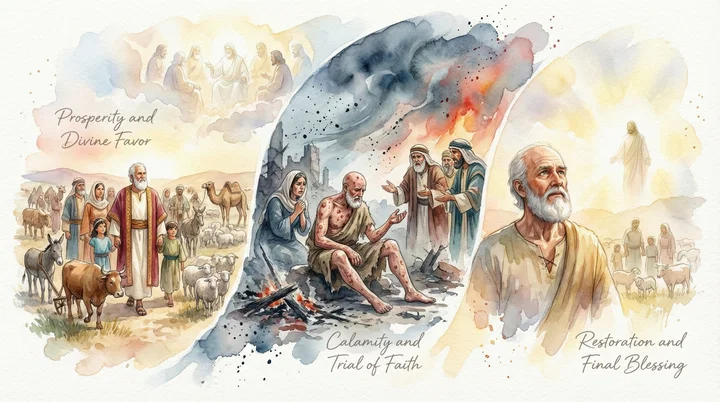





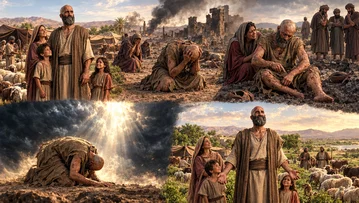

Cross-references
- Job 1:12
And the LORD said unto Satan, Behold, all that he hath is in thy power; only upon himself put not forth thine hand. So Satan went forth from the presence of the LORD.
God permits Satan to afflict Job before later blessing him.
- Job 8:7
Though thy beginning was small, yet thy latter end should greatly increase.
Compared with Job 42:12 to show the word’s meaning.
- James 5:11
Behold, we count them happy which endure. Ye have heard of the patience of Job, and have seen the end of the Lord; that the Lord is very pitiful, and of tender mercy.
Job’s endurance ends in blessing, showing the Lord’s pity and mercy.
- Job 1:10
Hast not thou made an hedge about him, and about his house, and about all that he hath on every side? thou hast blessed the work of his hands, and his substance is increased in the land.
Satan challenges Job’s devotion by pointing to God’s blessing of his possessions.
- Numbers 23:10
Who can count the dust of Jacob, and the number of the fourth part of Israel? Let me die the death of the righteous, and let my last end be like his!
Cited as another use of the Hebrew word.
- Numbers 24:20
And when he looked on Amalek, he took up his parable, and said, Amalek was the first of the nations; but his latter end shall be that he perish for ever.
Cited as another use of the Hebrew word.
- Job 2:7
So went Satan forth from the presence of the LORD, and smote Job with sore boils from the sole of his foot unto his crown.
Satan afflicts Job with sores.
- Job 42:6
Wherefore I abhor myself, and repent in dust and ashes.
Job’s repentance precedes the blessing of his latter end.
- Job 38:1
Then the LORD answered Job out of the whirlwind, and said,
The whirlwind revelation led Job to repentance before God blessed him.
Commentary
Each commentary is drawn from primary sources: the writings of Ellen G. White and Adventist pioneers and periodicals. Each commentary is separate. Its own words are not a quotation; follow the references to read the source passages.
Ellen G. White
7 sources
Job's suffering did not come from a perverted or sinful way of life, but because Satan was permitted and allowed to afflict him.ST Jun 21, 1899Ms 22, 1898, par. 29 That affliction stripped him of all he possessed and of earthly treasures, broke his family ties, bereaved him of his children, and covered his body with loathsome sores that caused great suffering.ST Jun 21, 1899Lt 10, 1879, par. 4–9Ms 22, 1898, par. 29 Stripped and bereaved, he was made a spectacle of loathing to his friends.Lt 10, 1879, par. 4–9
While he suffered, his friends tried to make him see that his own sinful course made him responsible for his afflictions, seeking to prove him guilty before God and deserving of punishment.ST Jun 21, 1899Ms 22, 1898, par. 29 This placed God in a false light and brought a grievous test upon him.ST Jun 21, 1899 Job denied the charge, called them miserable comforters, and did not swerve from loyalty or abandon it.ST Jun 21, 1899Ms 22, 1898, par. 29
After the Lord answered Job out of the whirlwind and revealed the might of His power, Job caught a glimpse of his Creator, abhorred himself and repented in dust and ashes.RH Oct 16, 1913PK 163.2–164.1 He rose from discouragement and despondency to implicit trust in divine mercy and saving power.RH Oct 16, 1913PK 163.2–164.1 By patient endurance and unswerving loyalty he vindicated his own character and thereby the character of God whose representative he was.ED 156.1–2ST Jun 21, 1899Ms 22, 1898, par. 29 This fulfilled his faith that when tried he would come forth as gold, so that according to his faith so it was unto him.ED 156.1–2
Only then was the Lord able to bless him abundantly.RH Oct 16, 1913PK 163.2–164.1 God in His time turned his captivity, lifted him up and showed him more favor than at any previous time, and gave him twice as much as he had before.ED 156.1–2Lt 10, 1879, par. 4–9 He blessed his latter end more than his beginning, lifted him from discouragement to trust, and made his last years the best of his life.ED 156.1–2RH Oct 16, 1913PK 163.2–164.1Lt 10, 1879, par. 4–9 That blessing means restoration above the former condition in health of body, clearness and strength of mind, and freedom of spirit, with means to give freely.3T 87.1–88.3
It proves the heavenly Father does not willingly afflict or grieve His children.Lt 10, 1879, par. 4–9 He will not utterly forget nor forever forsake those who have been faithful even if they sometimes commit errors.3T 87.1–88.3 He takes the case of a faithful servant into His own hands when unjust and heartless decisions remove blessing and returns the blessings removed.3T 87.1–88.3 So a Christian who loves God may be sorely afflicted, distressed, perplexed, and hedged in on every side with appearances against him while still standing in divine favor and not forsaken by God.Lt 10, 1879, par. 4–9
Sources
Pioneers and periodicals
28 sources
The verse closes the book with the final state of Job in contrast with his beginning, when the Lord restored him after his trial and blessed his latter life more abundantly than his former life with doubled possessions and riches.STST Jun 20, 1911ST Mar 27, 1893RH Feb 7, 1907ST Jan 10, 1911 The restoration followed his encounter with God out of the whirlwind, when in humility he let go of self-righteousness, repented in dust and ashes, and prayed for the friends who had condemned him.ST Jun 30, 1909RH Sep 23, 1902ST Jun 24, 1913STST Mar 26, 1896 It came because his faith and devotion to right stood firm through bereavement and severe suffering, justifying Jehovah and holding fast his patience and integrity.ST Dec 23, 1889RH Apr 8, 1858RH Mar 2, 1852RH Aug 16, 1906 His afflictions were thus sanctified for his good, revealing faults, teaching humility and trust, perfecting him, and bringing him into a nearness to God he had not known before.RH Feb 3, 1910ST Oct 18, 1883ST Mar 27, 1901 The increase faintly expressed God's enduring love, who does not afflict willingly but permits suffering for the sufferer's sake and then can safely give temporal blessings to increase usefulness and turn light afflictions into a far more exceeding and eternal weight of glory.RH Dec 18, 1913ST Oct 18, 1883ST Mar 26, 1896 His example therefore grounds hope that good may follow disaster, encouraging every struggling soul to take courage and endure under accusation until temptation ends and God pours out blessing abundantly.RH Feb 3, 1910STST Apr 1, 1897ST Mar 27, 1901
Wording and Story Setting
The verse belongs to the prose epilogue, the closing section of the book.ST The phrase latter end means the final state of what is described, in contrast with its beginning, and the Hebrew word rendered latter means the last or end of the thing to which it applies.ST Jun 20, 1911 The latter prosperity was a double blessing, and if that doubling included years of life, the total was 210 years.ST Jan 10, 1911 The blessing gave seven times former wealth.RH Aug 21, 1856
Before the blessing, Satan was permitted to strip him of all he possessed, break his family ties, take his children, and cover his body with loathsome sores causing great suffering.ST Jun 21, 1899 While he suffered his friends tried to make him see that his own sinful course made him responsible for his afflictions, sought to prove him guilty before God and deserving of punishment, put God in a false light and brought a grievous test upon him.ST Jun 21, 1899 But he denied the charge, called them miserable comforters, and did not swerve from loyalty, and his suffering did not come from a perverted life.ST Jun 21, 1899
The blessing followed the Lord answering out of the whirlwind and revealing the might of His power.ST Jun 24, 1913 It came through lessons from the common things around him showing how little he knows and how great God's power is, teaching trust whatever comes.ST Jun 24, 1913 The restored prosperity followed his encounter with God, humility, and prayer for the friends who had condemned him, when his captivity was turned after suffering and repentance made him humbled and of small account before God yet not beneath God's notice.ST Jun 30, 1909STST Jul 22, 1908 It does not establish that prosperity always proves a person righteous or that suffering proves sin.ST
Cause and Nature of Blessing
After his trial the Lord restored Job and blessed his latter life more abundantly than his former life, restoring his prosperity and increasing his possessions and riches to a greater measure than at the first.ST Mar 27, 1893RH Feb 7, 1907RH Aug 2, 1906 The blessing came because his faith stood firm through adversity and bereavement, through devotion to principles of right and faith in God, and because he justified Jehovah and remained faithful to the close of his misfortunes.RH Apr 8, 1858RH Mar 2, 1852RH Aug 16, 1906 It was a reward for patience and integrity through severe trials, for remaining loyal through suffering that did not come from a perverted life.ST Dec 23, 1889
After he met God and saw himself clearly, he caught a glimpse of his Creator, abhorred himself, let go of self-righteousness, and repented in dust and ashes, and God was then able to bless him abundantly and to bear abundant fruit through him.RH Oct 16, 1913RH Sep 23, 1902ST Mar 26, 1896 When he so repented, the Lord lifted him from the depths of discouragement and despondency to the heights of implicit trust in divine mercy and saving power, and made his last years the best of his life.RH Oct 16, 1913 That happy and prosperous close included restored prosperity, children, and long life, with his last days made prosperous and happy.ST Apr 17, 1907RH Mar 28, 1871
He was benefited by his suffering, for the better latter end was nearness to God not known before and humility of heart learned through trial.RH Feb 3, 1910 His afflictions served to reveal faults, teach humility and duty, lead to repentance, serve to perfect him, and they could be sanctified for his good.ST Oct 18, 1883ST Mar 27, 1901 The increase in possessions faintly expressed God's enduring love, not a new or greater love.ST Oct 18, 1883 God does not afflict willingly but permits suffering for the sufferer's own sake and for His cause, and after such affliction He can make the latter end a greater blessing than the beginning, turning light afflictions into a far more exceeding and eternal weight of glory.RH Dec 18, 1913 Those greatly increased temporal blessings could then be safely given and used to increase usefulness.ST Mar 26, 1896
After he remained faithful through severe suffering and loss, his wife, encouraged by his example, renewed her consecration and shared in that later blessing.RH Feb 24, 1916
Encouragement and Application
The latter end blessed more than the beginning grounds hope that good may follow disaster and that greater blessing may come after loss.ST After trial and temptation end, blessing is poured out again, and abundantly.STST Apr 1, 1897
Restored prosperity after severe trial makes the example a reason to take courage in the Lord.ST Mar 27, 1901 The experience illustrates that of every struggling soul and encourages endurance under continual accusation.RH Feb 3, 1910 Suffering served to perfect, and the benefit of it was nearness to God not known before and humility of heart learned through trial.RH Feb 3, 1910ST Mar 27, 1901
The increase of the estate came in part through friends and relatives giving money and gold jewelry. That increase is linked with precious souls being added to the family. So also after destruction by fire, a work may be restored and strengthened to greater usefulness than before.
Sources