Joel 1:2
Hear this, ye old men, and give ear, all ye inhabitants of the land. Hath this been in your days, or even in the days of your fathers?
Translations
Hear this, you old men, and give ear, all you inhabitants of the land. Has this been in your days, or even in the days of your fathers?
King James Version, Webster Bible, Darby Translation
Hear this, ye old men, and give ear, all ye inhabitants of the land. Hath this been in your days, or even in the days of your fathers?
Hear this, ye old men,
And give ear, all ye inhabitants of the land.
Hath this been in your days,
Or even in the days of your fathers?Revised Version, American Standard Version
Hear this, ye old men, and give ear, all ye inhabitants of the land. Hath this been in your days, or in the days of your fathers?
Hear this, ye aged ones, And give ear, all ye inhabitants of the land, Hath this been in your days? Or in the days of your fathers?
Hear this, ye elders, and give ear, all ye inhabitants of the land,—hath this ever happened in your days? or in the days of your fathers?
Berean Standard Bible, Majority Standard Bible
Hear this, O elders;
and give ear, all who dwell in the land.
Has anything like this ever happened in your days
or in the days of your fathers?Hear this, you elders,
and listen, all you inhabitants of the land!
Has this ever happened in your days,
or in the days of your fathers?Give ear to this, you old men, and take note, you people of the land. Has this ever been in your days, or in the days of your fathers?
Heare ye this, O Elders, and hearken ye all inhabitantes of the land, whether such a thing hath bene in your dayes, or yet in the dayes of your fathers.
Douay-Rheims (Challoner revision)
Hear this, ye old men, and give ear, all ye inhabitants of the land: did this ever happen in your days, or in the days of your fathers?
Pictures
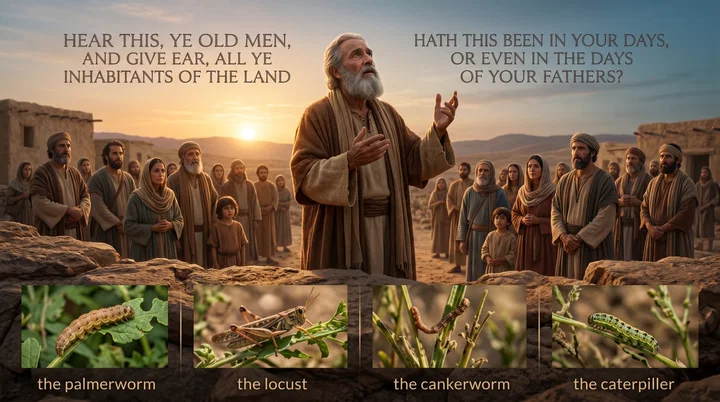
Cross-references
- Exodus 10:4-6
Else, if thou refuse to let my people go, behold, to morrow will I bring the locusts into thy coast:
Locusts are an image of devastating judgment.
- Joel 1:14-15
Sanctify ye a fast, call a solemn assembly, gather the elders and all the inhabitants of the land into the house of the LORD your God, and cry unto the LORD,
Calls the people to gather and seek God amid the devastation.
Commentary
Each commentary is drawn from primary sources: the writings of Ellen G. White and Adventist pioneers and periodicals. Each commentary is separate. Its own words are not a quotation; follow the references to read the source passages.
Ellen G. White
1 source
Together with the verses that follow it through verse 7, the summons to the aged and to all dwellers in the land to weigh whether anything like this occurred in their own lifetime or in their ancestors' time belongs to the prophecies of the last days.Ms 110, 1893, par. 13 It describes the moral condition of the world just before the second coming.Ms 110, 1893, par. 13 In that time iniquity abounds on every hand.Ms 110, 1893, par. 13 The abounding iniquity comes from transgressing God's law.Ms 110, 1893, par. 13 By that transgression men break the everlasting covenant.Ms 110, 1893, par. 13
Sources
Pioneers and periodicals
17 sources
Hear this summons to the aged and to every dweller in the land to listen closely and give earnest heed.ST Sep 26, 1911ST Nov 8, 1905ST Dec 3, 1874 It demands whether anything like this has happened in their own lifetime or even in the memory of their forefathers, marking the coming calamity as without precedent and all the more alarming for its severity.ST Sep 26, 1911ST Nov 8, 1905ST Dec 3, 1874 It announces an overwhelming wasting by successive swarms of devouring insects that strip crops, trees and pasture, leaving famine, suffering cattle, dried waters and drought in their wake.ST Sep 26, 1911ST Dec 3, 1874ST Jul 13, 1904 The warning belongs to the closing hours of time just before the second coming of Christ and the great day of the Lord, and is weighty enough to be told and retold from generation to generation.ST Nov 8, 1905ST Dec 3, 1874ST Dec 8, 1914 It is given so that the last generation may prepare and escape the approaching destruction by fleeing to the stronghold and ark of safety in the Lord, and those who take that shelter need not share in the ruin.RH Jan 8, 1901RH May 7, 1867ST Feb 13, 1901RH Sep 29, 1868
Summons to Hear Judgment
Hear this is addressed to the old men or elders and to all the inhabitants of the land, bidding them to hear, give ear, listen, and pay close attention.ST Sep 26, 1911ST Nov 8, 1905ST Dec 3, 1874ST Jul 13, 1904ST Jan 17, 1911 The prophecy opens abruptly with no introduction, withholding its subject to excite attention and alarm by first stressing its fearful nature.ST May 27, 1875RH Feb 18, 1875 The appeal is made first to the oldest men before the subject is revealed, calling them to attention concerning a coming judgment.ST May 27, 1875RH Feb 18, 1875
It asks whether this has been in their days or even in the days of their fathers, whether they or their ancestors had ever seen such devastation in their lifetime.ST Sep 26, 1911ST Nov 8, 1905ST Dec 3, 1874ST Jul 13, 1904RH Mar 31, 1868 The question marks the coming calamity as unprecedented in their own experience and in ancestral memory, with nothing in their days or their fathers' days to compare with it.ST Jan 17, 1911RH Mar 31, 1868RH Jan 8, 1901ST May 27, 1875RH Feb 18, 1875 By stressing its unprecedented severity it heightens alarm at the fearful judgment about to be announced.ST May 27, 1875RH Feb 18, 1875
The question introduces an extraordinary devastation by successive devouring insect pests, where each consumes what the previous ones leave.ST Jul 13, 1904ST Jan 17, 1911 Together they typify vast swarms of devouring insects, bringing ruin to crops, trees, and the land with widespread crop failure and loss making it nearly impossible to preserve food.ST Sep 26, 1911ST Jul 13, 1904ST Jan 17, 1911 The insects' names express their destructive character and need not identify four distinct species.ST Jul 13, 1904 In that setting crops and food fail, animals suffer and lack pasture, water dries up, and fire and drought intensify famine.RH Mar 31, 1868RH Jan 8, 1901
The locust devastation leaving the land desolate is a familiar figure of devastation.ST Mar 21, 1911 In that familiar sense it also portrays the devastating Saracenic forces that swept from Arabia and Western Asia into formerly Christian lands.ST Mar 21, 1911
Last-Day Warning and Refuge
The call to hear belongs to the closing hours of time just before the second coming of Christ and the great day of the Lord, and the matter is weighty enough to be told and retold from generation to generation.ST Nov 8, 1905ST Dec 3, 1874ST Dec 8, 1914RH Jan 8, 1901 The locust-like army and its devastation are the burden introduced by that call, and the grasshopper plague already seen is at least a beginning of that army's work shortly before the day of the Lord.ST Dec 3, 1874 The prophecy foretells insect pests becoming increasingly formidable in the last days, together with a spirit of war among the nations and widespread disease in which joy withers among men, all set forth as tokens and plagues of the last days and of the great day of the Lord.ST Dec 8, 1914ST Jul 13, 1904ST Feb 13, 1901ST Sep 23, 1913 The devastation comes by successive devouring pests that eat what the former have left, ruining crops, trees, and the land, and their names declare their destructive character rather than requiring four distinct species, for together they picture vast swarms of devouring insects.ST Jul 13, 1904
That ruin is already spreading and points forward to fuller agricultural ruin in the time of the plagues, when blessings are withheld from an unthankful world.ST Jan 17, 1911 Then God's restraining power will be withdrawn and the army of destructive insects let loose alongside the plagues of Revelation 16, falling upon those outside the ark of safety. In this the unprecedented crop failure and insect plague lay bare the decay of the earth under the curse of sin.ST Sep 26, 1911 The chapter also sets forth a work to be done before the Lord comes, coming after the Third Angel's Message and typified by the day of atonement and the feast of tabernacles, a work belonging to mortal probation and not to immortal saints.RH Sep 11, 1856
The warning is to be handed down through the generations so that the last generation and all who must face the approaching day of the Lord may hear of it, prepare, and escape.RH Jan 8, 1901RH Jan 8, 1901 Three generations are thus confronted with the question whether such dreadful conditions were ever witnessed before, and the answer marks the last generation as the one that must seek refuge in the stronghold.RH May 7, 1867 That preparation concerns coming famine, pestilence, and other plagues of the coming destruction, with fields withering, animals suffering, and fire and drought deepening famine.RH Jan 8, 1901RH Sep 29, 1868 Safety is found in the stronghold, the ark of safety, and the shelter of the Lord when restraining power is withdrawn.RH May 7, 1867RH Sep 29, 1868 Those who discern these signs and take that shelter need not share in the destruction, but Christ's servants may keep joy in His service and carry it to others even while disease and death are rampant and joy withers among men.ST Feb 13, 1901
Sources