John 13:32
If God be glorified in him, God shall also glorify him in himself, and shall straightway glorify him.
Translations
American King James Version, King James Version, KJV Cambridge Paragraph Bible
If God be glorified in him, God shall also glorify him in himself, and shall straightway glorify him.
If God is glorified in him, God will also glorify him in himself, and will immediately glorify him.
Revised Version, American Standard Version
and God shall glorify him in himself, and straightway shall he glorify him.
if God was glorified in him, God also will glorify him in Himself; yea, immediately He will glorify him.
If God be glorified in him, God also shall glorify him in himself, and shall glorify him immediately.
And, God, will glorify him, in himself,—and, straightway, glorify him.
Berean Standard Bible, Majority Standard Bible
If God is glorified in Him, God will also glorify the Son in Himself— and will glorify Him at once.
If God has been glorified in him, God will also glorify him in himself, and he will glorify him immediately.
If God is given glory in him, God will give him glory in himself, and will give him glory even now.
If God be glorified in him, God shall also glorifie him in himselfe, and shall straightway glorifie him.
Douay-Rheims (Challoner revision)
If God be glorified in him, God also will glorify him in himself; and immediately will he glorify him.
Pictures
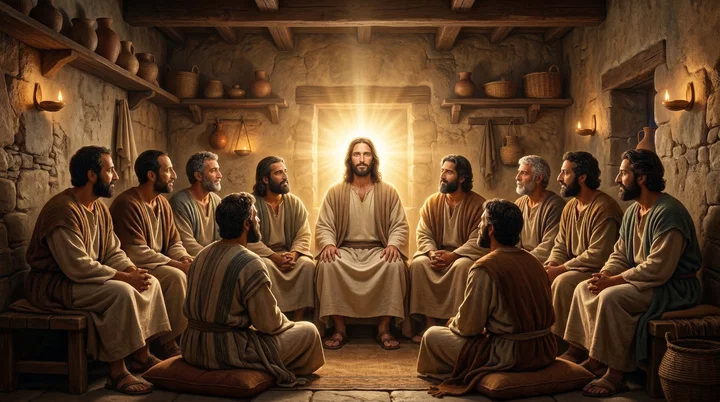
Cross-references
- John 17:1-5
These words spake Jesus, and lifted up his eyes to heaven, and said, Father, the hour is come; glorify thy Son, that thy Son also may glorify thee:
Jesus asks the Father to glorify him as his work reaches completion.
- John 12:23
And Jesus answered them, saying, The hour is come, that the Son of man should be glorified.
Jesus announces that the hour for the Son of man to be glorified has come.
- John 17:21-23
That they all may be one; as thou, Father, art in me, and I in thee, that they also may be one in us: that the world may believe that thou hast sent me.
Christ’s glory and love are shared with believers, who are called to unity with him.
- John 13:4-5
He riseth from supper, and laid aside his garments; and took a towel, and girded himself.
Jesus humbly stoops to wash his disciples’ feet.
- John 7:33-34
Then said Jesus unto them, Yet a little while am I with you, and then I go unto him that sent me.
same words first spoken to the Jews
- John 14:1-3
Let not your heart be troubled: ye believe in God, believe also in me.
Continues Christ’s words about leaving the disciples and preparing a place for them.
Commentary
Each commentary is drawn from primary sources: the writings of Ellen G. White and Adventist pioneers and periodicals. Each commentary is separate. Its own words are not a quotation; follow the references to read the source passages.
Ellen G. White
10 sources
The words belong to the eve of betrayal and crucifixion, when Jesus was approaching His imminent departure and coming separation from the disciples and preparing to leave them and tell them of it.Lt 56, 1907, par. 4–5Ms 97, 1906, par. 1–6Lt 131, 1900, par. 1–33SP 87.3–88.25RED 8.1–9.1 They were spoken immediately after Judas went out to do Satan's work in the streets of Jerusalem, no longer favored by God but abandoned to complete his betrayal with Christ's enemies.RH Nov 4, 1902 With the traitor gone, the painful restraint on Jesus during His last sacred meeting with the disciples was removed, and His countenance became cheerful and radiant with divinity clearly seen in humanity, transfigured and exalted above everything earthly.RH Nov 4, 1902 He marked that release and coming separation not by wasting words over the traitor's departure or speaking of the dreadful ordeal He must endure alone, but with tenderest affection as an irrepressible living spring of water, filling the disciples with admiration and love and a sense of co-partnership with Him that took away all thought of contention or desire to be first.RH Nov 4, 1902
The meaning is that God is glorified in the Son, the Son of man, and that because of this God will in turn glorify the Son in Himself, and do so immediately, straightway, soon.Lt 56, 1907, par. 4–5Ms 97, 1906, par. 1–63SP 87.3–88.2ST May 23, 18785RED 8.1–9.1 Christ's approaching humiliation and suffering would glorify the Father's name through the events now approaching, with approaching death and the glory bound up with it.DA 662.13SP 87.3–88.2ST May 23, 1878 Bringing that glory to the Father was a central purpose of Christ's mission and a source of joy to Him.DA 662.1 The disciples did not yet fully understand these truths about His approaching death, glory, and separation, but would understand them after the resurrection.ST May 23, 18785RED 8.1–9.1
As part of the chapter-long instruction and prayer expressing God's will for His people, the verse is connected with believers being made one with Christ in this life and remaining one with Him throughout eternity, calling for unity and love with one another and with Christ.RH Jun 18, 1901Lt 131, 1900, par. 1–3 Living that prayer out in practical life gives strength to withstand Satan's attacks and to stand the test.Lt 131, 1900, par. 1–3 Its words are not being heeded while God's people spoil His work with the defiling rubbish of unkind talk, passing judgment, and self-assured conversation that hurts souls.Lt 264, 1902, par. 11 They are then handling strange fire instead of receiving the Holy Spirit to cleanse their lips and make their counsels a savor of life unto life rather than a savor of death unto death.Lt 264, 1902, par. 11
Sources
Pioneers and periodicals
15 sources
The Father is glorified in the Son, and in turn will glorify the Son in Himself, and will do so at once.ST Jan 10, 1900 That glorifying is His approaching death, for the hour when the Son of man is glorified has come.ST Aug 12, 1886ST Nov 8, 1899 He spoke it the moment Judas took the sop and went out into the night to finish his betrayal.RH Nov 4, 1902ST May 26, 1909 Even with betrayal and suffering before Him He met the hour with calm dignity, self-forgetting love, and humility, stooping to wash His disciples' feet to enforce equality and lowliness.RH Nov 4, 1902RH Feb 24, 1859ST Aug 28, 1879 As Lord and Master He thereby left foot-washing as a standing ordinance and memorial of His humility, even as He told His own that He goes to prepare a place and will come again to receive them to Himself.ST Aug 18, 1881RH Jun 16, 1868ST May 21, 1896
Words and Setting
The saying belongs to the night of the Passover and the Lord's Supper in the upper room, to the final evening with the disciples before going to Gethsemane and betrayal.ST Nov 4, 1897ST May 21, 1896ST Mar 18, 1897 It is part of the instruction in John 13-14 given before leaving the upper chamber.ST Nov 4, 1897ST Mar 18, 1897 It stands within the upper-room discourse extending through John 13-17, which presents the divine glories of Christ and the theme of life.ST Mar 9, 1888ST Mar 18, 1897
It belongs to the foot-washing transaction in John 13, in which by an act a great moral lesson was enforced when surrounding circumstances called for it.RH Feb 24, 1859 As setting a little child in the midst taught humility and equality because the disciples had disputed who would be greatest in the kingdom of heaven, so this act taught humility and equality.RH Feb 24, 1859 It is not a lesson in hospitality, for the disciples showed no inhospitality and had no need of hospitality shown to them.RH Feb 24, 1859 To read the transaction as hospitality makes it a strange digression from the course of events then transpiring.RH Feb 24, 1859
It was spoken immediately after the pointing out of the betrayer.RH Nov 4, 1902ST May 26, 1909 Judas had received the sop and went out into the night.RH Nov 4, 1902 He went out to do Satan's work in the streets of Jerusalem, no longer favored by God but abandoned to complete his betrayal with Christ's enemies.RH Nov 4, 1902
The declaration was made as He looked upon His faithful followers.ST Aug 12, 1886 It introduces His approaching separation from the disciples.RH Nov 4, 1902ST Aug 12, 1886 It is the farewell word that where He goes they cannot come now but shall follow afterward, that He goes to prepare a place and will come again to receive them to Himself that where He is they may be also.ST Aug 18, 1881 It leads into Peter's questioning about where He is going.ST Aug 12, 1886
Glorification Through Death
If God is glorified in him, God in turn will glorify him in himself, and will do so immediately or straightway.ST May 23, 1878ST Jan 10, 1900 The saying was spoken as telling the disciples of soon separation, concerning approaching death and the glory bound up with it.ST May 23, 1878 It was spoken immediately after Judas received the sop and went out into the night, declaring that now the Son of man is glorified and God is glorified in him. That impending death is the glorification of himself and of God, to happen at once, for the hour of glorification had come.ST May 23, 1878ST Aug 12, 1886ST Nov 8, 1899 Looking upon faithful followers, the declaration introduces the approaching separation from the disciples and leads into Peter's questioning about where he is going.ST Aug 12, 1886
These truths about death and glory were not yet fully understood by the disciples, but would be understood after the resurrection.ST May 23, 1878 The greatness of his character is revealed and he is exalted in that he endured sorrow and the approach of betrayal and suffering with calm dignity, unwavering love, and humility.ST Aug 28, 1879 That included stooping to wash his disciples' feet, with self-forgetting care for friends and foes and steadfast endurance.ST Aug 28, 1879
The words were spoken immediately after Judas went out to do Satan's work in the streets of Jerusalem, no longer favored by God but abandoned to complete his betrayal with Christ's enemies.RH Nov 4, 1902 With the traitor gone the painful restraint in that last sacred meeting was removed, and his countenance became cheerful and radiant, with divinity clearly seen in humanity, transfigured and exalted above everything earthly.RH Nov 4, 1902 The release and coming separation were marked not by wasting words over the traitor's departure or speaking of the dreadful ordeal to be endured alone, but with tenderest affection as an irrepressible living spring of water.RH Nov 4, 1902 That filled the disciples with admiration and love and a sense of co-partnership with him that took away all thought of contention or desire to be first.RH Nov 4, 1902
Ordinance and Application
The chapter gives plain instruction that washing of feet must be practiced as an ordinance, for He who speaks here is Lord and Master, the Prince of glory.RH Jun 16, 1868 It is a memorial of His humility, just as the bread and wine are a memorial of His death and baptism is a memorial of His resurrection.RH Jun 16, 1868 The ordinance was kept in the earlier and purer ages of this dispensation until Rome laid polluting hands upon the ordinances of the church and either abolished or perverted them.RH Jun 16, 1868 At the close of the age the gospel must be as pure as at the beginning, so the perverted or neglected ordinances must be restored and foot-washing must occupy its appropriate place in the golden chain.RH Jun 16, 1868
The Lord's Supper and the washing of feet instituted on that final evening with the disciples in the upper room remind believers of His taking human nature, His humble life in the work of salvation, and His body and blood given for the world.ST May 21, 1896 As part of the chapter expressing God's will for His people, the saying is connected with believers being made one with Christ in this life and remaining one with Him throughout eternity.RH Jun 18, 1901 Standing in the farewell promise that where He goes they cannot come now but shall follow afterward, that He goes to prepare a place and will come again to receive them to Himself that where He is they may be also, it shows that His people get to be with Him at His second coming and not by going to Him at death.ST Aug 18, 1881
Sources