Translations
American King James Version, Webster Bible, Darby Translation
Nicodemus answered and said to him, How can these things be?
King James Version, KJV Cambridge Paragraph Bible, Revised Version, American Standard Version
Nicodemus answered and said unto him, How can these things be?
Nicodemus answered and said to him, 'How are these things able to happen?'
Nicodemus answered, and said unto him—How, can these things, come about?
Berean Standard Bible, Majority Standard Bible
“ How can this be?” Nicodemus asked.
Nicodemus answered him, “ How can these things be?”
And Nicodemus said to him, How is it possible for these things to be?
Nicodemus answered, and said vnto him, Howe can these things be?
Douay-Rheims (Challoner revision)
Nicodemus answered, and said to him: How can these things be done?
Pictures
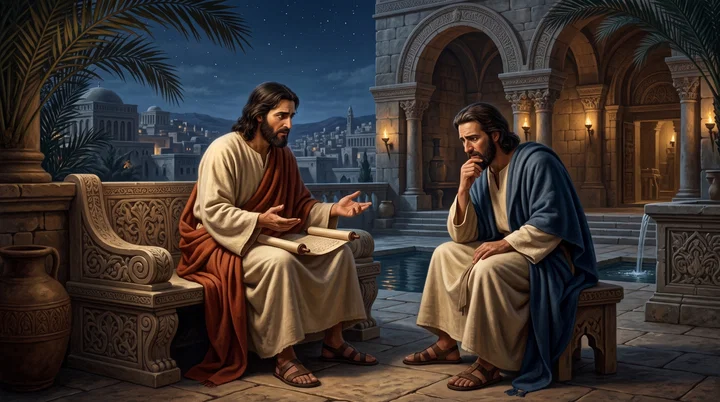
Cross-references
- John 3:3
Jesus answered and said unto him, Verily, verily, I say unto thee, Except a man be born again, he can not see the kingdom of God.
Jesus states the need to be born again, prompting Nicodemus’s question.
- John 3:2
The same came to Jesus by night, and said unto him, Rabbi, we know that thou art a teacher come from God: for no man can do these miracles that thou doest, except God be with him.
Nicodemus’s question follows his nighttime visit to Jesus.
- John 3:14-15
And as Moses lifted up the serpent in the wilderness, even so must the Son of man be lifted up:
The lifted-up serpent explains how looking to Christ brings life.
- John 3:4
Nicodemus saith unto him, How can a man be born when he is old? can he enter the second time into his mother’s womb, and be born?
Nicodemus first asks how an old man can be born again.
- John 3:5
Jesus answered, Verily, verily, I say unto thee, Except a man be born of water and of the Spirit, he can not enter into the kingdom of God.
Jesus explains birth by water and the Spirit.
- John 7:50-51
Nicodemus saith unto them, (he that came to Jesus by night, being one of them,)
Nicodemus later asks the council to hear Jesus before judging him.
- Numbers 21:8-9
And the LORD said unto Moses, Make thee a fiery serpent, and set it upon a pole: and it shall come to pass, that every one that is bitten, when he looketh upon it, shall live.
The raised serpent illustrates Jesus being lifted up, bringing life to those who look to him.
- John 19:39
And there came also Nicodemus, which at the first came to Jesus by night, and brought a mixture of myrrh and aloes, about an hundred pound weight.
Nicodemus openly helps prepare Jesus’ body for burial.
- 2 Kings 7:2
Then a lord on whose hand the king leaned answered the man of God, and said, Behold, if the LORD would make windows in heaven, might this thing be? And he said, Behold, thou shalt see it with thine eyes, but shalt not eat thereof.
Both ask how an extraordinary divine act could happen.
- John 6:52
The Jews therefore strove among themselves, saying, How can this man give us his flesh to eat?
The Jews question how Jesus’ teaching could be possible.
- Mark 10:27
And Jesus looking upon them saith, With men it is impossible, but not with God: for with God all things are possible.
God makes possible what is impossible for people.
- Ezekiel 36:26-27
A new heart also will I give you, and a new spirit will I put within you: and I will take away the stony heart out of your flesh, and I will give you an heart of flesh.
Promises a new heart and Spirit within.
Commentary
Each commentary is drawn from primary sources: the writings of Ellen G. White and Adventist pioneers and periodicals. Each commentary is separate. Its own words are not a quotation; follow the references to read the source passages.
Ellen G. White
43 sources
In His private night interview with Nicodemus, after teaching that a man must be born again of water and of the Spirit to see and enter the kingdom of God, like the wind heard but with unknown origin and destination, Nicodemus answered in astonished unbelief asking how these things could be.Ms 3, 1909, par. 6–8Ms 82, 1905, par. 1–2Lt 55, 1895, par. 51–55Lt 52, 1886, par. 4–5SC 28.3–29.1 He was more puzzled by the manner of the new birth than convinced of its necessity, for as a righteous ruler and teacher he thought his self-righteousness, good deeds, and exalted position entitled him to heaven and took the new birth in a literal instead of a spiritual sense.Lt 52, 1886, par. 4–5DA 173.2–174.1SC 28.3–29.1 The new birth is the cleansing and transforming work of the Spirit upon the unregenerate heart, necessary to discern God's kingdom, invisible in itself like the wind yet evident in a changed life of love, peace, and humility.Lt 54, 1894, par. 7–8Lt 4, 1895, par. 13–15Ms 53, 1905, par. 13–14ST Jan 11, 1877ST Apr 15, 1886 Jesus rebuked his ignorance as a master of Israel and pointed him to faith in the Son of Man lifted up, that eternal life comes through believing in Him and looking to the crucified and risen Savior and living.Lt 54, 1895, par. 45–49Ms 1, 1889, par. 2–5Ms 148, 1899, par. 9–11SPBC 186.41MR 364.3–365.2 All must enter life in the same way, renouncing personal righteousness and self-reliance and relying wholly on Christ whose righteousness is credited to the believer, a lesson Nicodemus remembered at the cross and which became the beginning of steadfast faith.DA 176.2–177.12SP 135.2–136.15T 219.1–3RH Nov 18, 1909SC 28.3–29.1
Setting and Occasion
The question belongs to Jesus' private night interview with Nicodemus, an honored rabbi, in which He gave precious individual instruction explaining the plan of salvation and the work needed in the hearts of those who inherit the kingdom of heaven.DA 176.2–177.1ED 231.2–232.1 That questioning did not mean the teaching was lost, for he remembered it when Jesus was lifted up on the cross and recognized Him as the world's Redeemer.DA 176.2–177.1
It comes from Jesus' meeting with a wealthy and cultured Pharisee.MH 24.2 While He ministered to the poor, He also studied to find ways of reaching the rich, seeking the acquaintance of such men, accepting their invitations, attending their feasts, and making Himself familiar with their interests and occupations, that He might gain access to their hearts and reveal to them imperishable riches.MH 24.2
The question follows Jesus' teaching that a man must be born again to see the kingdom of God, must be born of water and of the Spirit to enter the kingdom of God, that what is born of flesh is flesh and what is born of Spirit is spirit, and that everyone born of the Spirit is like the wind blowing where it wishes, heard but with unknown origin and destination.Ms 3, 1909, par. 6–8Ms 82, 1905, par. 1–2 It records Nicodemus asking how these things can be after being told he must be born again and that everyone born of the Spirit is like the wind whose sound is heard but whose coming and going cannot be traced.Ms 3, 1909, par. 6–8Ms 82, 1905, par. 1–2 It shows him asking how a person can be born again after Jesus teaches that a man must be born of water and of the Spirit to enter the kingdom of God and compares one born of the Spirit to the wind.Lt 55, 1895, par. 51–55ST Mar 6, 1907 He is amazed because he cannot see how he could enter a kingdom so pure without this new birth, after Jesus has explained that everyone born of the Spirit is like the wind, whose movement can be heard but whose origin and destination cannot be known.Lt 55, 1895, par. 51–55ST Mar 6, 1907
The verse belongs to Jesus' secret interview with Nicodemus, whose testimony about Jesus corresponds to John the Baptist's testimony about Christ's superiority.2SP 137.3–138.2
Question's Meaning and Attitude
Nicodemus asks how these things can be, voicing his struggle to grasp what Jesus has just taught him about the new birth.DA 167.2–168.1DA 167.1 Learned and high-standing as he is, he still does not understand, and he needs to learn more of the truths set before him.DA 167.2–168.1DA 167.1 He is more puzzled by the manner in which the new birth occurs than convinced of its necessity.DA 173.2–174.1 That failure to comprehend the work of grace in the heart also keeps him from understanding Christ's heavenly kingdom and mission.DA 173.2–174.1
His question comes in amazement, for he cannot see how anyone can enter so pure a kingdom without being born again. Gleams of truth are beginning to penetrate his mind, and Christ's words fill him with awe as he asks how this can happen.SPBC 186.4STMW9 25.2–26.1 His asking in awe and earnestness shows truth dawning upon him, though he has not yet fully grasped its spiritual meaning.SPBC 186.4STMW9 25.2–26.1
He whispers the question in astonished, startled unbelief.Lt 52, 1886, par. 4–5 As a righteous ruler and teacher in Israel praised by men, he has supposed he needs no spiritual work, imagining that self-righteousness, benevolence, many good deeds, and exalted position entitle him to heaven.Lt 52, 1886, par. 4–5 He comes with the mistaken confidence that his upright life and moral character exempt him from humbling himself before God like an ordinary sinner.SC 28.3–29.1 His comprehension is dull, taking being born again in a literal rather than a spiritual sense.Lt 52, 1886, par. 4–5
His stumbling comes from spiritual ignorance and from reliance on forms and precise ceremonies instead of the deep work of the Spirit.Lt 54, 1895, par. 45–49Lt 54, 1894, par. 11–12 Though a teacher in Israel, he is unwilling to admit truth he cannot fully explain, even while he accepts facts of nature that he cannot explain or comprehend.Lt 54, 1894, par. 11–12 His answer is that of one awakened and convicted yet held back by outside influences, speaking in puzzled unbelief and doubt.Lt 223, 1905, par. 21–25 It marks a change from irritation toward earnest inquiry, though he still does not fully understand the spiritual meaning.Lt 223, 1905, par. 21–25STMW9 25.2–26.1
Nature of New Birth
The new birth Jesus taught is necessary for a person to see the kingdom of heaven and to enter it, for it is the change of heart needed to discern God's kingdom, and one who has not been reconverted cannot see it.Lt 4, 1895, par. 13–15Ms 53, 1905, par. 13–14 That birth concerns the Spirit cleansing and transforming the unregenerate heart, not the bodily resurrection nor a nation being born in a day.ST Jan 11, 1877 It removes sin and gives new life, holiness, and fitness for God's kingdom, with God's truth bringing real change and sanctifying power in life and character.Ms 1, 1889, par. 2–5ST Jan 11, 1877
Its divine work is beyond human understanding and cannot be reconciled with mere human ideas of religion nor explained by precise human methods, which is why Nicodemus could not understand how God's power works.Lt 54, 1894, par. 7–8Lt 54, 1894, par. 11–12ST Jan 11, 1877 Though a teacher in Israel, he stumbled over conversion because he was unwilling to admit truth he could not fully explain, even while he accepted facts of nature he could not explain or comprehend, and his difficulty reflected reliance on forms and precise ceremonies rather than the deep work of the Spirit.Lt 54, 1894, par. 7–8Lt 54, 1894, par. 11–12 Jesus explained it by the wind, whose sound is heard but whose coming and going cannot be traced, teaching that the Spirit's work is invisible in itself yet its effects are evident in a changed life and actions.Lt 54, 1894, par. 7–8ST Jan 11, 1877ST Apr 15, 1886
The Spirit renews the mind and transforms the life, putting away wicked thoughts and deeds and producing love, peace, and humility, so that the inward change becomes visible in the person's actions.ST Jan 11, 1877ST Apr 15, 1886 What seemed mysterious to Nicodemus is thus answered by the unseen wind known by its effects, replacing evil with good in thought and deed.ST Jan 11, 1877ST Apr 15, 1886
Christ's Answer and Salvation
Jesus met the question with a rebuke spoken in deep earnestness, asking how a master of Israel could be ignorant of these things when one entrusted with the religious instruction and interests of the people ought to know this essential condition of divine life and entrance into the kingdom of heaven.Lt 54, 1895, par. 45–49SPBC 186.41MR 364.3–365.2 The rebuke exposed spiritual ignorance in a learned counselor who did not understand the change wrought by the Spirit, and it called for humility rather than irritation over plain truth or indulgence in irony.Lt 54, 1895, par. 45–49SPBC 186.4 It was uttered with solemn dignity and with earnest love in look and tone, so that Nicodemus, realizing his humiliating position, was not offended.Lt 55, 1895, par. 51–55SPBC 186.4
The change from irritation toward earnest inquiry showed gleams of truth penetrating his mind as Christ's words filled him with awe, yet he still had not fully grasped the spiritual meaning.Lt 55, 1895, par. 51–55SPBC 186.4STMW9 25.2–26.1 Christ did not answer with controversy but with new light intended to give practical truth and a new heart rather than mere learning or argument.Lt 223, 1905, par. 21–25 Until the heart is changed, reasoning about points of difference brings no saving result and only strengthens resistance, so God's workers are to keep to the affirmative and refuse to be drawn into controversy over false theories.Lt 223, 1905, par. 21–25
He directed Nicodemus to His own testimony of what He knew and had seen, though that witness was not received, and warned that if earthly things were told and not believed, heavenly things would not be believed.SPBC 186.4Lt 223, 1905, par. 21–25 He pointed him to faith in the Son of Man lifted up and to eternal life through belief in Him.Ms 148, 1899, par. 9–11SPBC 186.4 His words about being lifted up pointed to His crucifixion, which His disciples did not understand beforehand but after His resurrection proclaimed as Christ crucified and risen.Ms 1, 1889, par. 2–5
The answer to how these things can be is to look to the lifted-up Christ and live.DA 175.3–176.1 Like Nicodemus, many cannot see how salvation can come through looking to Jesus and trusting His grace rather than relying on obedience to earn God's favor, yet they must receive life as sinners through Christ.DA 175.3–176.1 Faith earns nothing but takes hold of Christ and His merits, and even repentance comes through the aid of God's Spirit, whose work draws souls to the cross, brings repentance, creates new life, and writes God's law in the heart.DA 175.3–176.1
All must enter into life in the same way as even the chief of sinners, for moral character and upright life may tempt a man to think he need not humble himself before God like an ordinary sinner.5T 219.1–3RH Nov 18, 1909SC 28.3–29.1 He must renounce personal righteousness and self-reliance, rely wholly on Christ, plead for Christ's righteousness to be credited to him, depend wholly on Him for strength, and give God the glory for His mercy and truth.5T 219.1–3RH Nov 18, 1909 Human strength must give way to dependence on divine grace, for Christ's light exposes impurity, selfish motives, and enmity against God within every person, and seeing Christ's purity makes sin and the defects of human character painfully clear.SC 28.3–29.1 Human righteousness cannot cleanse this defilement; only Christ's blood can cleanse from sin and renew the heart in His likeness.SC 28.3–29.1
Salvation is a living connection with God and a faith that lays hold of the merits of Christ, the crucified and risen Savior, as our righteousness, with God's truth bringing real change and sanctifying power in life and character.Ms 1, 1889, par. 2–5 Persistent unbelief in those holding positions of truth yet failing to recognize truth God has sent keeps them from understanding justification by faith, while taking sin to Jesus for forgiveness brings that understanding and peace with God.Ms 75, 1899, par. 5 The question also expresses wonder at the possibility of God's love abiding in believers and of salvation through Christ.FE 178.1 That love is received by faith in the Son of God, and union with Christ makes believers one with Him and recipients of the Father's love, which strengthens and reshapes the character.FE 178.1
Nicodemus's Later Belief
His questioning in John 3:9 did not mean the instruction of that night interview on the plan of salvation and the work needed in hearts to inherit the kingdom was lost.DA 176.2–177.1 He had come to learn the way of life, and the truths taught in that conversation afterward became the beginning of a faith that made him steadfast in supporting the followers of Christ.2SP 135.2–136.1 When Jesus was lifted up on the cross he remembered that teaching and recognized Him as the Redeemer of the world.DA 176.2–177.1 He received the lesson about the new birth and the kingdom and became a true believer, and the daily work of the Holy Spirit in the heart gives insight to perceive the character of God's kingdom.STMW9 27.1
Warning to Teachers and Workers
How can these things be reveals that even a learned teacher in Israel holding an honorable position lacked a true understanding of the first principles of Christian experience.Ms 101, 1907, par. 7–8Ms 68, 1897, par. 22FE 517.3–46T 154.2RH Nov 7, 1907 He had not learned the alphabet of true Christian experience and needed instruction in the very first principles of the divine life, the conditions of divine life and conversion itself.Ms 101, 1907, par. 7–8FE 459.3–461.1Ms 68, 1897, par. 22FE 517.3–4RH Nov 7, 1907 His question proves he had no true conception of what a teacher in Israel should be, lacking the spiritual understanding needed to grasp conversion and the beginning of the knowledge a true teacher needs.FE 517.3–46T 154.2RH Nov 7, 1907 That same ignorance and lack of preparatory experience disqualifies many holding positions of responsibility as teachers who have neglected the work essential to be done before they were qualified to teach.FE 459.3–461.1Ms 68, 1897, par. 226T 154.2 They are left without the higher intelligence and deeper spiritual knowledge of what constitutes a disciple and sincere follower of Christ, and they must first do that work, for receiving Christ's words brings deeper spiritual understanding of discipleship and God's transforming grace gives insight to follow Him.FE 459.3–461.1Ms 68, 1897, par. 226T 154.2
His ignorance of the most essential part of education, that which fits a person to deal with human minds in a Christlike manner, drew Christ's rebuke.FE 517.3–4 The same rebuke belongs to teachers, physicians, and ministers of the gospel in responsible positions today who have neglected that education.FE 517.3–4 The question exposes spiritual ignorance in one handling sacred truth, and it stands as a direct rebuke to those in the most responsible positions managing sacred work who have put a misshapen mold upon the cause.Ms 29, 1903, par. 3–6 They have perverted principles, held back in unbelief and fear from opening new territory, and misappropriated means raised for neglected fields, and like Nicodemus they must be broken as a potter's vessel is broken and reconstructed, and be converted in heart, soul, and body.Ms 29, 1903, par. 3–6
The verse shows the ignorance of spiritual things by learned men even when truth is stated clearly and distinctly with appropriate arguments and illustrations and earnest hope to save them.Lt 48, 1897, par. 12–23 Their carnal mind is as dark as midnight, unable to distinguish sacred, eternal interests from common things and treating sacred things as merchandise, for spiritual things are spiritually discerned and illumination must come from the Holy Spirit, not by might nor by power.Lt 48, 1897, par. 12–23 The failure to arouse their benumbed senses grieves and astonishes God's worker and tempts him to discouragement and to ask what is the use of working, but discouragement must not win.Lt 48, 1897, par. 12–23 The most simple representation will be most effective, and every believing child of God is to keep on working without failing whatever ignorance learned men show.Lt 48, 1897, par. 12–23 The question applies to people who hold positions of truth yet fail to recognize truth God has sent, whose persistent unbelief keeps them from understanding justification by faith, while taking sin to Jesus for forgiveness brings that understanding and peace with God.Ms 75, 1899, par. 5 It is greatly needed also by men who calculate just how religious exercises should be conducted and are very precise and methodical in diffusing the light and grace they hold.Lt 54, 1894, par. 6 Such precision proves they have little of the Holy Spirit, and with more of the Spirit they would meddle less with the experiences of those who have received this divine gift in large abundance.Lt 54, 1894, par. 6
Sources
Pioneers and periodicals
63 sources
Nicodemus is answering Jesus' teaching on the new birth in their private conversation by night about the kingdom of God and salvation, asking how these things can be or happen.ST Aug 27, 1894ST Aug 27, 1894ST Jul 16, 1896RH Nov 19, 1908
He asks after hearing that a person must be born of water and the Spirit and that everyone born of the Spirit is like the wind, whose sound is heard but whose origin and destination are unknown.ST Mar 6, 1907ST Aug 27, 1894ST Jul 16, 1896
His question shows perplexity, amazement and lack of understanding about being born again and born of the Spirit, and how a natural person can enter so pure a kingdom.ST Jun 22, 1904ST Jan 11, 1899
Becoming a subject of God's kingdom and seeing it requires birth of the Spirit, an inward change of conversion in which God gives a new heart, cleanses, renews the mind and transforms the life by the Holy Spirit through the Word; spiritual life does not come through natural generation, for flesh cannot produce a spiritual nature.ST Mar 8, 1899ST Apr 7, 1881ST Sep 17, 1894ST Feb 24, 1898RH Aug 30, 1870
That change cannot be accomplished by human power or learned by human reason alone but must be received by simple faith in the power of God's word, for divine truths may be beyond the finite mind's comprehension; the question both expresses a sincere desire for further instruction and marvels, doubts and questions by unaided human reason, trying to show the teaching impossible, which is why it is a great surprise that Nicodemus, a ruler, Pharisee and learned master in Israel, did not know it.ST Jan 18, 1905ST Jan 18, 1905ST Sep 17, 1894RH Sep 13, 1906RH Jul 23, 1914
Setting of the Interview
The question belongs to Jesus' private, personal conversation with Nicodemus by night about his soul, the kingdom of God, and the way to be saved, recorded at length in John 3.RH Nov 19, 1908RH Jul 4, 1907RH Mar 16, 1916ST Jan 20, 1914 Nicodemus came secretly for lack of courage to face hostility, though believing God had sent Jesus to teach deep truths, in contrast with his later public devotion after being born again.ST Mar 11, 1913 The exchange shows that people could bring their questions to Jesus and receive answers, and that God still answers through His written Word.RH Mar 16, 1916
The quiet, personal setting allowed Jesus to instruct Nicodemus in a way that would not have been possible before the Jewish Sanhedrin, and Nicodemus was more able to receive that instruction.RH Jul 4, 1907 Jesus taught people individually as well as preaching to crowds.RH Nov 19, 1908 The interview is one of the greatest sermons Jesus preached to one soul alone, and it leaves an example of personal work for souls to be followed. His sermon to one person was significant work, showing that speaking with and winning even one person for Christ is not a small task.RH Feb 9, 1911
Jesus ignored all compliments and flatteries and wasted no time or words in idle, commonplace conversation but made a direct reference to spiritual things to supply his greatest necessity, in the same way He dealt with the lowly Samaritan woman.ST Jan 25, 1905 The discourse is held up as a model for preaching and conversation: present clear gospel truth rather than pursue public controversy, so that people recognize their guilt before God and their need of a Saviour.RH May 18, 1911 Christ spoke openly to Nicodemus as a teacher in Israel, hiding nothing, and the gospel He brought was freely available to all.RH Oct 7, 1909
The midnight conversation with Nicodemus the proud Pharisee shows Christ as the Master soul-winner meeting men where they are without lowering His own level of true manliness in life and speech, reaching down not by degrading Himself but by translating His pure life into pity and helpfulness.ST Oct 15, 1902 Coarse methods, loud manners, and slang are never necessary to gain sympathy and lead people to Christ and a higher life, those who degrade themselves to win others will come to grief, and true workers must remain Christian gentlemen like Jesus.ST Oct 15, 1902 The asking of how the things taught could be points to Jesus' kind and compassionate dealings with Nicodemus, a learned Pharisee, alongside His care for people from very different backgrounds.RH Mar 24, 1910
Meaning of the Question
The question is Nicodemus's answer to Jesus' teaching about the new birth, asking how these things can be or happen.ST Aug 27, 1894ST Aug 27, 1894ST Jul 16, 1896ST Oct 20, 1914ST Aug 12, 1889 He asks it after hearing that a person must be born of water and the Spirit and that the Spirit's work is like the wind, yet he still does not understand spiritual things or the work of the Spirit.ST Aug 27, 1894ST Aug 27, 1894ST Jul 16, 1896 His perplexity is over being born of the Spirit, over how such things can happen.ST Jan 11, 1899ST Oct 20, 1914 The difficulty reflects his struggle to accept what Jesus taught about this earthly change.ST Aug 12, 1889
His asking shows perplexity, amazement, and lack of understanding about being born again and being born of the Spirit.ST Jun 22, 1904ST Jan 11, 1899ST Jul 16, 1896 He cannot see how a natural person can be born again, how one mature in years can be so changed, or how anyone can enter so pure a kingdom without this new birth.ST Mar 6, 1907ST Jun 22, 1904ST Jul 8, 1913 Though he can see beauty and force in Jesus' words, he asks doubtfully because he does not yet understand how God's Spirit works unseen within a person.ST Jul 8, 1913 The change is brought about by divine agencies invisible to the natural eye and perceived through faith, like the unseen operation of the wind, and its mystery belongs to the divine mind.ST Jun 22, 1904
He does not understand how a person born of the Spirit can be like the wind, whose movement or sound is heard but whose origin and destination are unknown.ST Mar 6, 1907ST Aug 27, 1894 His difficulty reflects the limits of human understanding when faced with the Spirit's work, whose effects are evident even though its working cannot be explained.RH Nov 7, 1907 He asks how Jesus' teaching about being born of the Spirit could be true, revealing ignorance of spiritual things despite religious standing and claimed righteousness and lack of understanding of the change of heart everyone must experience before entering God's kingdom.ST Oct 20, 1914ST Jul 16, 1896
The question also shows that he did not yet understand and wanted further instruction and explanation of his difficulties.ST Jan 18, 1905ST Jan 18, 1905RH Jul 1, 1902 He sought truth from one he recognized as a divine teacher, bringing his difficulties to receive answers, and the interview led to a practical lesson that exposed his need for true conversion and how far he was from light.RH Jul 1, 1902RH Mar 16, 1916RH Jul 1, 1902 In this the nighttime conversation about the way to be saved shows that people could bring their questions to Jesus and receive answers from Him, and that God still answers through His written Word, illustrating earnest truth-seeking held up for imitation.RH Mar 16, 1916RH Jul 1, 1902RH Jul 1, 1902
At the same time the question marvels, doubts, and questions Christ's teaching that men must be born again, trying to show it impossible.ST Jun 21, 1899ST Nov 5, 1896 It follows the method of the schools, the method of unbelief, the method of science falsely so called, the method of unaided human reason, questioning God's Word and power with an insinuating How.ST Jun 21, 1899 It is the same old question asked by Moses about a table in the wilderness, by the unbelieving noble about plenty in famine, by the disciples about feeding the multitude in the wilderness, and by seminary teachers training young men to bear the gospel message.ST Jun 21, 1899 His hesitating reflects how difficult it is to give up ideas learned over many years, especially for a teacher committed to those ideas, and the question is less sad from the world than from a professed teacher of the gospel, though he later learned wisdom by attending to the word.ST Jun 21, 1899ST Nov 5, 1896ST Apr 9, 1902
Nature of the New Birth
To see and enter God's kingdom a person must be born of the Spirit, for spiritual life does not come by natural generation and flesh cannot produce a spiritual nature.ST Mar 8, 1899ST Sep 17, 1894 This birth is the inward change of conversion in which God gives a new heart, cleanses and renews the person, removes sin, and transforms the life by the Holy Spirit through the Word, giving new life, holiness, and fitness for God's kingdom.ST Jan 11, 1877ST Apr 15, 1886ST Apr 7, 1881ST Feb 24, 1898RH Aug 30, 1870 The heart must be put in right order by God before it can be kept with diligence, and as Prince of life Christ redeems a chosen people of all who call upon His name in truth, delivers them from the bondage of corruption, and purifies them by regeneration through His Word to present them at last blameless and holy before the Father's glory as heirs of eternal life, triumphant over every temptation and power of the enemy.ST Feb 24, 1898RH Aug 30, 1870 The Spirit renews the mind, putting away evil thoughts and deeds and producing love, peace, and humility that become visible in changed actions.ST Jan 11, 1877ST Jan 11, 1877ST Apr 15, 1886
That divine work begins when a person yields to the Spirit and continues until grace is perfected or the Spirit is grieved away, and at last the same Spirit will also make God's people immortal and complete the work.ST Apr 7, 1881 Its operation is invisible to the natural eye like the wind, whose sound is heard though its origin and destination are unknown, and it is perceived through faith and known by its evident effects though its working cannot be explained.ST Jan 11, 1877ST Jan 11, 1877ST Apr 15, 1886ST Jun 22, 1904RH Nov 7, 1907 Water baptism is the sign of renouncing the world and receiving the Spirit, whose power from above regenerates and gives life.ST Dec 11, 1901 The change cannot be accomplished by human power or learned by human reason alone but must be received by simple faith in the power of God's word, for as a miracle of grace it is known through experiencing it rather than explained as a human achievement.ST Sep 17, 1894RH Jul 23, 1914
Those who held that the fitness for the kingdom is future taught that people in the present mortal state cannot enter it but must undergo the great change of being born again or born of the Spirit, which is the putting on of incorruption and immortality at the resurrection or an equivalent change, not merely conversion into members of a spiritual kingdom established in believers' hearts at Christ's first advent.RH Jan 22, 1857 In that reckoning the question was debated whether this birth occurs before a person is changed from mortality to immortality, or from corruption to incorruption, with the new birth said to involve the whole person and the inward experience sometimes called the birth distinguished as begetting.RH Feb 20, 1855 The weight of teaching holds instead that Jesus was speaking of the Spirit cleansing and transforming the unregenerate heart, not of the bodily resurrection or of a nation being born in a day, while likewise distinguishing the inward experience sometimes called the birth as begetting and the new birth as involving the whole person.ST Jan 11, 1877RH Feb 20, 1855
Faith and Human Reason
The question how these things can happen shows a mind unable to grasp what was described about spiritual things.RH Sep 13, 1906 Divine truths can lie beyond the comprehension of the finite mind, just as even some simple processes in nature cannot be explained.RH Sep 13, 1906 Believing that God speaks prepares the mind to understand what He says.RH Sep 13, 1906
The how follows the method of the schools, the method of unbelief, the method of science falsely so called, and the method of unaided human reason.ST Jun 21, 1899 It marvels and doubts and questions the teaching that people must be born again, questioning God's word and power with an insinuating how.ST Jun 21, 1899 It is the same old common question asked by Moses about a table in the wilderness, by the unbelieving noble about plenty in famine, and by the disciples about feeding the multitude in the wilderness, and it is still asked by seminary teachers training young men to bear the gospel message.ST Jun 21, 1899 The question is less sad from the world than from a professed teacher of the gospel.ST Jun 21, 1899
Unbelieving reason questions how God can do what He promised, and when people stop to reason about promises and say they do not see how God can do it, that tells God they do not believe Him.ST Nov 19, 1885 If faith does not honor God, He cannot honor people with mighty things for them, though for His own name's sake He will still do something.ST Nov 19, 1885 If the waiting disciples at Jerusalem had tried to work out how power from on high would be sent upon them, they never would have been endued with power.ST Nov 19, 1885
The asker tried to show by reason that the new birth was impossible, but he later learned wisdom by attending to the word.ST Nov 5, 1896 People hear spoken truth in fragments and do not understand, asking how these things can be, yet even the wonderful third chapter of John as a fragment found by the wayside can draw a seeker to ask for instruction.ST Jul 7, 1909 The printed book remains to be read and reread until the mystery of God is unfolded by His Holy Spirit to the dull heart of man.ST Jul 7, 1909 Truth may be hidden for years and then in some strange way come forth into other hands to be the seed of life.ST Jul 7, 1909
Who Nicodemus Was
Nicodemus was a ruler and leader in Israel, a Pharisee, and a learned and honored teacher and master of Israel, yet he did not know and understand what being born again or being born from above is.ST Apr 25, 1906RH Apr 10, 1913ST Jan 14, 1913ST Apr 9, 1902 His asking how these things can be shows him puzzled by the teaching on true connection with Christ and on divine life, wondering how it could be true.RH Nov 7, 1907ST Apr 25, 1906ST Jan 14, 1913 Though honored as a teacher, he lacked the first principles of Christian experience, the beginning knowledge needed for true teaching and for entering God's kingdom.RH Nov 7, 1907ST Apr 9, 1902 He came by night to learn the meaning of the new birth, hesitating because the teaching was hard to understand after many years spent in contrary ideas, especially for one committed to them as a teacher.RH Apr 10, 1913ST Apr 9, 1902 His ignorance proves that the Pharisees had never experienced the new birth, which goes beyond mere outward observance of the law to a change of heart that everyone must experience before entering God's kingdom.ST Oct 20, 1914RH Apr 10, 1913
Jesus' reply rebukes him and expresses great surprise that so great a master in Israel was ignorant of the new birth, the converted life, and spiritual regeneration.RH Jul 9, 1901ST Apr 9, 1902 That new birth is not of the law but belongs to true faith and genuine salvation as the blessed work of the Spirit.RH Jul 9, 1901 Without it there is no true conception of genuine Sabbath keeping and no spiritual power to keep it, since true keeping involves real heart service and resting from sin as well as outward observance of the day.RH Apr 10, 1913 With only carnal minds men could adopt nothing but strict regard for every outward detail enforced by human power and law, and if even Nicodemus did not understand, the ordinary Pharisee was much less likely to comprehend it.RH Apr 10, 1913 Jesus explained that Nicodemus did not believe even the earthly things told him, and would therefore find it harder to believe heavenly things.ST Jan 14, 1913
He assumed his correct moral conduct and character meant he did not need to humble himself before God like a sinner and unlike ordinary sinners.ST Jul 14, 1887RH Nov 18, 1909 No one enters life by relying on personal goodness or merit, for self must die, own righteousness be renounced, and salvation depend wholly on Christ's righteousness and strength credited to the believer, with God given the glory for His mercy and truth.ST Jul 14, 1887RH Nov 18, 1909 Like the young ruler he did not at first appreciate Jesus' divine character and thought of Him as a mere man, though he knew from the Scriptures that His power came from God and recognized Him as a divine teacher sent to teach deep truths.RH Jul 1, 1902ST Nov 8, 1899ST Jun 19, 1884 His questions showed desire for instruction while exposing how far he was from light and how much he lacked true understanding of conversion.RH Jul 1, 1902 He came secretly by night for lack of courage to face hostility, in contrast with his later public devotion to Jesus after he was born again.ST Mar 11, 1913
Doctrine and Scripture Connections
The questioning belongs to the conversation in John 3:1-15 that sets forth the whole plan of salvation as based on the love of God.ST Mar 15, 1905 Sin in its very nature produces death, and because God loves His creatures He devised a plan at the sacrifice of His willing only-begotten Son by which whoever believes in Him should not perish but have everlasting life.ST Mar 15, 1905 The wonder at how these things can be applies to the possibility of redemption despite humanity's natural depravity.ST Dec 26, 1906 God can redeem people, restore their lost dominion, and adopt them as His children and joint heirs with Jesus.ST Dec 26, 1906
The new birth taught in John 3:1-19 is not of the law but belongs to true faith and genuine salvation and is the blessed work of the Spirit.ST Feb 24, 1898RH Jul 9, 1901 As Prince of life Christ redeems to Himself a chosen people of all who call upon His name in truth, delivers them from the bondage of corruption, and purifies and cleanses them by regeneration of His Spirit through His Word.ST Feb 24, 1898 He will present them at last before the presence of the Father's glory as a blameless, holy band, heirs of eternal life, triumphant overcomers over all temptations and power of the enemy to overthrow them.ST Feb 24, 1898 The question, How can these things be, expresses the difficulty people feel about how the law can be fulfilled when no one can gain salvation by keeping it.RH Jan 10, 1916RH Mar 31, 1903 Salvation is by grace through faith in Jesus Christ, not by human deeds or feelings.RH Jan 10, 1916RH Mar 31, 1903
The law is fulfilled for believers through Christ, who bears its death penalty in their place and honors it as their representative, and they receive the benefit by faith.RH Mar 31, 1903 The same how is applied to how Christ, though immortal, could give up His life and die for humanity, with 1 Timothy 3:16 offered as a general answer. Ignorance of what being born again is proves the Pharisees had never experienced the new birth, which goes beyond mere outward observance of the law, so they had no true conception of genuine Sabbath keeping and no spiritual power to keep it.RH Apr 10, 1913 True Sabbath keeping involves real heart service and resting from sin as well as outward observance of the day, not strict regard for every outward detail enforced by human power and law, and if even a ruler and leader in Israel did not understand the new birth the ordinary Pharisee was much less likely to comprehend it.RH Apr 10, 1913
Jesus' acknowledgment of Nicodemus as a ruler in Israel proves the theocracy of Israel had not ceased before Christ's time but continued until Israel as a nation rejected Christ as King.ST Jun 30, 1909 The inquirer as a teacher in Israel did not understand that a person's heart must be changed and born from above, and wondered how these things could be.ST Jan 14, 1913 Jesus explained that he did not believe even the earthly things told him, and would therefore find it harder to believe heavenly things.ST Jan 14, 1913
Example for Personal Work
The night interview belongs to one of the greatest sermons ever preached to a single soul alone, and with the talk to the woman of Samaria it stands out as the chief example of preaching to audiences of one.RH Oct 5, 1905 It shows the work of God done not by great organizations alone but by personal effort with individuals, lavishing love wherever need is found and working practically alone.RH Oct 5, 1905 Salvation is thus gathered one by one from every nation, kindred, tongue, and people, so that a member of the true church is found wherever an individual accepts the Lord Jesus Christ and dedicates himself and his all as an offering to be consumed upon the altar of service.RH Oct 5, 1905 The personal conversation in Jerusalem about regeneration was significant work in itself, proving that speaking with and winning even one person for Christ is not a small task.RH Feb 9, 1911 It leaves an example of personal work for souls to be followed.
The discourse is a model for preaching and conversation and for individual ministry, showing that ministry includes individual conversations that can provide the basis for sermons.RH May 18, 1911RH Aug 26, 1902 It reached a man alone by night with profound truths about the Christian life.ST Jun 19, 1907 The model is to present clear gospel truth rather than pursue public controversy, so that people recognize their guilt before God and their need of a Saviour.RH May 18, 1911 As the midnight conversation with the proud Pharisee, it shows the Master soul-winner meeting men where they are without lowering His own level of true manliness in life and speech.ST Oct 15, 1902 He reaches down not by degrading Himself but by translating His pure life into pity and helpfulness, proving that coarse methods, loud manners, and slang are never necessary to gain sympathy and lead people to Christ and a higher life.ST Oct 15, 1902 Those who degrade themselves to win others will come to grief, and true workers must remain Christian gentlemen like Jesus.ST Oct 15, 1902
Bringing difficulties and seeking answers in that nighttime interview illustrates earnest truth-seeking and a course of action held up for imitation.RH Jul 1, 1902RH Jul 1, 1902RH Jul 1, 1902 When the need for inward cleansing and a life transformed by God is presented, a person may still ask how such change is possible.RH Jul 23, 1914 The change cannot be explained as a human achievement, for it is a miracle of grace known through experiencing it.RH Jul 23, 1914 The encounter exposed how far even a teacher was from the light and how much he lacked a true understanding of conversion, laying bare the need for true conversion.RH Jul 1, 1902RH Jul 1, 1902 Though learned and honored as a teacher in Israel, he lacked the first principles of Christian experience, the beginning of the knowledge a true teacher needs.RH Nov 7, 1907 His marveling, doubting, and questioning followed the method of the schools, the method of unbelief, the method of science falsely so called, and the method of unaided human reason questioning God's Word and power with an insinuating How.ST Jun 21, 1899 It was the same old common question asked by Moses about a table in the wilderness, by the unbelieving noble about plenty in famine, by the disciples about feeding the multitude in the wilderness, and by seminary teachers training young men to bear the gospel message, and that question is sadder from a professed teacher of the gospel than from the world.ST Jun 21, 1899
Sources