John 19:39
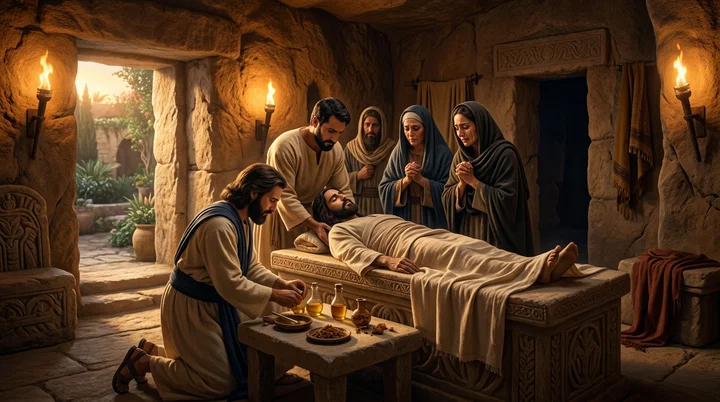
And there came also Nicodemus, which at the first came to Jesus by night, and brought a mixture of myrrh and aloes, about an hundred pound weight.
Translations
American King James Version, King James Version, KJV Cambridge Paragraph Bible
And there came also Nicodemus, which at the first came to Jesus by night, and brought a mixture of myrrh and aloes, about an hundred pound weight.
And there came also Nicodemus (who at the first came to Jesus by night) and brought a mixture of myrrh and aloes, about a hundred pound weight.
And there came also Nicodemus, he who at the first came to him by night, bringing a mixture of myrrh and aloes, about a hundred pounds weight.
And there came also Nicodemus, he who at the first came to him by night, bringing a mixture of myrrh and aloes, about a hundred pounds.
and Nicodemus also came — who came unto Jesus by night at the first — bearing a mixture of myrrh and aloes, as it were, a hundred pounds.
And Nicodemus also, who at first came to Jesus by night, came, bringing a mixture of myrrh and aloes, about a hundred pounds [weight].
There came, moreover, Nicodemus also,—he that came unto him by night at the first,—bearing a roll of myrrh and aloes, about a hundred pounds’ weight.
Berean Standard Bible, Majority Standard Bible
Nicodemus, who had previously come to Jesus at night, also brought a mixture of myrrh and aloes, about seventy-five pounds.
Nicodemus, who at first came to Jesus by night, also came bringing a mixture of myrrh and aloes, about a hundred Roman pounds.
And Nicodemus came ( he who had first come to Jesus by night) with a roll of myrrh and aloes mixed, about a hundred pounds.
And there came also Nicodemus (which first came to Iesus by night) and brought of myrrhe and aloes mingled together about an hundreth pound.
Douay-Rheims (Challoner revision)
And Nicodemus also came, ( he who at the first came to Jesus by night,) bringing a mixture of myrrh and aloes, about an hundred pound weight.
Pictures
Cross-references 20 of 22
- John 3:2
The same came to Jesus by night, and said unto him, Rabbi, we know that thou art a teacher come from God: for no man can do these miracles that thou doest, except God be with him.
Nicodemus’s first nighttime visit contrasts with his later public act of care.
- John 7:50-51
Nicodemus saith unto them, (he that came to Jesus by night, being one of them,)
Nicodemus had earlier defended Jesus against judgment without a hearing.
- Matthew 27:59-60
And when Joseph had taken the body, he wrapped it in a clean linen cloth,
Joseph wraps Jesus’ body and lays it in the tomb.
- Mark 15:43-46
Joseph of Arimathaea, an honourable counsellor, which also waited for the kingdom of God, came, and went in boldly unto Pilate, and craved the body of Jesus.
Joseph obtains Jesus’ body, wraps it in linen, and lays it in a tomb.
- Luke 23:50-51
And, behold, there was a man named Joseph, a counsellor; and he was a good man, and a just:
Joseph’s character and his role in arranging Jesus’ burial
- Luke 23:56
And they returned, and prepared spices and ointments; and rested the sabbath day according to the commandment.
The women prepare spices for Jesus’ body, then rest on the Sabbath.
- Isaiah 53:9
And he made his grave with the wicked, and with the rich in his death; because he had done no violence, neither was any deceit in his mouth.
Jesus was buried with the rich, fulfilling the prophecy of his grave.
- John 20:5-7
And he stooping down, and looking in, saw the linen clothes lying; yet went he not in.
The burial cloths from Jesus’ tomb are found lying there.
- John 3:14
And as Moses lifted up the serpent in the wilderness, even so must the Son of man be lifted up:
Nicodemus recalls Jesus’ teaching about the Son of man being lifted up, fulfilled in the crucifixion.
- Mark 16:1
And when the sabbath was past, Mary Magdalene, and Mary the mother of James, and Salome, had bought sweet spices, that they might come and anoint him.
Women bring costly spices to anoint Jesus after the Sabbath.
- Luke 23:53
And he took it down, and wrapped it in linen, and laid it in a sepulchre that was hewn in stone, wherein never man before was laid.
Jesus is wrapped in linen and laid in a tomb.
- Matthew 27:66
So they went, and made the sepulchre sure, sealing the stone, and setting a watch.
The tomb was secured after Jesus was buried.
- John 7:50
Nicodemus saith unto them, (he that came to Jesus by night, being one of them,)
Nicodemus later spoke up for Jesus before his colleagues.
- Psalms 16:10
For thou wilt not leave my soul in hell; neither wilt thou suffer thine Holy One to see corruption.
Christ’s body was not to see corruption.
- Luke 24:1
Now upon the first day of the week, very early in the morning, they came unto the sepulchre, bringing the spices which they had prepared, and certain others with them.
The women bring spices to the tomb after the Sabbath.
- John 19:34
But one of the soldiers with a spear pierced his side, and forthwith came there out blood and water.
The poem recalls Jesus’ pierced side and the blood and water flowing out.
- John 7:48
Have any of the rulers or of the Pharisees believed on him?
Nicodemus is a ruler who believes in Jesus.
- Matthew 27:63-64
Saying, Sir, we remember that that deceiver said, while he was yet alive, After three days I will rise again.
The leaders secure Jesus’ tomb because he foretold his resurrection.
- John 11:43-44
And when he thus had spoken, he cried with a loud voice, Lazarus, come forth.
Lazarus’s raising strengthened Nicodemus’s conviction of Jesus’ Messiahship.
- Mark 14:8
She hath done what she could: she is come aforehand to anoint my body to the burying.
both are burial honors wished for
Commentary
Each commentary is drawn from primary sources: the writings of Ellen G. White and Adventist pioneers and periodicals. Each commentary is separate. Its own words are not a quotation; follow the references to read the source passages.
Ellen G. White
30 sources
Nicodemus, the ruler who had first come to Jesus by night, brought about a hundred pounds weight of a costly mixture of myrrh and aloes to prepare His body for burial.DA 773.3–4ST Aug 1, 1878COS 166.3–5ST Aug 1, 18783SP 175.1–2 With Joseph of Arimathea he wrapped the body in linen cloths with the spices and ointments after the manner of the Jews, and laid it in Joseph's new tomb.ST Aug 1, 18783SP 176.15RED 95.2Ms 103, 1897, par. 19 This lavish provision gave Jesus extraordinary honor in death, fit for the most honored in Jerusalem, and secured Him an honorable burial instead of the dishonored burial given to those executed as criminals.ST Aug 1, 1878ST Aug 1, 18783SP 174.3AA 104.1–105.15RED 94.1 Nicodemus had believed but held back from open discipleship for fear of losing his place on the council, yet what he had heard from Jesus and what he saw of Christ's patient bearing at the cross turned his doubt into steadfast faith.ST Aug 1, 18783SP 175.1–22SP 134.3–135.1ST Apr 15, 18865RED 94.3–95.1 He therefore came forward boldly when the disciples were scattered and afraid, using his wealth, influence, and honored standing to openly honor and serve Jesus in shame and death, and in this tender care by the rich the prophecy that Christ would be with the rich in His death was fulfilled.DA 773.3–4ST Aug 1, 18782SP 134.3–135.1ST Jan 11, 1877Ms 103, 1897, par. 19
Burial Preparation and Honor
Nicodemus brought about a hundred pounds weight of a costly mixture of myrrh and aloes to prepare Jesus' body for burial.DA 773.3–4ST Aug 1, 1878COS 166.3–53SP 173.3–174.23SP 173.2 He came anticipating that Joseph of Arimathea would obtain the body, and used his wealth to help honor Jesus in death though he had not openly accepted Him while He lived.DA 773.3–4ST Aug 1, 18783SP 173.3–174.2 The spices were used with linen cloths and ointments according to the burial custom of the time as a form of embalming.COS 166.3–53SP 176.1COS 167.1–168.4 With the linen sheet the body was wrapped and then laid in Joseph's new tomb.ST Aug 1, 18783SP 176.15RED 95.2DA 773.5
That lavish, costly provision gave Jesus extraordinary honor in death.ST Aug 1, 1878AA 104.1–105.15RED 94.1 It showed Him the respect given to Jerusalem's most honored people.ST Aug 1, 1878COS 166.3–5COS 167.1–168.4 Nicodemus shared the burial expenses with Joseph of Arimathea in this open honoring of Jesus.AA 104.1–105.15RED 94.1 People executed for alleged treason against Rome were ordinarily taken down by soldiers and buried in ground reserved for criminals under death sentence.5RED 92.2 But Joseph obtained the body from Pilate, and Nicodemus joined him and the women in caring for the body to secure an honorable burial and prevent a dishonored burial.ST Aug 1, 18783SP 174.35RED 93.13SP 173.3–174.2
Nicodemus was a wealthy, honored member of the Sanhedrin who knew Pilate.ST Aug 1, 1878DA 772.4–773.1ST Aug 1, 1878 His wealth and influence enabled him to help when the disciples had no influence with the authorities.DA 772.4–773.1ST Aug 1, 18785RED 93.1 He boldly aided them when they were too disheartened and afraid to act openly, doing what they could not do under the protection his honored position gave him.ST Aug 1, 1878DA 772.4–773.13SP 175.1–2
Nicodemus's Secret to Open Faith
Nicodemus is the man who at first came to Jesus by night, who believed in Jesus but had not openly joined himself to Him while He was alive.ST Aug 1, 18783SP 175.1–2ST Jan 11, 18775RED 94.3–95.1Ms 111, 1897, par. 59–62 He held back from open declaration because he feared losing his place on the council and the influence he could use to help or protect Jesus.ST Aug 1, 18783SP 175.1–25RED 94.3–95.1
He had challenged the grounds for Jesus' condemnation and protested His arrest, but the priests secured the condemnation through a secret council to which he was not summoned.ST Aug 1, 1878 He was among those kept away from the mock trial by appointment to apparently important work, where his voice might have opposed the measures being taken.Ms 26, 1899, par. 20–21 He and Joseph of Arimathea had not been summoned to the council that condemned Jesus, and they could not change or lessen His sentence at the crucifixion.5RED 69.1
The teaching he had heard from Jesus and remembered, and what he witnessed at the cross, turned his doubt into faith.2SP 134.3–135.1ST Apr 15, 18864RED 18.3–19.2 Having seen Jesus' cruel treatment and patient, Godlike bearing, he now saw the high priest's character more clearly.Ms 111, 1897, par. 59–62 His faith, awakened by Jesus' teaching, was strengthened by witnessing His death, marking his change from a cautious, questioning secret follower to a firm and courageous disciple.4RED 18.3–19.2
At the burial he boldly showed his attachment and devotion, openly honoring and serving Jesus in shame and death.DA 773.3–4AA 104.1–105.1Ms 111, 1897, par. 59–62 His costly service in bringing about a hundred pounds of myrrh and aloes and joining Joseph of Arimathea to prepare the body showed that his earlier private faith had become open and steadfast.2SP 134.3–135.1ST Jan 11, 1877ST Apr 15, 18864RED 18.3–19.2 He came forward at a time of danger when the disciples were discouraged, scattered, disheartened and afraid to act openly, doing what they could not do.ST Aug 1, 18783SP 175.1–2ST Jan 11, 1877 As a wealthy and honored member of the Sanhedrin who knew Pilate, he boldly used his means, standing, and the protection his honored position gave him to aid them when they had no influence with the authorities.ST Aug 1, 1878DA 772.4–773.13SP 175.1–25RED 94.3–95.1
Prophecy and Divine Care
After not openly acknowledging Jesus as the Messiah during His life, Nicodemus came forward together with Joseph to care for His body in death.Ms 103, 1897, par. 19 They did prompt, tender work, bringing spices to wrap the body and help prevent decay, though such preservation was unnecessary because His body was not to see corruption.Ms 103, 1897, par. 19 That care fulfilled the prophetic history that Christ would be with the rich in His death, for He was laid in a new tomb distinct from others, providing clear evidence.Ms 103, 1897, par. 19 While His followers thus honored His body and laid it in the tomb, angels watched over the resting place.SG1 64.1
Sources
Pioneers and periodicals
51 sources
Nicodemus brought about a hundred pounds of costly myrrh and aloes to bury Jesus, wrapping his body with Joseph in many folds of linen according to Jewish burial custom.RH May 5, 1874RH Mar 10, 1859ST Feb 16, 1882ST Nov 19, 1902ST May 27, 1897 Together they took him down, prepared him with tender care, and laid him in Joseph's own new rock-hewn tomb near Calvary before the Sabbath, so his burial seemed final.ST Aug 1, 1878RH May 5, 1874ST Apr 21, 1914ST Aug 1, 1878ST Apr 8, 1903 The act shows Nicodemus grown from timid night visitor to bold open disciple, honoring Christ when his followers had fled in fear.ST Aug 27, 1894RH Aug 27, 1872 By this honorable burial by two rich rulers his grave was made with the rich and not with criminals as enemies intended.RH Oct 29, 1914RH Oct 29, 1914RH Nov 4, 1873 The lavish, tightly wound provision proves his death was real, and stands as the pattern of bold, sacrificial service that honors Christ and will be remembered in glory.RH Oct 4, 1870ST Aug 8, 1878RH Aug 27, 1872RH Nov 15, 1906RH Nov 4, 1873
Burial Spices and Tomb
Nicodemus brought for the burial of Jesus a mixture of myrrh and aloes weighing about a hundred pounds.ST Aug 1, 1878RH May 5, 1874RH Mar 10, 1859ST Feb 16, 1882ST May 27, 1897 It was a very large quantity, a costly, fragrant, precious and expensive provision, brought with great tenderness.ST Aug 1, 1878RH May 5, 1874RH Mar 10, 1859ST Feb 16, 1882RH Dec 1, 1868 Jewish embalming of the dead chiefly consisted in wrapping the body in many layers and folds of linen with abundant aromatic substances.ST Nov 19, 1902ST May 27, 1897ST May 27, 1897 Myrrh was one of the substances so used in embalming the dead.ST Nov 19, 1902ST May 27, 1897ST May 27, 1897 The body was wound tightly in many yards of linen with about a hundred pounds of spices, nearly doubling its weight, with the plan to complete the embalming after the Sabbath.ST May 27, 1897ST May 27, 1897RH Nov 15, 1906
With Joseph of Arimathea, Nicodemus took the body down from the cross, wrapped it in linen with the spices, and laid it in the tomb.ST Aug 1, 1878ST Aug 1, 1878ST Apr 8, 1903ST Sep 12, 1900 Together they acted with tender, reverent love and care, unfastening the nails, lifting the head, bathing the bloody forehead, folding the still hands over the breast, composing the body, and wrapping it with the spices in snow-white linen with napkin and shroud.ST Apr 8, 1903RH Oct 4, 1870ST Sep 12, 1900 The tomb was Joseph's own new and unused tomb, a rock-hewn tomb near Calvary belonging to one who loved Him.ST Aug 1, 1878ST Apr 8, 1903ST Sep 12, 1900 They bought a linen cloth for the burial, lowered Him into the tomb, and the grave was then closed with a great stone and officially sealed with the government seal, so that His burial seemed final.ST Aug 1, 1878ST Apr 8, 1903RH Oct 4, 1870
The crucifixion, death, taking down and burial took place on the day before the Sabbath, and Jesus and those crucified with Him died that day.RH May 5, 1874ST Apr 21, 1914RH Mar 10, 1859ST Feb 16, 1882 The burial work was completed tenderly and at great expense before the Sabbath began, and after the crucifixion Jesus lay in the tomb through the Sabbath without omission of a day in the sequence.RH May 5, 1874ST Feb 16, 1882ST Nov 15, 1910ST Jan 31, 1911 The tomb was closed with a great stone before the Sabbath.ST Apr 21, 1914RH Mar 10, 1859ST Nov 15, 1910 That decent burial already provided meant no further anointing was strictly necessary, and the anointing was not a necessary act of mercy or burial work that had to be done on the Sabbath, so the women's later preparation was not needed to supply a decent burial.RH May 5, 1874ST Feb 16, 1882
The lavish provision of about a hundred pounds of costly myrrh and aloes was brought in anticipation that Joseph would obtain the body.ST Aug 1, 1878 It honored Jesus in death with the respect shown to Jerusalem's most honored people, by one who loved Him, and His body was lovingly prepared with spices and laid in a rock-hewn tomb belonging to such a one.ST Aug 1, 1878
Nicodemus's Courageous Faith
The verse traces the growth of Nicodemus from timid, cautious reserve to open boldness, from the man who first came to Jesus by night out of fear to one who acted fearlessly by day with holy courage to honor Him.ST Aug 1, 1878ST Jan 11, 1877ST Aug 27, 1894RH Aug 27, 1872 Timid but candid, won to the truth by Christ's teaching, he stood ready after cruel hands had crucified the great and good Teacher to do what kindness his ability afforded, proving that however fearful before, he was fearless now.RH Aug 27, 1872RH Jul 1, 1902 He came forward boldly after the crucifixion to honor the body of Jesus when the disciples had forsaken Him and fled, and his costly service of about a hundred pounds of myrrh and aloes with Joseph of Arimathea showed that earlier private faith had become open and steadfast in a time of danger when the disciples were discouraged, scattered, disheartened and afraid to act openly.ST Aug 1, 1878ST Jan 11, 1877ST Aug 27, 1894RH Jul 1, 1902 His wealth and honored position enabled him to aid them then, and his generous final act of bringing linen and spices reflected growing faith and boldness in publicly honoring Jesus.ST Aug 1, 1878ST Jan 11, 1877RH Jul 1, 1902
That bold public act proves the lasting effect of his first night conversation with Jesus.ST Aug 27, 1894 In the darkest hour of Christ's mission he had become a firm disciple, seeing fulfilled in the lifted-up Christ what Jesus had told him that night about the Son of man being lifted up as Moses lifted up the serpent in the wilderness.ST Aug 27, 1894
Through observing Jesus and recalling the prophetic teaching about His mission, through remembering His teaching and witnessing the cross, he came to understand the death on the cross as the great sacrifice for the world.ST Apr 15, 1886ST Jul 8, 1913RH Jan 8, 1861 What he witnessed turned doubt into faith, and his gradual movement from conviction issued in committed faith as he openly joined Joseph in the burial rites.ST Apr 15, 1886ST Jul 8, 1913RH Jan 8, 1861 His presence to receive and prepare the body showed private conviction matured into steadfast discipleship in danger and discouragement.ST Apr 15, 1886ST Jul 8, 1913RH Jan 8, 1861
Nicodemus was a Pharisee, a Jewish ruler and member of the Sanhedrin, a man of wealth, influence and honored position acquainted with Pilate.ST Aug 1, 1878RH Sep 20, 1853 He was among the rulers who believed but did not confess, believing in Jesus yet not openly joining Him while He was alive for fear of losing his council place and the influence he hoped to keep and use to help or protect the truth and the cause of truth.ST Aug 1, 1878ST Feb 26, 1885RH Sep 20, 1853 He had challenged the grounds for condemnation and protested the arrest, but the priests secured condemnation through a secret council to which he was not summoned.ST Aug 1, 1878 Like Joseph of Arimathea he loved his church and was proud of her past history, associations, institutions, organizations, schools, hospitals, great men, wealth and influence in the world, yet before the truth of the first coming of the Son of God all the glories of the earthly church paled into insignificance, for greatness, glory, past history and what God wrought through a church in the past despite errors do not decide standing, but whether that church now and the person now are in harmony with God.
After Jesus died he came with Joseph of Arimathea to receive the body and prepare it for burial, helping obtain it and bringing linen and spices at costly expense.ST Jul 8, 1913RH Jul 1, 1902RH Apr 4, 1912 He brought myrrh to close the wounds inflicted on Him and shared in the mourning, thus helping Jesus in His time of need and openly identifying with Him after the crucifixion through love of the truth and holy boldness.ST Mar 11, 1913RH Jul 1, 1902RH Apr 4, 1912ST Jan 31, 1911 The scene places his return to the tomb, who had first come by night, at midnight.RH Apr 4, 1912ST Jan 31, 1911
Honorable Burial by Rulers
After Jesus died on the cross toward the close of the day, two wealthy men of His own nation, Joseph and Nicodemus, two rich and honorable rulers of Israel, went together to the governor to beg for His body.ST Apr 8, 1903RH Oct 29, 1914ST Feb 1, 1899 They bought a linen cloth and about a hundred pounds of myrrh, aloes and other aromatic substances, and with tender, loving hands they took Him down from the cruel cross, wrapped His body in them, and laid Him in a rock-hewn tomb belonging to Joseph near Calvary.ST Apr 8, 1903RH Oct 29, 1914 That tomb was new and unused, never before used for burial, and in it they gave Him the greatest honor that could be shown to the dead and a decent burial.ST Apr 8, 1903RH Oct 29, 1914ST Feb 1, 1899 The grave was then closed with a great stone and officially sealed with the government seal, so that His burial seemed final.ST Apr 8, 1903 Though Jesus was poor in life, this honorable burial by wealthy rulers literally fulfilled the prophecy that He would make His grave with the rich.RH Oct 29, 1914
Nicodemus was a member of the Sanhedrin, a man of wealth and influence, and acquainted with Pilate, and he and Joseph were determined to prevent the body from receiving a dishonored burial.ST Aug 1, 1878 Together these two rich and honorable men braved public opinion to care for the body after the crucifixion and give it a decent burial in Joseph's unused rock-cut tomb.ST Feb 1, 1899 While Jesus was dying on the cross not a friend dared to show himself, but at His death Nicodemus together with Joseph was filled with holy courage and went forward to perform the last sacred rites of burial.ST Feb 1, 1899ST Jul 1, 1880 That act showed a little sympathy and courage to the credit of the human race.ST Jul 1, 1880
By their prompt action in taking the body they frustrated the intent of His enemies to make His grave with the wicked by refusing Him burial as a criminal and burning His body in the Valley of Hinnom with thieves.RH Oct 29, 1914 Through them the Father carefully protected the sacred body of His Son.RH Oct 29, 1914 So His grave was appointed with the wicked but His tomb was with the rich man.RH Oct 29, 1914
Prophecy and Typology Fulfilled
John 19 records the sacrifice of Christ our Passover on the fourteenth day of the first month, fulfilling the type of the paschal lamb slain on that day exactly as to time.RH Oct 30, 1855ST Aug 13, 1874 The New Testament fulfillment gives a divine exposition of that part of the typical system, showing that the great event for which the Passover was noted met its antitype on the very day of the type.RH Oct 30, 1855 Mere preliminary and circumstantial burnt offerings did not prevent it from doing so.RH Oct 30, 1855
Though Jesus lived and died poor, with no grave prepared and not even a sepulcher of His own, He received honorable burial in a new, rock-hewn tomb that had never before been used, the tomb of Joseph who was a wealthy ruler of Israel.RH Oct 29, 1914RH Oct 29, 1914RH Nov 4, 1873 With tender, loving hands Joseph of Arimathaea joined by Nicodemus took Jesus from the cruel cross and laid His body there, giving Him the greatest honor that could be shown to the dead.RH Oct 29, 1914 This honorable burial by wealthy rulers literally fulfilled the prophecy that He would make His grave with the rich, His grave appointed with the wicked but His tomb with the rich man.RH Oct 29, 1914RH Oct 29, 1914 By their prompt action in taking the body the Father carefully protected the sacred body of His Son and frustrated the intent of His enemies to make His grave with the wicked by refusing Him burial as a criminal and burning His body with thieves in the Valley of Hinnom.RH Oct 29, 1914
The burial followed the end of the typical system at Jesus' death, when after Joseph begged His body He gave it room in His own new tomb for three days and three nights.RH Nov 4, 1873 The myrrh brought for that burial gives the myrrh presented to Him as a child a sign pointing to His burial and resurrection.ST Dec 3, 1896
Real Death and Atonement
The verse belongs to the scene in which Jesus had truly died, His side pierced, and His body taken down from the cross with Pilate's permission and laid in the tomb.ST Aug 8, 1878ST Jun 3, 1908 This was not the removal of a man in a deep swoon who was afterward revived and persuaded His disciples not to appear again, then retired to solitary life and died six months later from broken hopes and wounds.ST Jun 3, 1908 He truly rose from the dead, as demonstrated by nearly nineteen centuries of work in His name.ST Jun 3, 1908
When He died His disciples did not expect Him to rise but buried their hopes with His body in Joseph's tomb.RH Nov 15, 1906 They wound His body tightly in many yards of linen with about a hundred pounds of spices that nearly doubled its weight, and planned to come after the Sabbath to complete His embalmment.RH Nov 15, 1906 The tight wrapping would have made it humanly impossible for Him to move had He awakened from His death sleep and would have stifled Him had He still been living.RH Nov 15, 1906 Together with His being nailed to the cross, pierced to the heart, and giving up His blood, this proves His death was real and His rising on the third day to die no more was wholly without precedent.RH Nov 15, 1906
His death and burial were for each person.ST Aug 8, 1878 His blood is the means by which people can receive life despite the broken law.ST Aug 8, 1878
Example for Believers
Christ's teachings drive out needless fear and give courage in God's cause, so that one who first seeks Him timidly will soon stand for Him openly and be unashamed of Christ, His cause and His people.RH Aug 27, 1872 Nicodemus came at first by night from fear, yet afterward acted boldly by day and took a leading part with Joseph of Arimathea in caring for the body of his despised Master, bringing a very large amount of spices to prepare it for burial in the Jewish manner.RH Aug 27, 1872RH Mar 5, 1872 His growth from fear to boldness shows that those who now fear to come out openly on the Sabbath can gain strength and boldness, and others should be patient with them as God has been patient.RH Mar 5, 1872
His bringing of costly burial spices and his conspicuous joint work with Joseph is a willing, sacrificial response in God's service.RH Aug 27, 1901 Together they used means, wealth and influence in an emergency and crisis to give Jesus the burial they felt He deserved, and to sustain God's work when the other followers were scattered and the cause seemed near defeat.RH Aug 27, 1901RH Feb 26, 1901 Such use of heart, means and ability pleases Heaven and glorifies God, and makes him a noble example and a noble exception among people of means who are reluctant to sacrifice for God's work.RH Aug 27, 1901ST Mar 24, 1887ST May 18, 1882
Joining Joseph to take Jesus down from the cross was tender, reverent love, unfastening the nails, lifting the drooping head, bathing the bloody forehead, folding the still hands over the breast, wrapping the body with spices in snow-white linen with napkin and shroud, and lowering Him into the tomb.RH Oct 4, 1870 This service to God's dead Son in His shame and dishonor is high honor surpassing riches and earthly position.RH Oct 4, 1870 Christ will remember it when He comes again in glory and in His kingdom, giving a crown that fades not and a face-to-face meeting with the risen Jesus on the mount in the bliss of immortality, for the coming King notes and records such love done to Himself.RH Oct 4, 1870RH Oct 4, 1870 Joseph won immortal honor not because he was rich and not because he was an honorable counselor, but because he came and begged the body of Jesus and gave it room in his own new tomb for three days and three nights, and that borrowed tomb stands as the greatest example against covetousness.RH Nov 4, 1873
Those who wish they had been near to bury Christ can do the same deed to the Lord now by comforting, caring for, blessing His people and burying His poor friends, because Christ and the church are one as head and body so that doing for them is doing for Him.RH Oct 4, 1870 Living for the living Christ in this way takes the place of burying the dead Christ.RH Oct 4, 1870 The mixture of myrrh and aloes carried as a burden of love to Joseph's garden tomb was the purest, richest, best of the East, sought in Jerusalem's costliest markets to fill the dead sepulchre through and through with vital odors.ST Aug 26, 1880 The risen Christ did not need the gift, so the aloes went unused, yet the offering was not waste and those who brought it did not regret it, for giving all that love was allowed to give brought joy as the path to heaven, the clinging perfume stayed on their robes everywhere afterward, and spices bruised for Christ remain the measure of votive gifts burdened for God.ST Aug 26, 1880
Before the truth of the first coming of the Son of God all the glories of the earthly church paled into insignificance, though Nicodemus as a Pharisee and Joseph loved their church and were proud of her past history, associations, institutions, organizations, schools, hospitals, great men, wealth and influence in the world. Greatness and glory, past history and what God wrought through a church in the past despite its errors, and love for the church, do not decide standing. The great question is whether that church now and the person now are in harmony with God.
Sources