John 8:2
And early in the morning he came again into the temple, and all the people came unto him; and he sat down, and taught them.
Translations
And early in the morning he came again into the temple, and all the people came to him; and he sat down, and taught them.
King James Version, KJV Cambridge Paragraph Bible, Revised Version, American Standard Version
And early in the morning he came again into the temple, and all the people came unto him; and he sat down, and taught them.
Webster Bible, Darby Translation
And early in the morning he came again into the temple, and all the people came to him; and he sat down and taught them.
and all the people were coming unto him, and having sat down, he was teaching them;
And, early in the morning, again, came he into the temple, and all the people were coming unto him; and, sitting down, he began to teach them.
Berean Standard Bible, Majority Standard Bible
Early in the morning He went back into the temple courts. All the people came to Him, and He sat down to teach them.
Now very early in the morning, he came again into the temple, and all the people came to him. He sat down and taught them.
And early in the morning he came again into the Temple and all the people came to him and he was seated teaching them.
And early in the morning came againe into the Temple, and all the people came vnto him, and he sate downe, and taught them.
Douay-Rheims (Challoner revision)
And early in the morning he came again into the temple, and all the people came to him, and sitting down he taught them.
Pictures
Cross-references
- John 7:14-17
Now about the midst of the feast Jesus went up into the temple, and taught.
Jesus teaches in the temple and calls hearers to discern his teaching.
- Matthew 26:54
But how then shall the scriptures be fulfilled, that thus it must be?
Jesus says the events fulfill the Scriptures.
- John 8:7-9
So when they continued asking him, he lifted up himself, and said unto them, He that is without sin among you, let him first cast a stone at her.
Jesus answers the accusers, and they leave convicted by their conscience.
Commentary
Each commentary is drawn from primary sources: the writings of Ellen G. White and Adventist pioneers and periodicals. Each commentary is separate. Its own words are not a quotation; follow the references to read the source passages.
Ellen G. White
7 sources
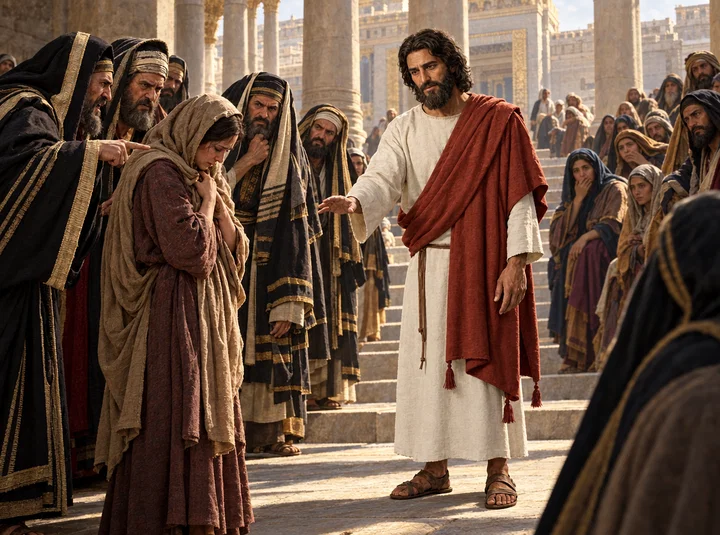
Before this verse Jesus had withdrawn to the olive groves to be alone with God.DA 460.2 Early in the morning He came again into the temple, and all the people came unto Him, and He sat down and taught them.DA 455.1–2DA 460.2 That public teaching took place while the priests and rulers were watching for a way to entrap Him and silence Him.DA 455.1–2
He taught there with divine wisdom and compassion.LC1 99.3 His teaching was not from Himself but from God who sent Him, and those who are willing to do God's will can discern that it is from God, while His seeking the glory of the One who sent Him marks Him as a true teacher and shows His authority.DA 455.3–456.1 In that temple scene His defense against His enemies' designs, His knowledge of the hidden secrets of their lives, and the conviction He pressed home upon the guilty consciences of the very men seeking to destroy Him prove His divine character.LC1 99.32SP 353.31RED 99.3
His teaching there exposes that those who are forward to accuse others, quick to detect wrong, and zealous to bring others to justice are often guiltier in their own lives than those they accuse.LC1 99.31RED 99.3 His pardoning compassion stands in contrast to the unrelenting, merciless spirit and lack of mercy of the Pharisees.LC1 99.31RED 99.3 In that scene He exposed the accusers' guilt and showed forgiving compassion to the accused woman and repentant sinner, calling her to leave sin and begin a life of purity, peace, and service to God, offering peace and security.DA 461.4–462.22SP 353.3 Seeing His pardoning compassion leads people to turn to Him and recognize Him as the pitying Saviour who will lead the repentant sinner into peace and security.LC1 99.32SP 353.31RED 99.3
Sources
Pioneers and periodicals
15 sources
Early in the morning he came back into the temple, and all the people gathered to him while he sat down and taught them in the temple court.ST Nov 24, 1881ST Oct 9, 1907RH Apr 9, 1901 His teaching was interrupted when the scribes and Pharisees brought the woman accused of adultery and set her in the midst before him.ST Nov 24, 1881ST Oct 9, 1907ST Jan 22, 1894 He did not come to condemn sinners but to lead them to eternal life, so he treated her with mercy, forgiveness and compassion, pardoning her and urging her to leave sin and begin a new life of purity and service to God.ST Mar 10, 1909ST Oct 9, 1907ST Nov 24, 1881ST Mar 18, 1889 When the accusers pressed him to have her stoned, he stooped and wrote their own sins on the ground, then told them that he who was without sin should cast the first stone, until the self-condemned men withdrew one by one.ST Apr 18, 1911ST May 28, 1894 Left alone with her, he who makes no mistakes told her he did not condemn her but to go and sin no more, which puts every person in her place, for all have sinned, yet accusers and outcasts alike may claim the same mercy by faith.ST Mar 18, 1889ST Apr 18, 1911
Setting and Authenticity
Early in the morning Jesus came again into the temple, and all the people came unto him, and he sat down in the temple court and taught them.ST Nov 24, 1881ST Oct 9, 1907RH Apr 9, 1901ST Mar 18, 1889ST Apr 18, 1911 His teaching there took place in the morning with the people gathered around him to hear him.ST Oct 9, 1907RH Apr 9, 1901RH Aug 9, 1864ST Mar 18, 1889ST Apr 18, 1911 He was sitting and teaching when scribes and Pharisees brought the woman accused of adultery and set her in the midst before him.ST Nov 24, 1881ST Oct 9, 1907ST Jan 22, 1894ST May 28, 1894 That temple teaching was thus interrupted by hardened accusers demanding that the law be enforced against her.ST Nov 24, 1881ST Oct 9, 1907ST Jan 22, 1894ST May 28, 1894
His sitting there at once made him chairman of the church trial thus brought to him.ST Jan 22, 1894 He never called a church trial nor went to one on purpose.ST Jan 22, 1894 The prominent male members came promptly with the accused woman and set her in the midst.ST Jan 22, 1894 They vehemently charged her with actual adultery and reminded him of their old established way of dealing with such cases, while the men themselves were worse than the woman.ST Jan 22, 1894
The verse belongs to the account of the woman accused of adultery, which is a genuine part of John's Gospel despite doubts about its manuscript history.RH Apr 17, 1879 It is part of the story that was omitted from some manuscripts, possibly because it was avoided in public church readings.RH Apr 17, 1879 This temple teaching took place during the final six months before his crucifixion, as he approached the shadow of the cross.ST Feb 15, 1883
Teaching and Forgiveness
His teaching appealed to reason and judgment so that hearers could examine the truth for themselves and decide whether to accept it.RH Aug 9, 1864 He spoke fearlessly to the Jews, calling them liars and murderers and exposing them as children of the devil, which shows fear of them did not keep Him from teaching necessary truth.ST Dec 8, 1887 He taught and answered opponents from the Old Testament, and the words and promises of the Old Testament supported His life and teaching.ST Feb 15, 1883
His purpose in coming early in the morning to the temple to teach was the salvation of those He came to save, and His example calls gospel workers to make seeking the lost their own object.RH Apr 9, 1901 The episode that follows shows He came not to condemn sinners but to lead them to eternal life, to lift them from degradation, and to call them to reform.ST Nov 24, 1881 In that temple teaching He treats the accused woman with mercy, forgiveness, and compassion rather than joining her accusers, pardoning her and urging her to leave sin and begin a new life of purity and service to God.ST Mar 10, 1909ST Oct 9, 1907ST Mar 18, 1889
When a crowd of scribes and Pharisees dragged the poor, cringing sinful woman before Him and pressed Him like bloodthirsty wolves to say whether they should stone her, He read their hypocritical hearts, stooped down and wrote with His finger in the sand, then rose and told them that he without sin should cast the first stone, then stooped and wrote again until the self-condemned accusers quietly withdrew one by one.ST Apr 18, 1911ST May 28, 1894 What He wrote on the ground was the very sins of which the accusers themselves were guilty, which their cloak of sanctity could not hide from Him.ST May 28, 1894 He stooped and wrote on the ground so He would not look on her shrinking figure and blushing face and so add to her shame and confusion.ST Feb 18, 1886
Left alone as the One who makes no mistakes to deal with the sinner with mercy, He asked where her accusers were and told her He did not condemn her but to go and sin no more.ST Apr 18, 1911 The encounter shows what divine forgiveness is: Jesus as the purest spirit present hates sin yet in love welcomes to sonship and brotherhood the one who has abandoned sin and set life resolutely away from it, and that forgiving love conquers sin where condemnation is powerless.ST Feb 18, 1886
Doctrine and Application
His ruling that only one without sin should cast the first stone suspended the civil penalties attached to violations such as Sabbath-breaking, while leaving untouched the law's true penalty, which is the wages of sin.RH Dec 31, 1861 The scene therefore requires that before condemning another, a person examine and acknowledge his own sins, repent of them, and pray.ST Mar 18, 1889 Every hypocrite in some sense knows his own sin, and so these accusers, confronted with their guilt, went out self-condemned without casting a stone.ST May 28, 1894
Their branding of the woman was an attempt to atone for their own sins, yet a sinner cannot atone for sin, for only Christ can do that.ST May 28, 1894 Jesus instead offers the oppressed heart rest and power to live a changed life, and his followers are to show others that same compassionate mercy.ST Mar 18, 1889 The scene places every person in the same place with that sinner in the temple, since all have sinned and come short of the glory of God, so that respectable accusers and common sinners alike, even those afraid of becoming hypocrites, may claim the same message of mercy and the same God-given aim, which when received by faith precludes hypocrisy.ST Apr 18, 1911
Knowing hypocrites who like wolves put on sheepskins are widely different from inexperienced Christians who make mistakes like novices learning their tools.ST Apr 18, 1911
Sources