Matthew 26:54
But how then shall the scriptures be fulfilled, that thus it must be?
Translations
American King James Version, King James Version, KJV Cambridge Paragraph Bible, Webster Bible
But how then shall the scriptures be fulfilled, that thus it must be?
Revised Version, American Standard Version
How then should the scriptures be fulfilled, that thus it must be?
how then may the Writings be fulfilled, that thus it behoveth to happen?'
How then should the scriptures be fulfilled that thus it must be?
How then should the Scriptures be fulfilled, that, thus, it must needs come to pass?
Berean Standard Bible, Majority Standard Bible
But how then would the Scriptures be fulfilled that say it must happen this way?”
How then would the Scriptures be fulfilled that it must be so?”
But how then would the Writings come true, which say that so it has to be?
Howe then shoulde the Scriptures bee fulfilled, which say, that it must be so?
Douay-Rheims (Challoner revision)
How then shall the scriptures be fulfilled, that so it must be done?
Pictures
Cross-references 20 of 33
- John 18:11
Then said Jesus unto Peter, Put up thy sword into the sheath: the cup which my Father hath given me, shall I not drink it?
Jesus accepts the Father’s cup, showing why his arrest and suffering must happen.
- Luke 22:51
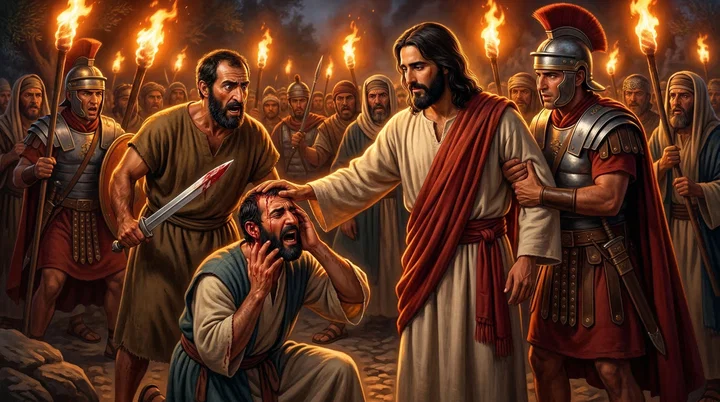
And Jesus answered and said, Suffer ye thus far. And he touched his ear, and healed him.
Jesus heals the wounded servant during his arrest.
- Mark 14:49
I was daily with you in the temple teaching, and ye took me not: but the scriptures must be fulfilled.
Jesus says his arrest happens so Scripture may be fulfilled.
- Isaiah 53:7
He was oppressed, and he was afflicted, yet he opened not his mouth: he is brought as a lamb to the slaughter, and as a sheep before her shearers is dumb, so he openeth not his mouth.
The silent lamb led to slaughter foretells Jesus’ suffering and death.
- Luke 24:44
And he said unto them, These are the words which I spake unto you, while I was yet with you, that all things must be fulfilled, which were written in the law of Moses, and in the prophets, and in the psalms, concerning me.
Jesus says the Scriptures concerning him must be fulfilled.
- Matthew 27:35
And they crucified him, and parted his garments, casting lots: that it might be fulfilled which was spoken by the prophet, They parted my garments among them, and upon my vesture did they cast lots.
Jesus’ crucifixion fulfills Scripture concerning his suffering and death.
- Isaiah 53:12
Therefore will I divide him a portion with the great, and he shall divide the spoil with the strong; because he hath poured out his soul unto death: and he was numbered with the transgressors; and he bare the sin of many, and made intercession for the transgressors.
Foretells the Messiah being numbered with transgressors and pouring out his soul unto death.
- Luke 22:37
For I say unto you, that this that is written must yet be accomplished in me, And he was reckoned among the transgressors: for the things concerning me have an end.
Jesus says Scripture must be fulfilled in what is about to happen.
- John 18:36
Jesus answered, My kingdom is not of this world: if my kingdom were of this world, then would my servants fight, that I should not be delivered to the Jews: but now is my kingdom not from hence.
Christ’s kingdom is not advanced or defended by fighting.
- Luke 24:27
And beginning at Moses and all the prophets, he expounded unto them in all the scriptures the things concerning himself.
Jesus explains how Moses and the prophets speak of him.
- John 10:35
If he called them gods, unto whom the word of God came, and the scripture can not be broken;
Jesus acts on the principle that Scripture cannot be broken.
- Matthew 28:2-6
And, behold, there was a great earthquake: for the angel of the Lord descended from heaven, and came and rolled back the stone from the door, and sat upon it.
The empty tomb and the risen Jesus show his victory over death.
- Philippians 2:8
And being found in fashion as a man, he humbled himself, and became obedient unto death, even the death of the cross.
Christ’s obedience unto death echoes his submission to Scripture.
- Isaiah 53:6
All we like sheep have gone astray; we have turned every one to his own way; and the LORD hath laid on him the iniquity of us all.
The LORD laid the iniquity of all upon him.
- Luke 24:46
And said unto them, Thus it is written, and thus it behoved Christ to suffer, and to rise from the dead the third day:
Christ’s suffering and resurrection were necessary to fulfill Scripture.
- Matthew 26:24
The Son of man goeth as it is written of him: but woe unto that man by whom the Son of man is betrayed! it had been good for that man if he had not been born.
Jesus says he goes as it is written of him.
- John 13:18
I speak not of you all: I know whom I have chosen: but that the scripture may be fulfilled, He that eateth bread with me hath lifted up his heel against me.
Jesus says Scripture must be fulfilled in events concerning him.
- Mark 14:43-45
And immediately, while he yet spake, cometh Judas, one of the twelve, and with him a great multitude with swords and staves, from the chief priests and the scribes and the elders.
Judas identifies Jesus with a kiss, leading to his arrest.
- Matthew 17:22-23
And while they abode in Galilee, Jesus said unto them, The Son of man shall be betrayed into the hands of men:
Jesus foretold his betrayal, death, and resurrection.
- Luke 22:52-53
Then Jesus said unto the chief priests, and captains of the temple, and the elders, which were come to him, Be ye come out, as against a thief, with swords and staves?
Jesus says his arrest fulfills Scripture.
Commentary
Each commentary is drawn from primary sources: the writings of Ellen G. White and Adventist pioneers and periodicals. Each commentary is separate. Its own words are not a quotation; follow the references to read the source passages.
Ellen G. White
24 sources
On the night He was betrayed in Gethsemane, Jesus willingly let Himself be bound and led away because the Scriptures required that His suffering happen in exactly this way.5RED 24.2–3ST Aug 21, 1879Ms 29, 1909, par. 10–11 He had power to stop it, for He struck the armed band to the ground with His word and could have called for more than twelve legions of angels to rescue Him, but He refused that deliverance because it would have left prophecy unfulfilled.5RED 24.2–3ST Aug 21, 1879Ms 113, 1899, par. 24ST Sep 23, 1886 He therefore rebuked Peter, ordered the sword put away, healed the wounded servant, and drank the cup His Father had given Him rather than leave His appointed path.5RED 24.2–3Ms 29, 1909, par. 10–11ST Sep 23, 1886 His disciples did not understand His refusal to deliver Himself, and when He submitted they fled in fear and sank into despair.Ms 29, 1909, par. 10–11COS 123.3–4EW 137.1 His betrayal, condemnation and crucifixion were a foretold trial of faith, not a failure of His purpose, and the same pattern is repeated when His followers face religious and civil powers.Ms 29, 1909, par. 2–44RED 102.2–103.1DA 394.2–3GC 198.2
Arrest in Gethsemane
The words belong to the night of the Passover, when Jesus went in company with His disciples to the garden of Gethsemane.DA 685.1 That garden was dark and wooded with dense trees and foliage, a spot He had often visited for meditation and prayer.DA 685.1DA 685 Above it the broad full Passover moon shone from a cloudless sky, while the city of pilgrims' tents was hushed into silence.DA 685.1
It was the night of His last agony, entered after He had earnestly instructed His disciples and then became strangely silent with a heart full of sorrow as never before.DA 685.2 Throughout His life on earth He had walked in the light of God's presence, but now He seemed shut out from the light of God's sustaining presence.DA 685.2 Now He was numbered with transgressors and must bear the guilt of fallen humanity, with the iniquity of all laid upon Him who knew no sin.DA 685.2 Sin appeared dreadful to Him, and the weight of guilt was so great that He was tempted to fear it would shut Him out forever from His Father's love, for He felt how terrible is the wrath of God against transgression.DA 685.2 After the Passover supper with His disciples, without food or drink, He agonized in conflict with satanic agencies striving to separate Him from God, and the struggle brought great drops of blood from His skin to the ground, yet He would not yield.Ms 95, 1897, par. 10–12
Though He had been daily with the people teaching openly in the temple and was not taken there, He allowed Himself to be taken at night as against a thief.5RED 24.2–3COS 123.2 At midnight in Gethsemane He was betrayed by Judas, one of His professed disciples, and seized by a Judas-led band of men and soldiers with swords and staves and spears, including chief priests and captains of the temple.5RED 24.2–3COS 123.2ST Nov 30, 1882Ms 107, 1893, par. 2 That betrayal was the work of Satan, who put it into the heart of Judas and entered into him.Ms 113, 1899, par. 24 He was betrayed with expressions of love, with a kiss.Ms 95, 1897, par. 10–12 In that hour of trial He did not resist with violence.Ms 29, 1909, par. 10–11
After the arrest He was seized at midnight and dragged before religious and civil authorities, and through the night endured insult upon insult and mockery upon mockery.ST Nov 30, 1882Ms 95, 1897, par. 10–12 He was condemned to death by the Sanhedrin but brought before Pilate for legal condemnation because execution required Pilate's confirmation.Ms 107, 1893, par. 2 He was taken to Annas, then to Caiaphas, then to Pilate, then sent to Herod who found nothing to condemn yet allowed mockery and insult, then sent again to Pilate.Ms 95, 1897, par. 10–12 There He was mocked, scourged and twice tortured by the scourge, condemned and led to crucifixion.ST Nov 30, 1882Ms 95, 1897, par. 10–12 Yet He did not fail, but kept dignity through the disgraceful trial and spoke no word beyond what was essential and tended to glorify God.Ms 95, 1897, par. 10–12
Willing Submission to Scripture
The verse means Jesus willingly let Himself be bound and taken and made to suffer because the Scriptures required that it happen in this way.5RED 24.2–3ST Aug 21, 1879Ms 29, 1909, par. 10–11Ms 29, 1909, par. 2–4COS 123.2 His quiet submission to the mob was itself part of that fulfillment, and His disciples should understand His arrest and what followed as part of what had been foretold and not as a failure of His purpose.5RED 24.2–3Ms 29, 1909, par. 10–11Ms 29, 1909, par. 2–4 Though He had taught openly daily in the temple and was not taken there, He allowed Himself to be taken at night as against a thief with swords and staves by the chief priests and captains of the temple, declaring that this course fulfilled Scripture.5RED 24.2–3COS 123.2 He had power to prevent it, for He had just shown power to prostrate the armed band and could have kept them helpless until He escaped, and even while firmly held by Roman soldiers He freed His hands to heal instantly the high priest's servant's ear that Peter had cut off with the sword.5RED 24.2–3ST Sep 23, 1886 He rebuked Peter and ordered the sword put away, warning that those who take the sword perish with the sword, and in that hour of trial He did not resist with violence.5RED 24.2–3Ms 29, 1909, par. 10–11
The saying was spoken to Peter at the moment the band led by Judas seized Him.Ms 113, 1899, par. 24 Though angels were ready to defend Him, He refused to pray to His Father for immediate rescue by more than twelve legions of angels, because using that deliverance would have prevented the Scriptures that foretold it must happen thus from being fulfilled, so He allowed His captors to lead Him away.5RED 24.2–3ST Aug 21, 1879Ms 113, 1899, par. 24ST Sep 23, 1886DA 696.3 Doing so would have prevented their fulfillment, and He chose not to summon them or to heal the wounded servant as a means of prevention but to accept capture and suffering as necessary.ST Sep 23, 1886ST May 20, 1889 In refusing escape He accepted the suffering appointed by His Father as the cup given Him to drink rather than leaving His appointed path.5RED 24.2–3ST Aug 21, 1879ST Sep 23, 1886DA 696.3ST May 20, 1889 He willingly allowed Himself to be arrested and would not call on the angels to escape, accepting the suffering His Father had given Him.COS 122.5–123.1 The necessity was such that Judas reasoned that if Jesus was to be crucified the event would happen regardless of his betrayal, and if Jesus was not to die Jesus could deliver Himself.DA 720.3 Judas had expected divine power to release and protect Jesus, but Jesus' quiet submission made Judas fear that he had truly betrayed Him to His death.COS 133.3–4
Testing of Disciples and Believers
He made no effort to deliver Himself because the Scriptures had to be fulfilled in this way, and His quiet submission to the mob without violent resistance was itself part of that fulfillment.Ms 29, 1909, par. 10–11COS 123.3–4EW 137.1SG1 48.1Ms 95, 1897, par. 10–12 He could have asked His Father for angelic rescue and escaped, with angels ready to defend Him, yet He chose not to call for that help but allowed His captors to lead Him away.EW 137.1SG1 48.1 The disciples did not understand why He would not resist and deliver Himself.COS 123.3–4 When He submitted to His enemies they proved fearful and fled in fear, forsaking Him and sinking into despair.Ms 29, 1909, par. 10–11COS 123.3–4EW 137.1Ms 95, 1897, par. 10–12
His betrayal, condemnation and crucifixion formed a trial of faith surrounding His death.4RED 102.2–103.1DA 394.2–3 Those events of arrest and what followed had to happen so the Scriptures would be fulfilled, and are to be understood as part of what had been foretold and not as a failure of His purpose.Ms 29, 1909, par. 2–4DA 394.2–3 He knew beforehand the ordeal His disciples would face in Gethsemane, at His condemnation and at the crucifixion, and He prepared them for it beforehand.4RED 102.2–103.1 Remembering earlier defections and the crowd's rejection of Him would help them withstand that ordeal and keep their faith from depending on the fickle favor of others.4RED 102.2–103.1 Earlier trials prepared them for that testing by exposing selfish motives and strengthening the faith of His true followers.4RED 102.2–103.1DA 394.2–3
His being handed over to Caiaphas and Pilate presents the pattern for what follows.GC 198.2 When evangelical Christians face persecution, their crisis repeats that suffering.GC 198.2 Their trial at the hands of religious and civil authorities is a repetition of Christ's suffering at the hands of religious and civil authorities.GC 198.2
Sources
Pioneers and periodicals
41 sources
In the garden when the mob seized him to lead him toward unjust trial and crucifixion, Jesus accepted arrest and suffering rather than resisting or using divine power because the Scriptures required that it happen so.ST Feb 7, 1900ST Feb 3, 1909RH Oct 24, 1854STST Sep 9, 1930 Though he could have asked the Father for anything and received more than twelve legions of angels for protection, he refused angelic rescue and drank the cup his Father had given him, for calling for rescue would have prevented fulfillment.ST Aug 21, 1879ST Sep 23, 1886ST May 20, 1889ST Jan 7, 1897ST Feb 20, 1879 He treated the Old Testament Scriptures as certain and authoritative, submitting to every detail of betrayal, trial, humiliation and death they foretold rather than evading them.ST Feb 6, 1907ST Jan 30, 1912RH Nov 18, 1862ST Aug 27, 1912ST Feb 15, 1883 That fulfillment in every detail, including being reckoned among transgressors and suffering and rising the third day as written in Moses, the prophets and the Psalms, testified that God's Word is true and that he is the Messiah given for redemption.ST Jan 30, 1912ST Sep 20, 1910ST Jun 27, 1878 His patient silence and non-resistance under betrayal and hostility reveal a strength greater than violent action and leave his followers an example that his kingdom is not advanced by force or the sword.ST Sep 20, 1910RH Oct 24, 1854ST Sep 3, 1894ST Feb 27, 1901ST Oct 20, 1914
Arrest and Trial Setting
The saying belongs to the account of Jesus' arrest and trials in his last days, when the mob seized him in the garden of Gethsemane and led him toward crucifixion, and it shows his submission to the events leading to his death because they had to occur for Scripture to be fulfilled.ST Feb 3, 1909ST Sep 9, 1930 That seizure happened at midnight after the Passover supper, followed by dragging before religious and civil authorities, with mocking, scourging, condemnation, and leading to crucifixion.ST Nov 30, 1882ST Mar 11, 1886 He was taken from Gethsemane by a mob, mistreated by priests, Pharisees and soldiers, and crucified that afternoon on the fifteenth day of the month.ST Nov 30, 1882ST Mar 11, 1886
The trial before the Sanhedrin and Pilate was illegal and irregular, though the record kept by his enemies would not present it that way, and that trial with the agony of Calvary are lessons not to be forgotten.ST Sep 3, 1912ST Jan 28, 1903 At the crisis he was betrayed by one of the twelve, denied by another, and forsaken by all.ST Apr 3, 1928RH Sep 2, 1873 Judas betrayed him, the disciples present forsook him and fled, and Peter denied knowing him, showing that trials and offenses can occur even among his closest followers.ST Apr 3, 1928RH Sep 2, 1873
The saying stands between Christ mocked and Christ rejected, with only a single step between them.RH Dec 29, 1863 The hollow homage of hail to the Master that mocks the Lord passes quickly into smiting and buffeting of open outrage, showing how easily seeming orthodox creed and merely traditional lip-confession joined to life-denial becomes open denial.RH Dec 29, 1863 The garden scene includes Peter trying to defend Jesus with the sword and trying to fight for him, an assertive but not truly courageous act soon followed by cowardly denial.RH Feb 5, 1914RH Jul 6, 1869 It shows that a servant of Christ must be willing to suffer shame for him and not merely fight for him, in contrast between aggressive human impulse and the progress of a regenerated life.RH Feb 5, 1914RH Jul 6, 1869
Choosing Suffering Over Rescue
Jesus accepted arrest and suffering rather than resisting or using divine power because what was happening had to fulfill the Scriptures.ST Feb 7, 1900RH Oct 24, 1854STST Jan 8, 1902ST He submitted to his arrest rather than resist, and willingly allowed himself to be taken, accepting the bitter cup and giving his life for humanity.RH Oct 24, 1854ST Jun 11, 1896ST His patient silence under betrayal and hostility is endurance of suffering without reproach or retaliation, and his submission to the Father's will meant drinking the cup given to him.RH Oct 24, 1854ST Jun 11, 1896 Though he could ask the Father for anything and receive it, even more than twelve legions of angels for protection, he refused angelic rescue and accepted the cup his Father had given him rather than escape his appointed path.ST Aug 21, 1879ST Sep 23, 1886ST May 20, 1889ST Jan 17, 1900ST Jan 7, 1897
He submitted to every detail of betrayal, arrest, unjust trial, and crucifixion, including betrayal, humiliation, and death, not from lack of power to escape but in accord with the prophecies of his rejection, betrayal, trial, and death.ST Feb 6, 1907ST Jan 30, 1912RH Nov 18, 1862 He willingly endured betrayal, humiliation, and death instead of calling for angelic deliverance or preventing fulfillment of the prophets' words, in complete submission to Scripture.ST Feb 6, 1907ST Jan 30, 1912 Fulfilling prophecy in every detail testified that God's Word is true and that he was the Messiah, and it was part of God's plan of redemption, so that if its prophetic details failed, faith in God's Word and in Jesus would lack its sure foundation.ST Jan 30, 1912 The power exercised against him was permitted from above for that purpose, and his arrest and suffering in the garden were included in the Father's plan.ST Apr 6, 1888RH Dec 16, 1873
God's permitting evil forces to act does not defeat his purpose in the conflict between good and evil, though the disciples failed to see that their experience was also within that plan and inwardly resisted it. Calling for rescue would have prevented the Scriptures from being fulfilled, so his question connects obedience to the foretold events with the necessity of fulfillment.ST May 20, 1889ST Feb 20, 1879 He could have escaped arrest by asking his Father for angelic help and could have called on more than twelve legions of angels to save him, but doing so would have prevented their fulfillment.ST May 20, 1889ST Feb 20, 1879 In Gethsemane he ordered Peter to put up his sword after Peter cut off the ear of Malchus, and he showed power to heal the wounded servant and healed the wound.ST Oct 20, 1914ST Mar 18, 1897
He refused to speak the word that would have brought legions of mighty angels accustomed to do his slightest bidding, though innocent and seized by a murderous mob.ST Mar 18, 1897 He refused armed resistance, reproved Peter for drawing the sword, forbade fighting to defend him, and submitted without opening his mouth or resisting.ST Oct 20, 1914ST Mar 18, 1897 His unlimited power to ask and receive from the Father is why it could be stated unconditionally that whatever he asked of God, God would give him, yet he held that power under the necessity that the Scriptures be fulfilled as they said he must suffer.ST Jan 7, 1897
Scripture's Authority and Necessity
Jesus treated the Old Testament Scriptures as certain and authoritative, accepting them as requiring what was unfolding in his arrest rather than as words that could be set aside.ST Aug 27, 1912ST Feb 15, 1883 What Scripture said had to be fulfilled, so the events taking place had to occur, and even in the face of arrest he pointed to Scripture as the necessity behind them.ST Aug 27, 1912ST Feb 15, 1883 He would not evade the suffering and death foretold, although he could have asked the Father for angelic rescue.ST Aug 27, 1912 In his greatest trials he relied on the Old Testament's words, prophecies, and promises for support and guidance, accepting what was happening as necessary for the Scriptures to be fulfilled.ST Feb 15, 1883ST Feb 15, 1883
Scripture cannot be broken because it is the word of God given through holy men as truths were given them by the Holy Spirit.ST Jun 27, 1878 For that reason he would not pray for more than twelve legions of angels to rescue him, though he was the Son of God, because the Scriptures must be fulfilled even though he should suffer.ST Jun 27, 1878 The fulfillment required was that as written Christ must suffer and rise from the dead the third day, with all things written in the law of Moses and in the prophets and in the Psalms concerning him fulfilled.ST Jun 27, 1878
Fulfilling prophecy in every detail testified that God's Word is true and that he was the Messiah, and it belonged to God's plan of redemption.ST Jan 30, 1912 He submitted to every detail of betrayal, arrest, unjust trial, and crucifixion, refusing to summon angels to rescue him, not because he lacked power to escape but in order that his suffering and death would fulfill the Scriptures.ST Jan 30, 1912 If those prophetic details had failed, faith in God's Word and in Jesus would lack its sure foundation.ST Jan 30, 1912
Prophecy Fulfilled for Redemption
The arrest was allowed to proceed because the writings had to be fulfilled, including that he would be counted among lawbreakers, and that necessity is why divine power was not used and the disciples were not permitted to fight, for his kingdom is not advanced by force or the sword.ST Sep 20, 1910 What had to happen in this way embraced his birth, words, works, crucifixion, resurrection, and ascension as the One whose coming was foretold and whose arrival was announced by angel voices of peace and good will.RH Jan 11, 1915 As written, he must suffer and rise from the dead on the third day, with all things written in the law of Moses and in the prophets and in the Psalms concerning him fulfilled.ST Jun 27, 1878
In Gethsemane he ordered the sword put up after the ear of Malchus was cut off, though he could at once have spoken the word and legions of mighty angels accustomed to do his slightest bidding would have rushed to his assistance, but he refused rescue so that it might be as it must be. The writings to be fulfilled were the vow and solemn compact between Jehovah and his Son, written in the volume of the book in the eternal archives above. That compact called for the life-blood of the Son and was fulfilled in the fullness of time when he said Lo, I come.
His pledge to become the sin-bearer and save those who come to him in faith led him to endure his persecutors' cruelty patiently and without complaint.ST Jan 17, 1900 He accepted the bitter cup and gave his life for humanity because the writings had to be fulfilled.ST He accepted the events of arrest and suffering as necessary for fulfillment, including betrayal, trial, condemnation, and crucifixion, making that day the day on which he showed his love for humanity above all other days.RH Feb 13, 1872
Pattern for Believers Today
His submission to arrest rather than resistance because the Scriptures had to be fulfilled is an example of patient silence under betrayal and hostility, showing how to endure suffering without reproach or retaliation.RH Oct 24, 1854ST Feb 27, 1901 That submission, silence, and non-resistance reveal a real strength greater than noisy or violent action.ST Feb 27, 1901
He allowed the arrest to proceed because the Scriptures had to be fulfilled, including that he would be reckoned among transgressors, which explains why he did not use divine power or allow his disciples to fight, since the events had to take place as foretold.ST Sep 20, 1910 His kingdom is not advanced by force or the sword, so the church is to use spiritual means and not physical force, relying on conviction rather than compelled obedience.ST Sep 20, 1910ST Sep 3, 1894
At his arrest he refused armed resistance, reproved Peter for drawing the sword, forbade fighting to defend him, and healed the wound Peter made.ST Oct 20, 1914ST Mar 18, 1897 He submitted to religious persecution with every indignity, insult, and outrage without opening his mouth or resisting, leaving Christians an example of nonresistance.ST Oct 20, 1914ST Mar 18, 1897 Even while facing an illegal trial and execution, he did not seek to have his opponents arrested or punished.ST Aug 29, 1895 No follower of his may fight in defense of self or even of persecuted brethren, since the disciple is not greater than his Lord.ST Mar 18, 1897 Christian warfare is not carried on with carnal weapons but with spiritual power mighty through God to pull down the strongholds of sin in the heart, because he came to save men's lives and not to destroy them, calling believers to follow his steps and patiently suffer unjustly without complaining or reviling.ST Oct 20, 1914ST Mar 18, 1897
The persecution of believers by religious leaders and armed authorities echoes the religious coercion surrounding his arrest.RH Jul 23, 1914
Sources