Judges 15:5
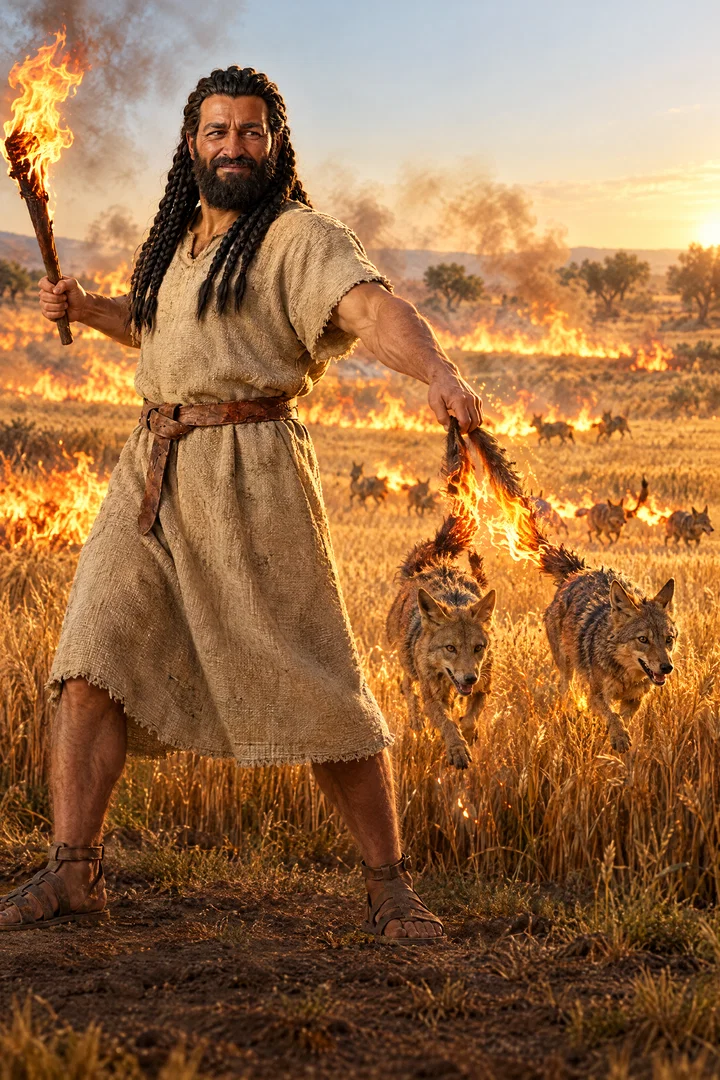
And when he had set the brands on fire, he let them go into the standing corn of the Philistines, and burnt up both the shocks, and also the standing corn, with the vineyards and olives.
Translations
American King James Version, King James Version, KJV Cambridge Paragraph Bible
And when he had set the brands on fire, he let them go into the standing corn of the Philistines, and burnt up both the shocks, and also the standing corn, with the vineyards and olives.
And when he had set the brands on fire, he let them go into the standing corn of the Philistines, and burnt up both the shocks and also the standing corn, with the vineyards and olives.
And when he had set the brands on fire, he let them go into the standing corn of the Philistines, and burnt up both the shocks and the standing corn, and also the oliveyards.
And when he had set the brands on fire, he let them go into the standing grain of the Philistines, and burnt up both the shocks and the standing grain, and also the oliveyards.
and kindleth fire in the torches, and sendeth [them] out into the standing corn of the Philistines, and burneth [it] from heap even unto standing corn, even unto vineyard — olive-yard.
And he set the torches on fire, and let [ them] run into the standing corn of the Philistines, and burnt up both the shocks, and also the standing corn, and the olive gardens.
And, when he had set fire to the torches, he let them go into the standing corn of the Philistines,—and set fire, both to the stack of sheaves and to the standing corn, and besides to the olive plantation.
Berean Standard Bible, Majority Standard Bible
Then he lit the torches and released the foxes into the standing grain of the Philistines, burning up the piles of grain and the standing grain, as well as the vineyards and olive groves.
When he had set the torches on fire, he let them go into the standing grain of the Philistines, and burned up both the shocks and the standing grain, and also the olive groves.
Then firing the sticks, he let the foxes loose among the uncut grain of the Philistines, and all the corded stems as well as the living grain and the vine-gardens and the olives went up in flames.
And when he had set the brandes on fire, he sent them out into the standing corne of the Philistims, and burnt vp both the rickes and the standing corne with the vineyardes and oliues.
Douay-Rheims (Challoner revision)
And setting them on fire he let the foxes go, that they might run about hither and thither. And they presently went into the standing corn of the Philistines. Which being set on fire, both the corn that was already carried together, and that which was yet standing, was all burnt, insomuch, that the flame consumed also the vineyards and the oliveyards.
Pictures
Cross-references
- Judges 13:5
For, lo, thou shalt conceive, and bear a son; and no razor shall come on his head: for the child shall be a Nazarite unto God from the womb: and he shall begin to deliver Israel out of the hand of the Philistines.
Samson’s Nazarite vow explains the source of his strength.
- Judges 14:19
And the Spirit of the LORD came upon him, and he went down to Ashkelon, and slew thirty men of them, and took their spoil, and gave change of garments unto them which expounded the riddle. And his anger was kindled, and he went up to his father’s house.
earlier proof of marvelous strength
- Judges 15:14-15
And when he came unto Lehi, the Philistines shouted against him: and the Spirit of the LORD came mightily upon him, and the cords that were upon his arms became as flax that was burnt with fire, and his bands loosed from off his hands.
The Spirit empowers Samson’s later victory with the jawbone.
Commentary
Each commentary is drawn from primary sources: the writings of Ellen G. White and Adventist pioneers and periodicals. Each commentary is separate. Its own words are not a quotation; follow the references to read the source passages.
Ellen G. White
3 sources
Samson was the promised son given to Manoah, a Nazarite from birth whose extraordinary physical strength did not depend on his well-knit sinews but on his condition as a Nazarite symbolized by his unshorn hair.PP 562.2–563.1 The burning of the Philistines' grain falls in the time when he was entering upon manhood to execute his divine mission as judge and deliverer of Israel, when above all others he should have been true to God.PP 562.2–563.1 Instead he mingled on friendly terms with the Philistines near Zorah, formed intimacies that darkened his whole life, and married a young woman of Philistine Timnath because she pleased him well, against the dissuasion of his God-fearing parents.PP 562.2–563.1
Despite his great physical strength and God's purpose for him, he failed to govern his passions, and his choices led toward shame, disaster, and death.ST Oct 13, 1881 The burning was his revenge after the wife he had obtained by transgressing God's command proved treacherous before the close of the marriage feast and had been given to another by the time he returned for her.PP 563.4–564.1 By wasting all the fields and vineyards of the Philistines he provoked the Philistines to murder her, although their own threats had driven her to the deceit with which the trouble began.PP 563.4–564.1 Moved to anger by that barbarous murder, he then attacked the Philistines and smote them with a great slaughter.PP 563.4–564.1
Sources
Pioneers and periodicals
11 sources
The verse belongs to the history of Samson's judgeship and career, set in a morally troubled time when Israel was subject to heathen peoples, the country was damaged, repentance was delayed, and deliverance was only partial through God's mercy.ST Apr 4, 1911ST Mar 24, 1909 The Philistine plains produced much grain in Samson's day, and those same plains still produce much grain.ST Nov 24, 1898 The fire destroyed both the harvested shocks and the standing grain, with the vineyards and olives, leaving a wake of conflagration, devastation, and ruin.RH Sep 11, 1860ST May 2, 1878ST Apr 17, 1879ST Apr 15, 1875ST Sep 22, 1898
In the verse, burnt up means totally and completely destroyed and reduced to ashes.ST May 2, 1878ST Apr 17, 1879ST Apr 15, 1875 The shualim are foxes and jackals, the jackal being an animal between the wolf and the fox, sometimes called the wolf-fox, very numerous in Palestine and gathering together in herds of two or three hundred.RH Sep 11, 1860 The firebrands were torches made of resinous wood that would not go out when trailed through the fields.RH Sep 11, 1860
Samson did not catch the 300 animals alone but employed agents, for a man is said to do what he does through agents, and he did not catch them all in one day but over several days.RH Sep 11, 1860 Samson used these mean and weak instruments instead of his own hands to put greater contempt upon his enemies, mingling ridicule with revenge.RH Sep 11, 1860 Samson was physically strong but morally weak, a man of very weak character marked by selfishness, carnality and sins, combining impulsive good with indulgent evil, and despite God's purpose for him he failed to govern his passions.ST Oct 13, 1881ST Apr 4, 1911ST Mar 24, 1909 His choices led toward shame, disaster, and death.ST Oct 13, 1881
Despite his faults and simplicity, beneath his weaknesses was strong faith in God, in His leading, and in Israel's mission, and he was willing at last to give his life to avenge his people's enemies.ST God did not use Samson because of those faults but in spite of them, in great pity using the very best material and instruments He could find to save His people when they were departed far from Him, despite all their failures.ST Mar 24, 1909 The Samson account in Judges 14-16 shows the danger of being unequally yoked together with unbelievers.RH Feb 21, 1907 Delilah's influence over Samson is a type of God's people in later ages being led away by the world's seductions.
Sources