Judges 16:30
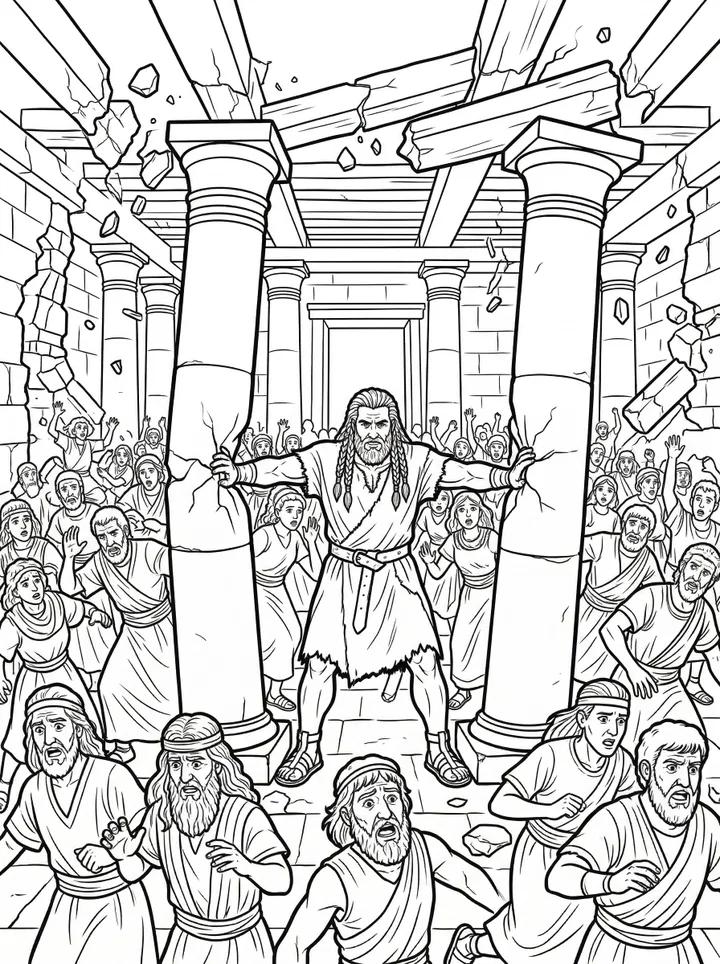
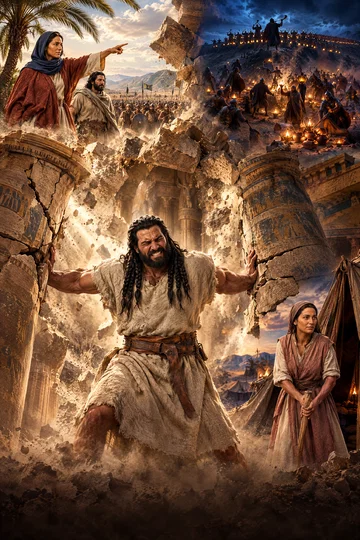
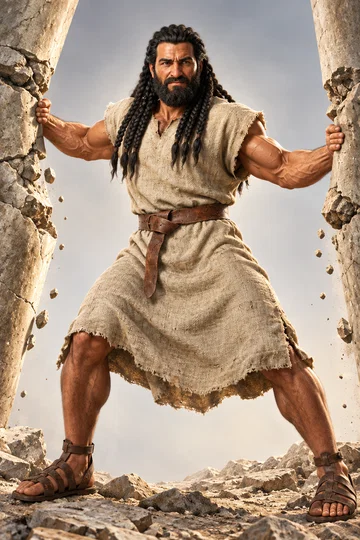
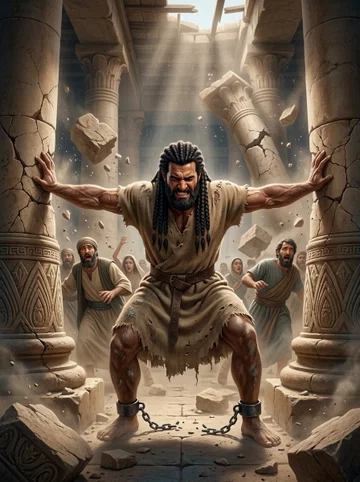
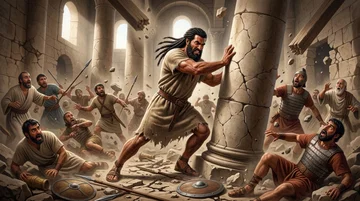
And Samson said, Let me die with the Philistines. And he bowed himself with all his might; and the house fell upon the lords, and upon all the people that were therein. So the dead which he slew at his death were more than they which he slew in his life.
Translations
And Samson said, Let me die with the Philistines. And he bowed himself with all his might; and the house fell on the lords, and on all the people that were therein. So the dead which he slew at his death were more than they which he slew in his life.
King James Version, Revised Version
And Samson said, Let me die with the Philistines. And he bowed himself with all his might; and the house fell upon the lords, and upon all the people that were therein. So the dead which he slew at his death were more than they which he slew in his life.
And Samson said, Let me die with the Philistines. And he bowed himself with all his might; and the house fell upon the lords, and upon all the people that were therein. So the dead which he slew at his death were moe than they which he slew in his life.
And Samson said, Let me die with the Philistines. And he bowed himself with all his might; and the house fell upon the lords, and upon all the people that were in it. So the dead which he slew at his death were more than they which he slew in his life.
And Samson said, Let me die with the Philistines. And he bowed himself with all his might; and the house fell upon the lords, and upon all the people that were therein. So the dead that he slew at his death were more than they that he slew in his life.
and Samson saith, 'Let me die with the Philistines,' and he inclineth himself powerfully, and the house falleth on the princes, and on all the people who [are] in it, and the dead whom he hath put to death in his death are more than those whom he put to death in his life.
And Samson said, Let me die with the Philistines! And he bowed himself with might; and the house fell on the lords, and on all the people that were therein. So the dead that he slew at his death were more than those whom he had slain in his life.
And Samson said—Let my soul die with the Philistines! And he bowed mightily, and the house fell upon the lords, and upon all the people that were therein. So the dead, whom he slew at his death, were more than they whom he slew in his life.
Berean Standard Bible, Majority Standard Bible
Samson said, “ Let me die with the Philistines.”Then he pushed with all his might, and the temple fell on the lords and all the people in it. So in his death he killed more than he had killed in his life.
Samson said, “ Let me die with the Philistines!” He bowed himself with all his might; and the house fell on the lords, and on all the people who were in it. So the dead that he killed at his death were more than those who he killed in his life.
And Samson said, Let death overtake me with the Philistines. And he put out all his strength, and the house came down on the chiefs and on all the people who were in it. So the dead whom he sent to destruction by his death were more than all those on whom he had sent destruction in his life.
Then Samson saide, Let me lose my life with the Philistims: and he bowed him with all his might, and the house fell vpon the princes, and vpon all the people that were therein. so the dead which he slewe at his death were more then they which he had slaine in his life.
Douay-Rheims (Challoner revision)
He said: Let me die with the Philistines. And when he had strongly shook the pillars, the house fell upon all the princes, and the rest of the multitude that was there: and he killed many more at his death, than he had killed before in his life.
Pictures
Cross-references
- Hebrews 11:32
And what shall I more say? for the time would fail me to tell of Gedeon, and of Barak, and of Samson, and of Jephthae; of David also, and Samuel, and of the prophets:
Samson is named among those commended for faith.
- Judges 16:23-24
Then the lords of the Philistines gathered them together for to offer a great sacrifice unto Dagon their god, and to rejoice: for they said, Our god hath delivered Samson our enemy into our hand.
The Philistines celebrate Dagon and mock Samson before the temple collapses.
- Numbers 23:10
Who can count the dust of Jacob, and the number of the fourth part of Israel? Let me die the death of the righteous, and let my last end be like his!
“Let me die” is rendered “Let my soul die.”
- Judges 14:1-3
And Samson went down to Timnath, and saw a woman in Timnath of the daughters of the Philistines.
Samson’s marriage to a Philistine woman begins his conflict with the Philistines.
Commentary
Each commentary is drawn from primary sources: the writings of Ellen G. White and Adventist pioneers and periodicals. Each commentary is separate. Its own words are not a quotation; follow the references to read the source passages.
Ellen G. White
3 sources
The end came while the Philistines were mocking their blinded captive and exalting Dagon for giving them victory over Samson and over Israel.ST Oct 13, 1881PP 566.4–567.1 In his affliction and humiliation Samson had turned back to God in repentance.ST Oct 13, 1881 His hair, growing again after being shorn, was the outward sign that his extraordinary strength was returning to him.ST Oct 13, 1881 He then prayed for strength for one last blow, that he might avenge the loss of his eyes upon his oppressors.ST Oct 13, 1881 Bowing himself with all his might against the pillars, he brought down the crowded temple of Dagon and died together with his enemies beneath its ruins.ST Oct 13, 1881PP 566.4–567.1
The number he slew in that dying act was greater than the whole number he had slain throughout his lifetime.ST Oct 13, 1881PP 566.4–567.1 What had been staged as Dagon's triumph was thus turned into a public display of the supreme power of Jehovah over idol gods.ST Oct 13, 1881 That fatal end lays bare where the path leads when passion is given free rein instead of relying on God and governing the self, for it ends in shame and disaster and death.ST Oct 13, 1881 It stands in direct contrast to Joseph, who when faced with temptation chose purity and held fast to principle.ST Oct 13, 1881
Sources
Pioneers and periodicals
31 sources
Samson asked to die with the Philistines and, set between the pillars of Dagon's temple, bowed with all his might until the house fell on its rulers and all within, dying with his enemies in its collapse.ST Oct 4, 1910ST Oct 13, 1881ST Mar 13, 1907 The slain at his death were more than all he had slain in his life, making his final act a great victory over the Philistines at the cost of his own life.ST Oct 4, 1910ST Oct 13, 1881ST Mar 13, 1907 His strength came from God and not from his hair, returning as his hair grew during affliction and repentance until prayer and divine power nerved him for one last blow to avenge his blindness and vindicate Jehovah over Dagon.ST Oct 4, 1910ST Oct 13, 1881RH Apr 2, 1861RH Jan 29, 1861 Though physically strong yet morally weak, selfish and sensuous, he still had strong faith in God and Israel's mission and gave his life against his people's foes, so he stands as an example of faith but not a hero to delight to follow, with his shameful end warning that passion unchecked and unequal yoking with unbelievers bring disaster.ST Oct 13, 1881ST Apr 2, 1912ST His words, rendered let my soul die, show that the soul can die, meaning himself, his person and life, not an immortal part distinct from the whole.ST Jan 30, 1879RH Feb 7, 1856ST Nov 2, 1882
Samson's Final Act
He asked to die with the Philistines and, guided to the pillars and bowing between them with all his might and strength, pulled down the house or temple of Dagon upon its lords or rulers and all the people inside, dying with his enemies in the collapse.ST Oct 4, 1910ST Oct 13, 1881ST Mar 13, 1907ST Aug 6, 1894RH Sep 1, 1859 He used all his strength to bring down the Philistine house, making a final, forceful effort in the name of Israel's God.ST Oct 4, 1910ST Oct 13, 1881ST Aug 6, 1894RH Sep 1, 1859ST Feb 18, 1913 The dead he slew at his death were more than those he slew in his life, a great victory over the Philistines at the cost of his life.ST Oct 4, 1910ST Oct 13, 1881ST Mar 13, 1907ST Aug 6, 1894RH Sep 1, 1859
The Philistines had gathered to celebrate their victory and honor Dagon while mocking him in his blindness and loss of strength, so the contest became a display of Jehovah's supreme power.ST Oct 4, 1910ST Oct 13, 1881 During his affliction and repentance his hair had gradually grown, indicating the return of his extraordinary strength.ST Oct 4, 1910ST Oct 13, 1881 After his strength returned he prayed for strength once more to avenge the loss of his eyes, for one final blow against the Philistines.ST Oct 4, 1910ST Oct 13, 1881RH Jun 28, 1870 That prayer was accompanied by a spiritual influence giving every nerve superhuman strength.RH Jan 29, 1861
His strength came from God and not from his hair, for though blind and shorn he was enabled to overturn the temple.RH Apr 2, 1861 The act belongs to his final exploits in Gaza and ends the real story of the book of Judges, which it closes.ST Nov 24, 1898 Chapters 17-21 record events from the early part of the period of the judges, and the story is not an inviting one. His final act fulfilled his role as one who would begin to deliver Israel.RH Jun 28, 1870
Character, Faith and Warning
Samson was crude and rough material, physically strong but morally weak.ST Apr 4, 1911 He was deeply selfish and sensuous, marked by grossness and simplicity, and he squandered his opportunities.ST Apr 2, 1912ST Apr 4, 1911ST His character mixed impulsive good with indulgent evil. Underneath it all he kept strong faith in God and in God's leading, believing in God and in Israel's mission.ST He was willing to give his life to avenge his people's foes, and amid the circumstances of Israel and the Philistines God could use him as the best instrument available for the deliverance of His people.ST Apr 2, 1912ST He stands as an example of faith, yet not as a hero to delight to follow nor as an example set to follow.ST Apr 2, 1912
He gave free rein to his passions instead of relying on God and governing himself, and so reached shame, disaster, and death.ST Oct 13, 1881 His end shows that backsliding cannot be done with impunity. His history, including his final act in which the dead he slew at his death were more than those he slew in his life, is recorded for instruction.RH Oct 28, 1862 It stands in contrast with Joseph, who chose purity under temptation.ST Oct 13, 1881
His involvement with the Philistines warns against being unequally yoked with unbelievers.RH Feb 21, 1907 Delilah's influence over him is a type of the way God's people in later ages have been led away by the seductions of the world.
Doctrine and Wider Applications
The margin renders the cry as let my soul die, showing that the soul can die.ST Jan 30, 1879RH Feb 7, 1856ST Nov 2, 1882 Here soul means Samson himself, his person and his life given with the Philistines, and does not by itself mean an immortal part distinct from the whole person.ST Jan 30, 1879RH Feb 7, 1856ST Nov 2, 1882
What was done there pictures what Christ did on Calvary, for like Samson He died, but in dying with all His might He pulled down the pillars of the kingdom of darkness.ST Nov 3, 1881 The powers of darkness wrought their will and seemed to triumph completely, yet their apparent success was their Waterloo and infinite disaster.ST Nov 3, 1881 On His cross He spoiled them and triumphed over them and made a show of them openly, and at His dying cry Satan fell like lightning from heaven.ST Nov 3, 1881 In dying He became the plague of death and the destruction of the grave, destroying through death him that had the power of death and delivering those held in bondage through fear of death.ST Nov 3, 1881
Emerging from prison with grown hair, finding the pillars, and stretching against them with restored strength until the house collapsed upon its rulers and people illustrates the Man of Sin recovering power after his deadly wound, then facing the trembling and fall of the pillars of earthly power and glory.
The pulling down of pillars when the house falls figures doctrinal and institutional supports.RH May 25, 1905RH Jul 20, 1876RH Apr 1, 1862RH Apr 4, 1871 The sanctuary is the fifth pillar among the pillars of faith, so essential in the doctrinal structure that if it were removed the entire work would collapse to ruin, yet it can never be removed, and the universe itself would first go to pieces.RH May 25, 1905 If the prophetic foundations represented by the 70 weeks and the 2300 days are displaced, the whole system of biblical interpretation falls into ruin.RH Jul 20, 1876 A spiritual Samson who pulls down faith brings the whole edifice of love to ruin, because faith is the foundation on which hope and love rest.RH Apr 1, 1862 The temple pillars are an image of institutions that can be brought down, with responsibility resting on those who cause their fall.RH Apr 4, 1871
The same image is applied to forces threatening present order: a blind, shackled force in the nation may destroy the liberties of the country, as the blinded captive brought down the Philistine temple upon himself and those gathered there, killing more in his death than in his life.ST Mar 13, 1907 Socialism bringing down the industrial order built by the captains of industry is the consequence of business conducted on wrong principles and a warning that such business is built in vain.ST War's destruction of civilization is figured by the mighty force pulling down the temple in death with many slain.ST Nov 17, 1914 Poland is portrayed as a blind Samson that will bring down the pillars supporting European peace, implying that its struggle may destroy the existing order and cause widespread upheaval.RH Dec 29, 1863
The act is also used as a pattern and contrast for effort.ST Dec 16, 1903RH Sep 1, 1859ST Feb 18, 1913ST Dec 22, 1881ST Jan 7, 1889 Believers are to make a final, forceful, mighty effort in the name of Israel's God to raise a standard against overwhelming iniquity, as more enemies were slain in the death than in the life.RH Sep 1, 1859 His destruction of the house is the image of the force needed to break the walls of rum and rescue those imprisoned by it.ST Feb 18, 1913 Laborers who grope blindly for a way to bring down the oppressing system and in desire for revenge are willing to die with their oppressors picture an impotent and misdirected effort, though their suffering still calls forth sympathy.ST Dec 16, 1903 Prayer brought Paul and Silas a greater victory than strength had wrought there at the cost of life.ST Jan 7, 1889 His fate in pulling down the pillars of Dagon's temple, dying in the collapse and being buried with his enemies, serves as an example of the danger Elijah appeared to face amid famine and hostility.RH Oct 1, 1861 The effective pulling down of Dagon's temple by bowing between its pillars is distinguished from a feeble mortal's threat against what God sustains.ST Dec 22, 1881
Sources