Lamentations 2:8
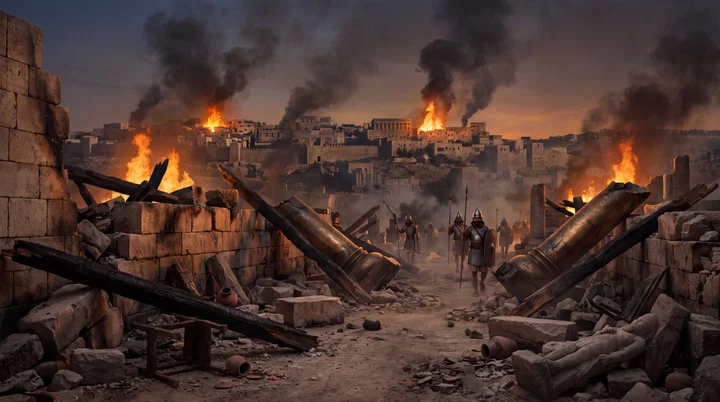
The LORD hath purposed to destroy the wall of the daughter of Zion: he hath stretched out a line, he hath not withdrawn his hand from destroying: therefore he made the rampart and the wall to lament; they languished together.
Translations
The LORD has purposed to destroy the wall of the daughter of Zion: he has stretched out a line, he has not withdrawn his hand from destroying: therefore he made the rampart and the wall to lament; they languished together.
King James Version, Webster Bible
The LORD hath purposed to destroy the wall of the daughter of Zion: he hath stretched out a line, he hath not withdrawn his hand from destroying: therefore he made the rampart and the wall to lament; they languished together.
The Lord hath purposed to destroy the wall of the daughter of Zion:
He hath stretched out a line, he hath not withdrawn his hand from destroying:
Therefore he made the rampart and the wall to lament; they languished together.The LORD hath purposed to destroy the wall of the daughter of Zion; he hath stretched out the line, he hath not withdrawn his hand from destroying: but he hath made the rampart and wall to lament; they languish together.
Jehovah hath purposed to destroy the wall of the daughter of Zion;
He hath stretched out the line, he hath not withdrawn his hand from destroying;
And he hath made the rampart and wall to lament; they languish together.Devised hath Jehovah to destroy the wall of the daughter of Zion, He hath stretched out a line, He hath not turned His hand from destroying, And He causeth bulwark and wall to mourn, Together — they have been weak.
Jehovah hath purposed to destroy the wall of the daughter of Zion: he hath stretched out the line, he hath not withdrawn his hand from destroying; and he hath made the rampart and the wall to lament: they languish together.
Yahweh hath devised to lay in ruins, the wall of the daughter of Zion, he hath stretched out a line, he hath not turned back his hand from swallowing up,—Thus hath he caused to mourn—rampart and wall, together, have they languished!
Berean Standard Bible, Majority Standard Bible
The LORD determined to destroy
the wall of the Daughter of Zion.
He stretched out a measuring line
and did not withdraw His hand from destroying.
He made the ramparts and walls lament;
together they waste away.The LORD has purposed to destroy the wall of the daughter of Zion.
He has stretched out the line.
He has not withdrawn his hand from destroying;
He has made the rampart and wall lament.
They languish together.It is the Lord's purpose to make waste the wall of the daughter of Zion; his line has been stretched out, he has not kept back his hand from destruction: he has sent sorrow on tower and wall, they have become feeble together.
The Lord hath determined to destroy the wall of the daughter of Zion: hee stretched out a lyne: hee hath not withdrawen his hande from destroying: therefore hee made the rampart and the wall to lament: they were destroyed together.
Douay-Rheims (Challoner revision)
Heth. The Lord hath purposed to destroy the wall of the daughter of Sion: he hath stretched out his line, and hath not withdrawn his hand from destroying: and the bulwark hath mourned, and the wall hath been destroyed together.
Pictures
Commentary
Each commentary is drawn from primary sources: the writings of Ellen G. White and Adventist pioneers and periodicals. Each commentary is separate. Its own words are not a quotation; follow the references to read the source passages.
Pioneers and periodicals
3 sources
The book is a mournful lament over the ruin that was about to engulf Jeremiah's people, a ruin he had foreseen and foretold as inevitable.RH Aug 3, 1916 It commemorates the awful sufferings that came upon the apostate people of God, the inhabitants of Jerusalem.ST Nov 3, 1909 Its second chapter describes the destruction and suffering of Jerusalem under Babylonian judgment brought upon the Jews.
Joined to the next verse, it shows that the law of God and the gift of prophecy are inseparable and flourish or fail together, so that when the law is no more the prophets are left without revelation from the Lord.ST Mar 7, 1906 The tribulation it describes was severe enough to challenge the claim that the later destruction of Jerusalem was history's greatest tribulation. As further shown by chapter 4, especially verses 3-10, the suffering under the Babylonians was as great as the suffering at Jerusalem's later destruction, which means the Jews under Babylon cannot be identified as the elect who experience the greatest tribulation spoken of in Matthew 24.
Sources