Luke 1:36
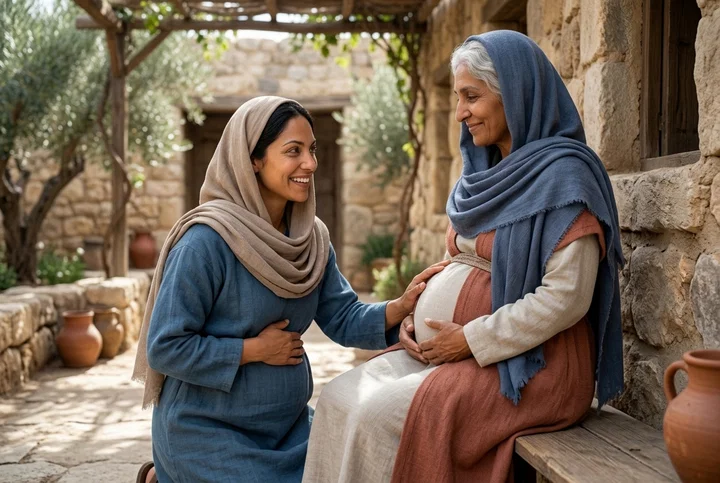
And, behold, thy cousin Elisabeth, she hath also conceived a son in her old age: and this is the sixth month with her, who was called barren.
Translations
And, behold, your cousin Elisabeth, she has also conceived a son in her old age: and this is the sixth month with her, who was called barren.
And, behold, thy cousin Elisabeth, she hath also conceived a son in her old age: and this is the sixth month with her, who was called barren.
And behold, thy cousin Elisabeth, she hath also conceived a son in her old age: and this is the sixth month with her, who was called barren.
And behold, thy cousin Elisabeth, she hath also conceived a son in her old age; and this is the sixth month with her who was called barren:
And behold, Elisabeth thy kinswoman, she also hath conceived a son in her old age: and this is the sixth month with her that was called barren.
And behold, Elisabeth thy kinswoman, she also hath conceived a son in her old age; and this is the sixth month with her that was called barren.
and lo, Elisabeth, thy kinswoman, she also hath conceived a son in her old age, and this is the sixth month to her who was called barren;
And behold, Elizabeth, thy kinswoman, she also has conceived a son in her old age, and this is the sixth month to her that was called barren:
And lo! Elizabeth thy kinswoman, even she, hath conceived a son in, her old-age;—and, this month, is, the sixth, to her, the so-called barren one;
Berean Standard Bible, Majority Standard Bible
Look, even Elizabeth your relative has conceived a son in her old age, and she who was called barren is in her sixth month.
Behold, Elizabeth your relative also has conceived a son in her old age; and this is the sixth month with her who was called barren.
Even now Elisabeth, who is of your family, is to be a mother, though she is old: and this is the sixth month with her who was without children.
And behold, thy cousin Elisabet, she hath also conceiued a sonne in her olde age: and this is her sixt moneth, which was called barren.
Douay-Rheims (Challoner revision)
And behold thy cousin Elizabeth, she also hath conceived a son in her old age; and this is the sixth month with her that is called barren:
Pictures
Cross-references
- Luke 1:13-17
But the angel said unto him, Fear not, Zacharias: for thy prayer is heard; and thy wife Elisabeth shall bear thee a son, and thou shalt call his name John.
Gabriel announces John’s birth and preparatory work.
- Luke 1:24-25
And after those days his wife Elisabeth conceived, and hid herself five months, saying,
Elizabeth’s conception is reported before the angel announces it to Mary.
- Luke 1:46-55
And Mary said, My soul doth magnify the Lord,
Mary’s poem is her song of praise.
- Romans 4:17
( As it is written, I have made thee a father of many nations,) before him whom he believed, even God, who quickeneth the dead, and calleth those things which be not as though they were.
God brings life where it seemed impossible, as in Elisabeth’s conception in old age.
Commentary
Each commentary is drawn from primary sources: the writings of Ellen G. White and Adventist pioneers and periodicals. Each commentary is separate. Its own words are not a quotation; follow the references to read the source passages.
Ellen G. White
1 source
The words were addressed to Mary in Nazareth as part of the angel's announcement of the coming birth of Jesus.DA 144.3–145.1 In reporting that Elizabeth had conceived, the announcement joined the birth of John the Baptist to the coming of Jesus.DA 144.3–145.1 Mary treasured those angelic words in her heart as evidence that Jesus was the Messiah.DA 144.3–145.1
Sources
Pioneers and periodicals
26 sources
The angel Gabriel spoke to Mary at Nazareth to tell her that her kinswoman Elizabeth had conceived a son in her old age and was in the sixth month though she had been called barren.ST Jan 1, 1894ST Jun 18, 1894ST Dec 3, 1896 It was spoken as part of the announcement that Mary had been chosen to be the mother of the Saviour and would conceive and bring forth Jesus.ST Jan 1, 1894ST Jun 28, 1905ST Feb 6, 1896 Elizabeth's pregnancy was given as a sign to strengthen Mary's faith, showing that nothing is impossible with God and no word from God is void of power.ST Jan 1, 1894ST Jun 18, 1894ST Dec 3, 1896 Since Elizabeth was six months pregnant when the angel spoke, John was six months older than Christ and began his ministry as forerunner six months before Christ began His.RH Apr 30, 1901ST Dec 19, 1892ST Jun 28, 1905 The account to which it belongs is a landmark in the fulfillment of the Old Testament gospel promises of a child born, of a virgin conceiving Immanuel, of seed born of a woman and of Abraham, and of Bethlehem as His birthplace.RH Nov 14, 1854RH Dec 2, 1909
Words and Setting
The word is spoken by the angel Gabriel to Mary at Nazareth.ST Jan 1, 1894ST May 19, 1898 He tells her that her kinswoman Elizabeth has also conceived a son in her old age, and that this is the sixth month with her who was called barren.ST Jan 1, 1894ST Jun 18, 1894ST Dec 3, 1896RH Dec 11, 1866ST Jan 22, 1894 Elizabeth is Mary's cousin.ST Jun 19, 1907ST Jan 6, 1904 Their mothers were cousins, so John the Baptist and Jesus are described as cousins, even as what is called second cousins, though John and Jesus grew up in separate, retired settings.ST Jun 19, 1907ST Jan 6, 1904
The word was spoken in the sixth month after Elizabeth's conception.ST Jan 1, 1894 It belongs to the announcement that Mary would conceive and bring forth Jesus and had been chosen to be the mother of the Saviour, and that announcement included news of Elizabeth's pregnancy and of John's birth and work as preparation for Christ's work on earth.ST Jan 1, 1894ST Jun 28, 1905ST Feb 6, 1896 Elizabeth's pregnancy was given as a sign accompanying the announcement of Jesus' coming birth.ST Jun 18, 1894RH Dec 11, 1866ST Jan 22, 1894 It was given to strengthen Mary's faith in the announcement.ST Jan 1, 1894ST Jan 1, 1894 It showed that no word from God is void of power and that nothing is impossible with God.ST Jan 1, 1894ST Dec 3, 1896
Mary acted on the word by going in haste into the hill country into the house of Zacharias to visit Elizabeth.ST Jan 1, 1894 That visit is one of the incidents connected with the birth of John the Baptist, the forerunner of Christ, about B.C. 5.ST Jan 1, 1894ST Mar 12, 1896
Prophecy and History
Luke opens his Gospel with an extended account of the early history of the mission of Jesus, dwelling far more largely on that early history than the other evangelists, including both the birth of John the Baptist and the birth of Jesus.ST Mar 17, 1909 That birth account is a prominent landmark in the fulfillment of the Old Testament gospel promises. It fulfills the prediction that a child is born, the word spoken over seven hundred years before that a virgin shall conceive and bear a son called Immanuel, the word spoken about four thousand years before in Eden that he should be born of a woman, the word spoken over two thousand years before to Abraham concerning his seed, and the word that Bethlehem should be his birthplace.RH Nov 14, 1854RH Dec 2, 1909
He was begotten by the power of the Highest and was born of Mary in Bethlehem of Judea in the reign of Augustus Caesar, proving that he was a real human being, truly born of the flesh and living among people.RH Nov 14, 1854ST May 19, 1898 The angels' testimony about his first advent in this account was fulfilled accurately, so their testimony can be relied on.ST Feb 3, 1898 Elizabeth's conception of a son in her old age, now in its sixth month, was made known by special revelation from heaven, corroborating the Scriptures' testimony about Christ's first advent.ST Feb 3, 1898RH Dec 11, 1866
Gabriel announced both births, bringing Zacharias news of John the forerunner of Christ and then announcing to Mary that Jesus would be born, making this chapter an example of the angel's role in announcing Christ's first advent.RH Apr 25, 1871 He was still in divine service more than four hundred years after his mission to Daniel, when he was sent to Mary and spoke of Elizabeth's conception in her old age.RH Jul 14, 1863 His mission to Mary illustrates the angels' role as living servants who stand in God's presence and are sent on errands of mercy.RH Apr 25, 1871ST Aug 23, 1910
John the Baptist's birth and work were announced as part of the preparation for Christ's work on earth.ST Jun 28, 1905 Since Elizabeth was six months pregnant when the angel spoke to Mary, John was six months older than Christ, Christ being six months younger than John.RH Apr 30, 1901ST Dec 19, 1892 Accordingly John began his ministry six months before Christ began his, a difference used to place the beginning of Christ's ministry six months after John began his work.RH Apr 30, 1901ST Dec 19, 1892 Gabriel's message belongs among the Christmas stories as a true event planned and told by God, not as fiction.ST Dec 24, 1912 The Gospel account of Jesus' birth is historical testimony whose credibility stands with the rest of the Gospel record, not to be dismissed while the other Gospel testimony is accepted as reliable, and Luke's record confirms the reliability of that birth narrative so that it cannot be set aside to support the claim that Jesus was born in Galilee.RH Jan 1, 1914ST Sep 29, 1909 The angel really appeared to Mary in Nazareth at the annunciation.ST May 19, 1898
Doctrine and Faith
Gabriel's visit to Mary in Nazareth at the annunciation was real, and Jesus Christ was truly born of the flesh and lived among people, taking human nature upon himself so that he could impart his nature to humanity.ST May 19, 1898 The account shows Mary believing God's word, in contrast to Eve's doubt, and through Mary Jesus the Saviour and God's righteousness comes into the world.RH Oct 7, 1915 In receiving the angelic message Mary was, like Noah, Abram, and Isaiah, chosen as an agent through whom God carried out his work, and while God's power did not depend on her, he honored her by using her.RH Apr 8, 1902
The record in Luke 1:26-38 that Jesus was born to the Virgin Mary fulfills the prophecies of his birth: the word spoken over seven hundred years before that a virgin shall conceive and bear a son called Immanuel, the word spoken about four thousand years before in Eden that he should be born of a woman, the word spoken over two thousand years before to Abraham concerning his seed, and the word that Bethlehem should be his birthplace.RH Dec 2, 1909 It gives no date for his birth and no command to celebrate it.RH Dec 2, 1909
Sources