Luke 1:58
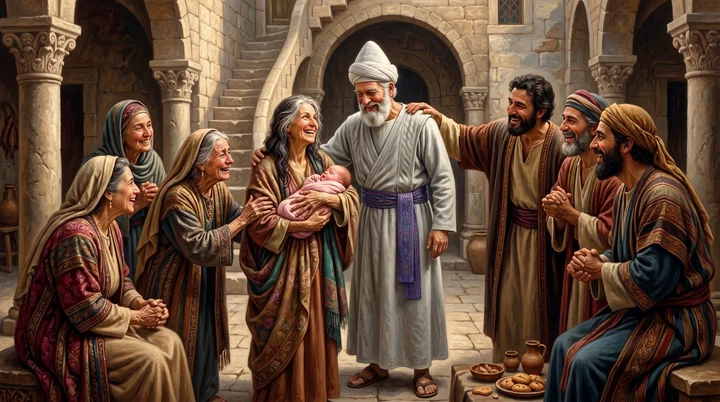
And her neighbours and her cousins heard how the Lord had shewed great mercy upon her; and they rejoiced with her.
Translations
And her neighbors and her cousins heard how the Lord had showed great mercy on her; and they rejoiced with her.
King James Version, KJV Cambridge Paragraph Bible
And her neighbours and her cousins heard how the Lord had shewed great mercy upon her; and they rejoiced with her.
And her neighbors and her cousins heard that the Lord had shown great mercy upon her; and they rejoiced with her.
And her neighbours and her kinsfolk heard that the Lord had magnified his mercy towards her; and they rejoiced with her.
And her neighbors and her kinsfolk heard that the Lord had magnified his mercy towards her; and they rejoiced with her.
and the neighbours and her kindred heard that the Lord was making His kindness great with her, and they were rejoicing with her.
And her neighbours and kinsfolk heard that [ the] Lord had magnified his mercy with her, and they rejoiced with her.
And her neighbours and kinsfolk heard, that the Lord had magnified his mercy with her, and they were rejoicing with her.
Berean Standard Bible, Majority Standard Bible
Her neighbors and relatives heard that the Lord had shown her great mercy, and they rejoiced with her.
Her neighbors and her relatives heard that the Lord had magnified his mercy toward her, and they rejoiced with her.
And it came to the ears of her neighbours and relations that the Lord had been very good to her, and they took part in her joy.
And her neighbours, and cousins heard tell howe the Lord had shewed his great mercie vpon her, and they reioyced with her.
Douay-Rheims (Challoner revision)
And her neighbours and kinsfolks heard that the Lord had shewed his great mercy towards her, and they congratulated with her.
Pictures
Cross-references
- Luke 1:13-14
But the angel said unto him, Fear not, Zacharias: for thy prayer is heard; and thy wife Elisabeth shall bear thee a son, and thou shalt call his name John.
The angel promises John’s birth and says many will rejoice.
- Luke 1:5
There was in the days of Herod, the king of Judæa, a certain priest named Zacharias, of the course of Abia: and his wife was of the daughters of Aaron, and her name was Elisabeth.
Identifies Zacharias and Elizabeth as husband and wife.
Commentary
Each commentary is drawn from primary sources: the writings of Ellen G. White and Adventist pioneers and periodicals. Each commentary is separate. Its own words are not a quotation; follow the references to read the source passages.
Ellen G. White
3 sources
The great mercy was the Lord giving Elizabeth a son in answer to many years of prayer for the coming Redeemer.DA 97.3 That mercy was announced in the holy place of the sanctuary before the golden altar while the cloud of incense with the prayers of Israel ascended before God.DA 97.3 The angel standing on the right side of the altar signaled divine favor, but Zacharias took no note of it.DA 97.3 The mercy seemed too great for him to credit, filling him with fear and self-condemnation.DA 97.3
Neighbors and relatives recognized the great mercy God had shown Elizabeth and shared her joy at John's birth.2SP 62.1–2DA 43.2–44.1 The news of the forerunner's birth and the significance of his mission spread abroad.DA 43.2–44.1 The signs surrounding his birth, including the angel's message to Zacharias and the restoration of his speech, were largely forgotten over the next thirty years but were recalled when John appeared as a prophet.2SP 62.1–2
Sources
Pioneers and periodicals
5 sources
Elizabeth's neighbours and relatives heard that the Lord had shown her great mercy in the birth of her son, and they shared her joy, so that his birth became a cause for communal rejoicing. News of John's birth and the significance of his mission spread among the people, and his birth was part of the events announcing Christ's coming.ST May 27, 1908 The verse is part of the account of the birth of John the Baptist, the forerunner of Christ, and forms part of the setting for the angel's messages about John and Jesus.RH Apr 25, 1871
It belongs within Luke's account running from Luke 1:21 to Luke 4:30, covering the births of John and Jesus, the angelic vision to the shepherds, their worship of the child Jesus, the presentation in the temple, the preaching of John the Baptist, the genealogy of Jesus traced back to Adam as Saviour of all nations, the temptation of Jesus, and His ministry in Nazareth.ST Mar 17, 1909 That extended opening shows Luke's fuller treatment of the early history of the mission of Jesus than the other evangelists give.ST Mar 17, 1909 It is part of Luke's account of the birth of Jesus, which is a landmark in the fulfillment of the Gospel promises made in the Old Testament.
The birth account in Luke 1-2 fulfills the prediction that unto us a child is born and proves Jesus was a real human being, begotten by the power of the Highest and born of Mary in Bethlehem of Judea in the reign of Augustus Caesar.RH Nov 14, 1854 The Luke 1 account of the birth of Christ is to be studied with Matthew 1, John 1:1-18, and the Matthew 2 account, whose events happened about four years before A.D. 1.ST Dec 3, 1896
Sources