Luke 1:5
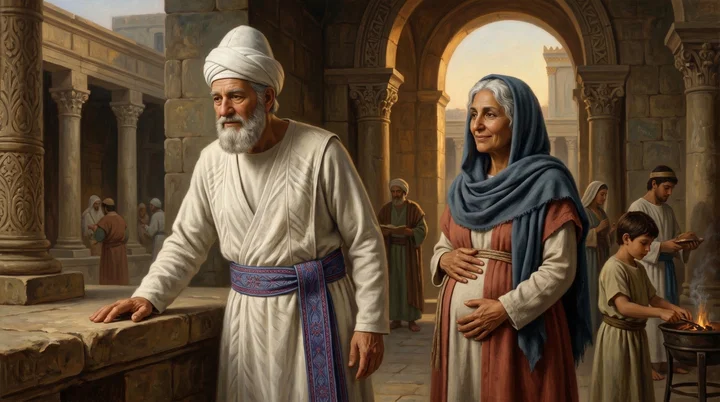
There was in the days of Herod, the king of Judæa, a certain priest named Zacharias, of the course of Abia: and his wife was of the daughters of Aaron, and her name was Elisabeth.
Translations
THERE was in the days of Herod, the king of Judaea, a certain priest named Zacharias, of the course of Abia: and his wife was of the daughters of Aaron, and her name was Elisabeth.
There was in the days of Herod, the king of Judæa, a certain priest named Zacharias, of the course of Abia: and his wife was of the daughters of Aaron, and her name was Elisabeth.
There was in the days of Herod, the king of Judea, a certain priest named Zacharias, of the course of Abia: and his wife was of the daughters of Aaron, and her name was Elisabeth.
There was in the days of Herod the king of Judea, a certain priest named Zacharias, of the course of Abia: and his wife was of the daughters of Aaron, and her name was Elisabeth.
There was in the days of Herod, king of Judaea, a certain priest named Zacharias, of the course of Abijah: and he had a wife of the daughters of Aaron, and her name was Elisabeth.
There was in the days of Herod, king of Judæa, a certain priest named Zacharias, of the course of Abijah: and he had a wife of the daughters of Aaron, and her name was Elisabeth.
There was in the days of Herod, the king of Judea, a certain priest, by name Zacharias, of the course of Abijah, and his wife of the daughters of Aaron, and her name Elisabeth;
There was in the days of Herod, the king of Judaea, a certain priest, by name Zacharias, of the course of Abia, and his wife of the daughters of Aaron, and her name Elizabeth.
It came to pass, in the days of Herod, king of Judaea, that there was a certain priest, by name Zachariah, of the daily course of Abia; and that he had a wife of the daughters of Aaron, and, her name, was Elizabeth.
In the time of Herod king of Judea there was a priest named Zechariah, who belonged to the priestly division of Abijah, and whose wife Elizabeth was a daughter of Aaron.
In the time of Herod king of Judea there was a priest named Zechariah, who belonged to the priestly division of Abijah, and whose wife Elizabeth was a descendant of Aaron.
There was in the days of Herod, the king of Judea, a certain priest named Zacharias, of the priestly division of Abijah. He had a wife of the daughters of Aaron, and her name was Elizabeth.
In the days of Herod, king of Judaea, there was a certain priest, by name Zacharias, of the order of Abijah; and he had a wife of the family of Aaron, and her name was Elisabeth.
In the time of Herod King of Iudea, there was a certaine Priest named Zacharias, of the course of Abia: and his wife was of the daughters of Aaron, and her name was Elisabet.
Douay-Rheims (Challoner revision)
There was in the days of Herod, the king of Judea, a certain priest named Zachary, of the course of Abia; and his wife was of the daughters of Aaron, and her name Elizabeth.
Pictures
Cross-references
- Luke 1:13-17
But the angel said unto him, Fear not, Zacharias: for thy prayer is heard; and thy wife Elisabeth shall bear thee a son, and thou shalt call his name John.
Gabriel announces John’s birth and his work preparing the Messiah’s way.
- 1 Chronicles 24:10
The seventh to Hakkoz, the eighth to Abijah,
Abijah is named as the eighth priestly course, matching Zacharias’s course.
- Luke 1:57
Now Elisabeth’s full time came that she should be delivered; and she brought forth a son.
Both record the birth of John.
- Matthew 2:1
Now when Jesus was born in Bethlehem of Judaea in the days of Herod the king, behold, there came wise men from the east to Jerusalem,
Both place events surrounding Jesus’ birth under Herod’s rule.
- Luke 3:1-18
Now in the fifteenth year of the reign of Tiberius Cæsar, Pontius Pilate being governor of Judæa, and Herod being tetrarch of Galilee, and his brother Philip tetrarch of Ituraea and of the region of Trachonitis, and Lysanias the tetrarch of Abilene,
Grouped with Luke 1:5-23 in the chapter’s account of John.
- Luke 1:36
And, behold, thy cousin Elisabeth, she hath also conceived a son in her old age: and this is the sixth month with her, who was called barren.
links maternal line to priestly family
- Luke 1:59-60
And it came to pass, that on the eighth day they came to circumcise the child; and they called him Zacharias, after the name of his father.
same Zachariah as father
- Luke 1:19
And the angel answering said unto him, I am Gabriel, that stand in the presence of God; and am sent to speak unto thee, and to shew thee these glad tidings.
Gabriel identifies himself as sent to announce the event to Zacharias.
- Luke 1:11
And there appeared unto him an angel of the Lord standing on the right side of the altar of incense.
The angel stands on the favored side of the altar.
Commentary
Each commentary is drawn from primary sources: the writings of Ellen G. White and Adventist pioneers and periodicals. Each commentary is separate. Its own words are not a quotation; follow the references to read the source passages.
Ellen G. White
5 sources
Luke 1:5 places Zacharias in the days of Herod, king of Judea.DA 97.2ST Apr 16, 1896DA 97.1 It identifies him as a priest of the course of Abia, and his wife Elisabeth as of the daughters of Aaron.DA 97.2ST Apr 16, 1896DA 97.1 It reflects a system in which priests served by courses, with Zacharias living in the hill country of Judea and coming up to Jerusalem for a week of temple service twice a year for each course.DA 97.2
It presents Zacharias and Elisabeth as an aged, godly couple, both righteous before God, whose faithful lives shone amid the darkness of that time.DA 97.1 It introduces Zacharias while exercising his priestly office in the holy place before the golden altar, burning incense as the cloud of incense with the prayers of Israel ascends before God.DA 97.3 There he becomes aware of a divine presence when an angel appears standing on the right side of the altar, a position indicating favor, though he takes no note of it.DA 97.3
He had prayed for many years for the coming of the Redeemer, and heaven then sends a messenger to announce those prayers are about to be answered, but the mercy seems too great to believe and he is filled with fear and self-condemnation.DA 97.3 Their promised son would go before the Lord to prepare His ways.DA 97.1 The couple were chosen as parents to train John to work in harmony with God as the messenger announcing the coming of Christ, faithfully cooperating with God to form in him a character fitting him as a competent worker for the part assigned to him.ST Apr 16, 1896
Although John was a son of their old age and a miraculous child with a special work, they did not leave his care to the Lord alone but moved to a retired place in the country so he would not be exposed to city temptations or drawn away from their counsel and instruction, and so that by no careless neglect he would fail to become good and wise to give light and guide feet into peace.ST Apr 16, 1896 The verse identifies Zacharias as the father of John the Baptist, whose important future work required his habits to be regulated from infancy, including abstaining from wine and strong drink.HSFM 208.3–209.2 The account therefore shows that parents must practice temperance because their habits affect their children.HSFM 208.3–209.2
Sources
Pioneers and periodicals
36 sources
Luke 1:5 sets its account in the days of Herod, king of Judea, about 5 B.C., introducing in detail the story of John the Baptist as the forerunner of Christ and the background to the birth of Jesus.ST Sep 19, 1911ST Dec 25, 1893ST Mar 12, 1896 Zacharias was a priest of the course of Abia, the eighth of the twenty-four courses appointed by lot for Aaron's descendants to serve in turn at the sanctuary, and his wife Elisabeth was of the daughters of Aaron, so John belonged to a priestly family through both parents.ST Dec 25, 1893ST Dec 30, 1889ST Dec 25, 1893RH May 5, 1859ST Apr 3, 1879 Zacharias and Elisabeth were elderly and childless, yet righteous people who kept every command and ordinance of the Lord without fault.RH Jul 6, 1911RH Sep 3, 1872ST Dec 12, 1892 While Zacharias was ministering at the altar at the hour of incense and praying for the Messiah's coming, Gabriel was sent to him to announce that Elisabeth would bear a son, John, who would prepare the Messiah's way.ST May 27, 1908RH Apr 25, 1871RH Apr 10, 1913RH Jul 14, 1863ST Jun 12, 1907 God chose John for that work because Zacharias and Elisabeth would guide their household rightly and faithfully cooperate with Him in forming his character, and their life of worship and prayer remains the pattern for Christian families gathering at the family altar morning and evening.ST Apr 16, 1896RH Aug 21, 1855RH Sep 12, 1871ST Dec 12, 1892RH Jul 28, 1904
Time, Persons, and Priesthood
Luke 1:5 places the account in the days of Herod, king of Judea, about 5 B.C., and introduces in detail the story of John the Baptist as the forerunner of Christ.ST Sep 19, 1911ST Dec 25, 1893ST Mar 12, 1896 These opening verses identify Zacharias and Elisabeth before Gabriel's announcement that they would have a son to prepare the Messiah's way.ST Dec 25, 1893 They form the background to be kept clear for the birth of Christ in Bethlehem and for the announcement to the shepherds and the presentation in the temple in Luke 2:8-33.ST Jan 22, 1894
Herod was Herod the Great, an Idumean by birth who practiced the Jewish religion.ST Dec 30, 1889 He was energetic but cruel and selfish, enlarged the Jerusalem temple later called Herod's temple, and died at Jericho in 4 B.C.ST Dec 30, 1889 That date does not mean he died before Christ's birth, because the A.D. reckoning introduced in the sixth century and calculated backward had an error of about four years, so 4 B.C. corresponds to A.D. 1 or 2.ST Dec 30, 1889
Zacharias was a priest of the course of Abia, also called Abijah or Abijah's order.ST Dec 25, 1893ST Dec 30, 1889ST Dec 25, 1893 That course was the eighth of the twenty-four courses or divisions formed by lot from the sons of Eleazar and Ithamar for Aaron's descendants to take turns serving at the sanctuary.ST Dec 30, 1889ST Dec 25, 1893 Because there were many thousands of priests and service was assigned by lot, a priest might serve only once in his lifetime or never be chosen, so Zacharias's service was a rare and important occasion.ST Dec 25, 1893 Elisabeth was of the daughters of Aaron and descended from Aaron, so John the Baptist belonged to a priestly family through both parents, with Zacharias of priestly line serving in the course of Abia and Elisabeth of Aaronic ancestry.ST Dec 25, 1893ST Dec 30, 1889RH May 5, 1859ST Apr 3, 1879
Zachariah the father of John the Baptist is only one of several different men in the Bible called Zachariah, distinct from Zachariah the king fourth in descent from Jehu, Zachariah murdered as recorded in 2 Chronicles, and Zachariah the prophet who encouraged the Jews to rebuild the temple, showing that different persons with the same name must be told apart.RH Nov 12, 1861 The Levitical priesthood was organized into courses with chief priests at the head of these courses, but only one man actually held the office of high priest, so the verse does not prove there were many high priests besides the officiating high priest.RH Aug 14, 1868 The word for days illustrates that day can refer to a period that includes night as well as daylight, a full twenty-four-hour period.RH Dec 12, 1871 The verse calls Zacharias the husband of Elisabeth, which by necessity implies Elisabeth is the wife of Zacharias.ST Mar 11, 1880RH Mar 22, 1870 The husband-wife relation is reciprocal and ends with death, so a dead Elisabeth and a living Zacharias could no longer be described as husband and wife, only that he had been her husband and she had been his wife.ST Mar 11, 1880RH Mar 22, 1870
Announced Forerunner of Christ
Zacharias and Elisabeth were elderly and childless, yet Elisabeth was to bear the Messiah's forerunner.RH Jul 6, 1911ST Dec 12, 1892 John was a child of promise, a miracle child of their old age whose birth and work were announced by Gabriel.RH Jul 6, 1911ST Dec 12, 1892ST Jun 28, 1905 Gabriel was sent to Zacharias while he was serving in the temple.RH Jul 6, 1911RH Apr 25, 1871RH Jul 14, 1863 Angels are real heavenly beings acting under God's direction who can appear in human form.RH Apr 25, 1871RH Apr 10, 1913
Gabriel's coming proves he was still serving God more than four hundred years after his mission to Daniel, when he was sent on sacred missions to Zacharias and Mary.RH Apr 10, 1913RH Jul 14, 1863 Gabriel, the mightiest angel in heaven, was sent to announce both the birth and work of John and the birth and work of Christ.RH Apr 25, 1871RH Jul 14, 1863ST Jun 28, 1905 John was sent by the Father to prepare the way for Christ's work on earth.RH Apr 25, 1871ST Jun 28, 1905 Zacharias was studying Daniel's prophecies and understood the promised time for the Messiah's appearance was near.ST Jun 12, 1907 While ministering at the altar at the hour of incense and praying for the Messiah's coming he received the angel's announcement that he would have a son, John, who would prepare the Messiah's way.ST May 27, 1908ST Jun 12, 1907
The announcement told of Christ's coming, and the forerunner's birth and mission were confirmed by miracle and prophecy.ST May 27, 1908ST Jun 12, 1907 Because Zacharias doubted God's prophetic promise announced through the angel, he was sentenced to be unable to speak until the prediction was fulfilled.RH Jul 6, 1911 Zacharias was afterward filled with the Holy Ghost and prophesied, blessing the Lord God of Israel for visiting and working redemption for his people. He spoke of his own son as prophet of the Most High who would go before the face of the Lord to make ready his ways.
John's childhood was spent with his parents, and his boyhood and early manhood were spent in the wilderness east of Judea and west of the Dead Sea.ST Mar 13, 1907 There disciplined, devoted living and meditation on the law and prophets prepared him to serve as the herald of Jesus and to call Israel away from sin and empty traditions.ST Mar 13, 1907 The account to which the verse belongs is a major landmark in the fulfillment of the Old Testament gospel promises.RH Nov 14, 1854 It brings Rome, the fourth and last universal kingdom represented by the iron legs of Daniel's image, into view through Augustus's decree for a census showing Rome had jurisdiction over the world.ST May 3, 1877RH Nov 14, 1854 Rome followed Grecia, and its eventual division into ten kingdoms is represented by the image's ten toes.ST May 3, 1877
Together with Matthew 1, Matthew 2, and Luke 2 it proves Jesus was a real human being, begotten by the power of the Highest and born of Mary in Bethlehem of Judea in the reign of Augustus Caesar.RH Nov 14, 1854 The verse shows the earthly pedigree of Jesus reaching back to David through kings on one side and through priests on the maternal side, since Elisabeth was of the daughters of Aaron.RH Jan 19, 1911 David, though of the tribe of Judah, stood as king at the head of the earthly priesthood, and in that union of kingship with headship over priests he was a type and prelude of Jesus as the heavenly Prince of Peace, in whom the priesthood merges into heavenly service.RH Jan 19, 1911 Zechariah belonged to the priestly line, and his selection as a messenger illustrates that God may choose a prophet from among the priests, since prophetic succession follows no fixed rule.RH Aug 19, 1915
Righteousness, Worship, and Parenting
Zacharias and Elisabeth were righteous people who kept God's law, obeying every command and ordinance of the Lord without fault.RH Sep 3, 1872 Their life proves that Jesus Christ was not the only person who ever kept the law, and refutes the claim that no one else kept it.RH Sep 3, 1872 Zacharias was a humble priest of the course of Abijah and Elisabeth was his humble wife, faithful, righteous, devoted servants who continued in simple duty into old age when their son John was born.ST Sep 3, 1912 Unlike the Pharisees who were creed-bound by tradition and unable to receive Christ's new life-working teaching, they walked with God and therefore saw and received additional light when it came.ST Jan 23, 1901 Their example proves that if God's life is in the heart the heart will respond to ever-unfolding truth.ST Jan 23, 1901
God chose John as Christ's forerunner because Zacharias and Elisabeth would guide their household rightly and because the circumstances of his birth and early life fitted him for that work, so his choice was not arbitrary.ST Dec 12, 1892 As parents chosen to train John to work in harmony with God in preparing a messenger to announce Christ's coming, they were to faithfully cooperate with God in forming in him such a character as would fit him to perform his assigned part as a competent worker.ST Apr 16, 1896 Though John was the son of their old age and a child of miracle with a special work to do, they did not leave the Lord to take care of him alone but moved to a retired place in the country where he would not be exposed to the temptations of city life or induced to depart from their counsel and instruction.ST Apr 16, 1896 By no careless neglect on their part was he to fail to become good and wise to give light and guide feet into peace.ST Apr 16, 1896 They present an example of godly parents whose faithful prayers and care helped prepare the way for the good fruit of his life, linking such a great and good man with the influence of a godly mother.RH Jul 28, 1904ST Apr 3, 1879
Zacharias ministered in the Jewish dispensation of morning and evening sacrifice, when there was a set hour in the morning and a set hour in the evening called hours for prayer.RH Sep 12, 1871 At those hours pious Jews prayed while priests interceded for the people through sacrifice and burning incense, with the whole multitude praying without at the time of incense.RH Sep 12, 1871 His appearance in connection with the hour of incense shows that God reveals important things at times of worship, sacrifice, and prayer.RH Aug 21, 1855RH Sep 12, 1871 Though burnt-offerings and temple worship have passed away through Christ's one offering, the morning and evening hour remains for Christian families to gather husband, wife, and children around the family altar in grateful praise and earnest supplication.RH Sep 12, 1871 That worship rises before the throne of mercy sweeter than an offering made by fire, and there the Lord meets His children as He met Israel at the tabernacle.RH Sep 12, 1871
The passage is an example of Scripture presenting its accounts without editorial explanation to reconcile differences, left to tell their own story and showing the unforced character of the Gospel records.ST Jun 14, 1877
Sources