Luke 1:7
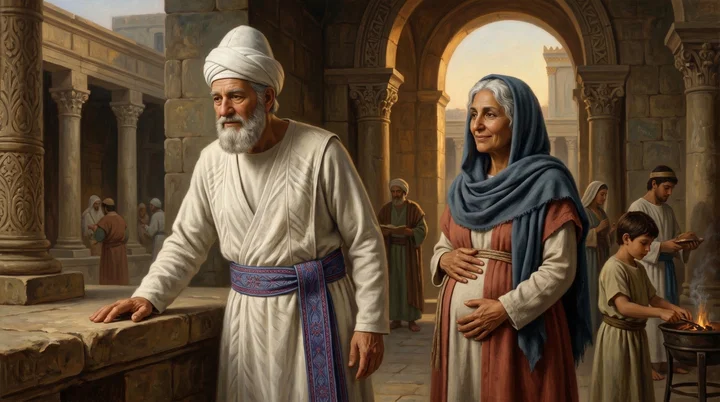
And they had no child, because that Elisabeth was barren, and they both were now well stricken in years.
Translations
American King James Version, King James Version, KJV Cambridge Paragraph Bible, Revised Version, American Standard Version
And they had no child, because that Elisabeth was barren, and they both were now well stricken in years.
And they had no child, because Elisabeth was barren, and they both were far advanced in years.
and they had no child, because that Elisabeth was barren, and both were advanced in their days.
And they had no child, because Elizabeth was barren, and they were both advanced in years.
and they had no child, inasmuch as Elizabeth was barren, and, both, had become, advanced in their days.
Berean Standard Bible, Majority Standard Bible
But they had no children, because Elizabeth was barren, and they were both well along in years.
But they had no child, because Elizabeth was barren, and they both were well advanced in years.
And they were without children, because Elisabeth had never given birth, and they were at that time very old.
And they had no childe, because that Elisabet was barren: and both were well stricken in age.
Douay-Rheims (Challoner revision)
And they had no son, for that Elizabeth was barren, and they both were well advanced in years.
Pictures
Cross-references
- Luke 1:13
But the angel said unto him, Fear not, Zacharias: for thy prayer is heard; and thy wife Elisabeth shall bear thee a son, and thou shalt call his name John.
The angel answers their prayer by announcing John’s birth.
- Luke 1:57
Now Elisabeth’s full time came that she should be delivered; and she brought forth a son.
Both recount the birth of John.
- Genesis 21:2
For Sarah conceived, and bare Abraham a son in his old age, at the set time of which God had spoken to him.
Sarah’s barren birth in old age parallels Elizabeth’s birth of John.
- 1 Samuel 1:20
Wherefore it came to pass, when the time was come about after Hannah had conceived, that she bare a son, and called his name Samuel, saying, Because I have asked him of the LORD.
Hannah's barren birth parallels Elizabeth's
- Psalms 113:9
He maketh the barren woman to keep house, and to be a joyful mother of children. Praise ye the LORD.
quoted as summary of Elizabeth's case
- Matthew 11:11
Verily I say unto you, Among them that are born of women there hath not risen a greater than John the Baptist: notwithstanding he that is least in the kingdom of heaven is greater than he.
identifies Elizabeth's son as greatest prophet
- Judges 13:2-3
And there was a certain man of Zorah, of the family of the Danites, whose name was Manoah; and his wife was barren, and bare not.
Both describe a barren woman who will bear a son.
- Luke 1:80
And the child grew, and waxed strong in spirit, and was in the deserts till the day of his shewing unto Israel.
both give birth of John
Commentary
Each commentary is drawn from primary sources: the writings of Ellen G. White and Adventist pioneers and periodicals. Each commentary is separate. Its own words are not a quotation; follow the references to read the source passages.
Ellen G. White
5 sources
Luke 1:7 means that Zacharias and Elisabeth had no child because Elisabeth was barren and both were well advanced in years, remaining childless into old age.ST Apr 16, 1896DA 97.1DA 97.3RH Jan 7, 1873 Their son was thus a son of their old age and a child of miracle.ST Apr 16, 1896 They were an aged, godly, faithful pair, righteous before God and blameless in all His commandments and ordinances, living at the time when Israel was waiting for the Messiah.DA 97.1RH Jan 7, 1873
Despite childlessness, Zacharias continued in faithful priestly ministry, standing before the golden altar in the holy place while incense burned and the prayers of Israel and the people outside ascended before God.DA 97.3RH Jan 7, 1873 Through those long years he had prayed both for the coming of the Redeemer and for a child, and heaven regarded those prayers as about to be answered.DA 97.3RH Jan 7, 1873 God promised this faithful pair a son, to be named John, assigned a special work as messenger to announce Christ and prepare the way for the Lord, as declared in the angel's message to Zacharias about the child to be born.ST Apr 16, 1896DA 97.1RH Jan 7, 1873HSFM 208.3–209.2 The announcement came while Zacharias was burning incense in the temple, when heaven's messenger appeared standing on the right side of the altar as a sign of divine favor.DA 97.3RH Jan 7, 1873
The mercy seemed too great for Zacharias to credit, so he took no note of the sign of favor and was filled with fear and self-condemnation.DA 97.3 The verse carries a lesson of parental responsibility to prepare for a child's birth: even with a divinely appointed child, parents cannot leave the child for God to care for alone but must faithfully cooperate with God in forming a character fit for his work.ST Apr 16, 1896HSFM 208.3–209.2 In that cooperation they moved to a retired place in the country so their son would not be exposed to the temptations of city life or be induced to depart from their counsel and instruction, sacredly fulfilling their obligation so that by no careless neglect on their part would he fail to become good and wise and give light and guide feet into peace.ST Apr 16, 1896
Sources
Pioneers and periodicals
17 sources
Luke 1:7 presents Zacharias and Elizabeth as an elderly, childless couple, with Elizabeth barren and both far advanced in years so that John was their son in old age after long childlessness.ST Apr 16, 1896RH Jul 6, 1911ST Nov 28, 1892 Their lack of a child was not a mark of divine displeasure, for both were righteous before God and walked blamelessly in all His commandments and ordinances.RH Jan 7, 1873ST Nov 28, 1892 While Zacharias was faithfully ministering in the priest's office, the angel Gabriel appeared to announce that his aged, barren wife would bear him a son to be named John as the forerunner and messenger to prepare the way for Christ.ST Apr 16, 1896RH Jan 7, 1873RH Apr 25, 1871ST Sep 3, 1912ST Jun 28, 1905 That humanly unlikely setting made John a child of miracle whose birth and mission were attested by miracle and prophecy, standing with barren Sarah bearing Isaac and barren Hannah bearing Samuel as proof that God makes the barren woman a joyful mother of children and fulfills His gospel promises.ST Apr 16, 1896ST May 27, 1908RH Jul 6, 1911RH Nov 14, 1854ST Apr 24, 1901 Though God assigned John a special work, his parents had to faithfully cooperate with God in forming a character fit for it, even moving to a retired place in the country away from city temptation, showing that barrenness is no barrier to God and that He will likewise make a barren church fruitful if she lets Christ rule and work.ST Apr 16, 1896ST Nov 28, 1892ST Dec 12, 1892RH Jul 28, 1904ST Apr 24, 1901
Words and Historical Setting
Luke 1 belongs to the fullest account given of John the Baptist and of the parents, infancy, and childhood of Christ, gathered by careful inquiry into all the details of His life.ST Sep 19, 1911 Luke himself was not one of the twelve disciples but was converted afterward, was called the beloved physician, and was much with Paul.ST Sep 19, 1911 The verse describes Zacharias and Elisabeth as an elderly, childless couple, for Elisabeth was barren and both were well stricken and far advanced in years.ST Apr 16, 1896RH Jan 7, 1873RH Jul 6, 1911ST Nov 28, 1892ST Sep 3, 1912 John was thus the son of their old age, born after a long period without a child.ST Apr 16, 1896ST Dec 12, 1892ST Sep 3, 1912
Their childlessness did not mark God's judgment upon them, for both were righteous before God, walking blameless in all His commandments and ordinances.RH Jan 7, 1873ST Nov 28, 1892 Childlessness had been regarded as a sign of divine judgment, yet here a woman remained childless while still walking blamelessly before God.ST Nov 28, 1892 That Zacharias is called Elisabeth's husband necessarily implies that Elisabeth is his wife, for the relation is reciprocal.RH Mar 22, 1870
The verse is set while Zacharias was faithfully ministering in the priest's office before God, an important event in his life.RH Jan 7, 1873ST Dec 25, 1893 He kept praying for a child, and his prayer was heard.RH Jan 7, 1873 While he was burning incense in the temple and the people were praying outside, the announcement of the child came to him.RH Jan 7, 1873 The birth account in Luke 1 is to be studied with Matthew 1 and John 1:1-18 and took place about four years before the time known as A.D. 1, in the year of Rome 749 rather than 753.ST Dec 3, 1896 That date agrees with the age of Jesus when He began His ministry in A.D. 27.ST Dec 3, 1896
Prophecy and Gospel Fulfillment
The angel Gabriel appeared to Zacharias to announce the birth and work of John the Baptist as the forerunner of Christ.RH Jan 7, 1873RH Apr 25, 1871ST Jun 28, 1905 While Zacharias was faithfully ministering in the priest's office, burning incense in the temple while the people prayed outside, the angel came to promise that his aged, barren wife Elisabeth would bear him a son to be named John.RH Jan 7, 1873 He had kept praying for a child, and his prayer was heard.RH Jan 7, 1873 John was thus their child in old age, foretold by God's angel.ST Sep 3, 1912
Elisabeth's barrenness and the advanced age of both parents set the humanly unlikely setting for the announcement that she would bear the Messiah's forerunner.RH Jul 6, 1911 John was therefore the son of their old age and a child of miracle.ST Apr 16, 1896 His birth and mission were attested by miracle and prophecy and announced the nearness of Christ's coming.ST Apr 16, 1896ST May 27, 1908
John was sent to prepare the way for Christ's work on earth as His forerunner and messenger to announce Christ.ST Apr 16, 1896RH Apr 25, 1871ST Jun 28, 1905 The births recorded in Luke's account mark the fulfillment of the Gospel promises of the Old Testament. They fulfill the prediction that a child is born, proving that Jesus was a real human being, begotten by the power of the Highest and born of Mary in Bethlehem of Judea in the reign of Augustus Caesar.RH Nov 14, 1854 Luke 1 in this way forms the background to the birth of Christ in Bethlehem and to the announcement to the shepherds and the presentation in the temple in Luke 2:8-33.ST Jan 22, 1894
Though aged and barren, Elisabeth became mother of the greatest of all God's prophets through the power of God.ST Apr 24, 1901 She stands with barren Sarah bearing Isaac the child of promise and barren Hannah bearing Samuel, fulfilling that He makes the barren woman to keep house and to be a joyful mother of children.ST Apr 24, 1901
Parental Faithfulness and Application
John's birth after a long childless period to parents far advanced in age, together with his early family life, fitted him for his work as Christ's forerunner, and his selection for that work was not arbitrary but rested on his fitness for it.ST Dec 12, 1892 Though God had assigned John the special work of messenger to announce Christ, his parents as the father and mother of his old age could not leave him for God to care for alone but had to faithfully cooperate with God in forming a character fit for that work.ST Apr 16, 1896 They were sacredly to fulfill their obligation, so that by no careless neglect on their part would he fail to become good and wise and to give light and guide feet into peace.ST Apr 16, 1896
To fulfill that trust they moved to a retired place in the country, where their son would not be exposed to the temptations of city life nor be induced to depart from their counsel and instruction.ST Apr 16, 1896 His life as an example of a godly man bore the fruit of such faithful parental care, with the prayers and tears of his parents helping to water the seed of his life and service.ST Apr 16, 1896RH Jul 28, 1904 Although childlessness had been regarded as a sign of God's judgment, Elizabeth could be barren and both parents advanced in years while still righteous before God and walking blamelessly in His commandments, showing that the family relation had a purpose beyond bearing children.ST Nov 28, 1892 That purpose was to honor God and to keep the hope of Christ's coming in view.ST Nov 28, 1892
Though aged and barren, Elizabeth became mother of the greatest of all God's prophets through the power of God, showing that barrenness is no barrier to God.ST Apr 24, 1901 The same power applies spiritually, for He will make a barren church fruitful if she lets Christ in to rule and to work.ST Apr 24, 1901
Sources