Genesis 21:2
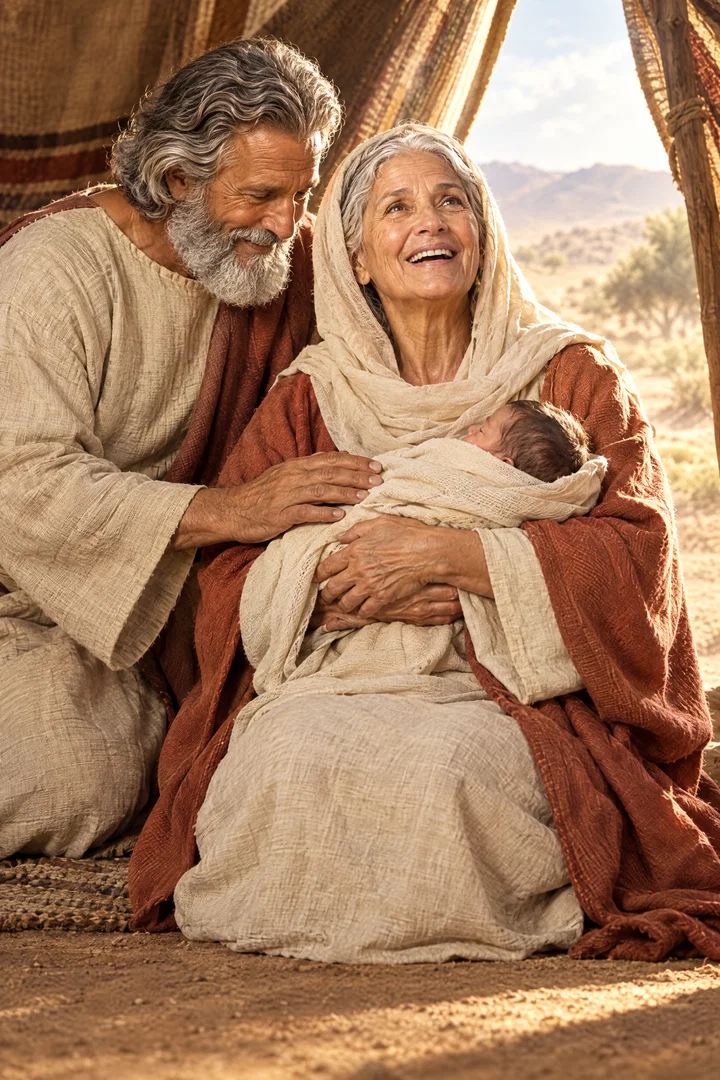
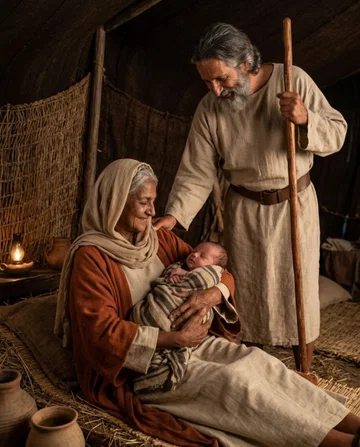
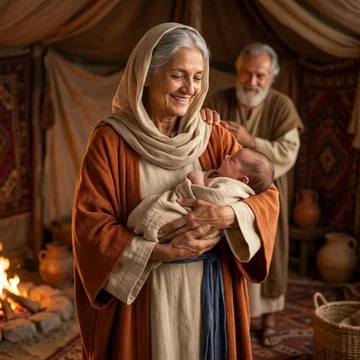
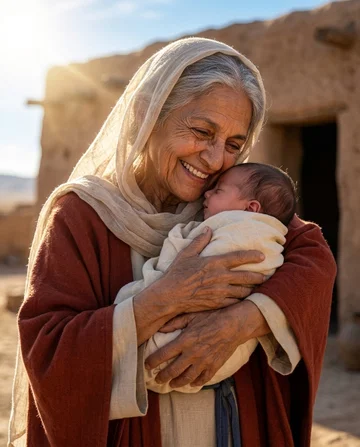
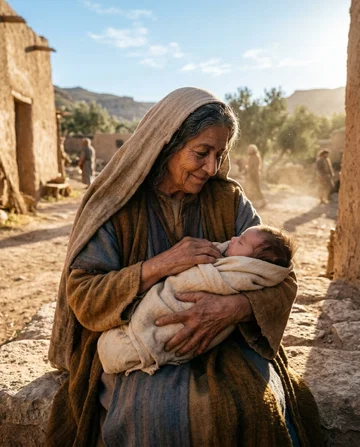
For Sarah conceived, and bare Abraham a son in his old age, at the set time of which God had spoken to him.
Translations
For Sarah conceived, and bore Abraham a son in his old age, at the set time of which God had spoken to him.
King James Version, KJV Cambridge Paragraph Bible
For Sarah conceived, and bare Abraham a son in his old age, at the set time of which God had spoken to him.
For Sarah conceived and bore Abraham a son in his old age, at the set time of which God had spoken to him.
Revised Version, American Standard Version
And Sarah conceived, and bare Abraham a son in his old age, at the set time of which God had spoken to him.
and Sarah conceiveth, and beareth a son to Abraham, to his old age, at the appointed time that God hath spoken of with him;
And Sarah conceived, and bore Abraham a son in his old age, at the appointed time of which God had spoken to him.
So, Sarah, conceived and bare, to Abraham, a son, for his old age, at the set time, of which God had spoken with him.
Berean Standard Bible, Majority Standard Bible
So Sarah conceived and bore a son to Abraham in his old age, at the very time God had promised.
Sarah conceived, and bore Abraham a son in his old age, at the set time of which God had spoken to him.
And Sarah became with child, and gave Abraham a son when he was old, at the time named by God.
For Sarah conceiued, and bare Abraham a sonne in his olde age, at the same season that God tolde him.
Douay-Rheims (Challoner revision)
And she conceived and bore a son in her old age, at the time that God had foretold her.
Pictures

Cross-references 20 of 37
- Galatians 4:22-23
For it is written, that Abraham had two sons, the one by a bondmaid, the other by a freewoman.
Isaac’s birth by promise is contrasted with Ishmael’s birth after the flesh.
- Genesis 16:1-4
Now Sarai Abram’s wife bare him no children: and she had an handmaid, an Egyptian, whose name was Hagar.
Abraham and Sarah sought an heir through Hagar before Isaac’s promised birth.
- Genesis 18:10-14
And he said, I will certainly return unto thee according to the time of life; and, lo, Sarah thy wife shall have a son. And Sarah heard it in the tent door, which was behind him.
God promises Sarah a son at the appointed time despite her old age.
- Genesis 17:19-21
And God said, Sarah thy wife shall bear thee a son indeed; and thou shalt call his name Isaac: and I will establish my covenant with him for an everlasting covenant, and with his seed after him.
God promises Sarah will bear Isaac at the appointed time and establishes the covenant with him.
- Genesis 15:5
And he brought him forth abroad, and said, Look now toward heaven, and tell the stars, if thou be able to number them: and he said unto him, So shall thy seed be.
God promises descendants as numerous as the stars.
- Genesis 22:17-18
That in blessing I will bless thee, and in multiplying I will multiply thy seed as the stars of the heaven, and as the sand which is upon the sea shore; and thy seed shall possess the gate of his enemies;
God reaffirms that Abraham’s seed will multiply and bring blessing to all nations.
- Genesis 12:1-3
Now the LORD had said unto Abram, Get thee out of thy country, and from thy kindred, and from thy father’s house, unto a land that I will shew thee:
God promised Abraham descendants and blessing through him, twenty-five years before Isaac’s birth.
- Genesis 15:2-4
And Abram said, Lord GOD, what wilt thou give me, seeing I go childless, and the steward of my house is this Eliezer of Damascus?
God promised Abraham an heir rather than Eliezer.
- Hebrews 11:17-19
By faith Abraham, when he was tried, offered up Isaac: and he that had received the promises offered up his only begotten son,
Abraham’s promised son Isaac was received back in a figure of resurrection.
- Genesis 13:16
And I will make thy seed as the dust of the earth: so that if a man can number the dust of the earth, then shall thy seed also be numbered.
God promised Abraham descendants as numerous as the dust of the earth.
- Hebrews 11:11
Through faith also Sara herself received strength to conceive seed, and was delivered of a child when she was past age, because she judged him faithful who had promised.
Sarah trusted God’s promise and received strength to conceive.
- Romans 4:17
( As it is written, I have made thee a father of many nations,) before him whom he believed, even God, who quickeneth the dead, and calleth those things which be not as though they were.
Paul describes Abraham’s faith in God, who gives life to the dead.
- Galatians 4:28-29
Now we, brethren, as Isaac was, are the children of promise.
Isaac’s promised birth illustrates the children of promise, and Ishmael’s treatment of him illustrates persecution.
- Genesis 21:10
Wherefore she said unto Abraham, Cast out this bondwoman and her son: for the son of this bondwoman shall not be heir with my son, even with Isaac.
Sarah’s words distinguish Isaac, the promised seed, from Ishmael in the inheritance.
- Genesis 22:1-2
And it came to pass after these things, that God did tempt Abraham, and said unto him, Abraham: and he said, Behold, here I am.
The promised son is later tested in the command to offer Isaac.
- Luke 1:18
And Zacharias said unto the angel, Whereby shall I know this? for I am an old man, and my wife well stricken in years.
Zacharias doubts the promised birth because of age, as Abraham once did.
- Galatians 3:16
Now to Abraham and his seed were the promises made. He saith not, And to seeds, as of many; but as of one, And to thy seed, which is Christ.
Paul identifies the promised Seed with Christ.
- Romans 4:13
For the promise, that he should be the heir of the world, was not to Abraham, or to his seed, through the law, but through the righteousness of faith.
God’s promised inheritance to Abraham came through faith, not law.
- Genesis 17:17
Then Abraham fell upon his face, and laughed, and said in his heart, Shall a child be born unto him that is an hundred years old? and shall Sarah, that is ninety years old, bear?
God promises Abraham a son through Sarah despite their old age.
- Genesis 16:3-5
And Sarai Abram’s wife took Hagar her maid the Egyptian, after Abram had dwelt ten years in the land of Canaan, and gave her to her husband Abram to be his wife.
Sarai’s plan with Hagar brings Ishmael before Isaac’s birth.
Commentary
Each commentary is drawn from primary sources: the writings of Ellen G. White and Adventist pioneers and periodicals. Each commentary is separate. Its own words are not a quotation; follow the references to read the source passages.
Ellen G. White
3 sources
At the set time of which He had spoken, God fulfilled His promise to Abraham and Sarah by giving them a son in their old age.ST Oct 11, 1877DA 98.2RH Jan 7, 1873 The child came at the appointed time He had announced beforehand, not before and not after.ST Oct 11, 1877RH Jan 7, 1873 Abraham received that son because he believed God, who had promised the child and faithfully kept His word.DA 98.2
That believing reception shows the son was given through faith in a promise-keeping God.DA 98.2 Faith laid hold of the divine word, and God's faithfulness answered it with fulfillment in old age.DA 98.2 The gift therefore stands as proof that God does what He says He will do.DA 98.2
The birth also reveals God's unlimited power to accomplish what seems impossible to men.ST Oct 11, 1877RH Jan 7, 1873 What nature and age declared hopeless, He performed, proving that nothing is impossible with Him.ST Oct 11, 1877RH Jan 7, 1873 Zacharias should have remembered this example when the angel promised a son to him and his wife in their old age.ST Oct 11, 1877RH Jan 7, 1873 Had he kept Abraham and Sarah's experience in mind, he would not have doubted on account of age as he did.ST Oct 11, 1877RH Jan 7, 1873
Sources
Pioneers and periodicals
39 sources
Sarah conceived and bore Abraham a son in his old age at the exact set time God had spoken, when Abraham was one hundred and Sarah was ninety after twenty-five years of waiting for the promise.ST Apr 11, 1900ST Jun 4, 1885ST Aug 28, 1901ST Jan 24, 1900 The birth was miraculous and impossible by ordinary human means, since Sarah was barren and past childbearing and both were beyond age for having a child.ST Mar 1, 1905STST Apr 29, 1908 It came by God's power and promise at the time he had appointed, not by Abraham's own plan, device, or human effort, and Sarah's barrenness and prior human scheming could not prevent his word.ST Sep 28, 1915STST Apr 29, 1908RH Jul 3, 1900 Sarah received power to conceive through faith by counting God faithful, and Abraham's renewed faith embraced the promise in its fullness and so obtained it through the son in whom it was to be fulfilled.ST Jan 6, 1909ST Mar 22, 1899ST Jun 15, 1904 Isaac, born through Sarah the free and lawful wife by promise, power, and Spirit, stands in contrast to Ishmael, born to Hagar the bondwoman by a fleshly scheme, for in Isaac alone the seed would be called as heir to inherit all Abraham had.ST Apr 11, 1900RH May 29, 1900ST Mar 1, 1905RH Jul 3, 1900ST Nov 21, 1900 His birth illustrates that believers are born from above through God's word and Spirit and receive freedom, justification, and salvation through God's promise in Christ rather than by human effort, and he continued the family line through which the promised Seed would come.ST Dec 20, 1910ST Aug 28, 1901RH Nov 18, 1862ST Sep 28, 1915
Text and Historical Setting
Sarah conceived and bore Abraham a son in his old age at the exact set time of which God had spoken, the fulfillment of the spoken promise of the promised son.ST Apr 11, 1900ST Aug 28, 1901ST Jan 24, 1900ST Feb 17, 1914RH Mar 12, 1901 Abraham was one hundred years old and Sarah was ninety when Isaac was born.ST Jan 24, 1900RH Mar 16, 1869 His birth came twenty-five years after God gave Abraham the promise, after many years of waiting with long patience for the promised son.ST Jun 4, 1885ST Nov 25, 1889ST Jul 22, 1908
The child was named Isaac, meaning laughter, and was duly circumcised, and his birth brought great rejoicing in God.ST Apr 11, 1900ST Aug 28, 1901 His birth came just after the destruction of Sodom.ST Oct 4, 1883 It followed Abraham's separation from Lot and his renewed faith that his own offspring would be his heir.ST Jun 15, 1904 It came after he had first thought the heir would come through Eliezer and then tried to bring it about through Hagar.
The birth continues the family line through Abraham as the chosen progenitor of the Seed, carrying forward God's providential dealings toward Jesus whose genealogy traces descent from Abraham.RH Nov 18, 1862STST Jan 14, 1913 Through this line Shem was able to converse with Isaac for fifty years, passing on divine truth through the generations.ST Oct 4, 1883 From that son given in old age came the millions who later populated Palestine in fulfillment of the promise concerning Abraham's descendants.ST Dec 8, 1914
Miraculous Fulfillment by Promise
Sarah bore Isaac when she was humanly barren and past the age of childbearing, while she and Abraham were both old and beyond ordinary age for having a child, so his birth was miraculous and impossible by ordinary human means.ST Mar 1, 1905STST Apr 29, 1908ST Mar 22, 1899ST Jan 18, 1883 He came through Sarah, Abraham's free and lawful wife, by God's power rather than by any human plan, and his birth and existence therefore brought glory to God rather than to human planning or effort.ST Mar 1, 1905ST Apr 29, 1908 He was the promised heir and seed whose coming fulfilled God's promise that Abraham's own offspring would be his heir, coming after Abraham separated from Lot and renewed his faith.ST Mar 1, 1905ST Jun 15, 1904 Sarah received power to conceive through faith because she counted God faithful to His promise, and Isaac was thus born through the promise and the Spirit as the son of a freewoman, in contrast to Ishmael who was born through the flesh to a slave woman.ST Mar 22, 1899 Because Abraham had received his son through God's power, he trusted that God could also raise Isaac from the dead.ST Jan 18, 1883
Isaac was born to Sarah and Abraham in their old age at the set time God had appointed and spoken, confirming that his birth came by God's promise and power rather than through Abraham's own plan or device.ST Apr 29, 1908RH Jul 3, 1900 His birth was not the result of human effort or confidence in the flesh but came through dependence on God's promise, and he was therefore a miraculous child and the child of promise.ST Apr 29, 1908RH Jul 24, 1900ST Apr 24, 1901 His birth illustrates the new covenant, which rests on God's promise, power, and work, and it illustrates that justification and salvation come through God's promise in Christ and not through human effort, with obedience following the receiving of life and salvation rather than earning them.RH Jul 24, 1900
Sarah's faith embraced the promise by counting God faithful, and Abraham's faith gradually developed until it embraced the promise in its fullness, renewed after separation from Lot and matured through a long, patient wait.ST Jan 6, 1909ST Mar 22, 1899ST Jun 15, 1904ST Nov 25, 1889 Abraham thus obtained the promise through the son in whom it was to be fulfilled, when Isaac was born in Abraham's old age at the time God had appointed.ST Nov 25, 1889 Their experience demonstrated God's power to do what seemed impossible and proves His unlimited power and that nothing is impossible with Him.ST Oct 11, 1877RH Jan 7, 1873 Zacharias should have remembered how God fulfilled His promise by giving Abraham and Sarah a son in their old age at the appointed time, but he forgot this example when he doubted the angel's promise of a son because he and his wife were old.ST Oct 11, 1877RH Jan 7, 1873
God still fulfilled His spoken word despite prior human scheming, impatience, and attempts to accomplish by human effort what only God could do, and Sarah's barrenness could not prevent Him from fulfilling His word.ST Sep 28, 1915STST Jul 22, 1908 Isaac, not Ishmael, was the son through whom the promise to Abraham and the promised Seed through Sarah would be fulfilled, whereas Ishmael's birth through Hagar resulted from human scheming and human effort, did not accomplish that promise, and led to trouble and bondage.ST Sep 28, 1915ST Isaac was born when Sarah was ninety and Abraham was one hundred, fulfilling God's promise at the time God had appointed, so his birth at such an age was a miracle of divine power.RH Mar 16, 1869 His birth followed Abraham's taking of Hagar and periods of impatience, yet God still fulfilled His promise, marking its fulfillment after Abraham's long wait.RH Mar 16, 1869ST Jul 22, 1908 Isaac therefore represents those who receive freedom through faith in God's promises, contrary to human plans and ordinary expectations.ST Sep 28, 1915
Isaac Contrasted with Ishmael
Isaac was born through Sarah, Abraham's free and lawful wife, while Ishmael was born to Hagar, a bondwoman, servant and slave woman.ST Apr 11, 1900RH May 29, 1900ST Nov 21, 1900GSAM 42.2ST Jan 24, 1900 Their different mothers and different status provide the basis for the contrast between the two sons, with Sarah as the freewoman and Isaac as representing the children of the covenant of promise, in contrast with Hagar and her son.ST Apr 11, 1900RH May 29, 1900ST Jan 24, 1900 Unlike Ishmael, who was born to a bondwoman after Abraham and Sarah tried to hasten the promise through Hagar, Isaac was born free and could inherit all that Abraham had, making him Abraham's true son with Sarah his lawful wife.ST Apr 11, 1900ST Nov 21, 1900GSAM 42.2
Isaac's birth came at the exact set time God had spoken, through God's promise, power and Spirit, fulfilling the repeated promise that the seed bringing salvation must come through the lawful free wife according to God's law and by God's power and not by human fleshly schemes.ST Apr 11, 1900ST Mar 1, 1905ST Jan 24, 1900STST Jul 29, 1913 Though Sarah was humanly barren and Abraham was one hundred and Sarah ninety and both were old, Sarah's barrenness could not prevent God from fulfilling his word at the appointed time.ST Mar 1, 1905ST Jan 24, 1900ST Ishmael's birth through Hagar had been a human attempt and fleshly arrangement to meet what seemed a failure of the promise, born through Abraham's human plan and effort, but it did not fulfill or accomplish that promise.ST Mar 1, 1905RH Jul 3, 1900ST Jan 24, 1900STST Jul 29, 1913 Isaac, not Ishmael, was therefore the promised son and heir through whom God's covenant seed would be called, with the contrast being between birth through human effort and birth according to God's promise.RH Jul 3, 1900STST Jul 29, 1913
In Isaac alone the seed would be called as heir, duly named Isaac and circumcised, bringing great rejoicing in God, in contrast to Ishmael the son of the bondwoman who was born after the flesh and later mocked and was cast out.ST Apr 11, 1900RH Jul 3, 1900 Whereas Ishmael's birth through Hagar resulted from human scheming and led to trouble and bondage, Isaac's birth came by God's power and promise contrary to human plans and ordinary expectations, and therefore represents those who receive freedom through faith in God's promises.ST Apr 11, 1900RH Jul 3, 1900ST Sep 28, 1915ST Nov 21, 1900 Isaac was weaned at about five years old, twenty-five years after God gave Abraham the promise, and Ishmael's mocking at that weaning was persecution.ST Jun 4, 1885 That mocking marks the beginning of the four hundred years of affliction foretold for Abraham's descendants.ST Jun 4, 1885
Covenant Doctrine and Inheritance
The birth of Isaac to Sarah at the set time belongs to the larger account of Abraham's two sons whose differing mothers and circumstances provide the basis for Paul's allegory of the two covenants.RH Jul 18, 1854ST Jan 24, 1900 Ishmael was born to Hagar the servant woman, while Isaac was born to Sarah the freewoman, and their history sets forth the typical and antitypical systems and literal and true Israel.RH Jul 18, 1854ST Jan 24, 1900 That allegorical history is found in Genesis, not in the law given at Sinai.RH Jul 18, 1854
Within Abraham's family Sarah stands as the freewoman and Isaac stands as the child of the covenant of promise in contrast with Hagar and her son.RH May 29, 1900ST Jul 29, 1913 His birth came through God's power and promise at the promised time, unlike Ishmael's birth through Abraham's human plan with Hagar, and therefore he represents the free children of the new covenant grounded in God's promises.RH May 29, 1900ST Jul 29, 1913 His birth was not the result of human effort or confidence in the flesh but came through dependence on God's promise, illustrating that the new covenant rests on God's promise, power, and work.ST Jul 29, 1913RH Jul 24, 1900
The fulfillment of God's word in Sarah's conception in old age at the exact promised time shows that believers are born from above through God's word and rejoice in His salvation, and Isaac's name meaning laughter marks that joy.ST Aug 28, 1901ST Mar 22, 1899 His birth came by God's power and promise contrary to human plans and ordinary expectations when Sarah was past the age of childbearing, whereas Ishmael's birth through Hagar resulted from human scheming and led to trouble and bondage, so Isaac represents those who receive freedom through faith in God's promises.ST Sep 28, 1915ST Mar 22, 1899 He was born through the promise and the Spirit as the son of a freewoman in contrast to Ishmael born through the flesh to a slave woman, for Sarah received power to conceive through faith by counting God faithful to His promise.ST Sep 28, 1915ST Mar 22, 1899 As the child of promise born not through Abraham's own plan or device but through God's power, his birth illustrates that justification and salvation come through God's promise in Christ and not through human effort, with obedience following the receiving of life and salvation rather than earning it.ST Sep 28, 1915
He was the miraculous child of promise born to Abraham in his old age at the time God had appointed, continuing the family line through which the promised Seed would come.RH Nov 18, 1862RH Jul 5, 1915ST Jan 14, 1913 His birth is part of God's providential dealings with Abraham's family, whose role was to carry forward the promised Seed, with Abraham identified as the chosen progenitor of the Seed.ST Dec 20, 1910ST The account establishes Abraham as an ancestor of Jesus, whose genealogy traces His descent from Abraham through the promised son born to Abraham and Sarah.ST Dec 20, 1910RH Nov 18, 1862
Christ Foreshadowing and Faith Example
Isaac's birth was marked by laughter and rejoicing, and in that joy it illustrates the birth of Christ.ST Sep 8, 1898 It was a step toward fulfilling the promise to Abraham and his seed, not its final fulfillment. From that son came the millions who later populated Palestine, yet the promise that Abraham and his seed would inherit the whole earth as an everlasting inheritance of righteousness still awaits its fulfillment when Christ returns and the dead are raised.ST Dec 8, 1914
The birth to Abraham and Sarah in their old age was a miracle and the fulfillment of God's promise at the appointed time, a son received through God's power after both were beyond the ordinary age for having a child.ST Jan 18, 1883ST Jul 9, 1894 He was the promised heir, unlike the result of the earlier attempt to secure the promise through human effort, and his birth began the fulfillment.ST Jul 9, 1894 Because Abraham had so received his son through God's power, he trusted that God could also raise Isaac from the dead.ST Jan 18, 1883 His later willingness to offer Isaac tested whether his faith rested in God's promise.ST Jul 9, 1894
The gift of a son to Abraham and Sarah in their old age at the appointed time demonstrated God's power to do what seemed impossible and proves His unlimited power and that nothing is impossible with Him.ST Oct 11, 1877RH Jan 7, 1873 Zacharias should have remembered that example when the angel promised him a son.ST Oct 11, 1877 He forgot it when he doubted because he and his wife were old.ST Oct 11, 1877RH Jan 7, 1873
Sources