Luke 11:5
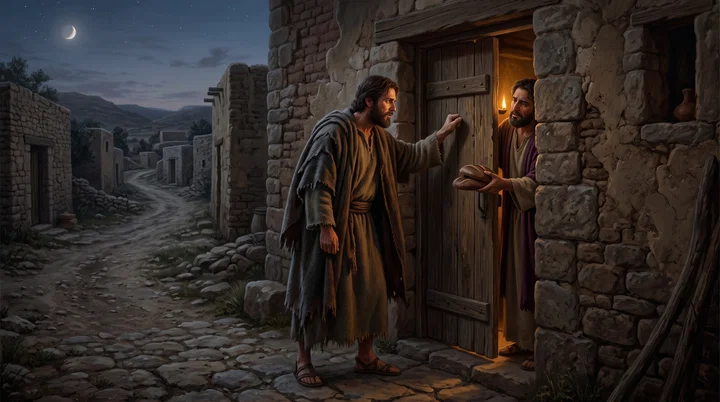
And he said unto them, Which of you shall have a friend, and shall go unto him at midnight, and say unto him, Friend, lend me three loaves;
Translations
And he said to them, Which of you shall have a friend, and shall go to him at midnight, and say to him, Friend, lend me three loaves;
King James Version, KJV Cambridge Paragraph Bible
And he said unto them, Which of you shall have a friend, and shall go unto him at midnight, and say unto him, Friend, lend me three loaves;
And he said to them, Which of you shall have a friend, and shall go to him at midnight, and say to him, Friend, lend me three loaves:
Revised Version, American Standard Version
And he said unto them, Which of you shall have a friend, and shall go unto him at midnight, and say to him, Friend, lend me three loaves;
And he said unto them, 'Who of you shall have a friend, and shall go on unto him at midnight, and may say to him, Friend, lend me three loaves,
And he said to them, Who among you shall have a friend, and shall go to him at midnight and say to him, Friend, let me have three loaves,
And he said unto them—Who from among you, shall have a friend, and shall go unto him at midnight, and say unto him—Friend! supply me with three loaves,
Berean Standard Bible, Majority Standard Bible
Then Jesus said to them, “ Suppose one of you goes to his friend at midnight and says, ‘ Friend, lend me three loaves of bread,
He said to them, “ Which of you, if you go to a friend at midnight and tell him, ‘ Friend, lend me three loaves of bread,
And he said to them, Which of you, having a friend, would go to him in the middle of the night and say to him, Friend, let me have three cakes of bread;
Moreouer he said vnto them, Which of you shall haue a friende, and shall goe to him at midnight, and say vnto him, Friende, lende mee three loaues?
Douay-Rheims (Challoner revision)
And he said to them: Which of you shall have a friend, and shall go to him at midnight, and shall say to him: Friend, lend me three loaves,
Pictures
Cross-references
- Luke 11:9-10
And I say unto you, Ask, and it shall be given you; seek, and ye shall find; knock, and it shall be opened unto you.
The teaching applies the parable through the promise that those who ask, seek, and knock receive.
- Luke 18:1-8
And he spake a parable unto them to this end, that men ought always to pray, and not to faint;
Both parables teach persistence in prayer without giving up.
- Luke 11:13
If ye then, being evil, know how to give good gifts unto your children: how much more shall your heavenly Father give the Holy Spirit to them that ask him?
The teaching promises the Holy Spirit to those who ask the Father.
- Matthew 7:7
Ask, and it shall be given you; seek, and ye shall find; knock, and it shall be opened unto you:
Both teach that asking brings an answer, even when it is delayed.
- Luke 11:1
And it came to pass, that, as he was praying in a certain place, when he ceased, one of his disciples said unto him, Lord, teach us to pray, as John also taught his disciples.
The disciples ask Christ to teach them to pray before he gives this illustration.
- Matthew 6:9-13
After this manner therefore pray ye: Our Father which art in heaven, Hallowed be thy name.
Presented as the parallel account of Jesus’ instruction on prayer.
- 1 John 5:14-15
And this is the confidence that we have in him, that, if we ask any thing according to his will, he heareth us:
no prayer of faith is unanswered
Commentary
Each commentary is drawn from primary sources: the writings of Ellen G. White and Adventist pioneers and periodicals. Each commentary is separate. Its own words are not a quotation; follow the references to read the source passages.
Ellen G. White
47 sources
At midnight a man goes to a friend to ask for three loaves because a weary traveler has arrived late and he has nothing to set before him.Ms 111, 1898, par. 2–5Ms 31, 1898, par. 2–3Ms 23, 1899, par. 1–4 He asks not to supply himself but to meet another's need, and the bread stands for the spiritual food, grace, wisdom and truth needed to feed hungry souls.Ms 31, 1898, par. 2–3ST Mar 16, 1915Ms 23, 1899, par. 1–4COL 140.1–3 The verse teaches persistent, earnest asking that keeps pleading patiently until the answer comes, even when the answer is delayed.19MR 227.3–228.2Ms 93, 1898, par. 21–26Lt 17, 1892, par. 10–12 The unwilling neighbor's selfish indifference is not a picture of God, but a contrast, for God is the compassionate best Friend who delights to give to those who come in faith.Ms 93, 1898, par. 21–26RH Aug 11, 1910COL 141.1 Importunate prayer offered at midnight for loaves to nourish others will always succeed, for it is the law of heaven that what is received from God is to be imparted to others.COL 148.1–3Ms 99, 1902, par. 15STB 426.2PMMEP 19.2RH Aug 12, 1909
Parable Story and Context
Luke 11:5 belongs to Christ's lesson on prayer, grounded in His practice of receiving from the Father so that He could give to others.COL 139.1 It stands within Luke 11:1-13 as part of the teaching that those who ask receive.COL 139.1Ms 54, 1895, par. 8–13
A man goes to a friend at midnight asking for three loaves because a weary, belated traveler on a journey has arrived late at an unseasonable hour and he has nothing to set before him.Ms 111, 1898, par. 2–5Ms 31, 1898, par. 2–3Ms 23, 1899, par. 1–4COL 140.1–3COL 140.4–5 The need is real and urgent, with a traveler to feed and no food to offer him.Ms 111, 1898, par. 2–5Ms 23, 1899, par. 1–4RH Aug 11, 1910 He asks not for himself alone but so he can meet another person's need, since he must obtain bread before he can supply the traveler's need.COL 140.1–3COL 140.4–5RH Aug 11, 1910 He must ask because he has nothing to give.Ms 31, 1898, par. 2–3COL 140.1–3COL 140.4–5
The friend is unwilling at first and repulses the petitioner again and again, revealing selfish indifference.Ms 93, 1898, par. 21–26COL 143.1 The asking may be refused for a time and may not receive an immediate answer.19MR 319.1–2Lt 143, 1899, par. 10–11Ms 59, 1900, par. 19–20 Yet the pleading continues and does not give up its purpose until he gives as much as is needed.Ms 93, 1898, par. 21–2619MR 319.1–2ST Jan 14, 1897COL 143.1Lt 143, 1899, par. 10–11 The midnight coming shows a persistent entreaty when there is nothing to offer, with the host keeping on pleading until the neighbor meets the need rather than leaving the guest's need unmet.Ms 93, 1898, par. 21–26ST Jan 14, 1897Ms 59, 1900, par. 19–20
Asking to Give
The midnight request for three loaves is made not for the asker himself but so he can meet the need of another.Ms 31, 1898, par. 2–3ST Mar 16, 1915COL 140.1–3COL 140.4–5RH Aug 11, 1910 A weary, belated traveler on a journey has arrived late at an unseasonable hour, and the host has nothing to set before him.Ms 31, 1898, par. 2–3ST Mar 16, 1915COL 140.1–3COL 140.4–5RH Aug 11, 1910 He must obtain bread before he can supply the traveler's need, because without receiving he has nothing to give.Ms 31, 1898, par. 2–3COL 140.1–3COL 140.4–5RH Aug 11, 1910RH Aug 11, 1910
The bread sought is grace and spiritual food needed to serve others.Ms 31, 1898, par. 2–3ST Mar 16, 191519MR 319.1–24MR 335.2Ms 99, 1902, par. 15 It is the bread of life to give to spiritually hungry people, received as the Holy Spirit, with wisdom and light and an intelligent knowledge of truth to share.Ms 31, 1898, par. 2–3ST Mar 16, 1915Ms 23, 1899, par. 1–419MR 319.1–2Ms 99, 1902, par. 15 Those who persistently ask for what they need to feed hungry souls will receive what is to be shared with others.Ms 23, 1899, par. 1–419MR 319.1–24MR 335.2
As Christ's representatives the disciples must seek blessings from God in order to give to the people.ST Mar 16, 1915COL 140.4–5RH Aug 11, 1910 When thrown into unexpected positions and feeling human insufficiency, destitute and helpless before souls hungering for the bread of life, they must receive spiritual food or they will have nothing to impart.COL 140.4–5RH Aug 11, 1910 They must not turn one soul away unfed, but must go to the source of supply and press their request.COL 140.4–5RH Aug 11, 1910 They can be certain that God who sent His servants to feed the hungry will supply their need for His own work.ST Mar 16, 1915COL 140.4–5
It is a law and rule and principle of heaven that as people receive they are to impart.Ms 99, 1902, par. 15STB 426.2PMMEP 19.2STB 579.1–2Lt 10, 1899, par. 29–32 Receiving from God is joined to the duty of sharing with others what was received.Ms 99, 1902, par. 15STB 426.2PMMEP 19.2Lt 10, 1899, par. 29–32RH Sep 21, 1905 Those who thus beg at midnight and plead for loaves to feed hungry souls and nourish others will be blessed and successful in inviting others to Christ and to receive the truth.Ms 99, 1902, par. 15PMMEP 19.2STB 579.1–2Lt 10, 1899, par. 29–32RH Sep 21, 1905
Persistence in Prayer
Luke 11:5 begins the lesson on persistent prayer, introducing a man who goes to a friend at midnight to ask for bread because a traveler has arrived and he has nothing to set before him.19MR 227.3–228.2Ms 93, 1898, par. 21–26Lt 17, 1892, par. 10–12DA 495.3 The request is for food for a weary, belated traveler when the petitioner himself has nothing to offer, so the entreaty is urgent and continued.Ms 111, 1898, par. 2–519MR 227.3–228.2Ms 93, 1898, par. 21–26Lt 17, 1892, par. 10–12 The friend is unwilling at first and repulses the petitioner again and again, revealing selfish indifference, but afterward gives as much as is needed because the pleading does not stop.Ms 93, 1898, par. 21–2619MR 319.1–2COL 143.1 Prayer may therefore be refused for a time and may not receive an immediate answer, so those who ask are to keep pleading patiently and earnestly until the request is answered and not give up their purpose.19MR 227.3–228.2Ms 93, 1898, par. 21–26Lt 17, 1892, par. 10–1219MR 319.1–24SP 224.1 Such determined, importunate faith obtains its request, gives force to the instruction to ask, seek, and knock, strengthens wavering faith in God's response, and continued earnest prayer brings a richer experience of grace.19MR 319.1–24SP 224.1DA 495.3
Persistent asking itself makes the petitioner more earnest and increases the desire to receive what is sought.Ms 111, 1898, par. 2–5ST Mar 16, 1915 The more earnestly and steadfastly a person asks, the closer the spiritual union with Christ becomes, and increased faith brings increased blessings.ST Mar 16, 1915COL 146.1–2 Delay in answer does not mean prayer should cease when the answer seems withheld or refused.COL 143.1ST Mar 16, 1915 Prayer does not change God but brings the one praying into harmony with Him, while delay comes because He leads through test and trial and humiliation to cause searching of heart and repentance of sin and to reveal what hinders the working of His Holy Spirit through the life.COL 143.1ST Mar 16, 1915
The coming at midnight means no hour is improper for prayer, because God's eye never slumbers nor sleeps.Ms 59, 1900, par. 19–20 God tries faith by delay and encourages pressing the petition to the throne of grace, and this pressing is for the petitioner's good.Ms 59, 1900, par. 19–20 He always hears the prayer of the humble suppliant and grants blessing, and never turns away unblessed those who seek Him with the whole heart, so that when believers feel their great need of grace and an intelligent knowledge of truth in order to give the bread of life to those in need, asking in humble faith brings grace for grace bestowed.19MR 319.1–2Ms 59, 1900, par. 19–20 Prayer in this verse is to be simple and earnest, and also bold and expectant, as one bringing a real need in order to receive supply to meet another's need.Ms 23, 1899, par. 1–4COL 136.1 Those who ask the heavenly Father receive good gifts, especially the Holy Spirit.Ms 23, 1899, par. 1–4
The human part is to pray and believe, to watch unto prayer, and to cooperate with the prayer-hearing God by speaking and acting in harmony with requests, which proves faith genuine rather than mere form.COL 146.1–2 Believers are therefore to keep praying rather than distrust God when an answer does not come at once, joining earnest prayer with good works.COL 146.1–2Ms 33, 1898, par. 13–14
God's Readiness to Answer
The reluctant neighbor does not portray God, for the lesson works by contrast rather than likeness.Ms 93, 1898, par. 21–26RH Aug 11, 1910COL 141.1ST Sep 15, 1898 The man in the story is unwilling at first and yields only to continued pleading, revealing selfish indifference, while God is the best Friend, compassionate and delighting to give to those who come to Him in faith.Ms 93, 1898, par. 21–26RH Aug 11, 1910COL 141.1 He does not turn away from His people indifferently even when the answer does not come at once.ST Sep 15, 1898
Unlike the friend who pleads trouble and a closed door, God never makes that excuse and never says He cannot help.COL 148.1–3 All who seek find and all who knock have the door opened, because the honor of His throne is staked to fulfill His word to those who come confessing unworthiness and sin.COL 148.1–3 God supplies His servants so they can minister to others and become like Him, and He will supply their need for His own work of feeding the hungry.ST Mar 16, 1915COL 140.4–5RH Aug 11, 1910 Those sent to feed the hungry with the bread of life can therefore trust Him to provide the spiritual food they lack.ST Mar 16, 1915COL 140.4–5
God invites humble petitioners to ask for what they need, including grace and knowledge of truth to share the bread of life, and answers them with blessing.19MR 319.1–2 He is pleased when people importune Him for His grace and favor, not only for themselves but for others who need help, and taking hold upon Him in earnest prayer with implicit confidence gives strength of soul and certainty that He will hear.19MR 319.1–2Lt 403, 1906, par. 3 Importunate prayer for others, asking God at midnight for loaves to feed hungry souls, will always be successful.COL 148.1–3Ms 99, 1902, par. 15 Humble workers who thus beg for what they need to nourish others, receiving spiritual bread from heaven to impart and inviting people to Christ, will be blessed and succeed, for it is a law of heaven that as people receive they are to impart.Ms 99, 1902, par. 15RH Aug 12, 1909Lt 10, 1899, par. 29–32RH Sep 21, 19052MR 32.2–3
Ministry and Daily Application
The midnight request for bread is the pattern for praying for the sick, teaching that when healing does not come at once believers are to keep asking earnestly in trusting faith that God hears.HPMMW 51.4–52.1HL 240.1 Answers in such prayer may come immediately or may require patient, earnest pleading, and petitions prompted by the Lord will be answered.HL 240.1 In soul-saving the verse pictures humble workers seeking spiritual bread for hungry souls and going house to house to invite people to receive the truth and to come to Christ.STB 426.2PMMEP 19.2STB 579.1–2 Those who thus plead for what they need to share will be blessed and helped to bring spiritual nourishment through personal work, for heaven's rule is that what is received is to be imparted to others.STB 426.2PMMEP 19.2STB 579.1–2
Its lesson applies to asking daily for instruction and guidance, keeping the request in mind and continuing to pray in faith while working until needed light and knowledge are received.FE 530.3 Such daily asking is offered with trust in God and with request for the power of the Holy Spirit.FE 530.3 The verse teaches wrestling with God in earnest, importunate, fervent prayer for the impartation of the vitalizing power of the Holy Spirit.Ms 242, 1902, par. 11 Such prayer has efficiency because in answer to it God can turn the thoughts and hearts of men as He turns the waters of the sea.Ms 242, 1902, par. 11
Believers may bring all needs to God, even the smallest concerns, without wearying Him, asking for what brings glory to His name and waiting patiently trusting His wisdom.ST Feb 14, 1906ST May 28, 1896 Prayer is a request to be made earnestly and persistently, and believers should remain before God until deep longing for salvation and assurance of pardoned sin are received.MYP 268.2ST Feb 14, 1906 Earnest, continuing prayer turns the soul toward Christ and transforms it into His likeness.ST May 28, 1896 Such prayer does not accept denial because it is offered in faith, pleading with God for the needs of others and committing both the petitioner and those prayed for to Jesus as sufficient helper and Saviour.Ms 8, 1892, par. 11–12 Making God the only trust and taking hold upon the Lord in much earnest prayer gives strength of soul, and putting implicit confidence in the Lord Jesus in continued praying and believing brings certainty that He will hear.Lt 403, 1906, par. 3 God is pleased when people importune Him for grace and favor, not only for themselves but for others who need help.Lt 403, 1906, par. 3
Asking a neighbor for bread when an unexpected guest arrives is also a practical response to having nothing to serve, showing that lack of prepared food is not a reason to refuse hospitality.2T 28.2
Sources
Pioneers and periodicals
46 sources
The verse pictures a host with nothing to set before a tired friend arriving late at night, who goes to a neighboring friend at midnight to borrow three loaves though the door is shut and the household is in bed.ST Nov 21, 1911ST Jan 14, 1897ST Jan 19, 1915ST Jan 19, 1882ST Jun 4, 1894 It begins the illustration that follows the model prayer for the Father's name, kingdom, bread, forgiveness and deliverance, showing persevering asking that leads to the assurance to ask, seek and knock and to the promise of the Holy Spirit to those who ask.ST Apr 20, 1904ST Jan 19, 1882ST Nov 20, 1901ST Sep 10, 1885ST Jan 16, 1901 It teaches continual, importunate prayer that keeps asking, seeking and knocking until the blessing is received, holding on in faith even when the answer is delayed.ST Mar 16, 1915ST Jan 19, 1882ST Sep 10, 1885RH Aug 28, 1856RH Oct 15, 1903 The reluctant neighbor is a contrast and not a picture of God, who never tires of petitions, delights to give, and answers earnest prayer far more readily than selfish men are moved by importunity.RH Aug 11, 1910ST Jun 15, 1904ST Jun 4, 1894ST Feb 27, 1896ST Nov 20, 1901 The petitioner asks not for himself but to supply another's need, showing that disciples helpless without spiritual food must seek from God the Bread of life in order to give it to hungry souls.ST Mar 16, 1915RH Aug 11, 1910RH Aug 11, 1910ST Nov 20, 1901RH Oct 1, 1901
Context and Story Setting
Jesus gave the saying in answer to the disciples' request, Lord, teach us to pray, after giving the model prayer to the Father for His name, kingdom, daily bread, forgiveness, and deliverance from temptation.ST Apr 20, 1904ST Nov 20, 1901ST Jan 16, 1901ST Feb 27, 1896ST Apr 7, 1909 It begins the illustration of need and importunity, a man going to a friend at midnight to say, Friend, lend me three loaves, which leads to the assurance to ask, seek, and knock and to the promise that the heavenly Father gives the Holy Spirit to those who ask.ST Apr 20, 1904ST Nov 20, 1901ST Feb 27, 1896ST Apr 7, 1909ST Apr 20, 1904 The Lord's Prayer in the same teaching is not a ritual for parrot-like repetition but a brief sample showing daily needs.ST Jun 15, 1904ST Mar 12, 1896 All matters concerning earthly life may be brought to God in prayer, and asking will be answered.ST Jun 15, 1904ST Mar 12, 1896
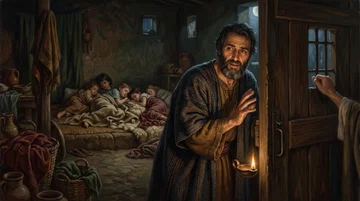
The picture is of a host who has nothing to set before a friend come to him from a journey, arriving late, tired, benighted, belated and in urgent need of prompt relief, so he goes to a neighboring friend at midnight to borrow three loaves.RH Aug 11, 1910ST Jan 19, 1915ST Jan 19, 1882ST Jun 4, 1894ST Feb 27, 1896 The unexpected guest leaves him without bread to serve, and he must seek supplies from one who has them despite the inconvenient hour.ST Nov 21, 1911RH Aug 11, 1910ST Jan 19, 1915ST Jun 4, 1894ST Feb 27, 1896 The one asked is within with the door shut and his children with him in bed, at first objecting that he cannot rise and give because rising would trouble him.ST Nov 21, 1911ST Jan 14, 1897ST Nov 20, 1901 Persistent pleading and continuing to solicit moves him to rise and give as many loaves as are needed, and the host does not simply leave his guest's need unmet.ST Nov 21, 1911ST Jan 14, 1897ST Nov 20, 1901
His statement that he cannot arise does not mean lack of power but settled refusal, since he afterward does arise.ST May 11, 1915
Persistence in Prayer Taught
Luke 11:5 begins an illustration of the power of persevering, importunate, continual prayer, in which a man goes to a friend at midnight to ask for three loaves because a friend has come to him out of his way, benighted, belated and lost, with nothing to set before him and needing prompt relief.ST Jan 19, 1882RH Aug 28, 1856RH Mar 4, 1915 To ask in this sense means to continue to solicit and persevere in knocking until the blessing is received, not to ask only once, for asking once is not importunity.ST Jan 19, 1882ST Sep 10, 1885RH Aug 28, 1856RH Mar 4, 1915 The parable is therefore one Christ used to teach that prayer should be earnest and continual, with seeking continued until the blessing is received.ST Sep 10, 1885RH Aug 28, 1856RH Mar 4, 1915 Such persistence does not mean that God is hard to persuade, but shows the seeker's earnestness and dependence on God.ST Sep 10, 1885 The midnight request illustrates importunate prayer whose lesson is to bring needs to God and keep praying when the answer is delayed, waiting patiently and trusting God's wisdom.ST Feb 14, 1906
Success in prayer requires holding on until success is assured, enduring and not letting go too soon, continuing as seeing Him who is invisible, and this persevering endurance brings the answer just as enduring to the end brings salvation.RH Oct 15, 1903 When the answer is delayed or seems refused or is not immediate or not granted at once, the lesson is to keep praying and believing and waiting patiently, trusting God's wisdom and asking for what brings glory to His name, even for years, and the Lord will supply the need.ST Mar 16, 1915ST Feb 14, 1906ST Mar 18, 1903 The scene of urgent need, where a traveler has arrived and the host has no bread or food to offer, presents steadfastness under trial and delayed hope and persistence in seeking help.ST Jan 19, 1915RH Dec 11, 1900 Felt need prompts earnest prayer and leads to persistent pleading, and encourages making requests known to God even when an answer appears delayed.ST Jan 19, 1915RH Dec 11, 1900
The hungry person asking a friend and intimate friend for food illustrates that prayer should be made with expectation and confidence that God is ready to answer prayer, so that as one asking for food waits to receive it, those who pray should wait expectantly to receive what they ask.RH Oct 16, 1860ST Jun 4, 1894 Naaman's healing illustrates the same lesson of continuing until the blessing is received, since he was cleansed only after completing the seven dips commanded, and turning away earlier would have left him a leper, while the sinner likewise has no cleansing fountain but Christ's blood.ST Sep 10, 1885 A mother who prayed through the night for her son illustrates that earnest, persistent prayer is effective and illustrates prayer for another person's salvation, since he was spared from death and returned home within the week and was later saved from coming wrath.RH Mar 5, 1861 The request in the parable is granted because the petitioner persists, not because the request is necessarily best for him or because of his goodness.ST Jun 28, 1905
Importunity is sometimes necessary and sometimes not, for prolonged pleading, even whole nights in prayer and agonized pleading, is often needed so the suppliant realizes the importance of the matter and his own weakness, but even the silent prayer of faith is heard because the Lord never changes.ST Feb 27, 1896
God Unlike Reluctant Friend
The midnight request works by contrast, not by likeness, for the neighbor is selfish and yields only to be rid of disturbance, while God willingly gives Himself, finds joy in self-denial, lives to save, delights to give, and has compassion on those who ask in faith.RH Aug 11, 1910ST Sep 15, 1898ST Jun 4, 1894ST Feb 27, 1896 He is never annoyed or disturbed by petitions but is full of mercy and sympathy, thinks thoughts of peace toward His children, listens for the first whisper of prayer, and is more willing to pour out blessings than they are able to receive.ST May 28, 1896ST Jun 4, 1894ST Feb 27, 1896 Unlike earthly parents who often tire of constant requests, He never tires of His children asking for what they need or will use for His honor.ST May 28, 1896ST Jun 15, 1904ST Feb 27, 1896
If persistence can move even a selfish man who has no sympathy, earnest petition is answered far more quickly by the Father in heaven, so help may be expected all the more from the Lord.ST Jun 4, 1894ST Feb 27, 1896ST Nov 20, 1901 Unlike the man who helps only to end persistent knocking, God does not turn away from His people indifferently even when His answer does not come at once.ST Sep 15, 1898 He always knows better than the petitioner what is best, so when the request is amiss He answers the spirit of the prayer rather than giving the very thing asked, yet no prayer of faith goes unanswered and the best thing is always given.ST Feb 27, 1896
Importunity is not so much to prevail upon God to save, since He is ever disposed to give mercy, but to bring the asker into a proper disposition to receive it.ST Jan 19, 1882 One who is not importunate does not feel the need of salvation, and favors are prized only in proportion to the sense of their necessity and importance.ST Jan 19, 1882
Asking in Order to Give
The midnight borrower asks not for himself but for the friend in need who has come to him, and he must obtain bread before he can supply the traveler's need.RH Aug 11, 1910ST Nov 20, 1901RH Feb 9, 1905RH Jan 8, 1914ST Nov 20, 1901 He has nothing to give and must seek supplies from one who has them, even at the inconvenient hour, persisting until his need is supplied.ST Mar 16, 1915RH Aug 11, 1910RH Aug 11, 1910 Those who held that he had enough bread for himself still taught that his asking was on behalf of his friend.RH Oct 1, 1901
The bread stands for the Bread of life and spiritual food, and the verse shows that Christ's disciples, helpless without spiritual food themselves, must seek from God as the source of supply the spiritual food they need to give to hungry people.ST Mar 16, 1915RH Aug 11, 1910RH Oct 1, 1901 Prayer here is not selfish asking merely for personal benefit, but asking so that one may give, even as Jesus offered earnest prayer for others.ST Nov 20, 1901RH Feb 9, 1905ST Nov 20, 1901 Selfish asking merely for one's own benefit is why some prayers are never granted.ST Nov 20, 1901
God supplies His servants so they can minister to others and become like Him, and He will supply those sent to feed the hungry who trust Him.ST Mar 16, 1915RH Aug 11, 1910 Those who receive this spiritual provision are to carry it to unsaved friends and relatives and invite people to Christ, not keep silent about it, and those who in this way seek spiritual bread for hungry souls will succeed in imparting to others what they have received.RH Aug 12, 1909RH Sep 21, 1905RH Oct 1, 1901 The same asking for bread on behalf of a friend in need illustrates the church's appeal for help for the needy, with the promise that asking will be answered with as much as is asked for.RH Apr 27, 1911 Asking, seeking, and knocking express a deepening of purpose in such unselfish prayer, with the assurance that all who ask receive, all who seek find, and the treasure-house of God is opened to all who knock.ST Nov 20, 1901 Turning from the sleeping friend who must be persuaded to rise and give to an earthly father teaches precious truths about God's willingness to give, which far exceeds even a father's willingness, and about preserving the capacity for receiving from God.ST Nov 20, 1901
How Prayer Changes Petitioners
Prayer does not change God but brings the petitioner into harmony with Him.ST Mar 16, 1915ST Nov 20, 1901 Steadfast, earnest asking draws the petitioner into closer spiritual union with Christ, and blessings increase as faith grows.ST Mar 16, 1915 Persistent asking itself brings the petitioner into a more earnest attitude and deepens the desire for what is sought.ST Mar 16, 1915
In answering, God may lead the petitioner to search the heart and repent.ST Mar 16, 1915ST Nov 20, 1901 He may use trials and humiliation to reveal what hinders the Holy Spirit from working through him, so that what blocks that working is removed.ST Mar 16, 1915ST Nov 20, 1901 Earnest, continuing prayer turns the soul toward Christ and transforms it into His likeness.ST May 28, 1896
Prayer is the soul's desire brought to God, to be offered with confidence in approaching Him.ST Jan 16, 1901 God's people should persist in prayer and bring all their needs to Him, even the smallest concerns.ST May 28, 1896 They may keep asking without wearying Him.ST May 28, 1896
Application to Life and Mission
The midnight appeal for bread applies to the church's urgent need to seek God's power for difficult work, especially for reaching large cities, since God is willing to supply what consecrated workers lack.RH Aug 25, 1910 The urgency of a request made at an inconvenient hour applies to seeking divine help for deliverance from sin and for the consecration and power needed for service.RH Jan 11, 1912 Humble workers who ask for loaves for hungry souls, bringing people the spiritual bread they need, will succeed in their work of inviting others to Christ by imparting to others what they have received.RH Aug 12, 1909RH Sep 21, 1905
Receiving through prayer must be joined with working as one prays, for the petitioner already has enough for himself but asks on behalf of his friend who has arrived with nothing to set before him.RH Oct 1, 1901 The bread represents the Bread of life, and earnest, faithful petitions offered for others will receive an answer.RH Oct 1, 1901 Those who receive this spiritual provision are to carry it to unsaved friends and relatives and invite them to Christ, not keep silent about it.RH Oct 1, 1901
Jesus Himself is the midnight friend to His own, who in His own time will come amid enormous worldliness when all but few give no thought to the stealthy approach of that great day. He who comes as a thief in the night to the world will come as the midnight friend to His beloved and be here, and a new order of things will begin. The righteous will then live and dwell with Him and loved ones through eternal ages. This prospect is to be remembered and cherished and maintained in the soul's sanctuary as a dear and joyful event, cultivated by such a view of Him that the heart naturally springs up in a moment to welcome Him.
Sources