Luke 11:7
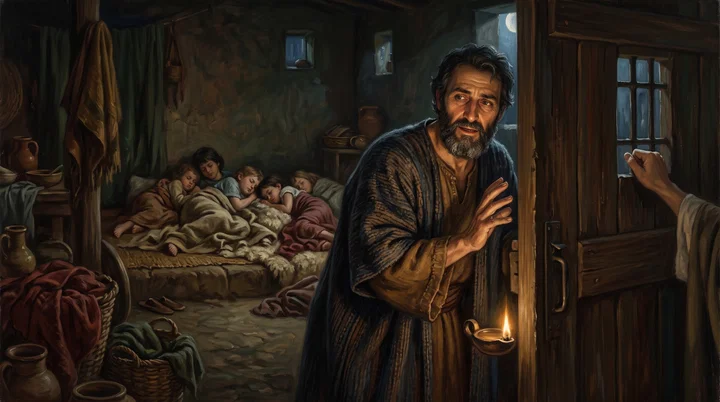
And he from within shall answer and say, Trouble me not: the door is now shut, and my children are with me in bed; I can not rise and give thee.
Translations
And he from within shall answer and say, Trouble me not: the door is now shut, and my children are with me in bed; I cannot rise and give you.
And he from within shall answer and say, Trouble me not: the door is now shut, and my children are with me in bed; I can not rise and give thee.
KJV Cambridge Paragraph Bible, Revised Version, American Standard Version
and he from within shall answer and say, Trouble me not: the door is now shut, and my children are with me in bed; I cannot rise and give thee?
And he from within shall answer and say, Trouble me not: the door is now shut, and my children are with me in bed; I cannot rise and give thee.
and he from within answering may say, Do not give me trouble, already the door hath been shut, and my children with me are in the bed, I am not able, having risen, to give to thee.
and he within answering should say, Do not disturb me; the door is already shut, and my children are with me in bed; I cannot rise up to give [ it] thee?
and, he, from within, shall answer, and say—Be not disturbing me,—already, the door hath been fastened, and, my children, with me, are, in bed: I cannot rise and give thee?
Berean Standard Bible, Majority Standard Bible
And suppose the one inside answers, ‘ Do not bother me. My door is already shut, and my children and I are in bed. I cannot get up to give you anything.’
and he from within will answer and say, ‘Don’ t bother me. The door is now shut, and my children are with me in bed. I can’ t get up and give it to you’?
And he, from inside the house, would say in answer, Do not be a trouble to me; the door is now shut, and my children are with me in bed; it is not possible for me to get up and give to you?
And hee within shoulde answere, and say, Trouble mee not: the doore is nowe shut, and my children are with mee in bed: I can not rise and giue them to thee.
Douay-Rheims (Challoner revision)
And he from within should answer, and say: Trouble me not, the door is now shut, and my children are with me in bed; I cannot rise and give thee.
Pictures
Cross-references
- Matthew 7:7-8
Ask, and it shall be given you; seek, and ye shall find; knock, and it shall be opened unto you:
The promise that those who ask and knock receive supports the lesson of persistent prayer.
- Luke 11:13
If ye then, being evil, know how to give good gifts unto your children: how much more shall your heavenly Father give the Holy Spirit to them that ask him?
The reluctant friend is contrasted with the willing Father, who gives the Holy Spirit to those who ask.
- Luke 18:1-8
And he spake a parable unto them to this end, that men ought always to pray, and not to faint;
Both parables teach that God hears persistent appeals, unlike an unresponsive human figure.
- Luke 11:1
And it came to pass, that, as he was praying in a certain place, when he ceased, one of his disciples said unto him, Lord, teach us to pray, as John also taught his disciples.
The disciples ask Jesus to teach them to pray.
- Matthew 6:9-13
After this manner therefore pray ye: Our Father which art in heaven, Hallowed be thy name.
Both present Jesus’ teaching on prayer.
Commentary
Each commentary is drawn from primary sources: the writings of Ellen G. White and Adventist pioneers and periodicals. Each commentary is separate. Its own words are not a quotation; follow the references to read the source passages.
Ellen G. White
44 sources
After the repetition of the Lord's prayer the verse is given as an illustration of prayer by the story of a man going to a friend at midnight for bread.Ms 31, 1898, par. 2–3COL 140.1–3 The answer from within is unwilling, that the house is troubled, the door shut and the children in bed, so he cannot rise to give.Ms 31, 1898, par. 2–3Ms 111, 1898, par. 2–5ST Mar 16, 1915 The petitioner comes at midnight for three loaves because a weary traveler has come to him and he has nothing to set before him, asking not to keep for himself but to supply another's need.COL 140.4–5COL 140.1–3RH Aug 11, 1910 Earnest, importunate pleading that will not accept denial overcomes the refusal, so that persistence is rewarded and as much as is needed is given.Ms 31, 1898, par. 2–3Ms 111, 1898, par. 2–5ST Mar 16, 1915Ms 23, 1899, par. 1–4Ms 93, 1898, par. 21–26 The selfish neighbor who yields only to rid himself of disturbance does not picture God, for the lesson is by contrast, since God delights to give and gladly answers those who ask in faith.ST Mar 16, 1915Ms 93, 1898, par. 21–26COL 141.1 So disciples are to ask God for the Bread of life and spiritual strength in order to feed hungry souls, and apparent refusal and delay are no reason to stop praying.Ms 31, 1898, par. 2–3ST Mar 16, 191519MR 227.3–228.2Ms 29, 1911, par. 18–19Lt 17, 1892, par. 10–12
Words and Setting
The verse stands in teaching given after the request to be taught to pray, when after repeating the Lord's prayer as given in the sermon on the mount the lesson on prayer was illustrated by the story of a man going to a friend at midnight to ask for three loaves for a traveling friend.COL 140.1–3 It is the answer from inside the house in that parable, the unwilling neighbor's excuse for not rising to give.COL 140.1–3
It records refusal because the door is shut and the children are in bed, with the plea not to be troubled and the claim that he cannot get up and give bread.Ms 31, 1898, par. 2–3Ms 111, 1898, par. 2–5ST Mar 16, 1915Ms 93, 1898, par. 21–2619MR 227.3–228.2 The refusal is at first, setting up continued pleading that overcomes it, and it reveals selfish indifference and unwillingness to be disturbed.Ms 111, 1898, par. 2–5Ms 93, 1898, par. 21–26Ms 54, 1895, par. 8–13 The scene illustrates persistent prayer in which the petitioner seeks bread not for himself alone but to meet need, and must keep asking rather than be turned away, trusting and persevering in asking for grace and spiritual food in order to give to others.Ms 31, 1898, par. 2–3ST Mar 16, 191519MR 227.3–228.2Ms 54, 1895, par. 8–13
The petitioner comes at midnight because a weary, belated traveler on a journey, a needy wayfaring friend, has come to him and he has nothing to set before his guest.COL 140.4–5COL 140.1–3RH Aug 11, 1910ST Sep 15, 1898 He asks for three loaves not to keep for himself but so he can give again, for he must obtain bread or he cannot supply the need of his friend who must be relieved.COL 140.4–5COL 140.1–3Lt 143, 1899, par. 10–11 Though his neighbor is unwilling to be troubled, he will not stop pleading until his wants are supplied, and his earnest determination to obtain the loaves illustrates persistent prayer for what is needed to give spiritual strength and light to others.COL 140.4–5RH Aug 11, 1910Ms 111, 1898, par. 14–15
Persistence in Prayer
The midnight refusal, with the door shut and the children in bed and the claim that he cannot rise and give bread, illustrates persistent prayer that keeps asking rather than being turned away.Ms 31, 1898, par. 2–3Ms 23, 1899, par. 1–4Ms 93, 1898, par. 21–26Ms 54, 1895, par. 8–13Lt 17, 1892, par. 10–12 The petitioner seeks bread not for himself alone but to meet the need of a weary traveler, and he must keep asking, seeking, and knocking in trust and confidence in God until the need is supplied.Ms 31, 1898, par. 2–3ST Mar 16, 1915Lt 17, 1892, par. 10–12RH Aug 11, 1910RH Aug 11, 1910 Prayer is to be earnest, importunate, and persevering, powerful when offered in faith, refusing to stop pleading or to accept denial.Ms 31, 1898, par. 2–3Ms 23, 1899, par. 1–4Ms 93, 1898, par. 21–26Ms 54, 1895, par. 8–13Ms 29, 1911, par. 18–19 The man inside at first refuses to be disturbed, revealing selfish indifference unlike God as the best Friend, yet he eventually gives because persistent entreaty wears him down, not because friendship moves him.Ms 31, 1898, par. 2–3ST Mar 16, 1915Ms 93, 1898, par. 21–26 Answers may not come immediately, so those who ask should continue presenting their requests while seeking divine enlightenment to know and ask for what is truly needed.Ms 31, 1898, par. 2–3Ms 29, 1911, par. 18–19Lt 17, 1892, par. 10–12
Continued pleading overcomes the initial refusal, so that importunity is at last rewarded and wants are supplied.Ms 111, 1898, par. 2–5ST Mar 16, 1915Ms 29, 1911, par. 18–19RH Aug 11, 1910RH Aug 11, 1910 The obstacle does not stop the petitioner, who keeps asking until the neighbor rises and supplies what is needed, giving as much as is needed even if moved only by persistence rather than friendship.ST Mar 16, 1915Ms 93, 1898, par. 21–26Ms 29, 1911, par. 18–19RH Aug 11, 1910RH Aug 11, 1910 Persistent asking brings the petitioner to greater earnestness and desire for what is sought.Ms 111, 1898, par. 2–5ST Mar 16, 1915 The more earnestly and steadfastly a person asks, the closer the spiritual union with Christ becomes, and blessings increase because faith increases.ST Mar 16, 1915COL 146.1–2 In this way trial proves faith genuine rather than mere form.COL 146.1–2
The human part is to pray and believe, to watch unto prayer and to cooperate with the prayer-hearing God by speaking and acting in harmony with prayer.COL 146.1–2Ms 33, 1898, par. 13–14 God hears prayer, and even when an answer does not come immediately He does not turn away indifferently.Ms 29, 1911, par. 18–19Lt 17, 1892, par. 10–12Ms 33, 1898, par. 13–14 Persistent prayer joined with good works shows confidence in God.Ms 31, 1898, par. 2–3Ms 33, 1898, par. 13–14
God Unlike Neighbor
The reluctant neighbor who pleads that the door is shut and the children are in bed and he does not want to be disturbed is selfish and indifferent, and he does not picture God, for the lesson is by contrast and not by comparison.ST Mar 16, 1915Ms 93, 1898, par. 21–26COL 141.1RH Aug 11, 1910 He yields at last not from friendship but because persistent entreaty wears him down, granting the urgent request only to rid himself of one who disturbs his rest.Ms 93, 1898, par. 21–26COL 141.1RH Aug 11, 1910 Unlike that selfish indifference, God is presented as the best Friend, compassionate and glad to answer those who ask in faith.ST Mar 16, 1915Ms 93, 1898, par. 21–26COL 141.1RH Aug 11, 1910
He delights to give, is full of compassion, and longs to grant the requests of those who come to Him in faith, giving willingly rather than grudgingly.ST Mar 16, 1915COL 141.1RH Aug 11, 1910 He is a divine Friend with abundant spiritual riches for everyone who recognizes need and asks in simple, trusting faith, with the assurance that those who seek find and to those who knock the door shall be opened.ST Mar 16, 1915ST Jan 14, 1897 He will not refuse help nor say He cannot help those who ask for bread to feed hungry souls, but supplies what they need.COL 148.1–3ST Jan 14, 1897
The shut door and refusal to rise do not mean God rejects prayer as coming at an improper hour, and apparent delay is not indifferent turning away.Ms 59, 1900, par. 19–20ST Sep 15, 1898Ms 33, 1898, par. 13–14 His eye never slumbers nor sleeps, He always hears the prayer of the humble suppliant, He does not turn away indifferently from His people even when the answer does not come immediately, and He never turns away unblessed those who seek Him with the whole heart.Ms 59, 1900, par. 19–20ST Sep 15, 1898Ms 33, 1898, par. 13–14 He gives so that those who receive may minister to others and thus become like Himself.COL 141.1
Asking to Give
The midnight petitioner does not ask to keep for himself but to meet the need of a weary, belated traveler who has come to him with nothing to set before him, and though the friend inside answers that the door is shut and the children are in bed so he cannot rise and give bread, the petitioner must keep asking rather than be turned away.Ms 31, 1898, par. 2–3RH Aug 11, 1910COL 140.4–5 The scene illustrates persistent prayer and trust and confidence in God in seeking grace and spiritual food in order to give to others.Ms 31, 1898, par. 2–3ST Mar 16, 1915 The neighbor at last supplies what is needed because of persistence, yet he does not represent God's character, for the lesson is by contrast since God is compassionate and gladly answers those who ask in faith.ST Mar 16, 1915 In the same way Christ's disciples must ask God for what they need in order to give spiritual food to others, turning to God for the bread of life so they can feed people who hunger for it.ST Mar 16, 1915RH Aug 11, 1910COL 140.4–5RH Aug 11, 1910
The bread sought at midnight represents the Bread of life, the spiritual strength and light and food that believers must receive from God before they can share it with spiritually hungry souls.Ms 111, 1898, par. 14–15 The earnest determination to obtain the loaves illustrates persistent prayer for what is needed to give that strength and light to others, and those who ask for what hungry souls need will be successful.Ms 99, 1902, par. 15Ms 111, 1898, par. 14–15RH Aug 12, 1909 As people receive from God they are to share what they have received with others, imparting as they receive and bringing spiritual nourishment to people.Ms 99, 1902, par. 15STB 579.1–2STB 426.2 Those who do this work of pleading for bread for hungry souls are blessed and greatly blessed.STB 579.1–2PMMEP 19.2STB 426.2 The example belongs to humble Christians and humble workers who go out to invite others to the gospel feast and seek what they need to minister to them, including saving souls through house-to-house ministry and inviting people to receive the gospel.STB 426.2RH Aug 12, 1909
The appeal for bread is seeking God's wisdom and the Holy Spirit so workers can share the bread of life with others, asking and working for the good of people who lack hope.Lt 166, 1899, par. 4–8 When believers feel great need for grace and intelligent knowledge of truth in order to give the bread of life to those in need, asking in humble faith brings grace for grace.Ms 59, 1900, par. 19–20 The picture is applied to asking for the Holy Spirit, who is received by those consecrated to God, denying self, taking up the cross, and following Christ, with what is received to be imparted to others.4MR 335.2 Christ calls for earnest, importunate prayer and wrestling with God for the vitalizing power and impartation of this Spirit, for there is efficiency in fervent prayer and in answer God turns the thoughts and hearts of men as He turns the waters of the sea.Ms 242, 1902, par. 11 Right asking needs grace and divine enlightenment through the Spirit to know what to ask and to ask for what is truly needed, and petitions prompted by the Lord will be answered.HPMMW 51.4–52.1 The lesson is applied to pleading with God for the Holy Spirit and for the salvation of others, while trusting Christ as the sufficient helper and committing the needs presented to Him.Ms 8, 1892, par. 11–12
As appointed representatives sent to feed the hungry, the disciples were to seek blessings from God so they would have spiritual food to impart and give the bread of life to the people.COL 140.4–5 Their faith would often be tried in unexpected positions where they would feel human insufficiency, destitute and helpless before souls hungering for the bread of life, yet they were not to turn one soul away unfed.COL 140.4–5 As the man who had nothing to set before his friend at midnight did not turn him away but went to one who had food and pressed his request until his need was supplied, Christ directs them to the source of supply, and God who sent His servants to feed the hungry will supply their need for His own work.COL 140.4–5 Lack of bread is no reason to turn away a visitor; one should seek help and welcome the guest, trusting God to provide.2T 28.2 Those who plead for what hungry souls need and share as they receive are blessed in bringing spiritual nourishment through house-to-house work and invitation to the gospel.Ms 99, 1902, par. 15STB 579.1–2PMMEP 19.2STB 426.2
Delay and Answered Prayer
The shut door and the unwilling voice from inside mean apparent refusal and delay, not a reason to stop praying.19MR 227.3–228.2Lt 17, 1892, par. 10–12ST Mar 16, 1915HPMMW 51.4–52.1CH 410.1 Answers to prayer may not come immediately, sometimes coming at once and sometimes requiring patient waiting while still pleading earnestly.19MR 227.3–228.2Ms 29, 1911, par. 18–19Lt 17, 1892, par. 10–12HPMMW 51.4–52.1CH 410.1 Those who ask should therefore keep asking earnestly and patiently even when no immediate response is realized, continuing to present requests until the need is supplied.19MR 227.3–228.2Ms 29, 1911, par. 18–19Lt 17, 1892, par. 10–12HPMMW 51.4–52.1CH 410.1 The householder at last gives as much as is needed because of persistence, and the lesson means more than can be imagined, calling for keeping on asking, seeking, and knocking.Ms 29, 1911, par. 18–19Lt 17, 1892, par. 10–12ST Mar 16, 1915HPMMW 51.4–52.1 Such persistent asking deepens earnestness and desire for what is sought, brings closer spiritual union with Christ, and is accompanied by increased faith and blessing.ST Mar 16, 1915
God tries faith by delay and encourages pressing petitions to the throne of grace for good.COL 143.1Ms 59, 1900, par. 19–20 The closed door and refusal to rise do not mean rejection at an improper hour, for His eye never slumbers nor sleeps and He always hears the prayer of the humble suppliant.Ms 59, 1900, par. 19–20 He never turns away unblessed those who seek Him with the whole heart, and when believers feel great need for grace and intelligent knowledge of truth in order to give the bread of life to those in need, asking in humble faith brings grace for grace.Ms 59, 1900, par. 19–20 Prayer does not change God but brings the one praying into harmony with Him, while He may use tests, trials, and humiliation to lead to searching of heart and repentance and to reveal what hinders the work of the Holy Spirit.COL 143.1 Christ as wonderful Counsellor looks upon His church with intense interest and tender sympathy and enters into the depth of human necessities, yet His ways are not human ways because He sees the result of every action.ST Feb 14, 1906 Many blessings are lost by failing to bring needs and cares and sorrows to Him and by following supposedly wise plans of human making instead of trusting patiently in His wisdom, so all plans must be laid at His feet and importunate prayers must continue to ascend while waiting for the answer.ST Feb 14, 1906
Right asking needs grace and divine enlightenment through the Spirit to know what to ask and to ask for what is truly needed.Ms 29, 1911, par. 18–19HPMMW 51.4–52.1 Petitions prompted by the Lord will be answered.HPMMW 51.4–52.1 If the request is for His name's glory He will speak acceptance and grant it according to the word of faith.ST Feb 14, 1906
The midnight request for bread, refused because the door is shut and the children are in bed, illustrates persistent prayer that keeps asking rather than being turned away.Ms 31, 1898, par. 2–3Ms 23, 1899, par. 1–4 The setting gives force to the instruction to keep asking, seeking, and knocking, and strengthens trust and confidence that God hears those who call to Him.Ms 31, 1898, par. 2–3DA 495.3Ms 33, 1898, par. 13–14 Even when an answer does not come immediately, God does not turn away from His people indifferently.Ms 33, 1898, par. 13–14 Persistent prayer joined with good works shows confidence in God.Ms 33, 1898, par. 13–14Lt 403, 1906, par. 3 God is pleased when His people importune Him with earnest, persistent prayer, taking hold upon Him as their only trust and the strength of the soul, praying and believing and praying again with implicit confidence in the Lord Jesus.Lt 403, 1906, par. 3 Asking in faith is powerful, teaching perseverance in asking for grace and spiritual food needed in order to give to others, including asking for grace and favor not only for oneself but for others in need of help.Ms 31, 1898, par. 2–3Ms 23, 1899, par. 1–4Lt 403, 1906, par. 3
Varied Prayer Applications
The shut door does not forbid importunate prayer for the salvation of others, for purity, and for assurance of pardoned sin, and such earnest determined pleading gains its request.4SP 224.1MYP 268.2Ms 8, 1892, par. 11–12 Continued importunity brings conversion of relatives or neighbors and a richer experience, continuing until deep longing for salvation and assurance are received.4SP 224.1MYP 268.2 Pleading is to be for the Holy Spirit and for others, trusting Christ as the sufficient helper and committing presented needs to Him, praying and believing and praying again with implicit confidence in the Lord Jesus.Ms 8, 1892, par. 11–12Lt 403, 1906, par. 3 Grace and favor are to be asked not only for oneself but for others in need of help, including one whose way is objectionable while preparing for the test of the judgment, and such importunity will certainly be heard, for persistent prayer does not weary God.Lt 403, 1906, par. 3ST May 28, 1896 Even the smallest cares, desires and needs may be kept presented with earnestness and a spirit of intercession.ST May 28, 1896
For the sick the unwilling answer means delay, not a reason to stop praying, for faith is essential and answers sometimes come immediately and sometimes require waiting patiently while continuing to plead earnestly.HPMMW 51.4–52.1 Keeping on asking, seeking and knocking is required even when no immediate response is realized, and right asking needs grace and divine enlightenment through the Spirit to know what to ask, with petitions prompted by the Lord answered.HPMMW 51.4–52.1 Wrestling with God is needed for the impartation of the vitalizing power of the Holy Spirit, and there is efficiency in fervent prayer, in answer to which God turns the thoughts and hearts of men as He turns the waters of the sea.Ms 242, 1902, par. 11 Prayer for instruction and guidance is to be kept in mind and continued in faith until the answer is received.FE 530.3
Those who plead for bread for hungry souls are greatly blessed, and those who persistently seek it will be successful.STB 426.2RH Aug 12, 1909 The lesson belongs to humble workers who seek to save souls through house-to-house ministry and go out to invite others to receive the gospel and come to the gospel feast, imparting as they receive.STB 426.2RH Aug 12, 1909 As the traveler’s need drew urgent continued appeal that at last obtained a response, so persistent pleas obtain resources to meet needs in missionary fields.Lt 143, 1899, par. 10–11
Sources
Pioneers and periodicals
43 sources
Luke 11:7 is the selfish neighbor's excuse in the midnight parable, where a man knocking at midnight to borrow three loaves for a weary traveler is told not to trouble him because the door is shut for the night and his children are with him in bed so he cannot rise and give.ST Jan 19, 1915ST Apr 20, 1904ST Jun 4, 1894ST Nov 20, 1901ST Nov 20, 1901 The cannot means unwillingness rather than inability, for the man inside is annoyed at being disturbed and yields at last only to get rid of the persistent knocking that keeps asking until he rises and gives as much as is needed.RH Aug 11, 1910ST Jan 19, 1915ST Jun 4, 1894ST Nov 9, 1915ST May 11, 1915 The unwilling friend does not picture God, for the parable teaches by contrast that the Father in heaven is all sympathy and mercy, never tired by asking and far more willing to give than even a kind earthly father.ST Mar 16, 1915RH Aug 11, 1910ST Jun 4, 1894ST Sep 10, 1885ST Feb 27, 1896 It therefore teaches earnest, importunate prayer that does not ask only once but keeps pleading and knocking until success is assured, trusting that seeming refusal is delay and not denial.ST Sep 15, 1898ST Feb 14, 1906ST Jan 19, 1882ST Sep 10, 1885RH Aug 28, 1856 The asker seeks bread not for himself but to set before another, representing disciples seeking spiritual provision to feed hungry souls, which the willing God gladly answers above all by giving the Holy Spirit to those who ask Him.ST Mar 16, 1915RH Aug 11, 1910RH Oct 1, 1901ST Feb 27, 1896ST Jun 4, 1894
Parable Story and Wording
The verse stands in the middle of the parable of the midnight visitor, given right after the teaching on how to pray as the first illustration of asking God and to impress the Lord's prayer, which is a sample prayer showing that all things concerning earthly existence may be presented at the throne of grace.ST Nov 20, 1901ST Mar 12, 1896ST Jun 4, 1894ST Nov 20, 1901 At midnight a man comes to borrow three loaves to feed a traveler who has arrived from a journey, a needy wayfaring friend, when he has nothing to set before him.ST Sep 15, 1898ST Apr 20, 1904ST Nov 20, 1901ST Nov 20, 1901
The friend inside answers from within with a plausible excuse for not complying, pleading not to be troubled because the door is now shut and the house closed for the night.ST Apr 20, 1904ST Jun 4, 1894ST Feb 27, 1896ST Jun 15, 1904ST Nov 20, 1901 His children are with him in bed and the household is settled for the night, the family already in bed, and he claims he cannot rise and give, cannot get up to give what is asked.ST Jan 19, 1915ST Apr 20, 1904ST Jun 4, 1894ST Feb 27, 1896ST Nov 20, 1901 The refusal sets up the lesson that importunity will overcome it and that continued asking receives what is needed.ST Apr 20, 1904ST Jun 4, 1894ST Feb 27, 1896
The man inside is selfish, without sympathy, annoyed and disturbed at being troubled and at having his rest disturbed.RH Aug 11, 1910ST Nov 20, 1901ST Jun 4, 1894ST Feb 27, 1896ST Nov 20, 1901 If he at last grants the urgent request and rises to give, it is not from delight in giving but only to rid himself of one who disturbs his rest and to stop being disturbed.RH Aug 11, 1910ST Nov 20, 1901ST Jun 4, 1894ST Feb 27, 1896ST Nov 20, 1901
The word cannot expresses his stated reluctance or unwillingness, not absolute inability, for he afterward nevertheless gets up.ST Nov 9, 1915ST May 11, 1915 The initial refusal is overcome by importunity, for the petitioner keeps asking, pleading and knocking until the neighbor rises and gives him what he needs, even as much as he needs.ST Mar 16, 1915ST Jan 19, 1915RH Oct 1, 1901ST Jun 4, 1894ST Feb 27, 1896 The obstacle does not stop the petitioner, who keeps on asking and by persistence secures the bread.RH Aug 11, 1910ST Jan 19, 1915RH Oct 1, 1901ST Jun 4, 1894ST Feb 27, 1896
Contrast With God's Character
The shut door and the children in bed do not picture God, for the unwilling neighbor teaches by contrast and not by comparison.ST Mar 16, 1915RH Aug 11, 1910ST Jun 4, 1894ST Sep 10, 1885RH Dec 11, 1900 The man inside is selfish and without sympathy, annoyed and disturbed at being troubled, and when at last he rises and gives as much as is needed it is only because of persistent asking and pleading, only to rid himself of one who disturbs his rest.ST Mar 16, 1915RH Aug 11, 1910ST Nov 20, 1901ST Jun 4, 1894ST Nov 20, 1901 That reluctance does not mean God is hard to persuade or must be worn down like an unwilling human friend, for felt need may properly prompt earnest prayer and keeping on when an answer seems delayed.ST Sep 10, 1885RH Dec 11, 1900ST Feb 27, 1896
Unlike earthly householders who tire of repeated requests, God never tires of having His children ask Him for things they need or will use for His honor.ST Nov 21, 1911ST Jun 15, 1904ST Jun 4, 1894 He does not turn them away nor turn away from His people indifferently, and He does not give refusal as an excuse, though an answer may not come immediately.ST Nov 21, 1911ST Sep 15, 1898ST Jan 14, 1897ST Jun 15, 1904 Sincere requests made in simple, trusting faith will be answered, so that those who seek find and those who knock have the door opened by a divine Friend whose abundant spiritual gifts and riches are for everyone who recognizes need and asks in faith.ST Mar 16, 1915ST Nov 21, 1911ST Jan 14, 1897
In contrast to the selfish friend, the Father in heaven is all sympathy and full of mercy, compassionate and delighting to give, ever overflowing in love with thoughts of peace toward His children.RH Aug 11, 1910ST Nov 20, 1901ST Jun 4, 1894ST Feb 27, 1896 He is more willing to pour out blessings than people can receive, and far more willing than even a kind earthly father, gladly helping those who pray and listening for their prayers.ST Jan 14, 1897ST Jun 4, 1894ST Feb 27, 1896ST Nov 20, 1901 If persistent asking can move even a selfish man to rise and give, earnest petition will much more quickly move God to answer.ST Mar 16, 1915ST Feb 27, 1896 God always knows better than the petitioner what is best, so when the request is amiss He answers the spirit of the prayer rather than giving the exact thing asked, and no prayer of faith goes unanswered because the best thing is given.ST Feb 27, 1896 Yet God sometimes grants a request because of importunity, not because the asker is good nor because what is asked is best, as when Hezekiah's continued prayer for healing from sickness was granted though it was not best for him, for three years later his son Manasseh was born and gave the people a terribly wicked rule, and Hezekiah himself became backslidden for a time with results that came upon the people a hundred years later.ST Jun 28, 1905
Persistence in Prayer
The verse teaches earnest, persistent, importunate prayer, which is asking more than once and not asking only once. ST Jan 19, 1882RH Aug 28, 1856 It means holding on until success is assured, enduring as seeing Him who is invisible, and boldly and continuously pulling until the bell rings. RH Oct 15, 1903RH Mar 4, 1915 The petitioner keeps asking until what is sought is received, and believers are not to become discouraged or give up duty. ST Sep 10, 1885RH Aug 28, 1856 Importunate prayer so offered is not spent in vain but may receive an answer. RH Mar 5, 1861
The first refusal is to be met by continuing to solicit, persevering in knocking, and keeping on pleading. ST Jan 19, 1915ST Jan 19, 1882ST Apr 20, 1904 The friend inside first refuses because the door is shut and the household is settled for the night with the children in bed, claiming he cannot rise and give, yet continued importunate asking overcomes that initial reluctance. ST Jan 19, 1915ST Apr 20, 1904ST Jun 4, 1894ST Feb 27, 1896 Persistent asking still receives what is needed, even as much as is needed. ST Jun 4, 1894ST Feb 27, 1896RH Oct 15, 1903 Success comes not to the specially talented but to the persevering, even the apparently untalented, who do not let go too soon, and the incident teaches constancy under trial and hope deferred. ST Jan 19, 1915RH Oct 15, 1903
The refusal is delay, not denial, for an answer may not come immediately and may seem like refusal, but believers should not stop praying. ST Sep 15, 1898ST Feb 14, 1906ST Mar 18, 1903 God hears prayer and does not turn away from His people indifferently though the answer tarries. ST Sep 15, 1898ST Feb 14, 1906 Prayer must not cease while waiting, but importunate prayers must continue to ascend until the answer comes. ST Mar 16, 1915ST Feb 14, 1906 Delay deepens earnestness and desire for what is sought, brings closer spiritual union with Christ, and is accompanied by increased faith and blessing. ST Mar 16, 1915RH Dec 11, 1900 Felt need prompts earnest prayer, and long pleading is often needed so the suppliant may realize the importance of the matter and his own weakness, so people should keep praying and keep making needs known even when an answer seems delayed. ST Mar 16, 1915RH Dec 11, 1900ST Feb 27, 1896
Importunity is sometimes necessary and sometimes not according to the petition, for Jesus spent whole nights in prayer and pleaded in agony in Gethsemane, yet God is unchanging and even the silent prayer of faith is heard. ST Feb 27, 1896 Persistent prayer does not weary God, so even the smallest cares, desires and needs may be kept presented with earnestness and a spirit of intercession. ST May 28, 1896ST Feb 27, 1896 Persistence is illustrated by Jacob, who would not let go until blessed, and by Naaman, who had to dip seven times so that stopping before the seventh dip would have left him unclean. ST Sep 10, 1885 Likewise the sinner has no cleansing source but Christ's blood and must seek cleansing there. ST Sep 10, 1885 Prayer for the salvation of loved ones may go unanswered at once and even for years, yet faith must not be lost because God's promises are sure, so keep on praying and believing and the Lord will do the rest. ST Mar 18, 1903
Asking to Give Others
The midnight petitioner is not asking for himself but that he may give again to another, for he already has bread for himself and seeks provision for a friend, a weary traveler in need who has come to him with nothing to set before him.RH Aug 11, 1910RH Aug 11, 1910ST Nov 20, 1901RH Oct 1, 1901ST Nov 20, 1901 The obstacle of the shut door and the household in bed does not stop him, but he keeps asking until his need is supplied.RH Aug 11, 1910RH Aug 11, 1910 He represents Christ's disciples seeking from God what they need in order to give spiritual food to others, turning to God for spiritual provision so they can feed people who hunger for it with the bread of life, the message of salvation.ST Mar 16, 1915RH Aug 11, 1910RH Aug 11, 1910RH Oct 1, 1901 The scene shows disciples asking God for spiritual provision in order to give the bread of life to another, while the neighbor's reluctance is overcome by persistence.ST Mar 16, 1915
Prayers are not to be a selfish asking merely for our own benefit; believers are to ask that they may give to those around them and to plead for others' needs with persistence and trust.ST Nov 20, 1901RH Jan 8, 1914ST Nov 20, 1901 The selfish willingness to give merely to stop being troubled is set in contrast to God, who delights to give and is far more willing than even a kind earthly father.ST Nov 20, 1901ST Nov 20, 1901 Those who persistently seek bread for hungry souls will be successful.RH Aug 12, 1909RH Sep 21, 1905 This is pictured by humble Christians who go out to invite others to the gospel feast and seek what they need to minister to them, by persistent humble workers asking at midnight for loaves for others and sharing received blessings with others, and by the church's appeal for help for the needy receiving as much as was asked.RH Aug 12, 1909RH Sep 21, 1905RH Apr 27, 1911
Prayer for others is joined with persevering work: after earnest prayer for others, believers are to carry them the Bread of life, the message of salvation.RH Oct 1, 1901 Enduring working quality joined with enduring prayer, holding on until success is assured and enduring as seeing Him who is invisible, is one of the most necessary qualifications for success.RH Oct 15, 1903 Success comes not to the specially talented but to the persevering, even the apparently untalented, who do not let go too soon.RH Oct 15, 1903
God's Willing Answer
The midnight refusal belongs to an illustration of readiness to answer prayer, so those in need may ask with confidence and expect to receive. God gladly helps those who pray, listens for their prayers, hears prayer, and does not turn away from His people indifferently.ST Sep 15, 1898ST Jun 4, 1894ST Jun 4, 1894RH Oct 16, 1860ST Jun 4, 1894 The closed door and the unwillingness to rise set the scene, and continued importunate asking overcomes the reluctance and receives what is needed.ST Jun 4, 1894ST Jun 4, 1894
All things concerning earthly existence are proper subjects to bring to the throne of grace, with assurance that asking will be given, seeking will find, and knocking will be opened.ST Mar 12, 1896 Sincere requests made in simple, trusting faith will be answered, for those who seek find and those who knock have the door opened by a divine Friend whose abundant spiritual gifts and riches stand ready for everyone who recognizes need and asks in faith.ST Nov 21, 1911ST Jan 14, 1897 The refusal in the story is not an excuse God gives to those who ask Him.ST Nov 21, 1911ST Jan 14, 1897 The heavenly Father gladly answers prayer by giving the Holy Spirit, and is so much more willing to give the Holy Spirit to those who ask Him.ST Feb 27, 1896ST Jun 4, 1894
Prayer should therefore be offered with expectation of receiving help, as one asking a friend for a favor expects an answer.RH Oct 16, 1860 God is to be sought earnestly with true purpose of heart, for He hears and gives and is willing to give the power His people need, including deliverance from sin and the consecration and power needed for service.RH Oct 16, 1860RH Aug 25, 1910RH Jan 11, 1912 Jesus Christ as the wonderful Counsellor looks upon His church with intense interest and tender sympathy and enters into the depth of human necessities, yet His ways are not human ways because He sees the result of every action.ST Feb 14, 1906 Many blessings are lost by failing to bring needs and cares and sorrows to Him and by following supposedly wise plans of human making instead of trusting patiently in His wisdom, so all plans must be laid at His feet and prayer must not cease while waiting, and if the request is for His name's glory He will speak acceptance and grant it according to the word of faith.ST Feb 14, 1906
The man’s saying he cannot rise and yet afterward getting up shows that cannot here expresses stated reluctance or unwillingness rather than absolute inability.ST Nov 9, 1915ST May 11, 1915 In that sense it illustrates a Christian’s refusal to commit a known sin.ST May 11, 1915 By contrast it illustrates that one born of God cannot consent to sin because of the new life within him.ST Nov 9, 1915
Sources