Luke 19:5
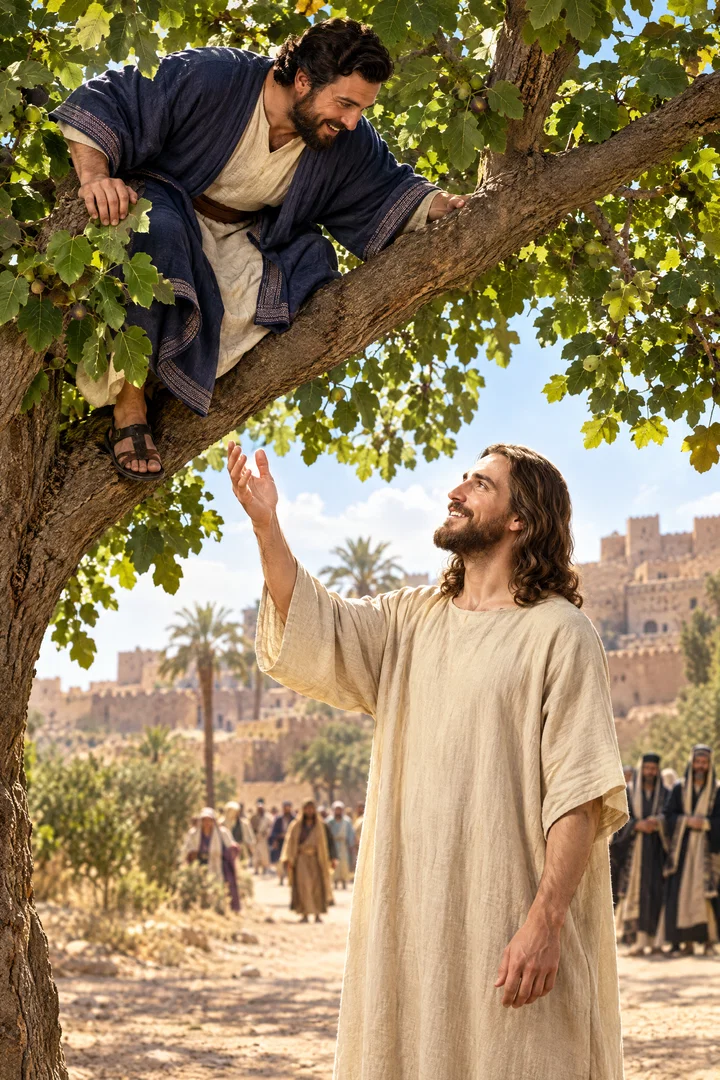
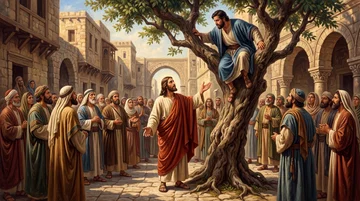
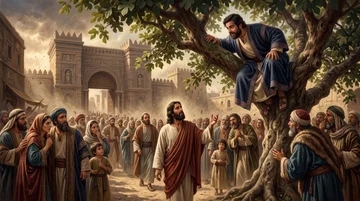
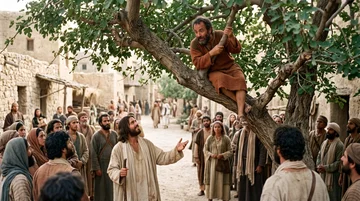
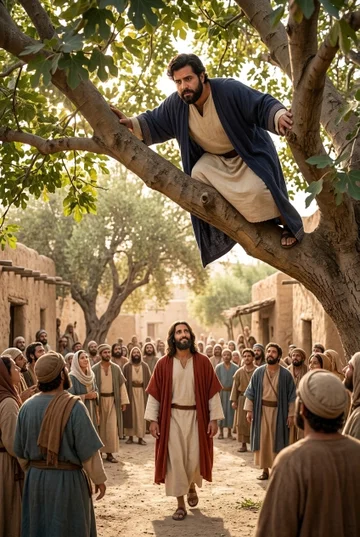
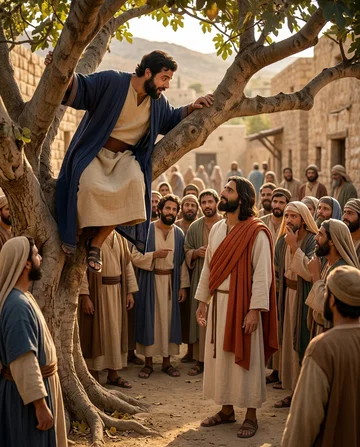
And when Jesus came to the place, he looked up, and saw him, and said unto him, Zacchæus, make haste, and come down; for to day I must abide at thy house.
Translations
And when Jesus came to the place, he looked up, and saw him, and said to him, Zacchaeus, make haste, and come down; for to day I must abide at your house.
And when Jesus came to the place, he looked up, and saw him, and said unto him, Zacchæus, make haste, and come down; for to day I must abide at thy house.
And when Jesus came to the place, he looked up, and saw him, and said unto him, Zaccheus, make haste, and come down; for to day I must abide at thy house.
And when Jesus came to the place, he looked up, and saw him, and said to him, Zaccheus, make haste, and come down: for to-day I must abide at thy house.
And when Jesus came to the place, he looked up, and said unto him, Zacchaeus, make haste, and come down; for today I must abide at thy house.
And when Jesus came to the place, he looked up, and said unto him, Zacchæus, make haste, and come down; for to-day I must abide at thy house.
And as Jesus came up to the place, having looked up, he saw him, and said unto him, 'Zaccheus, having hastened, come down, for to-day in thy house it behoveth me to remain;'
And when he came up to the place, Jesus looked up and saw him, and said to him, Zacchaeus, make haste and come down, for to-day I must remain in thy house.
And, as he came up to the place, looking up, Jesus said unto him—Zacchaeus! make haste, and come down; For, to-day, in thy house, I must needs abide.
When Jesus came to that place, He looked up and said, “ Zacchaeus, hurry down, for I must stay at your house today.”
When Jesus came to that place, He looked up and saw him and said, “ Zacchaeus, hurry down, for I must stay at your house today.”
When Jesus came to the place, he looked up and saw him, and said to him, “ Zacchaeus, hurry and come down, for today I must stay at your house.”
And when Jesus came to the place, looking up, he said to him, Zacchaeus, be quick and come down, for I am coming to your house today.
And when Iesus came to the place, he looked vp, and saw him, and said vnto him, Zaccheus, come downe at once: for to day I must abide at thine house.
Douay-Rheims (Challoner revision)
And when Jesus was come to the place, looking up, he saw him, and said to him: Zacheus, make haste and come down; for this day I must abide in thy house.
Pictures



Cross-references
- Luke 19:10
For the Son of man is come to seek and to save that which was lost.
Jesus’ visit to Zacchaeus illustrates his mission to seek and save the lost.
- Luke 19:9
And Jesus said unto him, This day is salvation come to this house, forsomuch as he also is a son of Abraham.
Jesus declares that salvation has come to Zacchaeus’s house that day.
- John 10:3
To him the porter openeth; and the sheep hear his voice: and he calleth his own sheep by name, and leadeth them out.
Jesus’ calling people by name illustrates personal, direct appeals.
Commentary
Each commentary is drawn from primary sources: the writings of Ellen G. White and Adventist pioneers and periodicals. Each commentary is separate. Its own words are not a quotation; follow the references to read the source passages.
Ellen G. White
15 sources
When Jesus came to the place He looked up and saw Zacchaeus in the tree, knew him and his desire, and called him personally by name to hasten down quickly because He must stay at his house that day.DA 552.4Ms 72, 1895, par. 4ST Jun 11, 1896 Zacchaeus had come with a heart already prepared by reports of merciful works and wonderful teaching, convicted of his need to reform, repent, and restore what he had unjustly taken, and longing to know more.ST Jun 11, 1896DA 553.1 By choosing to dine with one others called a sinner, lost, and hopeless, He looked beyond status to show love and mercy to open sinners and outcasts whom others would pass by.DA 552.4Ms 102, 1894, par. 12–14ST Jun 11, 1896 His coming to stay is a picture of entering the heart, and genuine conversion is proved by turning from unrighteous practices and making restitution for what was taken unjustly.DA 552.4Ms 5, 1897, par. 16–20DA 556.1 Instead of cutting such erring characters off and leaving them, He draws them with cords of love to pray for, lead, and guide them, melting hard hearts by tenderness rather than crushing them with harsh judgment.Ms 102, 1894, par. 12–14Ms 8a, 1891, par. 17–20
Setting and Encounter
The place was Jericho, where crowds were eager to honor Jesus after hearing that He had raised Lazarus, a city of sharply different groups that included many priests as well as Roman officials, soldiers, and publicans.DA 552.2–3 Zacchaeus came with a heart already prepared, having heard reports of merciful works and wonderful teaching and longing to see Jesus for himself.ST Jun 11, 1896 Those reported words had taken deep hold of his heart, convicting him of his need to reform his life, to repent, and to make restitution to those he had unjustly taxed and charged at exorbitant rates, while giving him hope as he tried to turn from his wrongs and creating desire to know more of His principles and doctrines, like seed sown and nurtured and ready to bring forth a harvest to the glory of God.ST Jun 11, 1896DA 553.1
When Jesus came to the place He looked up, saw Zacchaeus in the tree, recognized him and his desire, and personally called him by name to hasten and come down quickly, graciously choosing him and inviting Himself to stay at his house that day as a matter of necessity.DA 552.4Ms 72, 1895, par. 4ST Jun 11, 1896Ms 5, 1897, par. 16–20DA 553.3–554.1 Zacchaeus came down and welcomed Jesus joyfully, glad to receive His favor.Ms 72, 1895, par. 4ST Jun 11, 1896 Jesus rejoiced to meet one who welcomed Him and responded to the gracious drawing of the Spirit.ST Jun 11, 1896
The choice to visit drew scorn and fault-finding from rabbis and Pharisees who regarded Zacchaeus as a sinner.DA 553.3–554.1Ms 8a, 1891, par. 17–20 Yet the welcome was a bright spot for Jesus while traveling through Jericho amid rejection by religious leaders and grief over His family's unbelief.ST Jun 11, 1896
Mercy and Transformation
Jesus looked beyond despised publican standing to seek Zacchaeus personally and dine at the home of one others called a sinner, lost and hopeless, showing love and mercy to open sinners and outcasts whom people might pass by.DA 552.4Ms 102, 1894, par. 12–14ST Jun 11, 1896Ms 8a, 1891, par. 17–20
His personal notice and gracious word still reach those thought to be hardened sinners who have lived in serious error and sin.COL 235.1–236.1Ms 183, 1897, par. 3–6Lt 123, 1897, par. 24–28
To those with few and meager opportunities who walked in error because they knew no better way He sends beams of light that soften them and reveal hearts as tender as a child's.COL 235.1–236.1Ms 183, 1897, par. 3–6Lt 123, 1897, par. 24–28
In the time when great light shines from the Word and many with privileges reject it and make void the law, He calls these outsiders to take the place and crowns of those who turned away.Ms 183, 1897, par. 3–6
Even before meeting Christ, Zacchaeus had already begun generosity to the poor and restitution for wrongdoing, and those were Christian works though he had not yet met Him.DA 552.4Ms 72, 1895, par. 4
His welcome of such a despised publican kindled hope that repentance and a changed life were possible.DA 552.4
His coming to stay is also a picture of Christ entering the heart, shown by turning away from unrighteous practices.DA 556.1
Genuine conversion is proved by making restitution and restoring what was taken unjustly, teaching that one who has done wrong should face the principle involved and put things right.Ms 5, 1897, par. 16–20DA 556.1
Instead of cutting such objectionable, sick and erring characters off and leaving them to Satan, Christ drew Zacchaeus with cords of love into His own hands to pray for, lead and guide him.Ms 8a, 1891, par. 17–20
His example teaches tenderness and Christlike sympathy toward the erring rather than harsh judgment.Ms 102, 1894, par. 12–14Ms 8a, 1891, par. 17–20
No barrier is to be built between God and the soul, and no sinner is to be crushed with humiliation and harsh pressure that drives to desperation, stubbornness and discouragement.Ms 8a, 1891, par. 17–20
Hard hearts are melted by dealing tenderly as Christ dealt.Ms 102, 1894, par. 12–14Ms 8a, 1891, par. 17–20
Sources
Pioneers and periodicals
62 sources
When Jesus reached the spot under the sycamore tree at Jericho he looked up and saw Zacchaeus there, and told him to hurry down because he must stay at his house that day.ST Nov 21, 1900ST Mar 19, 1912ST Feb 20, 1912 He called him by name though they had never met, deliberately choosing the despised chief tax collector as his host as an act of mercy.ST Dec 4, 1893ST Feb 20, 1912ST May 18, 1882 In taking the initiative to invite himself to the home of a stranger, he showed his mission to seek and save the lost, reaching the rich as well as the poor and drawing near as guest even to a sinner others condemned.ST Dec 19, 1900ST Sep 22, 1914RH Nov 4, 1873 Zacchaeus had climbed the tree from earnest desire to see him, his heart already prepared by what he had heard to repent and make restitution, and meeting Jesus brought him joy and a changed life in which he gave half his goods to the poor and repaid fourfold what he had taken wrongfully.ST Jun 11, 1896ST Sep 22, 1914RH Oct 29, 1903ST Nov 21, 1900ST Mar 19, 1912 The command to make haste that day is also a call to every heart to come down from pride and receive him without delay, welcoming him not only into the house but into the heart and placing all possessions under his rule.ST Aug 21, 1907ST Mar 25, 1903
Setting Words and Journey
At Jericho Jesus came to the place beneath the sycamore tree, looked up, and saw Zacchaeus up in the tree.ST Nov 21, 1900ST Mar 19, 1912ST Feb 20, 1912ST May 26, 1914 He told him to hurry and come down, because that day he must stay at his house.ST Nov 21, 1900ST Mar 19, 1912ST Feb 20, 1912ST May 26, 1914 Zacchaeus was a rich tax collector, and he became Jesus' disciple.RH Aug 24, 1905 His small stature had led him to climb the tree to see Jesus, and the climb made the encounter and the call possible.ST Mar 19, 1912
Jesus addressed him by name as Zacchaeus, though they had never met.ST Dec 4, 1893ST Feb 20, 1912ST May 18, 1882 Hearing his own name from a stranger astonished Zacchaeus and convinced him that Jesus knew both his name and that he had a house.ST Dec 4, 1893 In doing so Jesus deliberately chose the despised chief tax collector as his host.ST May 18, 1882 That self-invitation served a purpose of mercy.ST May 18, 1882
The words are both a command to descend and an invitation to receive him as guest that day.ST Sep 10, 1894ST Nov 21, 1900ST Dec 4, 1893ST Nov 21, 1900 Zacchaeus obeyed at once and received him joyfully, and the visit that followed opens the explanation of how a rich person can be saved.ST Sep 10, 1894ST Nov 21, 1900ST Feb 20, 1912 Jesus in this took the initiative to invite himself into the home and stay there.ST Feb 20, 1912
The meeting belongs to his traveling from Jericho toward Bethany and Jerusalem in the six days before the Passover. He dined with Zacchaeus at Jericho on the day he traveled toward Bethany, and the arrival at Bethany where supper was made at the home of Lazarus was the first of those six days.RH Jan 29, 1914 That day was not the Sabbath, because he and his disciples had traveled many miles from Jericho, nor the first day of the week, because that would place the Passover on the following Sabbath. The parable of the pounds in Luke 19:11-27 was probably spoken at Zacchaeus's house in Jericho.ST Apr 30, 1896
Christ Seeking the Lost
Jesus takes the initiative to invite himself to stay with a stranger he has never met, and that self-invitation expresses his mission to reach and help people in need of salvation. He makes himself at home wherever he can help and save a soul, and his offer to come in is to be welcomed. The account illustrates that he came to seek and save the lost.ST Dec 19, 1900 His love meets human faith even when prejudice marks the man as a dishonest rich sinner, intending to win him and to rebuke those who despise him. He shows his readiness to draw near, to seek personal fellowship, and to be the guest of a sinner who comes to him.
He does not reject a person for being rich or for belonging to the despised tax-gatherers, but comes to seek and save the lost.RH Nov 4, 1873 He reaches the rich as well as the poor and opens spiritual eyes.ST Jun 14, 1905ST Feb 21, 1906RH Jan 8, 1914 He mingles with every class including the degraded and sinful, bringing the benefits of his ministry to a wealthy man just as to people in many other conditions, for his good works and gospel are freely offered to all who need them and are not reserved for an exclusive group.RH Jan 8, 1914RH Oct 7, 1909 He does not condemn possession of riches as such, but addresses wealth when it hinders noble character.ST Sep 22, 1914 His visit brings salvation that changes conduct into full salvation shown by making wrongs right and loosening the hold of wealth, giving half the goods to the poor and promising fourfold restitution for gain by false accusation, which frees from the bondage of avarice so that he asks no more, and the changed use of property marks a true son of Abraham.ST Sep 22, 1914RH Nov 4, 1873
His need to visit comes from love, recognizing a sinner in need of mercy who will gladly receive it. He sees the grace that can renew him and the good he may later do in service, and even curiosity can serve grace when it brings closer contact. He does not delay the good he intends but calls to receive him that very day, with a kind and comforting response rather than rebuke for boldness. Low and despised standing as a tax collector, wealth, and suspicion of unfair gain do not keep him away, for he welcomes people whatever their unpopular or undesirable circumstances and looks instead at honesty and integrity of heart. His welcome was a bright spot as he traveled through Jericho amid rejection by religious leaders and grief over family unbelief, reflecting the love and mercy he showed to outcasts and sinners.ST Jun 11, 1896 To save what is good in the soul he forgets, forgives, and puts out of sight what is bad, seeing and loving what is good.RH Jun 2, 1904 He associates with sinners to reach them rather than rejecting them as hopeless, deliberately choosing the despised chief tax collector as host and going to lodge with a man the crowd murmured against.ST May 18, 1882ST May 26, 1914 He chose this home rather than favoring the wealthy or respectable, showing concern for ordinary, obscure, and unpopular people whom others might despise.ST Jul 21, 1898ST Aug 5, 1886 This angered the Pharisees who regarded the host as a sinner.ST May 26, 1914
Amid important work he stopped and took time to notice and encourage, quietly and usefully busy and never so pressed that he neglected an opportunity to do good.ST Nov 9, 1915 In this way he gathered a greedy businessman hungry for gold into the gospel net.ST Oct 31, 1916 The verse shows his personal work of visiting homes and giving personal, direct attention to the curious man who climbed the tree, seeking people out and addressing them personally and directly.RH Nov 19, 1908RH Dec 26, 1907 His coming to a worldly man whom the world would throw away as rubbish shows God making a saint from a sinner.ST Mar 22, 1899 With Peter, Mary Magdalene, Thomas, and Paul, this proves the New Testament is a record of God making apostles and saints from rejected people, which he can do and is doing today.ST Mar 22, 1899
Zacchaeus Seeking Christ
Zacchaeus bore a name meaning pure and innocent, which was counted very inappropriate for him as chief among the publicans. He belonged to a hated class, having sacrificed spiritual privileges, religious character, and all held most sacred to love of gain, and stood corrupt and sordid instead of pure as a lost Israelite and lost sinner. His condition shows how sin degrades, brings contempt, and gains power so that men sacrifice anything to gratify it.
Being small of stature he could not see for the crowd, so he climbed a sycamore tree to see Jesus.ST Mar 19, 1912 The climbing was proper for him, and his determined search led him to find the Saviour.RH Oct 29, 1903 It made the encounter and the call possible.ST Mar 19, 1912
His climbing was more than curiosity over public attention; it was desire in his heart to know Jesus personally. That Jesus declared His intention to stay at his house proves it, for He would not have done so for mere curiosity.
His heart was already prepared by reports of merciful works and wonderful teaching that took deep hold.ST Jun 11, 1896 Those reports convicted him of need to reform, repent, and make restitution for unjust taxes and exorbitant rates, and created desire to know more of principles and doctrines.ST Jun 11, 1896 The seed of truth sown and nurtured was ready to bring forth harvest, so the call to come down quickly was answered.ST Jun 11, 1896
Jesus notices earnest desire and effort to be near Him with good intentions and meets it with kindness, welcome, and encouragement. Even curiosity can serve grace. His warm words reassure rather than make fear of reproach for boldness.
His words brought Zacchaeus joy because he received favor, and Jesus rejoiced to meet one who welcomed Him and responded to the gracious drawing of God's Spirit.ST Jun 11, 1896 This single declaration brought him joyfully to Christ.RH Apr 23, 1867 Sitting at the same table was special privilege and joy.RH Apr 16, 1867
Though little in stature he was a better man than Saul, showing true manhood is measured by moral character rather than bodily size or strength and is fully developed in Christ.ST Feb 3, 1887
Salvation Repentance and Restitution
Receiving him joyfully brings salvation to the receiver and to the household that very day.ST Sep 10, 1894ST Jul 29, 1913 His presence restores to God's favor and service, and he is found among sinners speaking salvation and leading people to follow him.ST Feb 17, 1898 He is still ready to abide with anyone who desires him, whether rich or poor.
His coming marks the beginning of a new era and a happy day, as it is for every sinner who receives him, because conversion reaches the whole person and all that belongs to him, including his money.RH Nov 4, 1873ST Dec 4, 1893 Welcoming him into house is welcoming him into heart.ST Dec 4, 1893 That full salvation is shown by making wrongs right and loosening the hold of wealth, and changed use of property marks the changed man as a true son of Abraham.RH Nov 4, 1873
The meeting turns covetousness into declared purpose to give half of goods to the poor and to restore fourfold anything taken by false charge or fraud.ST Nov 21, 1900ST Aug 24, 1904RH Nov 4, 1873 That generous response frees from the bondage of avarice, and no more is asked.ST Sep 22, 1914 Such giving does not buy salvation but is the fruit of faith and true repentance, and with it comes the promised blessing.ST Apr 13, 1882 Generosity is evidence of blessing received, and love for the gospel shown in this response is the model for showing love for the cause through faithful giving.RH Jun 9, 1868ST Jul 19, 1883
He is the pattern of confession joined with restitution, where wrongdoers own their sin with tears, ask pardon, restore what was wrong, and trust in Christ's blood alone to wash sin away, and such confessing and restoring opens the way for the Spirit's outpouring on those round about.RH Feb 22, 1870RH Jul 30, 1908 The proper response to having wronged others in business is to make reparation to those harmed and to go further, though others may not be able to do as much.RH Feb 22, 1870 Changed business conduct that gives more than full measure and overpays shows religion is real and can lead another to keep God's commandments and the faith of Jesus.RH Jul 30, 1872 Against this stands the prominent giver to missions and charities whose money came from the blood and sweat and toil of weak brothers and sisters, or by transgressions legal under the law of the land but unmoral under the law of God; such giving tries to bribe God by good works, and what is needed instead is forgiveness and Zacchaeus-like restitution that seeks to straighten the past.ST Mar 11, 1913
Kingdom Timing and Return
The verse stands on the way into Jerusalem when the disciples thought that the kingdom of God should immediately appear.ST Nov 27, 1879 The parable of the nobleman in the same chapter was spoken to correct that impression, yet the correction did not fully remove it, for on entering Jerusalem they still hailed him as the son of David with palm branches and shouts of triumph as a king, not realizing he was going to be condemned and crucified.ST Nov 27, 1879 That proves they were then laboring under mistakes about the time and order of future events, so their placing the overthrow of the city with the coming of Christ and the end of the world does not prove those events happen at the same time.ST Nov 27, 1879
The travel from Jericho toward Jerusalem and the arrival at Bethany, where a supper was made for him at the home of Lazarus, belongs to the six days before the Passover and contributes to the chronology of the final week.RH Jan 29, 1914 He dined with Zacchaeus at Jericho on the day he traveled toward Bethany, and the arrival at Bethany was the first of those six days.RH Jan 29, 1914 That day was not the Sabbath because he and his disciples had traveled many miles from Jericho, nor was it the first day of the week because that would make the Passover fall on the following Sabbath. This order of days proves he could not have been crucified before Friday.
He did a trading business for his Father, left this business in the hands of his servants when he went away to get for himself a kingdom, and will demand a strict account from everyone when he returns.ST Nov 20, 1884 The verse comes in Luke's presentation of Jesus on his human side as Son of Man traced back to Adam the first man, whereas Matthew traces him to Abraham and John shows his divine genealogy that the Word was God.ST Aug 26, 1913 It comes in the story of Zacchaeus the chief tax-gatherer, who was very desirous of seeing the Man of whom he had heard so much, but being small of stature could not see him for the crowd, so he found a position of advantage by climbing a sycamore tree.ST Aug 26, 1913 It shows Jesus personally meeting Zacchaeus and dining at his house, and he was the same personal Jesus who will return.ST Dec 21, 1915
Call to Receive Him
The words reach beyond Jericho to every heart that will receive Jesus as Lord and place its possessions under his laws, for he knocks for admission and makes his home where he is welcomed.ST Mar 25, 1903 Preparing that inner home means removing whatever competes with him and allowing him to rule without reserve. Zacchaeus welcomed him not only into his house but into his heart, and he gladly enters and remains with all who receive him in the same way.ST Mar 25, 1903
The call to come down is his call to sinners to leave pride, self-sufficiency, sin and self-importance and come in humility and repentance where they find their need of him.ST Dec 4, 1893ST Dec 4, 1893 It means laying aside self-exaltation, self-esteem, love of self and pride of heart, for a proud look is hateful to God, and many fail to find Jesus because they look too high, climbing for prominence and a name while Christ walks among the lowly.ST Oct 22, 1902 With him as abiding companion and guide they begin a safe path toward purity and lasting joy, and in that meek and lowly walk with God, though man is poor and helpless and weak before the infinite Creator, is found the rest and peace the world knows nothing about.ST Dec 4, 1893ST Oct 22, 1902
Telling Zacchaeus to come down from the sycamore and announcing the stay at his house that day is also a call to those who place themselves above others as judges to come down from that position. He did not condemn Zacchaeus or preach a recorded sermon to him, but his kind manner and look conveyed benevolence and forgiveness. Seeing him led Zacchaeus to desire to be like him.
The call to come down is not always a call to abandon a God-given work, but is to be heeded only when it comes from the Lord who gave the work, and then it is to be obeyed with haste.ST Mar 25, 1903 The call is to make haste today to welcome him as guest and prepare to receive the Master, because today may be the last opportunity.ST Aug 21, 1907 He does not delay the good he intends but calls to receive him that very day, and his coming brings salvation to heart and household.ST Feb 20, 1912
Had Zacchaeus delayed, Jesus would have passed by and the opportunity would have been lost, for delaying known duty hardens the heart until what was urgent no longer seems to be duty.ST Jun 5, 1901 The appeal is therefore urgent because the opportunity to welcome his invitation into the heart may pass.ST Feb 20, 1912
Bringing the gospel into that home shows the value of personal, house-to-house work for carrying the news of salvation to people.ST Jun 17, 1903 By personally seeking Zacchaeus, noticing him in the tree, calling him by name, speaking kindly, and coming with salvation, he helped him become acquainted with him and love him.ST Jul 29, 1913 Such personal ministry in homes and close personal contact can lead people to choose to serve God and come to Christ.RH May 4, 1911
His love toward the publican, seeing and loving what was good in him to save the soul while forgetting, forgiving and putting the bad out of sight, gives the pattern for loving one another despite differences and faults and making the best of one another instead of fixing attention on weak points.RH Jun 2, 1904 His accepting hospitality and entering a rich man's house shows no contemptuous aversion to the rich as such and no favoritism of rich homes over poor homes or only untroubled homes, but ability and willingness to enter every house, mingling with every class, rich and poor alike, even the degraded and sinful, to help and save them.RH Jan 8, 1914RH Apr 8, 1902 Christians following the example may associate with unbelievers while keeping religion evident and avoiding worldly trifling conduct.RH May 5, 1904
The scene teaches leaving speculative curiosity to receive Christ with childlike simplicity, for salvation comes through believing and repenting, not through philosophical argument.ST Mar 30, 1882 He met Zacchaeus openly with kindness, not embarrassing or rebuking him for his past or occupation, and his love became the means of reaching his heart.
Sources