Luke 4:20
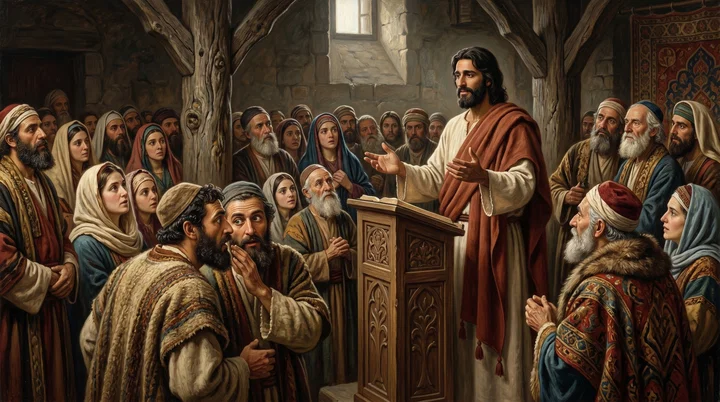
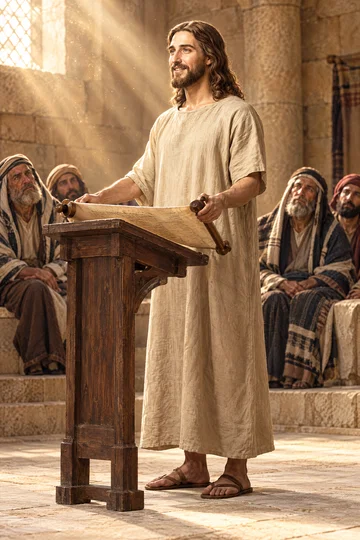
And he closed the book, and he gave it again to the minister, and sat down. And the eyes of all them that were in the synagogue were fastened on him.
Translations
American King James Version, King James Version, KJV Cambridge Paragraph Bible, Webster Bible
And he closed the book, and he gave it again to the minister, and sat down. And the eyes of all them that were in the synagogue were fastened on him.
Revised Version, American Standard Version
And he closed the book, and gave it back to the attendant, and sat down: and the eyes of all in the synagogue were fastened on him.
And having folded the roll, having given [it] back to the officer, he sat down, and the eyes of all in the synagogue were gazing on him.
And having rolled up the book, when he had delivered it up to the attendant, he sat down; and the eyes of all in the synagogue were fixed upon him.
And, folding up the scroll, he handed it to the attendant, and sat down; and, the eyes of all, in the synagogue, were intently fixed upon him;
Berean Standard Bible, Majority Standard Bible
Then He rolled up the scroll, returned it to the attendant, and sat down. The eyes of everyone in the synagogue were fixed on Him,
He closed the book, gave it back to the attendant, and sat down. The eyes of all in the synagogue were fastened on him.
And shutting the book he gave it back to the servant and took his seat: and the eyes of all in the Synagogue were fixed on him.
And hee closed the booke, and gaue it againe to the minister, and sate downe: and the eyes of all that were in the Synagogue were fastened on him.
Douay-Rheims (Challoner revision)
And when he had folded the book, he restored it to the minister, and sat down. And the eyes of all in the synagogue were fixed on him.
Pictures
Cross-references
- Isaiah 61:1-2
The Spirit of the Lord GOD is upon me; because the LORD hath anointed me to preach good tidings unto the meek; he hath sent me to bind up the brokenhearted, to proclaim liberty to the captives, and the opening of the prison to them that are bound;
Jesus read this prophecy in the synagogue and declared its promise fulfilled.
- Luke 4:28-30
And all they in the synagogue, when they heard these things, were filled with wrath,
The Nazareth crowd rejects Jesus and tries to cast him down, but he escapes.
- Acts 10:38
How God anointed Jesus of Nazareth with the Holy Ghost and with power: who went about doing good, and healing all that were oppressed of the devil; for God was with him.
Jesus’ ministry is connected with his anointing by the Holy Spirit.
- Isaiah 42:7
To open the blind eyes, to bring out the prisoners from the prison, and them that sit in darkness out of the prison house.
Promises sight and release for those imprisoned in darkness.
- Isaiah 61:2
To proclaim the acceptable year of the LORD, and the day of vengeance of our God; to comfort all that mourn;
Jesus stopped reading after the acceptable year, before the day of vengeance.
- Isaiah 58:6
Is not this the fast that I have chosen? to loose the bands of wickedness, to undo the heavy burdens, and to let the oppressed go free, and that ye break every yoke?
Both describe the Messiah’s work as freeing the oppressed.
- Luke 4:24
And he said, Verily I say unto you, No prophet is accepted in his own country.
Jesus says a prophet is dishonored in his own country.
- Luke 4:16
And he came to Nazareth, where he had been brought up: and, as his custom was, he went into the synagogue on the sabbath day, and stood up for to read.
Both describe Jesus’ Sabbath visit to the synagogue.
- Isaiah 49:8-9
Thus saith the LORD, In an acceptable time have I heard thee, and in a day of salvation have I helped thee: and I will preserve thee, and give thee for a covenant of the people, to establish the earth, to cause to inherit the desolate heritages;
Salvation and release for prisoners describe the day of grace.
- John 5:39
Search the scriptures; for in them ye think ye have eternal life: and they are they which testify of me.
both show Scriptures bear witness of Christ
Commentary
Each commentary is drawn from primary sources: the writings of Ellen G. White and Adventist pioneers and periodicals. Each commentary is separate. Its own words are not a quotation; follow the references to read the source passages.
Ellen G. White
48 sources
On the Sabbath in the Nazareth synagogue Jesus stood to read from the roll of Isaiah, then closed the scroll, gave it back to the attendant and sat down while every eye was fastened on Him in intent, expectant watching.LC1 53.2–54.1DA 236.1–21RED 53.2–57.1ST Jun 23, 1909Lt 51a, 1895, par. 5–8 What He had read was the Messiah's promise of Spirit-anointed good news, healing, deliverance and favor, and in closing the book He declared it fulfilled that day in their hearing as the Anointed One Himself.LC1 53.2–54.11RED 53.2–57.1ST Jun 23, 1909Lt 51a, 1895, par. 5–8Ms 105, 1898, par. 15–17 He thereby revealed His work as relieving the oppressed, liberating captives from evil, healing the afflicted, restoring sight to the blind and bringing the light of truth and salvation to body and soul.ST Jun 23, 19094RED 3.2–4.2DA 237.1–3SLP 229.1–230.2ST Jul 8, 1889 His manner and words at first thrilled the hearers with divine power and joy, but familiarity with His humble life and desire for deliverance from Rome turned them to unbelief, so they thrust Him out to the brow of the hill to destroy Him until angels guarded Him and He passed through their midst unharmed.1RED 53.2–57.1ST Jun 23, 1909Ms 7, 1884, par. 1–2Ms 55, 1886, par. 26–27ST Dec 16, 1897 That same announcement stands as the pattern for all who follow Him to preach to the poor, bind up the brokenhearted and proclaim liberty, and the fixed gaze of Nazareth warns against first welcoming gracious light and then hardening the heart in prejudice and pride to reject it.Lt 51a, 1895, par. 5–8Ms 105, 1898, par. 15–17Ms 7, 1884, par. 1–211MR 283.3–284.2Lt 4, 1894, par. 4–5
Synagogue Setting and Actions
On the Sabbath in the synagogue at Nazareth, during the service, Jesus stood up to read from the roll of Isaiah.DA 236.1–2ST Jun 23, 1909Ms 39, 1889, par. 2Lt 4, 1894, par. 4–5Ms 109, 1908, par. 14 After reading He closed the book or scroll, gave it back to the attendant or minister, and sat down.LC1 53.2–54.1DA 236.1–21RED 53.2–57.14RED 3.2–4.2ST Feb 17, 1881 The closing and returning of the roll and the sitting down came after the reading and before the declaration that followed.LC1 53.2–54.1DA 236.1–21RED 53.2–57.1ST Feb 17, 1881ST Feb 17, 1881
The eyes of all who were in the synagogue were fastened on Him as they watched Him intently with curious expectation.LC1 53.2–54.1DA 236.1–21RED 53.2–57.1Ms 12b, 1896, par. 5–712MR 182.2–183.2 Their fixed attention set the scene for His words and for the response that followed.LC1 53.2–54.1DA 236.1–21RED 53.2–57.112MR 182.2–183.2ST Feb 17, 1881 He stood before them as a living expositor and interpreter of the prophecies concerning Himself.ST Jun 23, 19094RED 3.2–4.2ST Feb 17, 1881LC1 55.1
Prophecy Read and Fulfilled
The portion read was Isaiah's prophecy understood as referring to the Messiah, promising good news and healing and deliverance together with the favor of the Lord.ST Jun 23, 1909DA 236.3–4ST Jul 8, 1889 It presented the Scriptures concerning His own mission, which He fulfilled by preaching good news to the poor and by healing and freeing those in need.ST Jun 23, 1909DA 236.3–4ST Jul 8, 1889
What was proclaimed was the Spirit-anointed preaching of the gospel to the poor, the healing of the brokenhearted, deliverance to the captives, recovering of sight to the blind, liberty to the bruised, and the acceptable year of the Lord.ST Jun 23, 1909Lt 51a, 1895, par. 5–8Ms 105, 1898, par. 15–17 The reading announced the Spirit of the Lord anointing Him to preach the gospel to the poor, heal the brokenhearted, preach deliverance to the captives, give sight to the blind, set at liberty the bruised, and preach the acceptable year of the Lord.ST Jun 23, 1909Lt 51a, 1895, par. 5–8Ms 105, 1898, par. 15–17
Closing the roll or book and returning it to the attendant and sitting down while all eyes were fastened on Him led directly into the declaration that the Scripture just read was fulfilled that day in their hearing.LC1 53.2–54.11RED 53.2–57.1Lt 51a, 1895, par. 5–8Ms 105, 1898, par. 15–174RED 3.2–4.2 In that moment He stood before them as a living expositor of the prophecies concerning Himself and presented Himself as the Anointed One and Messiah whose work is to bring good news to the poor, free captives, heal the afflicted, restore sight, and reveal the light of truth.ST Jun 23, 1909Ms 62, 1886, par. 60–644RED 3.2–4.2 Their fixed attention followed the reading of the prophecy about His mission as the Anointed One, and His authority and manner held them spellbound so that at first they responded with wonder and joy at His gracious words.1RED 53.2–57.1Ms 62, 1886, par. 60–64
Messiah's Work Revealed
Closing the roll and sitting down before the fixed gaze of the synagogue set the moment for explaining the Messiah as the reliever of the oppressed, the liberator of captives from evil, the healer of the afflicted, the restorer of sight to the blind, and the revealer of the light of truth to the world.ST Jun 23, 19094RED 3.2–4.2DA 237.1–3 That explanation presented Himself as the Anointed One in whom Isaiah's prophecy of Spirit-anointed preaching to the poor, healing the brokenhearted, deliverance to captives, sight to the blind, liberty to the bruised, and the Lord's favor was fulfilled that day.ST Jun 23, 19094RED 3.2–4.2 His exposition confronted the hearers with their own bondage, darkness, and need for truth and close examination of their deeds.DA 237.1–3
He was sent to comfort, bless, and save the sorrowing and sinful by preaching good news to the poor and by healing and freeing those in need.SLP 229.1–230.2ST Jul 8, 1889 In that mission He is Saviour of the body as well as of the soul.9MR 129.5–131.1 He came not only to console people, but also to restore and reprove them.Lt 81, 1896, par. 2–3 He came to represent the Father and to restore and uplift humanity with peace and happiness, standing in the world as the tree of life.Ms 136, 1899, par. 17–18 He revealed divine power by giving life to the dead and by restoring the sick and suffering to soundness and health, and His work stands opposite to Satan's work to condemn and destroy, to take away liberty and to destroy life.Ms 136, 1899, par. 17–18
His work was confined to a small circumference in Palestine and was not extended to the surrounding heathen nations.ST Dec 16, 1897Ms 50, 1897, par. 1 The heathen were not prepared for His work, and turning to them or devoting His time to the conversion of the Gentile world would have closed the door for bearing His message to the Jewish nation.ST Dec 16, 1897Ms 50, 1897, par. 1
Wonder Turning to Rejection
The closing of the roll and the fixing of every eye upon Him opened a moment of spellbound wonder, for His impressive manner and the wonderful import of His words thrilled the hearers with a power they had never felt before.1RED 53.2–57.1ST Jun 23, 1909DA 237.1–3 The tide of divine influence broke every barrier down, so that they beheld as it were the Invisible, and as their hearts were moved by the Holy Spirit they bore Him witness with wonder and joy.1RED 53.2–57.1ST Jun 23, 1909Ms 55, 1886, par. 26–27 They responded with fervent amens and praises to the Lord, wondering at the words of grace proceeding out of His mouth, held in conviction and peace and grace and hope that He was the promised Messiah.1RED 53.2–57.1ST Jun 23, 1909Ms 12b, 1896, par. 5–7
Their good impressions soon gave way to unbelief and doubt, and they questioned who He was.Ms 7, 1884, par. 1–2Ms 4, 1890, par. 13–161RED 57.2 Familiarity with His humble family and working life made them unwilling to believe His claim, and prejudice about His family turned them toward rejection.Ms 4, 1890, par. 13–161RED 57.2DA 237.4–238.1 They expected the Messiah to deliver them from Roman rule and to use His power for their benefit, and because He offered spiritual freedom instead, they recoiled from close examination of their deeds and hardened their hearts.Ms 7, 1884, par. 1–2DA 237.1–3DA 237.4–238.1 When He confronted their pride and bondage and darkness and spiritual apostasy, their appreciation gave way to rage.Ms 62, 1886, par. 60–64Ms 55, 1886, par. 26–27SLP 229.1–230.2
He showed that God had turned from rejecting Israel to favor believing Gentiles who accepted the light they had.AA 416.2–417.1SLP 229.1–230.2RH Sep 25, 1900 The widow of Sarepta and Naaman the Syrian had lived up to the light they received and were more righteous than backslidden Israelites who sacrificed principle for convenience and worldly honor.AA 416.2–417.1SLP 229.1–230.2 The people of Nazareth thought they loved Him, but when He showed that heaven's favor was not theirs alone and extended to Gentiles, they were filled with madness because they thought He reproved them for lack of piety and loyalty to God.Ms 55, 1886, par. 26–27RH Sep 25, 1900 Enraged by His reproof, they rose up and thrust Him out of the city and out of the synagogue to the brow of the hill on which the city was built, to cast Him down headlong and murder Him there.Ms 55, 1886, par. 26–27Lt 49, 1899, par. 6–10Ms 24, 1888, par. 11–15 The mob drove Him with no gentle hands and pushed Him hither and thither while quarreling among themselves how to stop His voice entirely.Ms 55, 1886, par. 26–27ST Dec 16, 1897Ms 50, 1897, par. 1
His time had not yet come and His mission was not ended, so heavenly angels guarded Him and held the eyes of the infuriated priests and elders.Ms 62, 1886, par. 60–64Ms 55, 1886, par. 26–27 By divine power He passed through their midst unharmed to carry on His work, until presently they lost sight of Him and He was gone they knew not where.Ms 55, 1886, par. 26–27ST Dec 16, 1897Ms 50, 1897, par. 1 God protected Him from harm from those enraged enough to throw Him from the precipice.Ms 62, 1886, par. 60–64Ms 24, 1888, par. 11–15Ms 50, 1897, par. 1 His reception at Nazareth, where He had spent His youth and early manhood, was so unfavorable that He made no stay there but left to seek more fruitful fields where ears would listen and hearts would receive His message.ST Feb 3, 18813RED 14.2–15.1ST Feb 1, 1877
He was driven from the people He had labored to save, unable to reach hearts blinded by prejudice and insane hatred who resolutely rejected the light.2SP 370.33RED 112.2DA 541.2–3 This was true despite His healing work and powerful teaching, and despite a life of self-denial and disinterested benevolence and purity and suffering and devotion, in which He was ever touched by human woe, healed the sick, restored sight to the blind and hearing to the deaf and speech to the dumb, fed the hungry, comforted the sorrowful, walked upon the billows and silenced their roaring, cast out devils, broke the slumbers of the dead, and held thousands entranced by words of wisdom.2SP 370.33RED 112.2DA 541.2–3 He left to carry on His work in cities more favorable to light and truth.Ms 55, 1886, par. 26–27 That scene in Nazareth later came vividly to the rulers' minds, when the Holy Spirit pressed on them the conviction that they were opposing God.DA 539.2
Pattern and Warning Today
The work announced when the book was closed is the pattern for all who fully follow Christ as co-laborers with Him and with God, doing the very same work of restoring the moral image of God in man.Ms 105, 1898, par. 15–17Lt 4, 1894, par. 4–5Ms 109, 1908, par. 14 That pattern is preaching good tidings to the meek and poor, binding up the brokenhearted, proclaiming liberty to the captives, and opening the prison to those who are bound.Ms 105, 1898, par. 15–17Lt 4, 1894, par. 4–5Ms 109, 1908, par. 14 The announcement rebukes valuing color or caste and shows the gospel is to be preached to the poor, for a Christianity that excludes people because of color is not the kind Christ accepts.STBk 159.1
The fixed attention of the men of Nazareth warns that there is just as much danger of rejecting truth today, with men closing hearts against Jesus while supposing to preserve dignity as free men with the right to think and act, to believe or doubt.11MR 283.3–284.2 Those who have taken the course of Nazareth in controversy must take heed lest after a first rejection they harden hearts in prejudice and pride against a second call of the divine Messenger, when after excitement and confusion are over He calls again with gracious light that would work for salvation.11MR 283.3–284.2 We are less excusable than the Jews, for we have before us their example of rejecting Christ and His apostles and have been warned not to fall after the same example of unbelief.11MR 283.3–284.2
The episode shows how people can first respond warmly under the Spirit to gracious words and feel convinced, and then resist light and promptings until good impressions give way to unbelief, doubt, prejudice, and pride.Ms 7, 1884, par. 1–2Lt 33, 1888, par. 19–24Lt 33a, 1888, par. 3–4Ms 4, 1890, par. 13–16 Initial attention did not prevent rejection when pointed words exposed spiritual condition and prejudice about His family arose, and the people of Nazareth opened hearts to unbelief until rejected light became a stumbling block rather than a blessing.Lt 33, 1888, par. 19–24Lt 33a, 1888, par. 3–4Ms 4, 1890, par. 13–16Ms 15, 1888, par. 38–40 To reject God's sent message not because it is error, to close eyes so as not to see and ears so as not to hear and darken understanding against conviction, is blindness smitten by the infatuation of the ruler of darkness, and it is dangerous to call the work of the Spirit of God the work of Satan.Lt 51a, 1895, par. 5–8
It shows that a faithful messenger can find no safety among people who reject his message, for they fail to value his work while their leaders lead away from obedience and leave them without God's protection in trouble.Ms 55, 1886, par. 26–27AA 416.2–417.1 The same enmity was in Catholic religious zealots who murdered the Vaudois, making them satanic in character, having the symbol of the cross without the spirit of Him who bore it.Ms 55, 1886, par. 26–27 The rejection at Nazareth teaches that lessons in God's Word apply to teachers' own conduct, and studying and understanding them benefits teachers and students, while neglecting lessons of eternal importance leaves teachers unfit to teach others.Ms 12b, 1896, par. 9 The closing of the book is also associated with Christ's example of watching for opportunities to work personally with people and draw them to study the Scriptures.Ms 21, 1910, par. 7
Sources
Pioneers and periodicals
67 sources
On the Sabbath at Nazareth at the beginning of His ministry, Jesus stood to read from the roll of Isaiah and then closed the book, gave it back to the attendant, and sat down to teach, sitting being the posture for teaching and standing the posture for reading.ST Mar 31, 1914ST Mar 22, 1899ST Aug 12, 1897 The eyes of all in the synagogue were fastened upon Him in fixed and expectant attention for what He would say next.ST Mar 31, 1914ST Mar 22, 1899 He had stopped deliberately in the middle of the prophecy after the acceptable year of the Lord, leaving unread the day of vengeance of our God because that wrath was not due in His first coming but reserved for fulfillment just before His second coming.ST Sep 16, 1886ST Sep 2, 1875ST Jan 13, 1887ST Jul 30, 1902ST Oct 28, 1913 What He read He declared fulfilled that day in their hearing, announcing Himself as the Spirit-anointed Messiah sent to preach to the poor, heal the brokenhearted, free the captives of sin, give sight to the blind, and proclaim the Jubilee of grace.ST Mar 31, 1914RH Oct 8, 1861ST Aug 12, 1897ST Nov 20, 1884 His keeping of the Sabbath for worship, reading Scripture, and works of preaching, healing, and freeing is the model for Sabbath-keeping, and His stopping point teaches that prophecy must be divided according to time, using only the portion that applies to the present subject.ST Aug 22, 1916RH Jan 10, 1856ST Jan 9, 1896
Synagogue Setting and Actions
It was the Sabbath day in the synagogue at Nazareth, where Jesus attended according to His custom, at the beginning of His ministry after His baptism and wilderness temptation.ST Mar 22, 1899ST Mar 16, 1904GSAM 61.4–62.1 Having stood up to read from the roll of Isaiah the prophecy of the Spirit's anointing to preach good tidings to the poor, heal the brokenhearted, proclaim release and liberty to captives, give sight to the blind, free the bruised, and proclaim the acceptable year of the Lord, He finished that reading and declared the scripture fulfilled that day in their hearing.ST Mar 31, 1914ST Mar 22, 1899GSAM 61.4–62.1 This reading and declaration mark the beginning of His work as the Anointed One, and provide the setting for His teaching and for the people's rejection of Him, since people may be slow to recognize a familiar person as called by God to an exalted position or great work.ST Mar 16, 1904GSAM 61.4–62.1
Having finished, He closed the book or roll, gave it back to the attendant or minister, and sat down in the teacher's place.ST Mar 31, 1914ST Mar 22, 1899ST Aug 12, 1897STST Jan 9, 1896 Reading was done standing and teaching was done sitting, so His sitting down was to give the discourse after reading.ST Mar 22, 1899ST Jan 9, 1896 The eyes of all in the synagogue were fastened on Him in close, fixed, expectant and curious attention for what He would say next.ST Mar 31, 1914ST Mar 22, 1899ST Aug 12, 1897ST Jan 9, 1896 That intent gaze was heightened because the text was unusual and because He had stopped abruptly, and it leads directly into His declaration that the scripture was being fulfilled that day.ST Mar 31, 1914STST Jan 9, 1896
He stood before them as a living expositor of the prophecies concerning Himself, explaining the Messiah as reliever of the oppressed, liberator of captives, healer of the afflicted, restorer of sight to the blind, and revealer of the light of truth to the world.ST Jun 23, 1909ST Feb 17, 1881 His impressive manner and the wonderful import of His words thrilled the hearers with a power they had never felt before, and the tide of divine influence broke every barrier down so that like Moses they beheld the Invisible.ST Jun 23, 1909 As their hearts were moved by the Holy Spirit they responded with fervent amens and praises to the Lord, bearing Him witness and wondering at the gracious words proceeding out of His mouth.ST Jun 23, 1909 The synagogue at Nazareth where He stood up to read on the Sabbath is still pointed out by its remains in the town.ST May 19, 1898
Divided Prophecy Reading
He closed the roll in the very middle of Isaiah 61:2, in the middle of the verse and even in the middle of the sentence, after to proclaim the acceptable year of the Lord and before and the day of vengeance of our God, leaving that clause unread and sitting down.ST Sep 16, 1886ST Sep 2, 1875ST Oct 28, 1913ST Jan 9, 1896 What He read He declared fulfilled, while the following clause about God's day of vengeance He left for fulfillment just before His second coming.ST Jul 30, 1902ST Oct 29, 1902 The first portion was fulfilled in His own ministry and the latter part was left unfulfilled until the last days and the last message.ST Jan 9, 1896
He stopped there because that vengeance had not yet come and was not then applicable or due during His earthly ministry.ST Sep 16, 1886ST Oct 28, 1913ST Sep 24, 1894ST Sep 27, 1910 It was not the burden of His preaching and not the special subject of proclamation at that time, for only the acceptable year was then having its fulfillment and was then present truth to be proclaimed.ST Sep 16, 1886ST Sep 2, 1875 The period of judgment and vengeance was still hundreds of years in the future.ST Sep 2, 1875 His first coming was not the day of the Lord in which wrath is revealed.ST Jan 9, 1896
What He read belonged to and was being fulfilled during His ministry in the day of grace, or day of salvation.ST Sep 2, 1875ST Jan 13, 1887 The opening of the prison therefore belongs to that time, not to the later resurrection of the dead.ST Jan 13, 1887 The unread part about the day of vengeance or judgment was reserved for future fulfillment just before His second coming and in the last days.ST Jul 30, 1902ST Oct 29, 1902 Jesus declared the portion He had read fulfilled that day, while the next clause was reserved for future fulfillment.
Closing the book in that place cut the message in two and divided the prophecy of salvation in two.ST Jan 9, 1896 Prophetic passages can concern events separated by time and must be divided according to when each part applies.ST Sep 24, 1894ST Sep 27, 1910 The part read, ending with the acceptable year of the Lord, was fulfilled in Christ's work on earth, while the part unread, the day of vengeance of our God, could not have its full application then.ST Jan 9, 1896
His example models rightly dividing the word of truth by using only the portion of Scripture that applies to the subject at hand and that bears on the chosen lesson.ST Sep 16, 1886ST Mar 19, 1885 He read Isaiah 61:1-2 to impress one certain truth and then deliberately stopped in the middle of a sentence because the remainder referred to a different matter He did not intend to teach on that occasion.ST Mar 19, 1885 Teachers of the word should follow that example, guided by what the Bible says rather than what men say, as when teaching about the Sabbath.ST Sep 16, 1886 Sticking to the lesson in hand holds even though the omitted part concerns a subject of great importance taught at other times.ST Mar 19, 1885 His stopping at that point rightly divided the message according to its appointed time.ST Sep 24, 1894
The omitted part must still be preached at its proper time, before it actually comes when it would be too late.ST Sep 2, 1875ST Sep 2, 1875 At its proper time the day of vengeance shall be preached as well as the acceptable year, as a closing gospel message and the closing message given by His people on earth preparatory to the final scenes of history.ST Sep 2, 1875ST Jan 9, 1896 That closing work is identified with the angel's later announcement in Revelation 14, reserved for the first angel's message that the hour of God's judgment has come.RH Feb 23, 1860RH Nov 24, 1874 Just before Christ comes His representatives are also to warn that God's day of wrath is near.ST Sep 24, 1894 It is a merciful warning of the near approach of the great day of wrath, proclaiming coming wrath in time for men to escape it by repentance and reformation.ST Sep 2, 1875ST Sep 2, 1875
Mission of the Anointed
The reading announces His Spirit-anointed mission as Messiah: to preach good tidings to the poor and meek, heal the brokenhearted, proclaim deliverance and liberty to captives, give sight to the blind, free the bruised, open the prison to the bound, and proclaim the acceptable year of the Lord understood as Jubilee.ST Jun 23, 1909ST Mar 22, 1899RH Oct 8, 1861ST Nov 20, 1884 That reading is His public application of Isaiah's prophecy to Himself and His work of preaching good news, healing the brokenhearted, freeing captives, and proclaiming the Lord's acceptable year.ST Jun 23, 1909RH Sep 9, 1902 That mission presents Him as reliever of the oppressed, liberator of captives, healer of the afflicted, restorer of sight to the blind, and revealer of the light of truth to the world.ST Jun 23, 1909 He is Saviour bringing salvation from sin, which is transgression of the law, representing the Father to restore and uplift people and bring peace and happiness, shown in giving life to the dead and restoring the sick and suffering to health.RH Feb 14, 1854
The captives, prisoners, and bound are all sinners held in spiritual darkness and bondage to sin and transgression of God's law, not disembodied spirits after death.ST Nov 20, 1884ST Nov 30, 1915RH Jun 18, 1872 The prison is a figure for imprisonment in darkness, error, and the dominion of sin, and true liberty is walking in God's precepts and belongs only to His servants, while those overcome by sin are servants of corruption and sin, struggling to escape its cruel bondage.ST Nov 20, 1884RH Jun 18, 1872 Through faith in Christ sinners may receive that liberty, for the Spirit presses the claims of the law on the heart and abides with those who repent and accept truth and the way of truth.ST Nov 20, 1884 In the same way in Noah's time when the wickedness of man was great, the Spirit through Noah's preaching strove with the disobedient while they were still alive in the prison of sin to bring them to repentance and true liberty.ST Nov 20, 1884ST Nov 30, 1915
That commission defines His kingdom as opposing slavery and oppression and affirming the dignity and equality of all people.RH Oct 8, 1861 It proclaims a liberty of the gospel that offends existing earthly government.ST Feb 27, 1893 The proclamation of mercy and love at Nazareth is also to and for people today, and the power in His spoken word then has never left that word through the centuries, so the same message comes with the same power now to be read, believed, and appropriated.ST Mar 12, 1896
Prophetic Fulfillment in Time
The fixed gaze of the congregation leads directly into His declaration that the Scripture He had just read was fulfilled that very day in their hearing, His open public application of Isaiah's prophecy to Himself and to His work of preaching good news, healing the brokenhearted, freeing captives and proclaiming the acceptable year of the Lord.ST Mar 31, 1914ST Aug 12, 1897STRH Sep 9, 1902 After finishing the reading of the Spirit's anointing to preach to the poor, release captives, give sight to the blind, free the bruised and proclaim the acceptable year, He returned the scroll and sat down to teach while all looked intently at Him before He spoke.ST Aug 12, 1897ST That preaching of the gospel and announcement of Himself as the Anointed One is a sign of His first advent and evidence that He was the promised Messiah.RH Jan 11, 1870ST Jan 9, 1879ST Jan 8, 1880RH Aug 11, 1853RH Apr 17, 1855 The reading announced that He was anointed to preach the gospel, and His declaration that it was fulfilled in their hearing made His gospel preaching itself the proof that prophecy concerning His work was being fulfilled before the people.RH Jan 11, 1870ST Jan 9, 1879ST Jan 8, 1880RH Apr 17, 1855RH Mar 17, 1859
The scene marks the beginning of His ministry as the Anointed One, for Messiah means the anointed one, anointed by the Holy Spirit and power at His baptism when the Spirit descended as a dove and God's voice proclaimed Him His beloved Son.GSAM 61.4–62.1ST Aug 8, 1878RH Dec 10, 1908ST Feb 7, 1906ST Nov 13, 1879 That anointing made Him Messiah the Prince, and going forth preaching that the time is fulfilled fulfills to the letter the angel's word.ST Aug 8, 1878RH Dec 10, 1908ST Feb 7, 1906 That beginning occurred when He was thirty years old in the fall of A.D. 27, immediately after His baptism, at the end of the sixty-nine prophetic weeks or 483 years from the decree to restore Jerusalem in 457 B.C. as foretold in Daniel 9:25.ST Aug 31, 1915RH Feb 17, 1874RH Dec 10, 1908ST Oct 22, 1874RH Mar 10, 1874 His reaching thirty by 27 A.D. is explained by the Christian era being fixed four years too late, and His announcement that the prophetic time had been fulfilled identifies His baptism with the Holy Spirit and power as His anointing and marks the predicted time of the Messiah's revealing.ST Aug 31, 1915ST Aug 8, 1878RH Mar 10, 1874
The prophecy's endpoint is His anointing and the start of His ministry, not His birth.RH Feb 17, 1874ST Aug 8, 1878ST Jan 18, 1883 His earlier work leading up to the Galilean preaching, calling of disciples, teaching in synagogues and healing recorded in Matthew 4:17-25 belongs to the second year of His ministry in A.D. 28 when He was between 31 and 32 years old.ST Jan 18, 1883ST Dec 23, 1897 By reading Isaiah and declaring it fulfilled in Himself, He proves the Old Testament is an organic whole with one common prophetic intent centered on Christ Himself.ST Feb 15, 1883 The Scriptures bear witness of Him so that all things written in Moses, the prophets and the Psalms concerning Him must be fulfilled, and He applies Isaiah's words to Himself rather than to a future David ruling literal Israel.ST Feb 15, 1883
The episode shows the gospel had begun before Pentecost, not on Pentecost, for His synagogue reading fulfilled Isaiah's prophecy about the beginning of the gospel.RH Feb 18, 1873RH Jan 17, 1871 The gospel is made up of distinct parts or proclamations, each belonging to the gospel with God's authority so that rejecting any part is rejecting the Saviour's work.RH Feb 18, 1873RH Jan 17, 1871 Luke records this early history of the mission of Jesus, including His temptation and ministry at Nazareth about six months later, more fully than any other evangelist.ST Mar 17, 1909
Sabbath Law and Liberty
Attending Sabbath worship in the synagogue was His custom, where the Old Testament Scriptures were read and made the basis of teaching, which He interpreted with true understanding and unfolded before the people.ST Sep 15, 1887 That custom of attending and taking part in the Sabbath services proves He was a faithful Sabbath keeper who kept His Father's commandments, including the fourth commandment.ST Aug 22, 1916 He continually used the Sabbath to instruct the people concerning proper Sabbath observance and to show His regard for the day by teaching there.ST Aug 22, 1916ST Sep 15, 1887 His teaching in that Sabbath synagogue worship upheld rather than changed God's law.RH Jan 10, 1856
His Sabbath ministry is the model for Sabbath-keeping, showing that it means serving God through Spirit-empowered work rather than idleness or outward observance compelled by civil law.RH Apr 3, 1900 That work is preaching good news, healing, freeing, and helping people, as announced when Isaiah's words were declared fulfilled that day while the people gave fixed attention.RH Apr 3, 1900
That declaring fulfilled of Isaiah's message of hope means the message is carried out and brought more fully to people in need, not abolished, for He came to preach good news to the poor and those bound by sin.ST Oct 23, 1893 In the same way, His fulfilling the law does not abolish it but carries it out.ST Oct 23, 1893 His reading in the synagogue at Nazareth on the Sabbath therefore shows His teaching upheld rather than changed God's law.RH Jan 10, 1856
Rejection and Present Application
The moment when the book was returned and all eyes were fixed is the setting both for teaching and for rejection by His own townspeople at Nazareth.ST Mar 16, 1904ST Jun 20, 1900ST Dec 17, 1894 Those who had known Him from childhood were reluctant to honor Him as a prophet, and after first bearing Him witness they were enraged, drove Him out, took Him to the brow of the hill to destroy Him, and put Him out of the town.ST Dec 16, 1897ST Feb 1, 1905RH Aug 17, 1876 He made no stay there but left to seek more fruitful fields, and He did not return there when He came again into Galilee.ST Feb 1, 1905RH Aug 17, 1876 People are slow to recognize a familiar person as called by God to an exalted position or great work.ST Mar 16, 1904
In Nazareth Jewish prejudice was strong and His reception unfavorable.ST Dec 16, 1897 He had not received instruction from the religious teachers of the nation, yet He showed perfect knowledge of the Scriptures and of the Jewish economy, which displeased the people.ST Dec 16, 1897 When He showed that heaven's favor was not theirs alone but extended to outsiders and Gentiles, and that God could more safely show healing mercy to outsiders than to His own people in their sinful unbelief, they rejected Him.RH Sep 25, 1900ST Jun 20, 1900 One discourse there so enraged the synagogue leaders that they would have killed Him if divine power had not saved Him.ST Dec 16, 1897ST Jun 20, 1900 Surrounded by religious enemies He was driven by the mob out of the synagogue and pushed hither and thither while they quarreled among themselves how to stop His voice entirely, until presently they lost sight of Him and He was gone they knew not whither.ST Dec 16, 1897
From His entering on His office in the synagogue until He expired on the cross His work was an uninterrupted scene of controversy.ST Apr 1, 1889ST May 27, 1913 His censures in that controversy were directed not only against false doctrines but against the supporters of false principles themselves.ST May 27, 1913 His work was then confined to a small circumference in Palestine and not extended to the surrounding heathen nations because they were not prepared for His work and turning to them would have closed the door for bearing His message to the Jewish nation.ST Dec 16, 1897 At Nazareth He lived among sinful people and endured sorrow and hatred yet hated no one in return.RH Nov 12, 1872 His human heart longed for human sympathy, most of all sympathy from His own church and home at Nazareth, His own little church where He stood up and read.ST Sep 12, 1916
Instead He found there no place to worship, no loving hands to provide the comforts of life, and no brotherly welcome to make His pilgrim life happier, leaving Him out of His place among His own.ST Sep 12, 1916 He had no fit place to be born, no place to live in love and sympathy among His brethren, and no home comfort in death, but grew up, lived, labored and died out of His place. Willingly leaving heaven He entered earth's dark back door to be born in poverty between two oxen, was rejected of men and treacherously wounded in the house of His friends, and died at last on a bleak hilltop outside the city, crucified between two thieves. The event proves that not one village in the country wanted Him then, and not one town or village under the sun wants Him now.RH Aug 17, 1876 His path warns that His followers will not always be met by eager, welcoming crowds but will face undeserved hostility.ST Mar 2, 1915
Sources