Luke 9:41
And Jesus answering said, O faithless and perverse generation, how long shall I be with you, and suffer you? Bring thy son hither.
Translations
And Jesus answering said, O faithless and perverse generation, how long shall I be with you, and suffer you? Bring your son here.
King James Version, KJV Cambridge Paragraph Bible
And Jesus answering said, O faithless and perverse generation, how long shall I be with you, and suffer you? Bring thy son hither.
And Jesus answering, said, O faithless and perverse generation, how long shall I be with you, and suffer you? Bring thy son hither.
Revised Version, American Standard Version
And Jesus answered and said, O faithless and perverse generation, how long shall I be with you, and bear with you? bring hither thy son.
And Jesus answering said, 'O generation, unstedfast and perverse, till when shall I be with you, and suffer you? bring near hither thy son;'
And Jesus answering said, O unbelieving and perverted generation, how long shall I be with you and suffer you? Bring hither thy son.
And, making answer, Jesus said—O faithless and perverted generation! how long shall I be with you, and bear with you? Bring, hither, thy son.
Berean Standard Bible, Majority Standard Bible
“ O unbelieving and perverse generation!” Jesus replied. “ How long must I remain with you and put up with you? Bring your son here.”
Jesus answered, “Faithless and perverse generation, how long shall I be with you and bear with you? Bring your son here.”
And Jesus said, O generation without faith and false in heart, how long will I have to be with you and put up with you? let your son come here.
Then Iesus answered, and said, O generation faithlesse, and crooked, howe long now shall I be with you, and suffer you? bring thy sonne hither.
Douay-Rheims (Challoner revision)
And Jesus answering, said: O faithless and perverse generation, how long shall I be with you, and suffer you? Bring hither thy son.
Pictures
Cross-references
- Mark 9:19-27
He answereth him, and saith, O faithless generation, how long shall I be with you? how long shall I suffer you? bring him unto me.
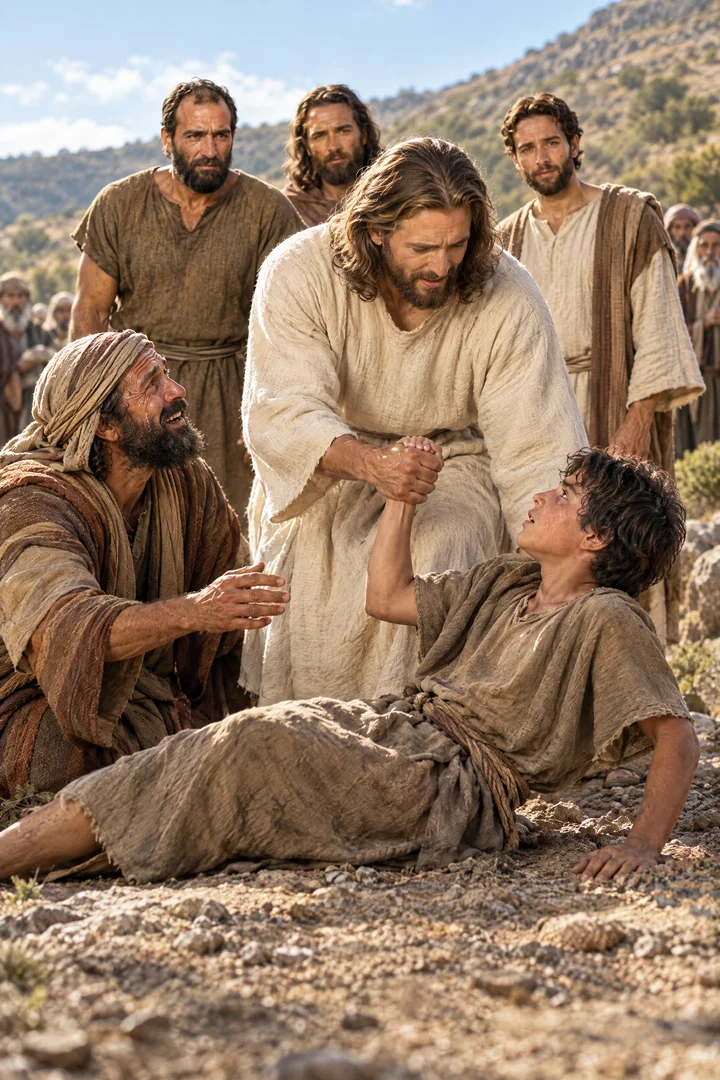
Jesus rebukes the faithless generation and commands that the afflicted boy be brought to him.
- Matthew 17:14-18
And when they were come to the multitude, there came to him a certain man, kneeling down to him, and saying,
Jesus rebukes the disciples’ faithlessness and heals the afflicted boy.
- Mark 9:29
And he said unto them, This kind can come forth by nothing, but by prayer and fasting.
Deliverance is connected with prayer.
- Luke 9:1
Then he called his twelve disciples together, and gave them power and authority over all devils, and to cure diseases.
Jesus had given the disciples authority over demons and diseases.
Commentary
Each commentary is drawn from primary sources: the writings of Ellen G. White and Adventist pioneers and periodicals. Each commentary is separate. Its own words are not a quotation; follow the references to read the source passages.
Ellen G. White
7 sources
The verse belongs to the scene just after the transfiguration, when Jesus comes down from the mountain to meet people in need, including a boy suffering under Satan's enslaving power.2SP 336.1DA 429.2–430.1ST Jan 22, 1902 The immediate occasion is the disciples' failure to cast out the spirit afflicting the boy, a defeat the scribes use to discredit both the disciples and Jesus.DA 426.3–427.2 In response Jesus sorrowfully grieves over and rebukes the unbelief, faithlessness, failure and perversity of the generation around Him, including the scribes and His perplexed disciples.DA 426.3–427.2DA 426DA 427.3–6 He then tells the distressed father to bring his son to Him.DA 426.3–427.2DA 426DA 427.3–6
Jesus stoops to lift the child from the ground, frees him forever from the demon, and restores him to his father whole in mind and body.2SP 336.1DA 429.2–430.1 That stooping to lift and restore pictures redemption as the Divine One stooping to save the lost.DA 429.2–430.1 The scene calls those who have seen Christ's glory to self-sacrificing service among needy souls enslaved by Satan, where their faith and prayer can help set the enslaved free.DA 429.2–430.1ST Jan 22, 1902
He spoke these words while reflecting light in the world when the time was nearly come for Him to be taken away, wanting His hearers to remember all He had said so they would stand firm when trials and persecutions come everywhere.Ms 72, 1911, par. 1–5 The verse belongs to the teaching of Luke 9:26-62, which must be studied to get its meaning with hearts in full harmony with Christ and intelligent understanding of His work.Ms 72, 1911, par. 1–5 Knowing Him in this way brings a continual increase of light, with His going forth prepared as the morning.Ms 72, 1911, par. 1–5
Sources
Pioneers and periodicals
14 sources
Jesus spoke these words just after coming down from the transfiguration mountain to a waiting crowd, when the disciples had failed to heal an afflicted, demon-possessed boy and He called for the child to be brought to Him for healing.ST Sep 27, 1910ST Jul 12, 1899ST Mar 31, 1898ST Oct 5, 1904 His rebuke grieved a lack of faith among people who had God's promises and repeated proofs of His help, yet He did not turn away but remained willing to help the suffering boy and his burdened father.ST Aug 16, 1905 The disciples' failure exposed unbelief that left them without courage and trust in Christ's power, tied to neglected prayer and watchfulness and to ambition and jealousy, showing that victory over evil requires dependence on God.RH Nov 30, 1911 Coming down from communion with His Father on the mountain to work among unbelief and suffering in the valley, He showed that power to help the demon-tormented below belongs to those who have been with Christ above, since nearness to God brings nearness to men in their need.ST Jun 13, 1900ST Dec 17, 1896RH Jan 4, 1912 The glory seen on the mount therefore calls His followers to self-sacrificing service on the plain, where souls enslaved by Satan wait to be set free through faith and prayer.ST Jan 22, 1902ST Oct 8, 1902RH Mar 7, 1912ST May 8, 1901
Setting and Rebuke
The saying belongs to Luke's account of the transfiguration and of the events that immediately follow it.ST Mar 31, 1898ST Oct 5, 1904 It stands in the scene after the transfiguration, when Jesus descends from the mountain to face the crowd and the demon-possessed boy.ST Oct 5, 1904 It marks the abrupt move from mountaintop experience to difficult work among people in need.ST Oct 5, 1904
It is part of the account of Jesus healing an epileptic, afflicted boy.ST Sep 27, 1910ST Jul 12, 1899 After the disciples fail to heal him, Jesus rebukes the faithless, perverse generation and then directs that the boy be brought to him.ST Jul 12, 1899 The rebuke shows Jesus grieving over lack of faith when the people had God's Word, its promises, and repeated proof of God's help.ST Aug 16, 1905 Even so, he does not turn away from the afflicted boy or his burdened father but remains willing to help them.ST Aug 16, 1905
The saying confronts the disciples' failure to cast out the demon, for their lack of faith left them unable to meet the evil spirit with courage or trust in Christ's power.RH Nov 30, 1911 Their failure was connected with neglecting prayer and watchfulness and with ambition and jealousy, showing that spiritual victory requires dependence on God.RH Nov 30, 1911 The surrounding passage is an example of Satan torturing his own subjects.ST Oct 8, 1902 It connects severe affliction with the possible involvement of an unclean spirit that is overcome by prayer and Jesus' authority bringing deliverance.RH Mar 7, 1912 The account of the relapsing demoniac to which the saying belongs is a parable against the Jews, showing that they have no peculiar blessings in reserve for them.RH Sep 9, 1858
From Mountain to Service
Luke 9:41 belongs to what happens right after the mountain experience, when the disciples have just heard the Teacher's voice and the accents of immortals while demon-tormented sufferers are waiting below for help, so the verse stands in the movement from spiritual blessing on the mountain to service for sufferers on the plain.ST Dec 17, 1896 After Jesus and the disciples come down they meet at the foot a multitude that includes the sick and the demon-possessed, showing that the transfiguration did not end human suffering or the need for help and that Christ and His disciples had to return to serve people in need.RH Jan 4, 1912 The verse shows Jesus coming down from communing with His Father in prayer on the mountain to work for man in the valley, there meeting unbelief and casting out the evil spirit from the boy.ST Jun 13, 1900
Power to cast out evil spirits at the foot of the mount belongs to those who have been with Christ on the mount, because nearness to God's heart brings nearness to men and their need.ST Jun 13, 1900 Indifference in Christian service comes from ignorance and dim vision, while conviction is born of knowledge and actual sight, seeing man as God sees him in his sin, need and peril, with passion for service born only in sight of the cross that reveals and measures the world's need.ST Jun 13, 1900 The glory of Christ's life is given in service to those in need, and the scene after the transfiguration, when Jesus comes down to a needy, demon-haunted multitude, points to the labor of saving souls.ST May 8, 1901 The plain below has souls enslaved by Satan waiting for faith and prayer to set them free, and seeing Christ's glory calls His disciples to serve them with self-sacrificing love.ST Jan 22, 1902
Sources