Mark 9:19
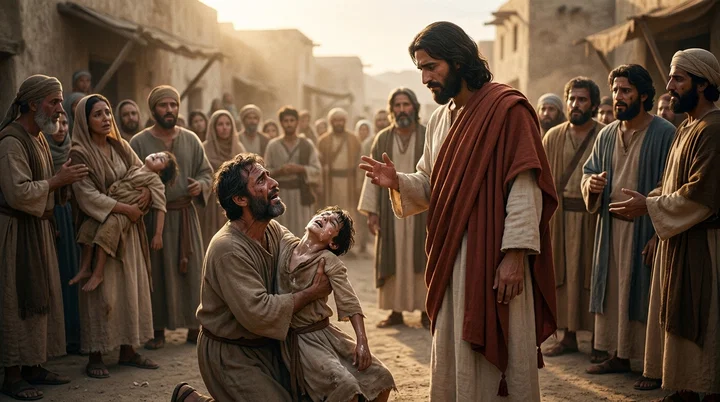
He answereth him, and saith, O faithless generation, how long shall I be with you? how long shall I suffer you? bring him unto me.
Translations
He answers him, and says, O faithless generation, how long shall I be with you? how long shall I suffer you? bring him to me.
King James Version, KJV Cambridge Paragraph Bible
He answereth him, and saith, O faithless generation, how long shall I be with you? how long shall I suffer you? bring him unto me.
He answered him, and saith, O faithless generation, how long shall I be with you, how long shall I suffer you? bring him to me.
Revised Version, American Standard Version
And he answereth them and saith, O faithless generation, how long shall I be with you? how long shall I bear with you? bring him unto me.
And he answering him, said, 'O generation unbelieving, till when shall I be with you? till when shall I suffer you? bring him unto me;'
But he answering them says, O unbelieving generation! how long shall I be with you? how long shall I bear with you? bring him to me.
But, he, answering, saith—O faithless generation! how long, shall I be with you? how long, shall I bear with you? Bring him unto me!
Berean Standard Bible, Majority Standard Bible
“ O unbelieving generation!” Jesus replied. “ How long must I remain with you? How long must I put up with you? Bring the boy to Me.”
He answered him, “Unbelieving generation, how long shall I be with you? How long shall I bear with you? Bring him to me.”
And he said to them in answer, O generation without faith, how long will I have to be with you? how long will I put up with you? let him come to me.
Then he answered him, and said, O faithlesse generation, how long now shall I be with you! how long now shall I suffer you! Bring him vnto me.
Douay-Rheims (Challoner revision)
Who answering them, said: O incredulous generation, how long shall I be with you? how long shall I suffer you? bring him unto me.
Pictures
Cross-references
- Matthew 17:17
Then Jesus answered and said, O faithless and perverse generation, how long shall I be with you? how long shall I suffer you? bring him hither to me.
Jesus rebukes the faithless generation and commands them to bring the boy to him.
- Luke 9:37-43
And it came to pass, that on the next day, when they were come down from the hill, much people met him.
Parallel account of Jesus’ rebuke, the boy’s affliction, and his healing.
- Mark 9:23-24
Jesus said unto him, If thou canst believe, all things are possible to him that believeth.
Jesus calls for belief, and the father asks for help with his unbelief.
- Mark 9:25-27
When Jesus saw that the people came running together, he rebuked the foul spirit, saying unto him, Thou dumb and deaf spirit, I charge thee, come out of him, and enter no more into him.
Jesus casts out the spirit and restores the boy.
- Mark 9:29
And he said unto them, This kind can come forth by nothing, but by prayer and fasting.
Jesus explains the disciples’ failure through their need for prayer and fasting.
- Matthew 17:20
And Jesus said unto them, Because of your unbelief: for verily I say unto you, If ye have faith as a grain of mustard seed, ye shall say unto this mountain, Remove hence to yonder place; and it shall remove; and nothing shall be impossible unto you.
Jesus explains the disciples’ failure by their little faith.
- Matthew 17:15
Lord, have mercy on my son: for he is lunatick, and sore vexed: for ofttimes he falleth into the fire, and oft into the water.
Describes the boy thrown into fire and water.
- Matthew 17:1-9
And after six days Jesus taketh Peter, James, and John his brother, and bringeth them up into an high mountain apart,
parallel account to section containing verse
- Luke 9:39
And, lo, a spirit taketh him, and he suddenly crieth out; and it teareth him that he foameth again, and bruising him hardly departeth from him.
Describes the spirit’s seizures of the boy.
- Mark 9:2-8
And after six days Jesus taketh with him Peter, and James, and John, and leadeth them up into an high mountain apart by themselves: and he was transfigured before them.
The mountain experience precedes the waiting sufferers below.
Commentary
Each commentary is drawn from primary sources: the writings of Ellen G. White and Adventist pioneers and periodicals. Each commentary is separate. Its own words are not a quotation; follow the references to read the source passages.
Ellen G. White
17 sources
Coming down from the glory of the transfiguration, Jesus meets His remaining disciples defeated in their attempt to free a youth tormented by a deaf and dumb spirit under Satan's power.DA 426.1–24SP 334.1GC88 515.22SP 336.1 His rebuke of a faithless generation answers the unbelief He reads in the perplexed disciples, the doubting multitude, and the challenging scribes gathered around the afflicted boy.2SP 333.1–2DA 428.1–5ST Jun 7, 1877 His questions of how long He shall be with them and suffer them express His sorrowful grief at having to endure their lack of faith and trust.DA 426.3–427.2DA 428.1–5ST Jun 7, 1877 His command to bring the boy to Him calls the father and the crowd to bring the helpless sufferer to Him for deliverance.DA 426.1–22SP 333.1–2DA 426.3–427.2 That deliverance reveals an open conflict between the Prince of life and the prince of darkness in which His compassion and power are complete, yet the healing waits on faith entrusted to His mercy, and He frees the victim forever and restores him whole to his father.4SP 334.1GC88 515.2DA 428.1–5ST Jan 20, 19044MR 177.3–180.1
Setting and Rebuke
The words were spoken just after Jesus came down with three disciples from the mountain of transfiguration to meet the disciples left behind who had failed to free a boy from an evil spirit.DA 426.1–22SP 336.1 On that mountain He had been glorified, had talked with messengers of heaven, and had been proclaimed the Son of God by the Father's voice from radiant glory.2SP 336.1 In a brief space the extremes of glory and grief met, for the mighty Redeemer glorified only a few short hours before now stood before suffering on the plain.2SP 336.1
The sufferer was a youth held under Satan's power by a dumb and deaf spirit.4SP 334.1GC88 515.2GC 515.2 He is described as a lunatic child with distorted countenance, gnashing his teeth in spasms of agony which no mortal could relieve.2SP 336.1 The spirit repeatedly threw him into fire and water to destroy him.4SP 334.1GC88 515.2GC 515.2
The rebuke of the faithless generation answered the disciples' failure, the doubts, ridicule and confusion of the people, and the boasting challenge of the caviling scribes.2SP 333.1–2ST Jun 7, 18773RED 125.23RED 122.2–3 He read unbelief in every heart of the awe-stricken multitude, the scribes, and the perplexed disciples.DA 428.1–5DA 427.3–6 His questions how long He shall be with them and suffer them sorrowfully expressed His grief at having to endure their lack of faith and trust.DA 426.3–427.2DA 428.1–5ST Jun 7, 18773RED 122.2–3DA 427.3–6 Then His command to bring him to Him told the group and the distressed father to bring the afflicted boy to Jesus for deliverance.DA 426.1–22SP 333.1–2DA 428.1–5ST Jun 7, 18773RED 125.2
Deliverance Through Faith
When the boy is brought, open battle is joined between the Prince of life, come to proclaim release to captives and set the bruised free, and the prince of darkness seeking to hold his victim.DA 428.1–5 Angels of light and hosts of evil angels press near unseen to behold the conflict.DA 428.1–5 For a moment Jesus permits the evil spirit to display its power, violently throwing the boy down and tearing him, leaving him wallowing in convulsions and foaming with unearthly shrieks, so that beholders comprehend the deliverance about to be wrought.DA 428.1–54MR 177.3–180.1
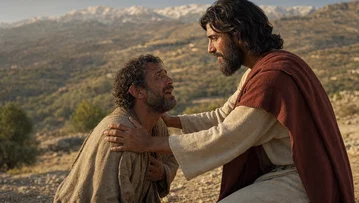
There is no lack of power on His part, for the healing reveals His compassion and power to heal a youth tormented by a dumb spirit that repeatedly threw him into fire and water to destroy him.4SP 334.1GC88 515.2GC 515.2DA 428.1–5 The healing waits on faith, and by His word of command He orders the dumb and deaf demon to leave its victim, torment him no further, and frees him forever.4SP 334.1GC 515.2DA 428.1–5 He stoops to lift this victim of Satan from the ground where he is wallowing, takes him by the hand and raises him in perfect soundness of mind and body, showing the Divine One stooping to save the lost and restoring him to his father.DA 428.1–52SP 336.1DA 429.2–430.1
Christ had power to heal, while the father's appeal revealed doubt about that power.ST Jan 20, 1904 The father's help depended on faith, received by entrusting his weakness to Christ's mercy.ST Jan 20, 1904 The boy's deliverance brings joy to him and his father, amazes the multitude at the mighty power of God and astonishes the people, and leaves the caviling scribes defeated.DA 428.1–53RED 124.2
The movement from glory on the mountain to people on the plain enslaved by Satan, who wait for the word of faith and prayer to set them free, shows that the glory seen with Christ must be joined to self-sacrificing service.DA 429.2–430.1ST Jan 22, 1902 His servants must carry their work beyond moments of spiritual illumination to those in need.DA 429.2–430.1 The child's suffering when brought to Jesus, violently thrown down and torn, is an example of the severe conflict some face before coming to the Saviour, though not everyone need expect to undergo such conflicts and trials.4MR 177.3–180.1
Sources
Pioneers and periodicals
29 sources
Coming down from the glory revealed on the mount to the suffering multitude waiting in the valley, Jesus finds the nine disciples unable to free the afflicted boy and questioned by the crowd.ST Jun 7, 1877ST Jul 21, 1914ST Mar 31, 1898ST Jun 13, 1900ST Dec 17, 1896 The boy is under the control of an evil, deaf and dumb spirit that throws him down in seizures, often into fire and water.ST Jan 28, 1875RH Mar 7, 1912RH Sep 27, 1864 In grief over unbelief and slowness to understand despite God's promises fulfilled, He rebukes the faithless generation and asks how long He must remain and bear with them.ST Aug 16, 1905ST Jul 12, 1899ST Aug 16, 1905 Yet His rebuke is joined with love and compassion, for He does not turn away but commands the boy to be brought to Him to meet the need.RH Oct 30, 1860ST Aug 16, 1905ST Aug 16, 1905 The father's doubt about ability is answered by making the issue his own believing, which he confesses while asking help for unbelief, and the son is delivered in answer to that faith.ST Jan 20, 1904ST Jul 18, 1900ST Oct 6, 1881ST Jan 8, 1902 The disciples had failed through unbelief, neglect of genuine prayer and fasting, and jealous ambition that left them without power until the evil in their own hearts was removed.ST Jul 18, 1900RH Dec 16, 1902RH Nov 30, 1911RH Sep 25, 1913ST Apr 1, 1897
Setting and Rebuke
The saying belongs just after the transfiguration, as Jesus comes down with the three disciples from the mountain's revelation of glory and the kingdom to the multitude waiting in the valley on the plain below.ST Jun 13, 1900ST Dec 17, 1896RH Jan 4, 1912ST May 8, 1901 The triumphant vision has not put an end to earth's needs, for sick and demon-possessed souls with suffering and sorrow are still there calling for relief, and Christ and His disciples must leave the mount to do the work where it is.ST Jan 22, 1902RH Jan 4, 1912ST May 8, 1901 The section including the transfiguration and the events immediately following it parallels Matthew 17:1-9 and Luke 9:28-42 and fulfills the promise that some standing with Jesus would not taste of death till they see the Son of man coming in His kingdom.ST Mar 31, 1898 It marks the turn from the mountain's revelation of glory to ministry among suffering people, giving the glory of His life to a needy, demon-haunted multitude through casting out evil spirits at the mountain's foot, where people enslaved by Satan wait for faith and prayer to set them free.ST Jan 22, 1902ST Jun 13, 1900ST May 8, 1901
Its immediate setting is the failure of the nine disciples to free the boy, with a crowd gathered around them in dispute and confusion and with the father's appeal for help.ST Jun 7, 1877ST Jul 21, 1914ST Oct 6, 1881 Jesus confronts the doubt, ridicule, confusion, and discouragement surrounding that failure, including the doubts of the people and of the father himself, and asks what they are discussing.ST Jun 7, 1877ST Jul 21, 1914ST Oct 6, 1881 The disciples afterward went to Jesus to ask why they had failed in their work and received His instruction, after which they succeeded the next time.RH Sep 25, 1913 Their failure was linked to prayers and fasting that were not genuine and was taken to indicate the condition of their minds and hearts.ST Apr 1, 1897ST Apr 17, 1901
The boy is afflicted by an evil, deaf and dumb, unclean spirit that has gained control and acts through him, and his actions are attributed to the devil and not to himself.ST Jan 28, 1875RH Mar 7, 1912ST Sep 4, 1879 The spirit produces epilepsy-like seizures, seizing him and throwing him down in public places and often into fire and water.RH Mar 7, 1912RH Sep 27, 1864RH Dec 12, 1871ST Sep 4, 1879 Demonic possession of this kind was an evil already known in Christ's day and not new, but an advance of powers present in biblical times, like the demonic power of modern Spiritualism said to overpower people.RH Sep 27, 1864ST Sep 4, 1879 The afflicted boy who often fell into fire and water is a comparison for the earth, which suffers destructive extremes of fire and flood at the same time.RH Dec 12, 1871
In answer Jesus rebukes a faithless and perverse generation for unbelief and slowness to understand, exposing doubt and failure despite God's promises and Israel's history of their fulfillment.ST Jun 7, 1877ST Jul 12, 1899ST Aug 16, 1905 He grieves over the people's lack of faith and asks how long He must remain with them and bear with them and endure their lack of trust.ST Jun 7, 1877ST Aug 16, 1905ST Aug 16, 1905ST Aug 16, 1905 Even while rebuking faithlessness, His power is joined with love, benevolence, humility, sympathy, and compassion, and He relieves the burdened and does not use His power for selfish gain.RH Oct 30, 1860 He does not turn away from the afflicted boy and his burdened father but commands that the boy be brought to Him, ready to meet their need despite their weak faith, where He delivers him and demonstrates His power over the demon.ST Jun 7, 1877ST Aug 16, 1905ST Aug 16, 1905ST Oct 6, 1881ST Aug 16, 1905
Faith and Healing
The father's plea, if thou canst, laid bare his doubt about ability to heal, and the answer turned the question back upon him, making the issue not ability to do but ability to believe.ST Jan 20, 1904ST Jul 18, 1900ST Jan 8, 1902 Confronted with that call to believe, he confessed belief while asking for help with his unbelief, thus relinquishing doubt and entrusting his very weakness to mercy.ST Jan 20, 1904ST Jul 18, 1900ST Jan 8, 1902 In answer to that faith the son received healing and lasting relief and deliverance, which demonstrated power to heal and authority over the demon.ST Jan 20, 1904ST Jul 18, 1900ST Oct 6, 1881ST Jan 8, 1902 The command to bring the boy to be healed showed that power meeting need even where doubt and discouragement surrounded the failure.ST Jan 20, 1904ST Oct 6, 1881
The failure of the disciples is to be traced to unbelief, to having no courage to face the evil spirit, and to neglect of prayer and watchfulness.ST Jul 18, 1900RH Nov 30, 1911 Their prayers and fasting were not genuine, and so availed nothing against the dumb spirit.ST Jul 18, 1900ST Apr 1, 1897 Jealousy and ambition and desire for supremacy had left them without power, revealing the condition of their minds and hearts.RH Dec 16, 1902RH Nov 30, 1911ST Apr 17, 1901 That evil first needed to be removed through genuine prayer and fasting, that they might serve as pure channels of divine power.RH Dec 16, 1902 Failure should therefore lead to honest self-examination and to seeking Christ for its cause, as they went to Him to ask why they had failed, and after receiving His instruction they succeeded the next time.RH Nov 30, 1911RH Sep 25, 1913
The episode shows compassion and power to free from severe affliction even when the case is counted incurable, as with the boy afflicted with symptoms like epilepsy by an unclean spirit.RH Dec 16, 1902RH Mar 7, 1912 Prayer may accompany a plea for that help.RH Mar 7, 1912 The prayer and fasting that delivered the young man from the enemy's power remain the means of helping young people who are under the enemy's influence, when Jesus intervenes to rescue after coming down from the mount.RH Dec 16, 1902RH Apr 9, 1914
His word to bring the boy shows willingness to meet need despite weak faith, for He did not turn away from the afflicted boy and his burdened father even while grieving over unbelief.ST Aug 16, 1905ST Aug 16, 1905 It belongs among the recorded miracles given to comfort every class of people who may live on earth, showing Him just as willing to forgive the sinful who come, to heal and restore the sick, and to comfort those in trouble.ST Jul 29, 1908 In this He shows God to be the God of all who will seek Him, and not of the Hebrews alone.ST Jul 29, 1908
Service and Wider Connections
The turn from mountain to valley belongs to the meaning of the verse, for after the revelation of glory on the transfiguration mountain Jesus comes down with the three disciples to the multitude waiting below where human need remains unmet.ST Jun 13, 1900RH Jan 4, 1912ST May 8, 1901 The triumphant vision of the kingdom of heaven has not put an end to earth's suffering and sorrow, and sick and demon-possessed souls still call for relief on the plain.ST Jun 13, 1900RH Jan 4, 1912 Those who have been with Christ on the mount must leave the mount to do the work where it is, giving the glory of His life to a needy, demon-haunted multitude through self-sacrificing service.ST Jan 22, 1902RH Jan 4, 1912ST May 8, 1901 That service includes casting out evil spirits at the mountain's foot, where people enslaved by Satan wait for faith and prayer to set them free.ST Jan 22, 1902ST Jun 13, 1900
The section containing the transfiguration and the events immediately following parallels Matthew 17:1-9 and Luke 9:28-42 and fulfills the promise that some standing with Jesus would not taste of death till they see the Son of man coming in His kingdom.ST Mar 31, 1898 Mark 9 is to be read on Wednesday August 5 as part of Mark 6 to 13 for the week ending August 8, 1908, to be compared with the parallel stories in the other gospels and taken home to the heart as a lesson of life.ST Jul 29, 1908 The verse belongs to recorded miracles given to comfort every class of people who may live on the earth, showing Jesus just as willing to forgive the sinful who come to Him, to heal and restore the sick, and to comfort those in trouble.ST Jul 29, 1908 In this God is shown to be the God of all who will seek Him and not of the Hebrews alone.ST Jul 29, 1908
Demonic possession in the account is an evil already known in Christ's day and not new, in which a spirit seized the boy and threw him down in public places and into fire and water.RH Sep 27, 1864ST Sep 4, 1879 Such manifestations are an advance of powers present in biblical times, compared with people said to be overpowered by the demonic power of modern Spiritualism.RH Sep 27, 1864ST Sep 4, 1879 The afflicted boy who often fell into fire and water is a comparison for the earth, which suffers destructive extremes of fire and flood at the same time.RH Dec 12, 1871
Sources