Mark 3:18
And Andrew, and Philip, and Bartholomew, and Matthew, and Thomas, and James the son of Alphaeus, and Thaddaeus, and Simon the Canaanite,
Translations
American King James Version, King James Version
And Andrew, and Philip, and Bartholomew, and Matthew, and Thomas, and James the son of Alphaeus, and Thaddaeus, and Simon the Canaanite,
and Andrew, and Philip, and Bartholomew, and Matthew, and Thomas, and James the son of Alpheus, and Thaddeus, and Simon the Canaanite,
And Andrew, and Philip, and Bartholomew, and Matthew, and Thomas, and James the son of Alpheus, and Thaddeus, and Simon the Canaanite,
and Andrew, and Philip, and Bartholomew, and Matthew, and Thomas, and James the son of Alphaeus, and Thaddaeus, and Simon the Cananaean,
and Andrew, and Philip, and Bartholomew, and Matthew, and Thomas, and James the son of Alphæus, and Thaddæus, and Simon the Cananæan,
and Andrew, and Philip, and Bartholomew, and Matthew, and Thomas, and James of Alpheus, and Thaddeus, and Simon the Cananite,
and Andrew, and Philip, and Bartholomew, and Matthew, and Thomas, and James the [son] of Alphaeus, and Thaddaeus, and Simon the Cananaean,
and Andrew, and Philip, and Bartholomew, and Matthew, and Thomas, and James the son of Alphaeus, and Thaddaeus, and Simon the zealot;
Berean Standard Bible, Majority Standard Bible
Andrew, Philip, Bartholomew, Matthew, Thomas, James son of Alphaeus, Thaddaeus, Simon the Zealot,
Andrew; Philip; Bartholomew; Matthew; Thomas; James, the son of Alphaeus; Thaddaeus; Simon the Zealot;
And Andrew, and Philip, and Bartholomew, and Matthew, and Thomas, and James, the son of Alphaeus, and Thaddaeus, and Simon the Zealot;
And Andrew, and Philippe, and Bartlemew, and Matthewe, and Thomas, and Iames, the sonne of Alpheus, and Thaddeus, and Simon the Cananite,
Douay-Rheims (Challoner revision)
And Andrew and Philip, and Bartholomew and Matthew, and Thomas and James of Alpheus, and Thaddeus, and Simon the Cananean:
Pictures
Cross-references
- Luke 6:13-16
And when it was day, he called unto him his disciples: and of them he chose twelve, whom also he named apostles;
A parallel account names the twelve disciples Jesus chose as apostles.
- Matthew 10:2-4
Now the names of the twelve apostles are these; The first, Simon, who is called Peter, and Andrew his brother; James the son of Zebedee, and John his brother;
A parallel list gives the apostles’ names and distinguishes the two men named James.
- Matthew 10:5-8
These twelve Jesus sent forth, and commanded them, saying, Go not into the way of the Gentiles, and into any city of the Samaritans enter ye not:
Describes the disciples’ mission and authority to heal and cast out devils.
- Acts 1:15-26
And in those days Peter stood up in the midst of the disciples, and said, (the number of names together were about an hundred and twenty,)
Believers appoint Matthias to replace Judas among the apostles.
- Acts 15:19
Wherefore my sentence is, that we trouble not them, which from among the Gentiles are turned to God:
James gives the council’s sentence, supporting his identification.
Commentary
Each commentary is drawn from primary sources: the writings of Ellen G. White and Adventist pioneers and periodicals. Each commentary is separate. Its own words are not a quotation; follow the references to read the source passages.
Ellen G. White
7 sources
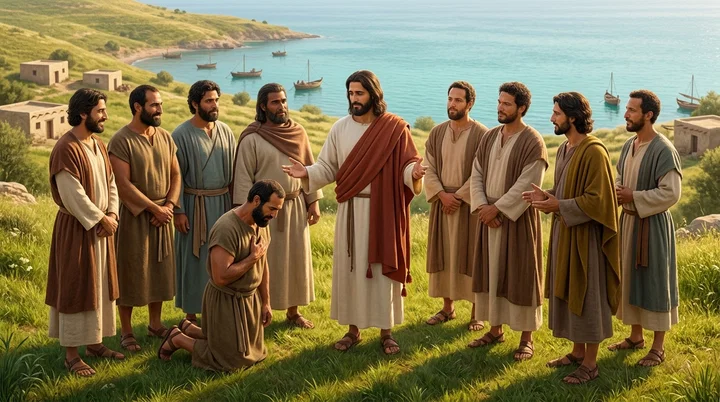
Mark 3:18 names Andrew, Philip, Bartholomew, Matthew, Thomas, James the son of Alphaeus, Thaddaeus, and Simon the Canaanite as eight of the twelve whom Jesus chose, called, ordained and set apart to the apostolate, to sacred gospel work and the gospel ministry.DA 290.2–291.2DA 290.1ST Apr 19, 1877ST Apr 19, 1877DA 716.4 The calling took place beneath sheltering trees, beneath the trees on a mountainside a little distance from, or near, the Sea of Galilee.DA 290.2–291.2DA 290.1ST That same mountainside was also the place where the sermon on the mount was given.DA 290.1
The fields and hills were His favorite resorts, and much of His teaching was given under the open sky rather than in the temple or the synagogues.DA 290.2–291.2DA 290.1 He loved the scenes of nature, and to Him each quiet retreat was a sacred temple, and He chose to teach in the fields and groves not for this reason only, for no synagogue could have received the throngs that followed Him and He had no costly sanctuary at command.DA 290.2–291.2DA 290.1 For this ordination He led the disciples away from the confusion of the city to the quiet retreat He loved in the fields and hills, in harmony with the lessons of self-abnegation He desired to teach them.DA 290.2–291.2 The sacred experiences of that day were forever linked in their minds with the beauty of mountain and vale and sea.DA 290.2–291.2
The step was the first in organizing and laying the foundation of the church, of the Christian church, that after His departure and death was to be His representative on earth and continue His work.DA 290.2–291.2ST Apr 19, 1877 Those set apart were to stay with Jesus, learn from Him, witness His works, and be prepared to teach and work as He did, entrusted with evangelistic work with power to heal the sick and cast out devils.ST Apr 19, 1877DA 716.4 Judas also was given a place among the twelve and entrusted in the same way, though he did not fully surrender himself to Christ.DA 716.4 The choice of men of diverse characters shows the work was not meant to depend on one person, since each could supply what another lacked and their different qualities could blend together toward a shared purpose.Lt 49, 1876, par. 13–15 After their ordination Jesus taught them on the mountain, where His sermon set out the principles of His kingdom of divine grace rather than the earthly glory and political freedom the people expected.ST Apr 19, 1877
Sources
Pioneers and periodicals
13 sources
Mark 3:18 names part of the Twelve whom Jesus chose apart on a mountain near the Sea of Galilee from among common people of humble occupation.STRH Sep 18, 1900ST Dec 23, 1897ST It is Christ who chooses, and when those he chooses yield to his choosing he ordains them and works through them to bring forth fruit to his glory.ST Dec 17, 1894 Those named were set apart and ordained for sacred gospel work, to stay with Jesus, learn from him, witness his works and travel with him, and then give forth freely what they had received.ST Apr 19, 1877RH Sep 18, 1900ST Apr 15, 1897 They were to be prepared to work as he did and to continue the work after his death and lay the foundation of the Christian church.ST Apr 19, 1877RH Sep 25, 1913 Their choosing was the first step in organizing the New Testament church, with the Twelve representing the whole gospel church in ministry of the word and general oversight to unite its work as it spread.RH Apr 15, 1909RH Aug 17, 1916
Names and Setting
The names belong to the calling of the Twelve apart on a mountain to be with Jesus, beneath the trees on a mountainside near the Sea of Galilee.STRH Sep 18, 1900 They were chosen from among the common people of humble occupations when no others at that time believed in him or his doctrines.ST Dec 23, 1897 That choosing included humble fishermen taken as his companions.ST Dec 23, 1897ST
James the son of Alphaeus is distinguished from James the brother of John, and the list supports identifying the James of the epistle as James the son of Alphaeus, who presided at the Jerusalem council.ST Mar 20, 1907 Simon the Canaanite is Simon called Zelotes, or the Zealot, which does not mean he was an inhabitant of Canaan.RH Sep 18, 1900 In Luke's list he stands tenth, while in Mark's he stands eleventh.
Among those named, Philip is a preacher, Bartholomew is bold, and Thomas is a doubter.RH Sep 18, 1900 The twelve included imperfect people, exemplified by one betrayer in Judas and one rash disciple in Peter, so that even a group called to lead and serve could contain such flaws.RH May 12, 1863 Yet the great difference between Jesus and his companions was bridged by his love, and having particular close friends did not keep him from welcoming the others, including Judas.ST
Mission and Organization
It is Christ who chooses, and when those he chooses yield to his choosing he ordains them and works through them so they bring forth fruit to his glory.ST Dec 17, 1894
Those named here were set apart and ordained for sacred gospel work and ministry.ST Apr 19, 1877RH Sep 18, 1900ST Apr 15, 1897 They were to stay with Jesus, learn from him, and witness his works.ST Apr 19, 1877 They traveled with him as he taught and ministered to people, went with him to be near his heart and to gather his truth while with him, and then to give it forth as they had freely received.RH Sep 18, 1900ST Apr 15, 1897
They were to be prepared to teach and work as he did.ST Apr 19, 1877 They were to continue the work after his death and lay the foundation of the Christian church.ST Apr 19, 1877 The twelve were sufficient in their generation to carry the gospel through the civilized world.RH Sep 25, 1913
After their ordination Jesus taught them on the mountain, where his sermon set out the principles of his kingdom of divine grace rather than the earthly glory and political freedom the people expected.ST Apr 19, 1877
The choosing of the Twelve was the first step in organizing the New Testament church.RH Apr 15, 1909RH Aug 17, 1916 The twelve represented the whole gospel church.RH Apr 15, 1909RH Aug 17, 1916 Their apostolic office served the whole church through ministry of the word and general oversight, helping unite its work as the gospel spread, not merely a local congregation.RH Apr 15, 1909RH Aug 17, 1916
Sources