Matthew 18:24
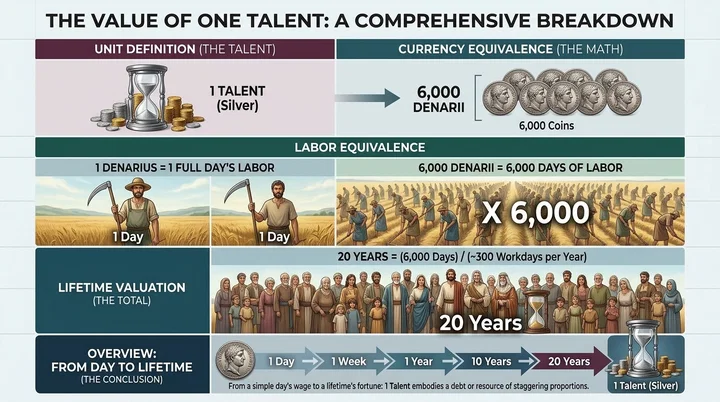
And when he had begun to reckon, one was brought unto him, which owed him ten thousand talents.
Translations
And when he had begun to reckon, one was brought to him, which owed him ten thousand talents.
King James Version, Revised Version
And when he had begun to reckon, one was brought unto him, which owed him ten thousand talents.
And when he had begun to reckon, one was brought unto him, which ought him ten thousand talents.
And when he had begun to reckon, one was brought to him who owed him ten thousand talents.
And when he had begun to reckon, one was brought unto him, that owed him ten thousand talents.
and he having begun to take account, there was brought near to him one debtor of a myriad of talents,
And having begun to reckon, one debtor of ten thousand talents was brought to him.
And, when he, began, to settle, there was brought unto him a, certain, debtor, of a thousand talents;
As he began the settlements, a debtor was brought to him owing ten thousand talents.
As he began the settlements, a debtor owing ten thousand talents was brought to him.
When he had begun to settle, one was brought to him who owed him ten thousand talents.
And at the start, one came to him who was in his debt for ten thousand talents.
And when he had begun to reckon, one was brought vnto him, which ought him ten thousand talents.
Douay-Rheims (Challoner revision)
And when he had begun to take the account, one was brought to him, that owed him ten thousand talents.
Pictures
Cross-references
- Matthew 6:12
And forgive us our debts, as we forgive our debtors.
The parable illustrates the prayer to forgive debts as we forgive debtors.
- Matthew 18:32-35
Then his lord, after that he had called him, said unto him, O thou wicked servant, I forgave thee all that debt, because thou desiredst me:
The forgiven servant is judged for refusing others the mercy he received.
- Matthew 18:28-30
But the same servant went out, and found one of his fellowservants, which owed him an hundred pence: and he laid hands on him, and took him by the throat, saying, Pay me that thou owest.
The servant’s refusal to forgive a small debt contrasts with his own enormous debt forgiven.
- Matthew 18:34
And his lord was wroth, and delivered him to the tormentors, till he should pay all that was due unto him.
The unforgiving servant’s pardon is revoked, and he is punished until the debt is paid.
- Luke 7:41-42
There was a certain creditor which had two debtors: the one owed five hundred pence, and the other fifty.
Both texts portray debtors unable to pay and the forgiveness of debt.
- Ephesians 4:32
And be ye kind one to another, tenderhearted, forgiving one another, even as God for Christ’s sake hath forgiven you.
God’s forgiveness is the reason believers should forgive others.
- Matthew 18:30
And he would not: but went and cast him into prison, till he should pay the debt.
Both depict a debtor imprisoned over an unpaid debt.
- Matthew 25:14-30
For the kingdom of heaven is as a man travelling into a far country, who called his own servants, and delivered unto them his goods.
Both depict a master reckoning with servants over what they owe or have been entrusted.
- Galatians 5:3
For I testify again to every man that is circumcised, that he is a debtor to do the whole law.
Both describe an obligation as an overwhelming debt.
- Luke 11:4
And forgive us our sins; for we also forgive every one that is indebted to us. And lead us not into temptation; but deliver us from evil.
Debts are identified with sins.
- Colossians 3:13
Forbearing one another, and forgiving one another, if any man have a quarrel against any: even as Christ forgave you, so also do ye.
Connects forgiving others with the Lord’s forgiveness.
Commentary
Each commentary is drawn from primary sources: the writings of Ellen G. White and Adventist pioneers and periodicals. Each commentary is separate. Its own words are not a quotation; follow the references to read the source passages.
Ellen G. White
40 sources
When the king begins to settle accounts with his servants, one is brought before him owing ten thousand talents.COL 243.1Ms 11, 1888, par. 39–41Lt 48a, 1900, par. 5–6 The sum is immense beyond all paying, no less than fifteen million dollars by the lowest reckoning, and the servant is a high officer entrusted with great wealth who has nothing with which to pay.15MR 186.2–188.3Ms 1, 1880, par. 62–65ST May 11, 1915Ms 143, 1905, par. 6–10Ms 11, 1888, par. 39–41 The king pictures God, and the debt is the immeasurable account sinners owe Him through transgression of His broken law, which humanity cannot save itself from paying.Lt 199, 1901, par. 31–32Ms 3, 1895, par. 3–7COL 243.2–244.2COL 244.3–245.1 That debt is freely pardoned by divine mercy at infinite price, because Christ clothed His divinity with humanity and gave His life as the just for the unjust to secure salvation.Ms 89, 1898, par. 14–1612MR 290.1–291.1COL 245.2COL 245.3COL 244.3–245.1 One so forgiven must from the heart forgive his brother's far smaller trespasses, for the ten thousand talents beside the hundred pence show human sins against God outweighing beyond measure the sins of others against us, and refusal to forgive revokes the pardon and delivers the unforgiving debtor to the tormentors.Lt 199, 1901, par. 31–32Ms 3, 1895, par. 3–7Ms 89, 1898, par. 14–16COL 245.2COL 245.3
Parable Setting and Context
When the king began to reckon and settle accounts with his servants, one servant was brought before him owing ten thousand talents, opening the lesson of accountability and forgiveness.COL 243.1Lt 48a, 1900, par. 5–6Ms 107, 1903, par. 8–10Lt 31, 1903, par. 4–5Lt 111, 1886, par. 6–9 The bringing of the servant at the examination of the accounts set before the hearers an immense debt that frames all that follows.COL 243.1Ms 11, 1888, par. 39–41Ms 107, 1903, par. 8–10 The servant was a high-ranking officer entrusted with great wealth to administer government affairs, and his account showed him unfaithful in his trust.15MR 186.2–188.3ST May 11, 1915Ms 11, 1888, par. 39–41
The debt of ten thousand talents was extraordinarily great and immense, beyond any ability of the servant to meet.Ms 1, 1880, par. 62–65Ms 143, 1905, par. 6–10Lt 48a, 1900, par. 5–6Lt 81, 1896, par. 9–11 He had nothing with which to pay, and the amount stood as one he could not repay.Ms 1, 1880, par. 62–65ST May 11, 1915Ms 143, 1905, par. 6–10Lt 81, 1896, par. 9–11 By the lowest computation it was valued at no less than fifteen million dollars.15MR 186.2–188.3Ms 11, 1888, par. 39–41
The reckoning over property was a temporal thing presented to represent a spiritual thing.COL 243.2–244.2Ms 89, 1898, par. 17–18 It was spoken to answer Peter's question about forgiveness, showing both divine pardon and the example of forbearance human beings should exercise toward one another.Ms 89, 1898, par. 17–18 The specific details of the royal accounting carry no separate spiritual meaning of their own.COL 243.2–244.2
The verse belongs to Christ's teaching in Matthew 18 about responding to error and sin.Ms 112, 1904, par. 12–14Lt 202, 1902, par. 7Lt 32, 1892, par. 29–30 That teaching establishes the duty to address wrongdoing and to seek to save the person who is in the wrong.Ms 112, 1904, par. 12–14Lt 32, 1892, par. 29–30 It shows that the church must be thoroughly organized, and it teaches that people reap as they sow.Lt 202, 1902, par. 7Lt 32, 1892, par. 29–30
Debt Owed to God
The king in the reckoning pictures God, and Christ as represented by the king, while the reckoning itself pictures God's compassionate dealing with those in error in freely forgiving so large a debt.Lt 199, 1901, par. 31–32COL 244.3–245.1 The debt brought before him is the great, immeasurable account sinners owe God through years of misusing what belongs to Him.Ms 3, 1895, par. 3–7 It means sin under the condemnation of the broken law, under which humanity stands condemned and cannot save itself, having nothing to give in return and no means to pay.COL 243.2–244.2COL 244.3–245.1Ms 89, 1898, par. 17–18 The reckoning over property is a temporal thing presented to represent this spiritual reality.Ms 89, 1898, par. 17–18
The ten thousand talents are our own sins and transgressions against God, including many errors and sins for which love, pity and patience have been shown.12MR 290.1–291.1Lt 30, 1895, par. 7–8 It is a sum that cannot be computed, illustrating how much a person owes the Lord.12MR 290.1–291.1Lt 38, 1901, par. 13–15 That forgiveness is made possible at infinite price to redeem from hopeless despair, because Christ clothed His divinity with humanity, came in human nature, gave His life as the just for the unjust, and died in self-denial to secure salvation.12MR 290.1–291.1COL 244.3–245.1Ms 89, 1898, par. 17–18Lt 38, 1901, par. 13–15 By this blood-bought redemption, purchased by His blood at infinite price for human souls, sinners are His purchased possession rescued from hopeless despair.12MR 290.1–291.1COL 244.3–245.1Ms 89, 1898, par. 22–23
The king's cancellation and release of the debt shows God's divine, supernatural pardon and mercy toward the debtor who pleads for compassion.Ms 3, 1895, par. 3–7Ms 89, 1898, par. 14–16Ms 89, 1898, par. 17–18 It is freely given through mercy and cannot be earned or repaid by the debtor, not repaid by works but accepted as a free gift of grace.Ms 89, 1898, par. 14–16COL 245.2COL 245.3COL 244.3–245.1 The ten thousand talents stand in overwhelming contrast to the hundred pence owed by the fellow servant, at nearly a million to one, showing that human sins against God far exceed the sins others commit against us.COL 245.2COL 245.3 The greatness of the forgiven debt thus measures guilt before God and exposes the harshness of treating a fellow servant harshly in a similar case.Lt 199, 1901, par. 31–32COL 245.2
Forgiveness Received Requires Forgiving
One so forgiven must from the heart forgive every brother his trespasses, walking and working in the love of Christ and showing compassion, tenderness, forbearance and love to fellow sinners and giving freely to others.Lt 199, 1901, par. 31–32Ms 3, 1895, par. 3–7Ms 89, 1898, par. 14–16Ms 143, 1905, par. 6–10Lt 81, 1896, par. 9–11 Being forgiven so great a debt calls a person to forgive others' much smaller offenses in church, in business and in every part of life, and to conduct all business on His lines.Lt 199, 1901, par. 31–32Ms 3, 1895, par. 3–7Ms 89, 1898, par. 14–16 Those who seek God's pardon must forgive others from the heart, for God will not sanction the work of those who refuse to forgive when they themselves have been forgiven.Lt 199, 1901, par. 31–32Ms 143, 1905, par. 6–10ST Dec 14, 1882 The enormous forgiven debt set beside the much smaller debt owed by the fellow servant teaches that those who have received such mercy must not treat a fellow servant harshly over a small debt but must show mercy and forgiveness in return.Ms 3, 1895, par. 3–7Ms 89, 1898, par. 14–1615MR 186.2–188.3Ms 143, 1905, par. 6–1015MR 364.1–368.3 Because Christ bears with us and forgives us at great cost, we must show the same compassion and forgiveness to others rather than criticize, condemn, or deal harshly with those who err.Ms 89, 1898, par. 14–1615MR 186.2–188.3Ms 1, 1880, par. 62–65
The ten thousand talents beside the hundred pence, at nearly a million to one, measures the overwhelming guilt before God compared with what a fellow servant may owe us.15MR 186.2–188.3COL 245.3 People who fail to recognize how helpless they are to pay their own debt may rely on their works to earn God's favor instead of accepting grace as a free gift, and this self-righteousness leaves them unforgiving toward others.COL 245.3 The king's forgiveness of so enormous an unpayable debt makes later refusal to forgive a much smaller debt inexcusable.Ms 89, 1898, par. 14–16Lt 81, 1896, par. 9–11ST Dec 14, 1882 Refusal to show mercy after being forgiven so much revokes the pardon, so that the unforgiving debtor is delivered to the tormentors.Lt 81, 1896, par. 9–11ST Dec 14, 1882 The Lord will repay hardheartedness, unsympathetic faultfinding and an exacting, undisciplined spirit, as when a man blames his wife at home and his brethren in the church for trials caused by his own unconverted heart, withholds pity, patience and longsuffering kindness, and fails to bind the family together; unless he falls on the Rock and is broken, has his hard heart melted and softened, dies to self and is entirely renewed as a new man in Christ with love that suffers long and is kind, tender and pitiful, he cannot be saved in the kingdom of heaven.Lt 81, 1896, par. 9–11ST Dec 14, 1882Lt 30, 1895, par. 7–8
God judges people by the spirit they show toward erring brothers and sisters rather than by their own self-assessment.Ms 11, 1888, par. 45–46Lt 10a, 1885, par. 6–7 The parable warns against treating others harshly while depending on God's compassion, and teaches that people are accountable according to the light and knowledge they have received.Ms 11, 1888, par. 45–46Lt 10a, 1885, par. 6–7 The verse means constant need of grace and daily forgiveness and mercy and compassion every moment, so hearts filled with gratitude to God must show the same tenderness, forbearance and love to erring brethren of like passions with ourselves.12MR 290.1–291.1 Being severe and exacting, ready to criticize, censure and condemn, is out of place and unbecoming for Christians, coming from self-esteem and self-exaltation and striving for supremacy.12MR 290.1–291.1Ms 1, 1880, par. 62–65 Meekness and humility must be cultivated continually, becoming as little children, practicing self-denial and self-sacrifice without regard to ease and comfort to seek and save the wandering and perishing soul, as the shepherd seeks the one lost sheep without reprimand and rejoices when it is found.12MR 290.1–291.1
Application to Church and Life
Matthew 18 lays down the most positive principles for disciples of the meek and lowly Jesus to act upon in every case and under all circumstances, forbidding all striving for supremacy and showing that greatness in Christ's spiritual kingdom is not position, outward splendor, or authority but spiritual excellence manifested in true conversion, and its words apply to everyone who claims discipleship.Lt 64, 1900, par. 1–3 The chapter is a call to humble oneself before God and to turn from self toward sympathy and love for others, especially through personal effort for those outside Christ, for following Jesus requires thorough conversion, a single purpose, and pure motives.RH May 18, 1876 Its practical lesson as a whole is to be hung in the chambers of the mind, kept in memory, often read and pondered and obeyed and woven into Christian experience, teaching obedience to God's holy law in loving God with all heart and soul and mind and strength and loving neighbor as self as the only terms for securing eternal life.Ms 40, 1896, par. 12–13 That obedience is practiced by cultivating the garden of the soul, removing every weed and tare, taking stewardship of self instead of seeking weeds in the neighbor's garden, purifying thoughts and bringing them into captivity to Jesus Christ, and refusing to scatter words recklessly without careful consideration of where they lodge and what they produce.Ms 40, 1896, par. 12–13
The lessons must be received and practiced as a learner in the school of Christ, giving the discipline of the Word by which a person takes himself in hand, reprimands himself, and overcomes selfish, unholy tempers and temptations so as to be fit to handle sacred things and preach the Word.Lt 48a, 1900, par. 3–4 In that instruction believers are to love fellow believers with tenderness, compassion, and courtesy, for people reap as they sow, and they are not to separate from one another but to address wrongdoing in a spirit that preserves love and fellowship.Lt 202, 1902, par. 7Lt 21, 1903, par. 14Lt 31, 1903, par. 4–5 The words are educating lessons of high and holy principles for daily practical life, calling for compassion, tenderness, and love, for first reforming self and then reforming youth with perfect love and compassion under Christ as head, for acting as brethren as branches in the same vine, and for treating youth in care as the property of Jesus Christ with deep interest and earnest prayer.Lt 37a, 1900, par. 18–20
Those in positions of responsibility are to follow this instruction to counsel and protect God's people rather than rule over them as kings, rejecting selfishness, narrow-mindedness, impatience, boasting, and overbearing conduct.18MR 182.3–4 Those who do sacred work must be transformed in spirit in order to represent Jesus Christ, dealing with God's children with courtesy, kindness, encouragement and mercy rather than harshness, severity, and a dictatorial, condemnatory, overbearing spirit that wounds and bruises souls, exasperates brethren and destroys confidence, loving neighbor as self and helping and favoring brethren as acting in Christ's stead.18MR 182.3–4Lt 58, 1901, par. 18–19 The chapter rebukes dissension, self-esteem, self-exaltation, and strife to be highly esteemed by men, and especially criticism and faultfinding.Lt 107a, 1900, par. 2–3 Criticism and faultfinding is expressly the work of the devil, who began that work in the heavenly courts by claiming he could do wonderful things if not hampered by the law of Jehovah, by suggesting to angels that a change in the government of God would benefit the heavenly family, by putting his own thoughts in their minds and then repeating them to the highest Authority as theirs, and by covering his tracks so that suspicion and distrust of God and of one another spread without detection, until God took hold of it with decision and expelled the instigator of evil and the disloyal for the good of the loyal and true; therefore Matthew 18 is to be read in plain, decided, clear-cut words to anyone who begins criticism and faultfinding, because it traces out the cause of disaffection and its evil consequences.Lt 107a, 1900, par. 2–3
Self-sufficiency, pride in one's own discernment and judgment, and inward concealed strife for the supremacy and open strife to be first must be cleansed from the soul, because this unsanctified spirit grieves the Saviour, hinders the work, and keeps the Lord from manifesting His power and grace through workers who ought to be a blessing.Ms 26, 1889, par. 15–17 Being severe and exacting, ready to criticize, censure and condemn, is out of place and unbecoming for Christians, coming from self-esteem and self-exaltation and striving for supremacy.12MR 290.1–291.1Ms 1, 1880, par. 62–65 Meekness and humility must instead be cultivated continually, becoming as little children and practicing self-denial and self-sacrifice without regard to ease and comfort to seek and save the wandering and perishing soul for whom Christ died, as the shepherd seeks the one lost sheep without reprimand and rejoices when it is found.12MR 290.1–291.1 Because Christ bears with us and forgives our own sins and transgressions against God at infinite price to redeem us from hopeless despair, we need His grace constantly and forgiveness daily and mercy and compassion every moment, and with hearts filled with gratitude we must show the same tenderness, forbearance, compassion, love and forgiveness to erring brethren of like passions with ourselves rather than criticize, condemn, or deal harshly with those who err.12MR 290.1–291.1Ms 1, 1880, par. 62–65
Being forgiven so great a debt calls a person to forgive from the heart every trespass of every brother, with its much smaller offenses, in church, business, and every part of life, to walk and work in the love of Christ and conduct all business on His lines, for God will not sanction the work of those who refuse to forgive when they themselves have been forgiven.Lt 199, 1901, par. 31–32Ms 3, 1895, par. 3–7 The greatness of the forgiven debt stands against all harshness and oppression toward fellow servants in similar cases, and the king's reckoning pictures God's compassionate dealing with those in error in freely forgiving so large a debt, while the debt itself represents the great, immeasurable account sinners owe God through years of misusing what belongs to Him.Lt 199, 1901, par. 31–32Ms 3, 1895, par. 3–7 A hardhearted, unsympathetic, faultfinding man who blames his wife at home and his brethren in the church for trials caused by his own unconverted heart, who withholds from his wife when she makes mistakes the pity, patience and longsuffering kindness God has shown him, and who fails as husband and priest of the family to bind the family together and carry accountability, is in the case of the relentless servant owing ten thousand talents for many errors and sins.Lt 30, 1895, par. 7–8 Unless he falls on the Rock and is broken all to pieces, has his hard heart melted and softened, dies to self and is entirely renewed in heart and mind and spirit as a new man in Christ with love that suffers long and is kind, tender and pitiful, the Lord will repay him for all these things, and with that faultfinding, exacting, undisciplined spirit he cannot be saved in the kingdom of heaven.Lt 30, 1895, par. 7–8
Sources
Pioneers and periodicals
77 sources
When the king had begun to reckon with his servants, one was brought before him owing ten thousand talents.ST Feb 5, 1880RH Dec 23, 1902ST Jul 12, 1899 The sum was an immense, hopeless debt of many millions of dollars that the servant had nothing to pay.ST Sep 30, 1886ST Apr 26, 1883RH Oct 17, 1865ST Dec 24, 1885ST Apr 21, 1881 It represents the sinner's guilt and obligation to God, an overwhelming moral debt to His holy law that can be canceled only by free grace through redemption.ST Sep 30, 1886ST Feb 5, 1880ST Apr 26, 1883ST Dec 20, 1899ST Dec 20, 1899 In compassion the master forgave the whole debt at once, freely and fully, showing mercy that is practically unlimited.RH Sep 28, 1916ST Oct 16, 1893ST Jan 28, 1913ST Apr 1, 1897RH Sep 17, 1901 That pardon is conditional and not final, so it is taken back if the one forgiven refuses from the heart to forgive his fellow, and those who have received such great mercy must forgive the far smaller debts owed them.ST Sep 30, 1886RH Oct 17, 1865RH Jun 23, 1874RH Sep 7, 1905
Setting and Enormous Debt
When the king had begun to reckon with his servants, one servant was brought before him owing ten thousand talents.ST Feb 5, 1880RH Dec 23, 1902ST Jul 12, 1899ST Jan 15, 1902 The reckoning is the king beginning to settle accounts, and the bringing forward opens the lesson on forgiveness developed in the parable.ST Jul 12, 1899ST Apr 7, 1898 The debtor is an officer administering government affairs, presented as the chief debtor with nothing to pay.ST May 11, 1915ST Apr 1, 1897 He faces bondage and sale of himself with his wife and children, and with his family faces torment.RH Oct 17, 1865ST Apr 1, 1897
The ten thousand talents is an immense, hopelessly large and impossible-to-pay debt, and the servant has nothing with which to pay it.ST Sep 30, 1886ST Apr 26, 1883RH Oct 17, 1865RH Jun 23, 1874ST Dec 20, 1899 His helplessness sets up the contrast between the king's forgiveness and the servant's refusal to forgive a much smaller debt.ST Jul 12, 1899RH Sep 7, 1905 The debt is valued at between nine and ten million dollars, showing the vastness of the mercy received.ST Feb 5, 1880ST Feb 5, 1880 The debt is estimated at eight to fifteen million dollars, literally about $8 million to $15 million.ST Jul 12, 1899ST Jul 12, 1899
The debt is described as twelve million dollars that the servant cannot pay.ST Feb 7, 1900 The debt is represented as $20,000,000.RH Nov 21, 1907 The debt is valued at $9,000,000, showing the greatness of forgiving mercy.ST Mar 17, 1898 The ten thousand talents is about $9,000,000 in silver, requiring 18,750 years to repay by saving and paying $10 weekly.RH Jan 18, 1912
The debt is about fourteen million four hundred thousand dollars, with nothing to pay.RH Aug 21, 1900RH Aug 21, 1900 The debt is described as many millions of dollars, far beyond ability to repay.ST Dec 24, 1885ST Apr 21, 1881 The debt is compared to about ten million dollars, while the fellow servant's debt was only a few shillings.ST Nov 30, 1915ST Sep 30, 1886 The debt is valued at more than nine million dollars.ST Feb 5, 1880
If measured in gold talents, the debt would amount to more than $337 million, deliberately beyond ordinary experience.ST Dec 20, 1899 At £240 per talent the debt is reckoned at about $11,710,000, with some estimates placing it as high as $20,000,000.ST Apr 7, 1898 The debt is pictured as ten thousand pounds.RH Sep 3, 1861 The amount reflects a debt swollen by unpaid interest compounded with the principal.
The great debt means complete bankruptcy and pictures the economic condition of Palestine at Christ's time, when the masses were wretchedly poor, wealth was congested among a few, and debt and anxiety over food and clothing were widespread.ST Aug 24, 1904 In that picture everyone except the king is bankrupt, the steward being in debt to the king and the servant in debt to the steward.ST Aug 24, 1904
Debt as Human Guilt
The ten thousand talents owed when the reckoning began stands for the sinner's guilt and obligation to God, especially the guilt incurred by sin.ST Feb 5, 1880ST Dec 20, 1899ST Dec 20, 1899ST Dec 20, 1899ST Feb 5, 1880 It is humanity's immense obligation that cannot be repaid by human effort, deliberately set beyond ordinary experience to show both the greatness of guilt before God and how small by comparison are the wrongs people must forgive in one another.ST Dec 20, 1899ST Dec 20, 1899ST Jan 15, 1902 All have sinned, and the debt can be canceled only through gracious redemption and free mercy.ST Jan 15, 1902
The servant brought forward with nothing to pay pictures sinful humanity's enormous, hopeless debt to God and need for pardon.ST Sep 30, 1886ST Apr 26, 1883ST Apr 7, 1898ST Jul 12, 1899ST Jul 22, 1880 The sum is hopelessly large and impossible to pay, estimated at eight to fifteen million dollars, and it is freely forgiven by God.ST Jul 12, 1899ST Jan 15, 1902 Receiving that pardon must lead to a forgiving spirit toward others, for pardon given during probation is brought into question and leads to judgment when mercy is refused.ST Sep 30, 1886ST Apr 26, 1883ST Jul 22, 1880
Sin is an overwhelming moral debt of about fourteen million four hundred thousand dollars, with nothing to pay and no ability to gain anything to pay.RH Aug 21, 1900RH Aug 21, 1900 It involves guilt that must be expiated by punishment and satisfaction as payment of a debt.RH Aug 21, 1900RH Aug 21, 1900 The king forgave such a debtor, yet when that servant cast a fellow servant owing about fifteen dollars into prison until payment, the king delivered him to the tormentors till he should pay all that was due, and so the Heavenly Father will do to those who do not from their hearts forgive every brother his trespasses.RH Aug 21, 1900
The debt is humanity's debt to God's holy law, pictured as ten thousand pounds, with no claim of righteousness to offset great guilt before God.RH Jun 4, 1901RH Sep 3, 1861 It can be canceled only by free, sovereign grace.RH Sep 3, 1861 Set against the small debt one person owes another, it requires those who depend on God's forgiveness to forgive others rather than act as though holier.RH Sep 3, 1861 The same debt illustrates humanity's guilt in surrendering God's dominion to rebellion and destruction, where forgiveness includes paying the cost and restoring what was lost.ST Apr 1, 1897
The man owing an unpayable sum with nothing to pay pictures the sinner who is a debtor to do the whole law and tries to stand justified by his own works.ST Jun 3, 1886 To stand as a doer he must present a record of obedience unbroken by a single sin and must himself take away past sins from the part of life already spent in sin, which he cannot do.ST Jun 3, 1886 Like the servant cast into prison till he should pay it all, he has no hope and must to all eternity remain a debtor in hopeless bondage.ST Jun 3, 1886 All are or have been in that bondage, from which only mercy and plenteous redemption with the Lord and cleansing of all sin by the blood of Christ can free.ST Jun 3, 1886
The amount owed was infinite and called for the suffering and death of Jesus Christ, yet it was all forgiven.RH Jun 2, 1868 The soul cannot balance good and bad deeds to find repayment but must look to Christ, who has taken its debts upon himself.RH Jun 2, 1868RH Aug 6, 1861 The debt shows long-suffering, compassion and mercy toward those who have wandered far and apostatized, whom repeated calls do not leave, answering seventy times seven.RH Jun 2, 1868RH Mar 31, 1874 Every sin is a debt to God that can never be paid and must be forgiven, and human guilt made up of follies, sins and crimes is vast and infinite.RH Mar 31, 1874 One such debt of ten thousand talents amounts to $20,000,000, forgiven in answer to the prayer to forgive debts as debtors are forgiven.
The bankrupt debtor cannot pay for his own wrongdoing and needs a divine Redeemer.ST Jun 3, 1886ST Apr 28, 1909 Plenteous redemption with the Lord and cleansing by the blood of Christ alone frees from hopeless bondage.ST Jun 3, 1886ST Apr 28, 1909 The immense debt forgiven by the king is deliberately contrasted with the much smaller debt the servant refuses to forgive, showing how small fellow servants' debts are by comparison.RH Dec 23, 1902ST Jul 12, 1899ST Dec 24, 1885ST Dec 20, 1899 The great debt, described as many millions of dollars, sets up the contrast between the king's compassion in forgiving it and the servant's refusal to show mercy over a trifling debt, teaching that those who have received such mercy must forgive others from the heart, lest by holding a grudge and refusing to forgive they themselves not be forgiven.RH Dec 23, 1902ST Jul 12, 1899ST Dec 24, 1885ST Apr 7, 1898
King's Free Forgiveness
When the servant fell down in worship and begged for patience with the promise to pay all, the master was moved with compassion and forgave the whole debt at once, freely and fully, instead of merely granting time to repay.RH Sep 28, 1916ST Apr 1, 1897RH Sep 17, 1901 That forgiveness was the exchange of the sinner's guilt for pardoning love, which is Christ's pardoning grace.ST Feb 5, 1880ST Feb 5, 1880ST Feb 5, 1880 The lord's compassion and cancellation of the debt is forgiveness under the gospel, or justification by faith, given while the person remains on probation awaiting the Judgment.ST Jul 22, 1880
The king's free forgiveness of so enormous a debt shows that God's mercy and forgiveness are practically unlimited, an infinite grace not exhausted by forgiving it, far exceeding the small debts people owe one another.ST Oct 16, 1893ST Jan 28, 1913ST Mar 17, 1898ST Nov 30, 1915 The debt forgiven is vast and infinite, made up of follies, sins and crimes, yet mercy answers it with repeated forgiveness.RH Mar 31, 1874 It illustrates the long-suffering, compassion and mercy of the Lord toward those who have wandered far and apostatized, whom He does not leave until repeated calls are given, answering seventy times seven, swift to forgive and to forget.RH Jun 2, 1868RH Mar 31, 1874
God's forgiveness includes paying the cost Himself and restoring what was lost when His dominion was surrendered to rebellion and destruction.ST Apr 1, 1897 The immense debt was forgiven in answer to the prayer to forgive debts as debtors are forgiven, showing that those who ask God to forgive them should own their sins and be ready to forgive others who ask for mercy.ST Apr 3, 1893
Conditional Pardon and Judgment
The lord's forgiveness of the ten thousand talents with nothing to pay, facing sale of himself with wife and children and all he had, was full and free in answer to earnest entreaty and worship with promise to pay all, yet it was conditional and not absolute and final.RH Oct 17, 1865RH Sep 28, 1916RH Aug 21, 1900 When that same servant refused mercy to a fellow servant owing a trifling sum of about fifteen dollars and cast him into prison until he should pay, his lord in wrath called him to account, laid the forgiven debt back upon him, and delivered him to the tormentors till he should pay all that was due.RH Oct 17, 1865RH Sep 28, 1916RH Aug 21, 1900 That revoking shows pardon received by faith during probation does not excuse refusing mercy to others, and the life after the decree of forgiveness must show obedience and trust, sincere repentance and abandonment of wrongdoing, daily surrender to Christ and walking in the light.ST Apr 26, 1883RH Jun 23, 1874RH Sep 7, 1905ST Jul 31, 1884RH Sep 28, 1916 If the forgiven one refuses to forgive or backslides into sin, the pardon is taken back and he is punished for the whole life of sin, first and last together.ST Aug 21, 1884ST Jul 22, 1880RH Sep 28, 1916
If forgiven people afterward become transgressors by refusing from the heart to forgive every brother his trespasses, the heavenly Father will do likewise to them, the original debt returning upon them so they are held responsible to the uttermost farthing.RH Oct 17, 1865RH Aug 21, 1900 A person who has been forgiven a very great debt therefore loses that pardon and loses justification when he refuses to show mercy by forgiving someone who owes him much less.ST Aug 27, 1896 Forgiveness pardons the sinner but leaves the sin still recorded, and though sins are forgiven the record of life taken by angels is presented before the Judge in the heavenly sanctuary and remains there till the great day of atonement, when repentant sins are blotted out at the times of refreshing from the presence of the Lord.ST Mar 25, 1889ST Feb 11, 1886 Confessed sins are forgiven and covered by Christ's righteousness and will never be uncovered if the one who confessed remains faithful, but if he forsakes the Lord and turns back into the world the covered part of his past life appears uncovered on the books of heaven, and having withdrawn from Christ he must meet the record of his entire life in the judgment.RH Sep 26, 1912
Sins forgiven now will come up against a person in the judgment if that person later falls away and dies in sin, and the final judgment determines whether sins are blotted out or fall back upon him.ST Apr 26, 1883ST Aug 21, 1901 Forgiveness covers daily pardon upon confession while the final blotting out of sin waits until the final judgment, the parable's account remaining open until then so that its final value depends on perseverance and faithfulness to the end.RH Sep 28, 1916ST Dec 20, 1899 The bringing of the servant before his lord when the accounts are reckoned illustrates that a person's account is examined in judgment, rather than sins being blotted out at the moment they are forgiven.ST Aug 21, 1901 The word forgiveness or pardon here is used in that limited sense, which does not contradict that atonement for sin is made by blood.ST Oct 18, 1883
Duty to Forgive Others
The ten thousand talents owed when the reckoning began shows utter helplessness with nothing to pay, and the need to seek mercy, and the pardon received must lead to a forgiving spirit toward others.ST Aug 21, 1884ST Sep 30, 1886RH Dec 23, 1902ST Apr 26, 1883ST Dec 24, 1885 The king forgave that great debt, yet the servant refused to forgive a fellow servant's much smaller debt, and the contrast teaches that God's forgiveness of great debts calls for forgiving others from the heart.ST Aug 21, 1884RH Dec 23, 1902ST Apr 26, 1883ST Dec 24, 1885 The debt was many millions of dollars in scale, setting up the contrast with the trifling amount owed to the servant and showing the scale of mercy received.ST Sep 30, 1886RH Dec 23, 1902ST Apr 26, 1883ST Dec 24, 1885 The servant's refusal to remember that kindness and to extend mercy brought revocation of pardon and punishment, for pardon during probation requires forgiving others from the heart.ST Aug 21, 1884RH Dec 23, 1902ST Apr 26, 1883
God's forgiveness of sins is given only as men forgive their debtors, a condition of divine pardon on which nothing less than salvation depends.RH Jan 19, 1864 Every man needs to be forgiven, so forgiving others keeps open the way for his own forgiveness, and he that cannot forgive others breaks the bridge over which he himself must pass.RH Jun 13, 1865 Every sin is a debt to God that can never be paid and must be forgiven, pictured here as ten thousand talents amounting to $20,000,000 and forgiven in answer to the prayer to forgive debts as debtors are forgiven. Cherishing a forgiving spirit toward whatever the offense, never hate or revenge, is the test of fitness to receive forgiveness, for God does not forgive the unforgiving. The debt God forgives is also valued at $9,000,000, showing a greatness of forgiving mercy not exhausted by forgiving it, and refusing to forgive a much smaller debt is out of harmony with that mercy and prevents receiving it.ST Mar 17, 1898 Those who ask God to forgive their great debt of sin must forgive those who wrong them, and cherished hatred and refusal to forgive leave sin unforgiven by God.RH Nov 7, 1907 If a grudge is held and forgiveness refused, a person will not be forgiven.
Those who ask God to forgive them should own their sins and be ready to forgive others who ask for mercy, for the servant refused his fellow servant's plea for patience of the same kind he had made to his lord.ST Apr 3, 1893 The lesson is to forgive a repentant brother and to make peace rather than pursue contentious claims, since the parable concerns forgiveness between people.ST Jul 14, 1881ST Apr 3, 1893 One who seeks God's forgiveness must not refuse forgiveness to a penitent person, but should forgive as he hopes to be forgiven.RH Oct 17, 1854 The immense debt owed to God was freely forgiven by infinite grace, valued at about $9,000,000 in silver and requiring 18,750 years to repay by saving and paying $10 weekly, illustrating that mercy in judgment is measured by man's mercy.RH Jan 18, 1912 One loosed from so great a debt who shows no mercy for a $15 hundred-pence wrong owed him is delivered to the tormentors till he should pay all, because wrongs suffered from one another are but as the mote compared to the beam of transgressions against the Heavenly Father.RH Jan 18, 1912 The enormous debt compared to about ten million dollars against a fellow servant's debt of only a few shillings warns that demanding strict justice from others while withholding mercy is like asking God to deal in the same unyielding way.ST Sep 30, 1886
People readily plead for forgiveness of their own great sins while resisting forgiveness of another's lesser wrong, minimizing their own transgressions and magnifying their neighbors' sins, even distrusting someone after saying they forgive him.ST Dec 12, 1892 The wrongs others owe cannot exceed the measureless debt of sin owed to Christ, and remembering Christ's patient love, mercy and sacrifice calls for forgiving others freely as God is asked to forgive.ST Aug 19, 1880 Cancelling an old wrong that calls for forgiveness when the debtor cannot pay is an act of love toward an enemy.RH Sep 28, 1905 The verse belongs to the lesson about forgiveness and brotherly kindness in the chapter's teaching on how church members should treat offenders.ST May 18, 1882 When faithful efforts cannot recover erring members the church may withdraw fellowship but must continue working for their restoration as for those outside, and this teaching in Matthew 18 is not to be dismissed as irrelevant because spoken before Pentecost.RH Jun 16, 1903ST Jun 4, 1885
The chapter calls for humbling before God and turning from self toward sympathy and love for others, especially through personal effort for those outside Christ, requiring thorough conversion, single purpose and pure motives.RH May 18, 1876 The parable warns against cherishing malice and seeking revenge while asking God for pardon, since human beings err and need mercy.RH Apr 14, 1859 It is applied to letting go of resentment toward people who owe money rather than holding malice or insisting on collection.RH Apr 14, 1859 The king's demand for payment and forgiveness of the one who could not pay may excuse those who cannot pay what they owe, but it does not establish that a debtor who has means to pay should be excused.RH Apr 25, 1854 The servant brought before the king with an immense debt is offered as a parallel that may comfort someone who cannot repay past unpaid tithes.RH Apr 23, 1901 Remembering the ten-thousand-talent debt owed to God and gratitude for it should move Christians to devote time, abilities, speech and work to sharing the Gospel rather than selfish pursuits.ST Jun 7, 1905
The overwhelming and impossible debt pictures human sin and need, applied in prayer to asking God for mercy and patience.ST Feb 22, 1910 God grants forgiveness when there is true sorrow and repentance, and the danger lies in loving sin until a person no longer truly repents or desires forgiveness.ST May 13, 1903 The unmerciful servant is a thoroughly human parable about accountability in which excuses do not undo failures or make them equivalent to success, teaching foresight and responsibility.ST Mar 2, 1882 The servant's enormous debt as the king begins to reckon is the starting point for the lesson on the depth of God's forgiveness and the duty to forgive, connected with the forgiving spirit and forgiving debts.ST Sep 19, 1900ST Sep 12, 1911
Sources