Numbers 1:52
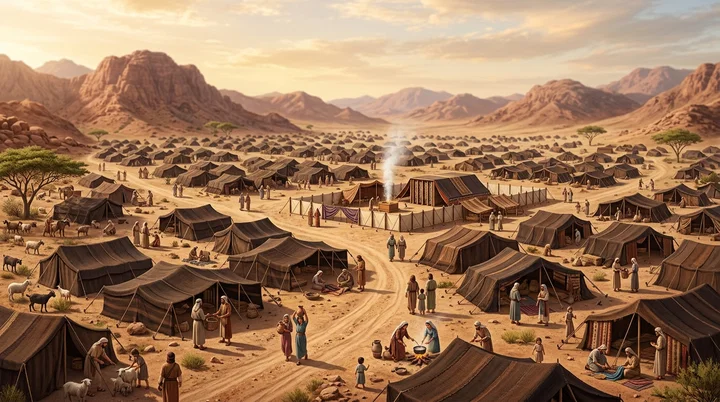
And the children of Israel shall pitch their tents, every man by his own camp, and every man by his own standard, throughout their hosts.
Translations
American King James Version, King James Version, KJV Cambridge Paragraph Bible
And the children of Israel shall pitch their tents, every man by his own camp, and every man by his own standard, throughout their hosts.
And the children of Israel shall pitch their tents every man by his own camp, and every man by his own standard, throughout their hosts.
Revised Version, American Standard Version
And the children of Israel shall pitch their tents, every man by his own camp, and every man by his own standard, according to their hosts.
And the sons of Israel have encamped, each by his camp, and each by his standard, by their hosts;
And the children of Israel shall encamp every man in his camp, and every man by his own standard, according to their hosts;
So then the sons of Israel shall pitch their tents, every man, near his own camp, and, every man, near his own standard, by their hosts;
Berean Standard Bible, Majority Standard Bible
The Israelites are to camp by their divisions, each man in his own camp and under his own standard.
The children of Israel shall pitch their tents, every man by his own camp, and every man by his own standard, according to their divisions.
The children of Israel are to put up their tents, every man in his tent-circle round his flag.
Also the children of Israel shall pitch their tentes, euery man in his campe, and euery man vnder his standerd throughout their armies.
Douay-Rheims (Challoner revision)
And the children of Israel shall camp every man by his troops and bands and army.
Pictures
Cross-references
- Numbers 2:2
Every man of the children of Israel shall pitch by his own standard, with the ensign of their father’s house: far off about the tabernacle of the congregation shall they pitch.
Describes the tribes camping by their standards.
- Numbers 26
And it came to pass after the plague, that the LORD spake unto Moses and unto Eleazar the son of Aaron the priest, saying,
The later census compares Israel’s tribal numbers with the numbering in chapter 1.
- Numbers 2:17
Then the tabernacle of the congregation shall set forward with the camp of the Levites in the midst of the camp: as they encamp, so shall they set forward, every man in his place by their standards.
The tribes set out in their assigned places by their standards.
- Numbers 10:14-28
In the first place went the standard of the camp of the children of Judah according to their armies: and over his host was Nahshon the son of Amminadab.
The tribes travel in ordered groups under their standards.
- Numbers 9:17-18
And when the cloud was taken up from the tabernacle, then after that the children of Israel journeyed: and in the place where the cloud abode, there the children of Israel pitched their tents.
The cloud showed where Israel should pitch their tents.
- Numbers 3:23-38
The families of the Gershonites shall pitch behind the tabernacle westward.
Lists the Levite positions and their assigned tabernacle duties.
- Numbers 10:2-8
Make thee two trumpets of silver; of a whole piece shalt thou make them: that thou mayest use them for the calling of the assembly, and for the journeying of the camps.
trumpet sounds directed orderly movement
- Numbers 24:5
How goodly are thy tents, O Jacob, and thy tabernacles, O Israel!
Both describe Israel’s tents and encampment.
Commentary
Each commentary is drawn from primary sources: the writings of Ellen G. White and Adventist pioneers and periodicals. Each commentary is separate. Its own words are not a quotation; follow the references to read the source passages.
Ellen G. White
6 sources
Very soon after leaving Egypt Israel was organized and most thoroughly disciplined under Moses, whom God in special providence had qualified by leadership of the armies of Egypt to stand at the head of the armies of Israel.1T 650.2–652.1 In all their journeyings perfect order was required in encamping and marching.1T 650.2–652.1 Every man camped by his own camp and under his own tribal standard, with each standard bearing the sign of his father's house upon it.1T 650.2–652.1 Those standards identified the tribes and kept their distinct places in the organized community, as part of God's directions, with each tribe assigned its place around the tabernacle among the people.1T 650.2–652.1PP 375.1Lt 32, 1892, par. 22–28
The hosts pitched at a distance from the tabernacle, while the Levites alone were assigned the office of erecting the tabernacle and encamping immediately around about it closest to it.SG4 28.1–2PP 375.13T 345.1 The Levites were given charge of the tabernacle and all pertaining to it both in camp and on the journey, striking the sacred tent when the camp moved and setting it up at each halting place.RH Oct 5, 1905SG4 28.1–23T 345.1 When journeying they bore the ark with the candlestick and the other sacred articles of furniture, and no person of another tribe was allowed to come near on pain of death.RH Oct 5, 1905SG4 28.1–23T 345.1 They were separated into divisions from Levi's three sons with assigned position and work: Moses and Aaron in front of the tabernacle and nearest to it, the Kohathites on the south to care for the ark and the other furniture, the Merarites on the north in charge of the pillars, sockets, boards and related parts, and the Gershonites in the rear in charge of the curtains and hangings.RH Oct 5, 1905
God's will to halt or journey was signified by the pillar of cloud resting directly over the tabernacle until He would have them journey again, and by the moving of the ark.1T 650.2–652.1 When the ark moved the armies journeyed with the different tribes marching in order under their own standards, with the Levites designated as the tribe in the midst of whom the sacred ark was borne.1T 650.2–652.1 Moses and Aaron marched just in front of the ark and the sons of Aaron followed near them, each bearing trumpets to receive directions from Moses and signify them to the people by special understood sounds.1T 650.2–652.1 The head officer of each company gave definite directions, so that none who gave attention was left ignorant.1T 650.2–652.1
The Levites were honored with this tabernacle service because they took no part in making and worshiping the golden calf and were faithful in executing God's order upon the idolaters.SG4 28.1–23T 345.1 That honor made them ambitious for still higher office and greater influence with the congregation, leading them to join Korah's demand to obtain the priesthood and the government.SG4 28.1–2 Failure to comply with the requirements for encamping and marching was punished with death, for not knowing the will of God was willing ignorance and as great a sin as transgression after hearing, since all had the same opportunities to obtain the knowledge imparted.1T 650.2–652.1 The order that each man pitch by his own camp and standard means that every worker is to know his place, faithfully perform the special duties committed to him, and leave alone what another worker has been appointed to do.RH Oct 5, 1905
Sources
Pioneers and periodicals
10 sources
The command belongs to the first numbering of Israel, taken soon after the departure from Egypt at the close of the first year in the wilderness, forty years before the second numbering in Numbers 26.RH Mar 16, 1869ST May 11, 1904 That numbering enrolled the adult men by tribe, counting 603,550 men twenty years old and older who were able to go to war, not counting Levi, women, or those under twenty.RH Mar 16, 1869ST May 11, 1904 Every one so counted expected and might have had an inheritance in the land of promise.RH Mar 16, 1869 This taking of names and marshaling was preparation for marching into Canaan and indicated speedy entrance, coming with tokens of lovingkindness, presence, and willingness to save such as no other people had witnessed.RH Mar 16, 1869 It came after the law had been proclaimed from the flaming mount, the tabernacle had been erected with the ark of the law in its most holy place, the cloud of glory had taken possession of it, bread had been given from heaven every morning and water from the smitten rock, and the pillar of cloud by day and of fire by night abode with the camp.RH Mar 16, 1869
The verse directs that the children of Israel shall pitch their tents, every man by his own camp and every man by his own standard, throughout their hosts, keeping the people organized by tribes in an orderly arrangement.ST Jul 29, 1880RH Jan 6, 1853ST Feb 20, 1912ST Feb 22, 1910 The sanctuary stood at the center, with the tribe of Levi pitched around the tabernacle to take charge of it.RH Jan 6, 1853ST Feb 14, 1911 The other tribes camped under twelve tribal standards grouped beneath four great standards, one on each side of the tabernacle.ST Feb 14, 1911 Those four larger standards were those of Judah, Reuben, Ephraim, and Dan.ST Feb 15, 1910ST Feb 15, 1910 According to those who identified their emblems, they were symbolized respectively by a lion, a man, an ox, and an eagle.ST Feb 15, 1910
Comparing this first numbering with the second numbering in Numbers 26 shows differences in the tribes, with some decreasing in number while others increased.ST Feb 22, 1910 The order that each pitch by his own camp and standard means that every worker is to know his place, perform faithfully the special duties committed to him, and leave alone what another has been appointed to do.RH Oct 5, 1905 The Levites were given charge of the tabernacle and all pertaining to it both in camp and on the journey, striking it when the camp moved and setting it up at each halting-place, with no person of another tribe allowed to come near on pain of death.RH Oct 5, 1905 They were separated into assigned positions and work, with Moses and Aaron in front nearest the tabernacle, the Kohathites on the south caring for the ark and the other furniture, the Merarites on the north in charge of the pillars, sockets, boards, and related parts, and the Gershonites in the rear in charge of the curtains and hangings.RH Oct 5, 1905
Sources