Numbers 10:2
Make thee two trumpets of silver; of a whole piece shalt thou make them: that thou mayest use them for the calling of the assembly, and for the journeying of the camps.
Translations
Make you two trumpets of silver; of a whole piece shall you make them: that you may use them for the calling of the assembly, and for the journeying of the camps.
Make thee two trumpets of silver; of a whole piece shalt thou make them: that thou mayest use them for the calling of the assembly, and for the journeying of the camps.
Make thee two trumpets of silver; of a whole piece thou shalt make them: that thou mayest use them for the calling of the assembly, and for the journeying of the camps.
Make thee two trumpets of silver; of a whole piece shalt thou make them; that thou mayest use them for the calling of the assembly, and for the journeying of the camps.
Revised Version, American Standard Version
Make thee two trumpets of silver; of beaten work shalt thou make them: and thou shalt use them for the calling of the congregation, and for the journeying of the camps.
'Make to thee two trumpets of silver; beaten work thou dost make them, and they have been to thee for the convocation of the company, and for the journeying of the camps;
Make thee two trumpets of silver; of beaten work shalt thou make them; and they shall serve for the calling together of the assembly, and for the journeying of the camps.
Make thee two trumpets of silver, of beaten work, shalt thou make them,—and they shall be unto thee for calling the assembly, and for setting forward the camps.
Berean Standard Bible, Majority Standard Bible
“ Make two trumpets of hammered silver to be used for calling the congregation and for having the camps set out.
“ Make two trumpets of silver. You shall make them of beaten work. You shall use them for the calling of the congregation and for the journeying of the camps.
Make two silver horns of hammered work, to be used for getting the people together and to give the sign for the moving of the tents.
Make thee two trumpets of siluer: of an whole piece shalt thou make the, that thou mayest vse them for the assembling of the Congregation, and for the departure of the campe.
Douay-Rheims (Challoner revision)
Make thee two trumpets of beaten silver, wherewith thou mayest call together the multitude when the camp is to be removed.
Pictures
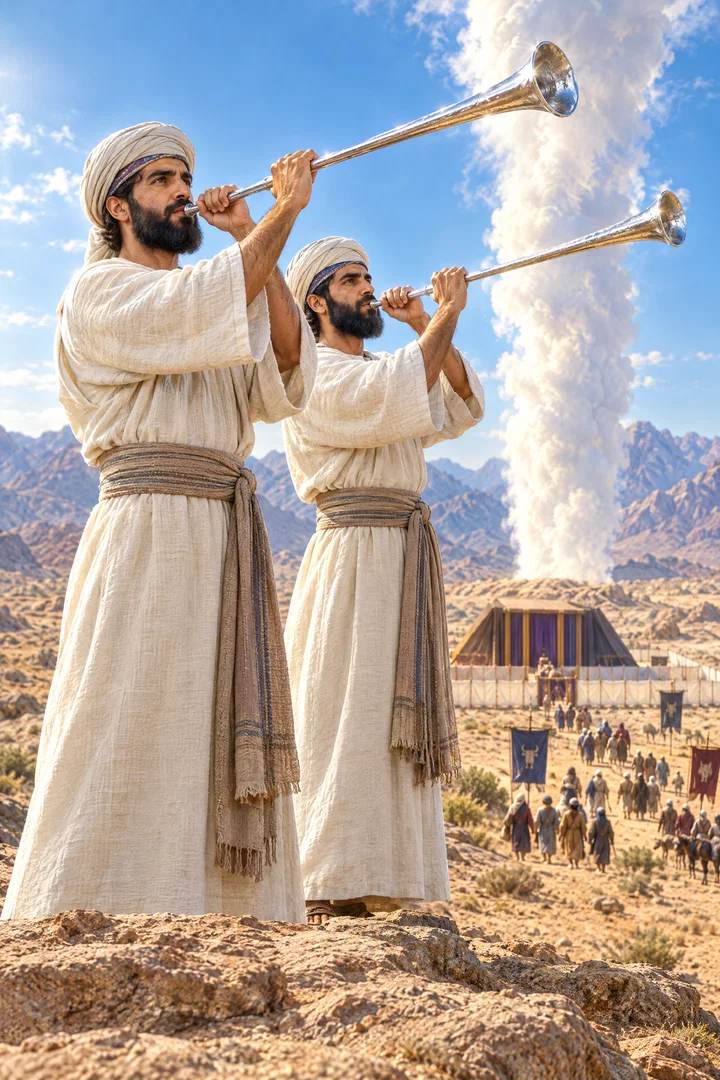
Cross-references
- Numbers 10:8-10
And the sons of Aaron, the priests, shall blow with the trumpets; and they shall be to you for an ordinance for ever throughout your generations.
Continues the instructions for using the trumpets, including on days of gladness.
- Leviticus 23:24
Speak unto the children of Israel, saying, In the seventh month, in the first day of the month, shall ye have a sabbath, a memorial of blowing of trumpets, an holy convocation.
The trumpet memorial marked the approach of atonement.
- Numbers 10:11-28
And it came to pass on the twentieth day of the second month, in the second year, that the cloud was taken up from off the tabernacle of the testimony.
The camps set out in an appointed order after the signals directed their movements.
- Matthew 24:31
And he shall send his angels with a great sound of a trumpet, and they shall gather together his elect from the four winds, from one end of heaven to the other.
The trumpet gathers the elect.
- Joel 2:1
Blow ye the trumpet in Zion, and sound an alarm in my holy mountain: let all the inhabitants of the land tremble: for the day of the LORD cometh, for it is nigh at hand;
The trumpet sounds an alarm because the day of the Lord is near.
- 2 Chronicles 5:13
It came even to pass, as the trumpeters and singers were as one, to make one sound to be heard in praising and thanking the LORD; and when they lifted up their voice with the trumpets and cymbals and instruments of musick, and praised the LORD, saying, For he is good; for his mercy endureth for ever: that then the house was filled with a cloud, even the house of the LORD;
Trumpeters sound together in praise and thanksgiving to God.
- Revelation 14:7
Saying with a loud voice, Fear God, and give glory to him; for the hour of his judgment is come: and worship him that made heaven, and earth, and the sea, and the fountains of waters.
A trumpet-call announces the judgment hour.
Commentary
Each commentary is drawn from primary sources: the writings of Ellen G. White and Adventist pioneers and periodicals. Each commentary is separate. Its own words are not a quotation; follow the references to read the source passages.
Ellen G. White
5 sources
God appointed two trumpets of silver to give the signals for calling the assembly together and for directing the journeying and movements of the camps.GW92 158.11T 650.2–652.1GW92 158.2Lt 32, 1892, par. 22–28 The trumpets were carried by the sons of Aaron, who marched just behind Moses and Aaron in front of the ark, received directions from Moses, and announced them to the people through the trumpets, while each company officer gave definite directions so that none who gave attention was left ignorant of what to do.Lt 32, 1892, par. 22–28 The trumpets gave clear, distinct, and certain special sounds for the different instructions, with a special signal first to call attention and then distinct orders to be obeyed attentively, so there was no confusion of sound.GW92 158.11T 650.2–652.1GW92 158.2Lt 32, 1892, par. 22–28
The people knew and understood the signals and were expected to give attention and obey them, so their journeys could proceed in perfect order rather than confusion of movement.GW92 158.11T 650.2–652.1GW92 158.2Lt 32, 1892, par. 22–28 At the trumpet signal for breaking camp and marching, the entire camp set forward with the tabernacle borne in the midst and each tribe in its appointed position under its own standard, all watching to see in what direction the cloud would lead.PP 377.1 Because the instructions were made known, ignorance was no excuse, and those who failed to learn or obey were responsible for their ignorance and disobedience, with refusing to learn or understand God's requirements being as blameworthy as knowingly disobeying them.1T 650.2–652.1GW92 158.2Lt 32, 1892, par. 22–28
The arrangement proves that God is a God of order who is the same in the present as in the days of Moses and designs the church now to learn order and organization from Israel.Lt 32, 1892, par. 22–28
Sources
Pioneers and periodicals
18 sources
God directed that two trumpets of silver be made, each hammered from one solid piece, to call the assembly together and to order the journeying of the camps.RH Oct 6, 1904RH Mar 12, 1908RH Mar 18, 1873 One trumpet summoned the princes while both together gathered the whole congregation, with distinct blasts for marching, for alarm in war, and for the solemn feasts, sacrifices and days of gladness.RH Oct 6, 1904RH Mar 12, 1908RH Mar 18, 1873 Each call had a fixed meaning that the people were trained to distinguish, so the clear sound left no excuse for confusion and failure to move together was willful disobedience.ST Jul 29, 1880ST Mar 4, 1913RH Sep 3, 1908RH Apr 9, 1901 Their being made of one piece signifies one gospel, one Lord, one faith and one baptism, borne by a faithful ministry to warn of danger and to gather the elect.RH Mar 18, 1873 Sounded through the camp they forewarned of the typical day of atonement and cleansing of the sanctuary, and true to that type they foreshadow the present gathering call in the third angel's message that gathers true Israel from every nation to follow Christ in the Most Holy Place onward to the promised home.RH Dec 13, 1853ST Dec 8, 1898RH Nov 7, 1912RH Dec 1850
Trumpets in Israel's Camp
God commanded Moses to make two trumpets of silver, each fashioned from one whole solid piece.RH Oct 6, 1904RH Mar 12, 1908RH Mar 18, 1873RH Apr 9, 1901RH Dec 13, 1853 Their stated purpose was for calling the assembly together and for ordering and directing the journeying and movements of the camps.RH Oct 6, 1904RH Mar 12, 1908RH Apr 9, 1901ST Dec 8, 1898 When both were sounded, all the people were to gather at the tabernacle.RH Oct 6, 1904
One trumpet summoned the princes or elders, while the same call sounded with both trumpets together gathered the whole congregation at the door of the tabernacle.RH Oct 6, 1904RH Mar 12, 1908RH Sep 3, 1908 Blowing an alarm gave marching orders for the journeying of the camps.RH Sep 3, 1908RH Dec 10, 1903 The trumpets were also for sounding an alarm for war, and for calling to solemn feasts and sacrifices, and they were sounded in days of gladness and on all occasions of joy in strains of rejoicing.RH Mar 18, 1873RH Sep 3, 1908RH Dec 10, 1903
They were kept and sounded by the priests to summon the people to the sanctuary on important occasions and to signal what they should prepare for.RH Mar 18, 1873RH Dec 13, 1853 They were given in Israel's second year after leaving Sinai, when the pillar of cloud moved and the people followed its guidance toward Kadesh-barnea.ST Jul 14, 1881RH Dec 27, 1906 That was eleven marching days from the promised land, a journey that brought the people to the land's border but also exposed their unbelief and rebellion.ST Jul 14, 1881
The silver trumpets were at first sounded as military blasts to bring the national assembly together.RH Jan 12, 1911 That earlier use, together with terrifying explosive blasts of rams' horns to strike fear into enemies, gave way under David and Solomon to a milder priestly service in which song and prayer accompanied by harp, psaltery, and cymbal were joined to the bloody sacrifices.RH Jan 12, 1911 The blowing of trumpets was a limited Jewish national ordinance, unlike the seventh-day Sabbath made at creation which is not a type or shadow pointing to Christ, so its limited duration does not establish that the Sabbath also ceased.RH Jun 10, 1862
The two trumpets later stood in temple service in front of the table of showbread with its two cups, together with the seven-branched golden candlestick and the book of the law.ST May 14, 1902 They were taken from the temple as spoils by the Romans and sculptured on the Arch of Titus.ST May 14, 1902 They were chosen for sculpture because they came from the holy place and were counted among the most important and most sacred things in the temple.ST May 14, 1902
Order and Obedient Response
Two trumpets of silver were provided for giving signals, and each call had a fixed meaning that all the people were expected to recognize and obey.ST Jul 29, 1880RH Sep 3, 1908RH Apr 9, 1901 One trumpet assembled the princes or elders, the same call with both trumpets gathered the whole congregation at the door of the tabernacle, and blowing an alarm gave marching orders for the journeying of the camps.ST Jul 29, 1880RH Sep 3, 1908 The trumpets were a means of conveying direction through distinct sounds that the people understood, so their movements followed an orderly plan.ST Jul 29, 1880RH Apr 9, 1901 They were used in days of gladness and on all occasions of joy to blow calls rendered in strains of rejoicing, and the people were trained to distinguish one call from another as readily as a veteran soldier tells the morning reveille from the evening taps, or the long roll from the marching step.RH Sep 3, 1908
The clear sounds left no excuse for confusion or ignorance, so failure to follow the instructions was willful disobedience.ST Jul 29, 1880 That strict order among the children of Israel in the wilderness, with its ceremonies, service, and wanderings, was given not because God needed it but because Israel needed to learn it.ST Jul 29, 1880ST Mar 4, 1913 Carrying out such system forms a systematic character in those who do it.ST Mar 4, 1913
The trumpets were for calling assemblies, signaling the camp to move, and sounding an alarm for war.RH Oct 6, 1904RH Mar 12, 1908RH Feb 1, 1906RH Dec 10, 1903 They were for these purposes, not for drawing attention to oneself or gaining honor for charitable acts.RH Dec 10, 1903 Their call pictures God sounding an alarm to awaken his people and calling them to move forward toward the promised land.RH Oct 6, 1904RH Feb 1, 1906 When both are sounded for gathering at the tabernacle and for moving into new territory, watchmen should repeat the call so the people respond together, united in heart and voice in praising God and without discord, and their use as a signal for Sabbath services shows worship conducted in harmony with the instruction.RH Oct 6, 1904RH Mar 12, 1908
Type and Final Gathering
The two trumpets were each hammered from one whole piece of silver, and that oneness signifies one gospel, one Lord, one faith, and one baptism.RH Mar 18, 1873 In Christian application they represent the faithful gospel ministry warning the world of coming danger, and the resurrection trumpet that will gather the elect to Mount Zion.RH Mar 18, 1873 They belonged to the priests to summon the people and to sound alarms, and also to call Israel to solemn feasts and sacrifices.RH Mar 18, 1873
God never brings a solemn event without forewarning it, and the silver trumpets sounding through the camp forewarned Israel that the typical day of judgment, the cleansing of the sanctuary and day of atonement, was near at hand.RH Nov 7, 1912 Their sound called for preparation of heart and consecration of soul before God, so that no soul would let the day pass unheeded with sins unforgiven.RH Nov 7, 1912 True to that type, the same trumpet-call sounded through Christendom as the fateful year of 1844 drew near, announcing the opening of the great antitypical day of atonement, the judgment hour in heaven.RH Nov 7, 1912
Kept and sounded by the priests to summon the people to the sanctuary on important occasions, they signaled what the people should prepare for and gave the signals for gathering the assembly and setting the camps on their journey.RH Dec 13, 1853ST Dec 8, 1898 They are a type of the present gathering call in the third angel's message, sounding to gather Christ's sheep to Him and into unity of faith.RH Dec 13, 1853 Christ, their good Shepherd and High Priest, speaks from the heavenly sanctuary, and His sheep hear and follow Him, which requires hearts made right so the Holy Spirit can reprove sin and dwell within them.RH Dec 13, 1853 While the sound in the type gathered Israel quickly around the tabernacle at the appointed time, the antitypical gathering of God's true Israel took years and reached people in every nation through the messages proclaiming the judgment hour.RH Dec 1850 At the appointed time the true Israel were to gather in their places of worship and by faith attend to Christ's work in the Most Holy Place as the sanctuary was cleansed, and that call still summons God’s people onward toward their promised home while the Holy Ghost refreshes them in the latter rain.ST Dec 8, 1898RH Dec 1850
Sources