Numbers 10:8
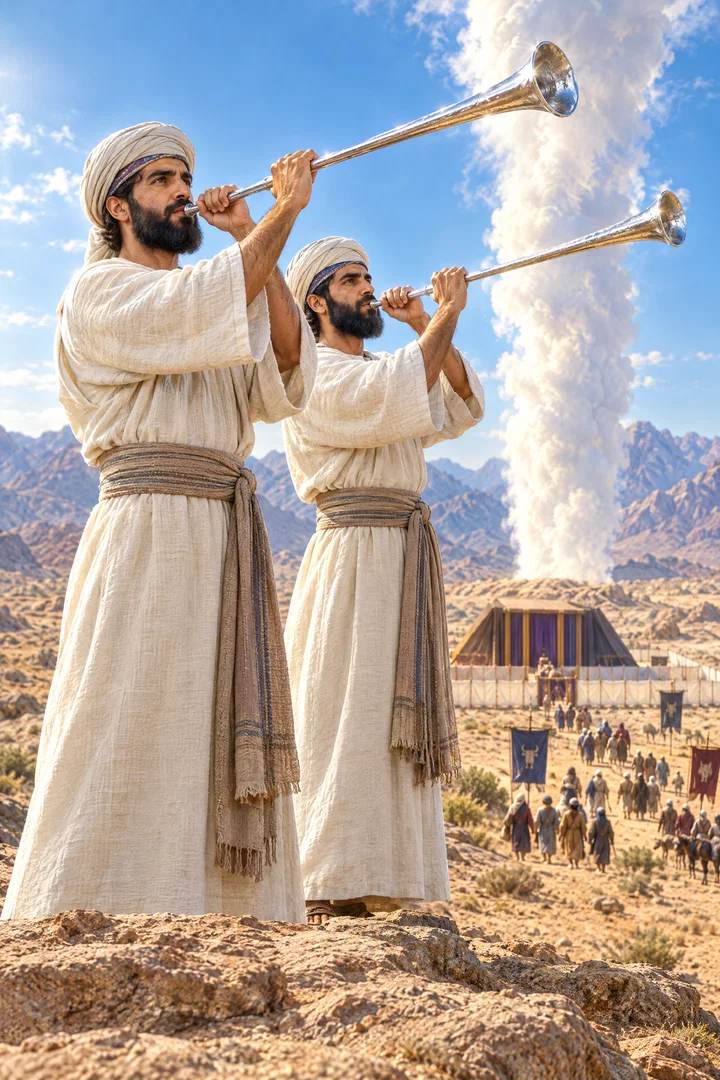
And the sons of Aaron, the priests, shall blow with the trumpets; and they shall be to you for an ordinance for ever throughout your generations.
Translations
American King James Version, King James Version, KJV Cambridge Paragraph Bible, Webster Bible
And the sons of Aaron, the priests, shall blow with the trumpets; and they shall be to you for an ordinance for ever throughout your generations.
And the sons of Aaron, the priests, shall blow with the trumpets; and they shall be to you for a statute for ever throughout your generations.
And the sons of Aaron, the priests, shall blow the trumpets; and they shall be to you for a statute for ever throughout your generations.
and sons of Aaron, the priests, blow with the trumpets; and they have been to you for a statute age-during to your generations.
the sons of Aaron, the priests, shall blow with the trumpets; and they shall be to you for an everlasting statute throughout your generations.
And, the sons of Aaron the priests, shall blow with the trumpets,—and it shall be unto you for a statute age-abiding, unto your generations.
Berean Standard Bible, Majority Standard Bible
The sons of Aaron, the priests, are to sound the trumpets. This shall be a permanent statute for you and the generations to come.
“ The sons of Aaron, the priests, shall blow the trumpets. This shall be to you for a statute forever throughout your generations.
The horns are to be sounded by the sons of Aaron, the priests; this is to be a law for you for ever, from generation to generation.
And the sonnes of Aaron the Priest shall blowe the trumpets, and ye shall haue them as a lawe for euer in your generations.
Douay-Rheims (Challoner revision)
And the sons of Aaron the priest shall sound the trumpets: and this shall be an ordinance for ever in your generations.
Pictures
Cross-references
- Joel 2:1
Blow ye the trumpet in Zion, and sound an alarm in my holy mountain: let all the inhabitants of the land tremble: for the day of the LORD cometh, for it is nigh at hand;
The trumpet alarm warns that the day of the Lord is near.
- Numbers 10:2
Make thee two trumpets of silver; of a whole piece shalt thou make them: that thou mayest use them for the calling of the assembly, and for the journeying of the camps.
The single-piece trumpets signify one gospel, one Lord, one faith, and one baptism.
- 1 Corinthians 14:8-9
For if the trumpet give an uncertain sound, who shall prepare himself to the battle?
A trumpet must give a clear signal for people to understand what to do.
- 2 Chronicles 2:4
Behold, I build an house to the name of the LORD my God, to dedicate it to him, and to burn before him sweet incense, and for the continual shewbread, and for the burnt offerings morning and evening, on the sabbaths, and on the new moons, and on the solemn feasts of the LORD our God. This is an ordinance for ever to Israel.
Both describe practices appointed as perpetual ordinances.
- Ezekiel 33:3-9
If when he seeth the sword come upon the land, he blow the trumpet, and warn the people;
The watchman’s trumpet warning illustrates ministers’ duty to warn people of danger.
Commentary
Each commentary is drawn from primary sources: the writings of Ellen G. White and Adventist pioneers and periodicals. Each commentary is separate. Its own words are not a quotation; follow the references to read the source passages.
Ellen G. White
3 sources
The blowing of the trumpets belonged to the sons of Aaron, the priests.GW92 158.11T 650.2–652.1Lt 32, 1892, par. 22–28 That appointment was made a lasting ordinance for Israel throughout its generations.1T 650.2–652.1 In the march the sons of Aaron went just in front of the ark and close to Moses and Aaron, each with a trumpet to receive directions from Moses and relay them to the people.Lt 32, 1892, par. 22–28
The trumpets gave distinct, certain sounds that the people knew and understood, telling them when and how to move so that all could act in order.GW92 158.11T 650.2–652.1Lt 32, 1892, par. 22–28 A special signal first called the people to attention, and then commands followed that all were to heed attentively.Lt 32, 1892, par. 22–28 There was no confusion in the trumpet sounds and therefore no excuse for confusion in movement, and the head officer of each company gave definite directions so that everyone who paid attention knew what to do.Lt 32, 1892, par. 22–28
By this arrangement perfect order and thorough discipline were instituted for journeying and camping.Lt 32, 1892, par. 22–28 The God who established it through Moses is the same God of order now as then, and order and organization are to be learned today from what was then established for Israel.Lt 32, 1892, par. 22–28
Sources
Pioneers and periodicals
11 sources
The verse belongs to the instructions for Israel's camp signals and marching in the wilderness.ST Feb 17, 1909RH Feb 1, 1906 Its setting is Israel taking up the journey again to the Promised Land after their education at Sinai, where God kept them nearly a year, feeding them daily with the corn of heaven and giving them water from the riven rock to teach that man does not live by bread alone but by every word from the mouth of God, though the journey from Horeb to the Promised Land was only eleven days' distance. It commands that the sons of Aaron, the priests, shall blow with the trumpets, and that this shall be a lasting ordinance for Israel throughout its generations.ST Jul 29, 1880RH Mar 18, 1873RH Feb 1, 1906RH Mar 4, 1875RH Apr 9, 1901
The trumpets gave distinct and clear signals that conveyed Moses' directions and guided the people's movements, so they could understand what to do and move in order, leaving those who heard the signals with no excuse for disobedience.ST Jul 29, 1880RH Apr 9, 1901 The trumpets were appointed for calling assemblies, signaling the camp to move, and sounding an alarm of war, with the alarm signaling the camp to move forward toward the promised land.RH Feb 1, 1906RH Dec 10, 1903 The trumpet service was not given to draw attention to oneself or to win honor from people.RH Dec 10, 1903 The verse shows part of the ceremonies and service of Israel in the wanderings and part of the very strict order God had among His children, given not because He needed it but because Israel needed to learn it, since carrying out system forms a systematic character in the one who does it.ST Mar 4, 1913
As the priests warned Israel of approaching danger, the verse is a pattern for ministers of God to understand the unfolding of God's work and warn people when judgments are declared and about to fall on the unfaithful.ST Feb 8, 1883ST Jun 3, 1875RH Mar 4, 1875 In prophetic application, the priests' trumpet-blowing represents the faithful gospel ministry sounding the worldwide warning of coming danger, and the trumpet also points to the resurrection call that gathers the elect to Mount Zion.RH Mar 18, 1873 The alarm to move forward applies to God sounding an alarm in Zion and stirring His people to advance the work.RH Feb 1, 1906 Its word forever does not mean unending observance, for the trumpet ordinance belonged to Israel's national and ceremonial system and, like other types and shadows, lasted until Christ fulfilled its purpose; this limited duration does not apply to the seventh-day Sabbath, which is not a type but a creation memorial and part of God's enduring law.RH Jun 10, 1862
Sources