Numbers 25:7
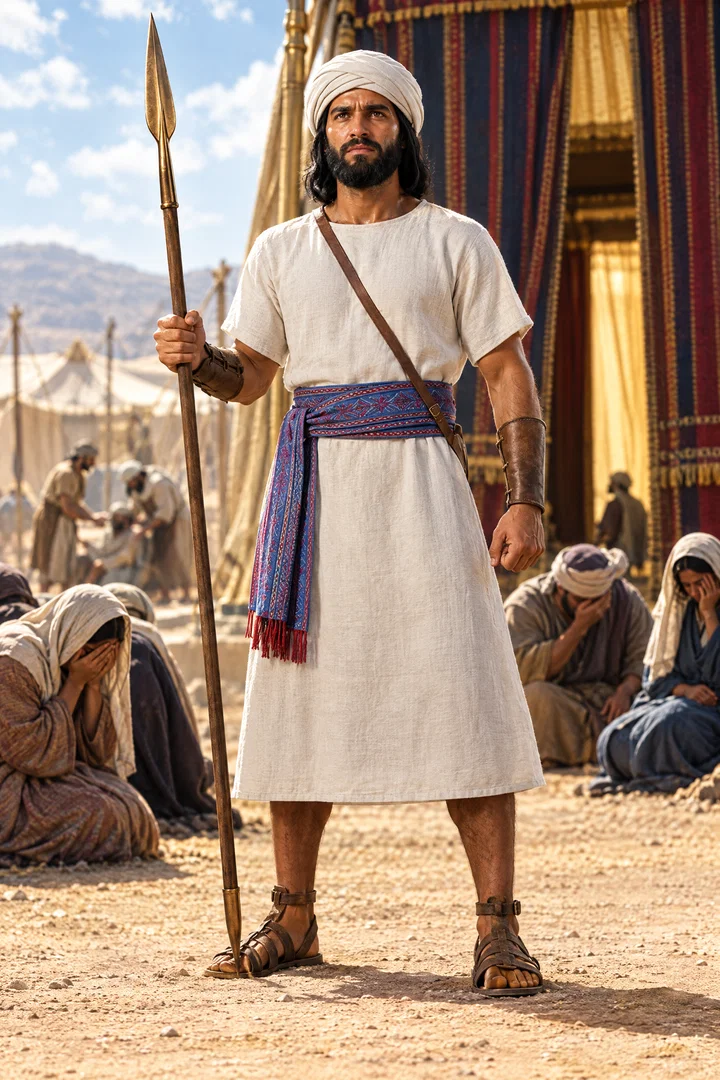
And when Phinehas, the son of Eleazar, the son of Aaron the priest, saw it, he rose up from among the congregation, and took a javelin in his hand;
Translations
American King James Version, King James Version
And when Phinehas, the son of Eleazar, the son of Aaron the priest, saw it, he rose up from among the congregation, and took a javelin in his hand;
And when Phinehas, the son of Eleazar, the son of Aaron the priest, saw it, he rose up from amongst the congregation, and took a javelin in his hand;
And when Phinehas, the son of Eleazar, the son of Aaron the priest, saw it, he rose from among the congregation, and took a javelin in his hand;
Revised Version, American Standard Version
And when Phinehas, the son of Eleazar, the son of Aaron the priest, saw it, he rose up from the midst of the congregation, and took a spear in his hand;
and Phinehas, son of Eleazar, son of Aaron, the priest, seeth, and riseth from the midst of the company, and taketh a javelin in his hand,
And Phinehas, the son of Eleazar, the son of Aaron the priest, saw it, and rose up from among the assembly, and took a javelin in his hand,
And Phinehas son of Eleazar, son of Aaron the priest saw it, so he rose up out of the midst of the assembly, and took a spear in his hand;
Berean Standard Bible, Majority Standard Bible
On seeing this, Phinehas son of Eleazar, the son of Aaron the priest, got up from the assembly, took a spear in his hand,
When Phinehas, the son of Eleazar, the son of Aaron the priest, saw it, he rose up from the middle of the congregation, and took a spear in his hand.
And Phinehas, the son of Eleazar, the son of Aaron the priest, seeing it, got up from among the people and took a spear in his hand,
And when Phinehas the sonne of Eleazar the sonne of Aaron the Priest sawe it, hee rose vp from the middes of the Congregation, and tooke a speare in his hand,
Douay-Rheims (Challoner revision)
And when Phinees the son of Eleazar the son of Aaron the priest saw it, he rose up from the midst; of the multitude, and taking a dagger,
Pictures
Cross-references
- 1 Corinthians 10:8
Neither let us commit fornication, as some of them committed, and fell in one day three and twenty thousand.
Israel’s sexual sin and resulting deaths warn against fornication.
- Psalms 106:30-31
Then stood up Phinehas, and executed judgment: and so the plague was stayed.
Phinehas’s judgment stopped the plague and was counted as righteousness.
- Deuteronomy 4:3-4
Your eyes have seen what the LORD did because of Baal-peor: for all the men that followed Baal-peor, the LORD thy God hath destroyed them from among you.
Recalls Baal-peor’s judgment, contrasting those destroyed with those who remained faithful.
- Numbers 25:11-13
Phinehas, the son of Eleazar, the son of Aaron the priest, hath turned my wrath away from the children of Israel, while he was zealous for my sake among them, that I consumed not the children of Israel in my jealousy.
God commends Phinehas’s zeal and grants him a covenant of peace and an enduring priesthood.
- Numbers 31:16
Behold, these caused the children of Israel, through the counsel of Balaam, to commit trespass against the LORD in the matter of Peor, and there was a plague among the congregation of the LORD.
Explains that Balaam’s counsel led Israel into Peor’s sin and the ensuing plague.
- Numbers 25:3
And Israel joined himself unto Baal-peor: and the anger of the LORD was kindled against Israel.
Israel’s defection to Baal-peor is the wrongdoing Phinehas opposes.
- Malachi 2:4-6
And ye shall know that I have sent this commandment unto you, that my covenant might be with Levi, saith the LORD of hosts.
Phinehas’s faithful action reflects Levi’s covenant of life and peace and turning people from iniquity.
- Revelation 2:14
But I have a few things against thee, because thou hast there them that hold the doctrine of Balaam, who taught Balac to cast a stumblingblock before the children of Israel, to eat things sacrificed unto idols, and to commit fornication.
Balaam’s teaching led Israel into idolatry and sexual sin.
- Psalms 106:28
They joined themselves also unto Baal-peor, and ate the sacrifices of the dead.
Israel joined Baal-peor and ate sacrifices to the dead.
- 1 Corinthians 10:11
Now all these things happened unto them for ensamples: and they are written for our admonition, upon whom the ends of the world are come.
Israel’s recorded experiences were written as warnings for later generations.
- Numbers 25:17-18
Vex the Midianites, and smite them:
doom pronounced when probation ended
- Numbers 25:2
And they called the people unto the sacrifices of their gods: and the people did eat, and bowed down to their gods.
Israel joined the feast and sacrificed to their gods.
- Numbers 31:2
Avenge the children of Israel of the Midianites: afterward shalt thou be gathered unto thy people.
The command to avenge Israel followed the Midianites’ sin.
- Exodus 32:27-28
And he said unto them, Thus saith the LORD God of Israel, Put every man his sword by his side, and go in and out from gate to gate throughout the camp, and slay every man his brother, and every man his companion, and every man his neighbour.
Both describe summary punishment carried out by men under the theocracy.
Commentary
Each commentary is drawn from primary sources: the writings of Ellen G. White and Adventist pioneers and periodicals. Each commentary is separate. Its own words are not a quotation; follow the references to read the source passages.
Ellen G. White
20 sources
Phinehas saw an Israelite prince openly bring a Midianite woman into the camp in bold impurity while the congregation wept before the tabernacle under plague, and he rose from among them with a javelin, followed them into the tent and thrust them both through to stop the crime.Ms 162, 1903, par. 3–8Ms 83, 1904, par. 7–10PP 455.2–3 This belonged to Israel's national apostasy at Baal-peor near the close of the wilderness wandering, when at Balaam's suggestion Satan ensnared them through Midianite women and a heathen feast into idolatry and licentious transgression on the borders of the promised land.PP 454.4SLP 168.3ST Jan 6, 1881 By that zealous deed the plague was stayed after twenty-four thousand died for joining to Baal-peor, God's wrath was turned away so He consumed not Israel, and Phinehas received God's covenant of peace, even an everlasting priesthood for him and his seed.Ms 162, 1903, par. 3–8Ms 83, 1904, par. 7–10PP 455.2–3 The judgment destroyed all who followed Baal-peor with disease and death while those who cleaved to the Lord and kept His commandments lived unharmed, showing obedience brings life and disobedience brings disaster.Lt 9, 1898, par. 10–12ST Jan 6, 1888 All this happened as an ensample and is written for admonition upon whom the ends of the world are come, for the same snare laid just before entering Canaan is laid for God's people now who are repeating that history.STM2 4.3ST May 12, 1881CH 613.3Ms 79, 1908, par. 13–15
Setting and Zealous Action
This moment belongs to Israel's national apostasy at Baal-peor near the close of the wilderness wandering on the very borders of the promised land just before entering Canaan.PP 454.4STM2 4.3PK 293.2–294.1 At Balaam's suggestion carried out through the Midianite women, Satan laid a snare by a feast connected with heathen worship, enticing Israel to sin and transgression.SLP 168.3ST Jan 6, 1881ST Jan 6, 1881 Licentious practices spread from Mount Peor into the camp, drawing Israel into brazen impurity and idolatry and provoking the indignation of Moses and the wrath of God.PP 454.4SLP 168.3Lt 22, 1892, par. 15–16
The immediate scene was grief and judgment, with the congregation weeping before the door of the tabernacle over its sin while the plague was killing the people during God's reproof.Ms 162, 1903, par. 3–8Ms 83, 1904, par. 7–10PP 455.2–3 Into that mourning came bold, defiant sexual immorality, when an Israelite prince openly brought a Midianitish woman to his brethren in grave public wrong.Ms 162, 1903, par. 3–8Ms 83, 1904, par. 7–10PP 455.2–3ASCOP 26.1–27.1 Phinehas, the son of Eleazar, the son of Aaron the priest, saw it and rose up decisively from among the congregation, took a javelin in his hand, and went after them into the tent to thrust both through, killing the man of Israel and the woman.Ms 162, 1903, par. 3–8Ms 83, 1904, par. 7–10PP 455.2–3 That decisive action was commanded by God to stop the offender and to stop the advance of impurity and crime, which had become so bold that only the severest punishment could stop it.Ms 83, 1904, par. 7–10ASCOP 26.1–27.1Lt 22, 1892, par. 15–16
By that deed the plague was stayed from Israel after twenty-four thousand died for joining unto Baal-peor.Ms 162, 1903, par. 3–8PP 455.2–3 It was zeal for God that turned God's wrath away from Israel and made an atonement for Israel so that God consumed them not in His jealousy.Ms 162, 1903, par. 3–8Ms 83, 1904, par. 7–10PP 455.2–3 God gave Phinehas His covenant of peace, even the covenant of an everlasting priesthood for him and his seed after him.Ms 162, 1903, par. 3–8PP 455.2–3 The slaying connected with the sin is also reckoned as twenty-three thousand slain by the sword at God's command through Moses, and the fall connected with the fornication is also reckoned as three and twenty thousand falling in one day.SLP 168.3Ms 79, 1908, par. 13–15
Judgment and Last-Day Warning
The record at Baal-peor reveals a clear distinction by God between the disobedient and the faithful.Lt 9, 1898, par. 10–12 Israel separated from God by fixing the will on self-indulgence against His direct commands and following temptation into idolatry, bringing disaster and laying the nation under the curse.ST Jan 6, 1888 All the men that followed Baal-peor were destroyed from among the people, smitten with disease and death.ST Jan 6, 1888 By contrast those who cleaved unto the Lord and kept His commandments were alive and unharmed that day, proving that obedience brings blessedness, prosperity and life and that the commandments are not grievous while the people remain firm in allegiance.ST Jan 6, 1888
The judgment that followed was both just upon the guilty and merciful toward Israel.ST Jan 6, 1881 Those led into sin were destroyed, and the severe punishment stopped the advance of impurity and crime.ASCOP 26.1–27.1RH Aug 31, 1905 Impurity and crime had become so bold that only the severest punishment could stop their advance.Lt 22, 1892, par. 15–16 Their continued influence could have corrupted all Israel, so the judgment warned the people not to dishonor God and disregard His law.RH Aug 31, 1905 It also gave Israel victory over a people seeking by every evil art to destroy them.ST Jan 6, 1881
The wile laid for Israel filled up the measure of Midianite iniquity, ended their day of probation, and closed the door of mercy to them.ST Jan 6, 1881 This brought the divine mandate to vex the Midianites and smite them in judgment.ST Jan 6, 1881 The Midianite women were the principal criminals, idolatrous and licentious, and sparing them as captives would constantly endanger the morals of Israel.ST Jan 6, 1881 Thorough execution of God's command against the guilty was therefore required.ST Jan 6, 1881
Such execution was not to gratify malice or revenge but as God's instrument in obedience to Him from zeal for the divine glory.ST Jan 6, 1881 God requires His messengers to faithfully perform the appointed work of judgment however repugnant to natural feeling, and He reproves lack of faithfulness rather than too great thoroughness and severity.ST Jan 6, 1881 This is because sin is a deadly contaminating leprosy, God as Creator and owner has full right to take abused blessings from persistent despisers of divine authority, and His name and authority as ruler must be maintained against idolatry, blasphemy and rebellion, with certain retribution in the future judgment upon every evildoer according to deeds done.ST Jan 6, 1881 Sympathy that spares transgressors is contrary to the will of God and is not the charity of the Bible.ST Jan 6, 1881 The friendship of the wicked is more dangerous than their enmity, for none can prevail against the servants of the living God except by tempting them to disobedience, and the offensive character of such sin is estimated only in the light of the cross, where Christ took upon Himself the guilt of the disobedient and suffered in the sinner's stead.ST Jan 6, 1881
At that time the conditions of the covenant were repeated, and those who remained faithful renewed their vows of allegiance.PK 293.2–294.1 Through Moses Israel was warned against temptations that would assail them in the future and earnestly exhorted to remain separate from the surrounding nations and to worship God alone.PK 293.2–294.1 This was by hearkening to His statutes and judgments in obedience, that they might live and possess the land.PK 293.2–294.1
The outbreak of fornication brought a signal manifestation of God's displeasure, with judgment following close upon the heinous sin when thousands fell and their polluted bodies were left in the wilderness.CH 613.3 The fall is also reckoned as three and twenty thousand falling in one day.Ms 79, 1908, par. 13–15 Although all were under the cloud and passed through the sea and were baptized unto Moses in the cloud and in the sea and ate the same spiritual meat and drank the same spiritual drink from the spiritual Rock that followed them, which was Christ, with many of them God was not well pleased and they were overthrown in the wilderness.Ms 79, 1908, par. 13–15 All these things happened for ensamples to keep people from lusting after evil things and from committing fornication, idolatry, tempting Christ and murmuring, and are written for admonition upon whom the ends of the world are come.Ms 162, 1903, par. 3–8Ms 79, 1908, par. 13–15 This is because Israel placed itself on a level with idolatrous nations and suffered the sure results of its own choice; the facts are to be repeated lest they be forgotten, so that him that thinketh he standeth must take heed lest he fall, knowing no temptation is uncommon and God is faithful to make a way of escape to bear it.Ms 162, 1903, par. 3–8
The failure just before entering Canaan warns that God's people can be caught in snares through impurity and other sins.STM2 4.3 The same snare of Satan laid just prior to entrance into Canaan is laid for God's people now, who are repeating that history.HL 280.2 Terrible judgments fell upon the guilty, yet many still cherished the same sins afterward.ST May 12, 1881 Phinehas held up that punishment as a warning against rebelling against the Lord, fearing that Israelites living surrounded by worshipers of that idol would again be led to partake of its iniquity and bring wrath upon the whole nation.ST May 12, 1881 The fearful results of the sin remained fresh in Israel's memory and shaped their horror as they looked upon Jericho.PP 487.2
Sources
Pioneers and periodicals
35 sources
Phinehas the grandson of Aaron seized a spear and struck down a prominent Israelite and his Midianite companion in the midst of Israel's flagrant apostasy with Baal-peor at Shittim, while the congregation wept before the tabernacle and the plague was still killing. ST Dec 30, 1880RH Dec 17, 1903RH Dec 8, 1910 That apostasy had been deliberately engineered after Balaam failed to curse Israel, for he counseled Balak that Israel could only be overcome by drawing them into sin through idolatrous feasts and immoral women. ST Apr 28, 1909RH Jun 10, 1862STRH Jun 10, 1862 The worship they joined was sun-worship under Baal as lord of reproduction, whose rites made eating sacrifices to the dead and gross sensual prostitution inseparable from idolatry. ST Dec 3, 1902RH Jun 20, 1907ST Mar 11, 1889ST Aug 21, 1901 God honored Phinehas's prompt and decisive zeal for His honor by staying the plague, giving him His covenant of peace and confirming the priesthood to his house forever as righteousness. ST Dec 30, 1880RH Oct 3, 1907RH Dec 17, 1903 The event stands as a warning at the end of the world against friendship with the wicked, unlawful union with the world, and lusting after evil things, and as a call for moral courage to step forward on the Lord's side to put sin out of the camp. ST Sep 10, 1912STST Feb 15, 1910RH Sep 7, 1869ST May 31, 1899
Setting and Action
The verse falls in Israel's final and most flagrant apostasy in the valley of Shittim, when the hosts had been brought a second time to the borders of the promised land after forty years of wandering. They had been led there by the fiery, cloudy pillar, and the plague that followed this apostasy struck down the last of the original host that had been led out of Egypt.
Midian and Moab deliberately sought to draw Israel into sin in order to bring divine judgment upon the nation, using immoral women and carrying out the plan openly and brazenly.ST Apr 28, 1909RH Sep 4, 1860 This followed Satan's futile effort through Balak and gold-loving Balaam to defeat God's purpose by cursing Israel in Numbers 22 to 24, which ended instead in blessings.ST Feb 21, 1911 Israel could be overcome only through sin, and Balaam sold himself to destroy them by counseling this wile.ST Feb 21, 1911 In doing so he betrayed his prophetic office for gain and led the people into wrongdoing.ST
The sin was joining to Baal-peor and eating sacrifices offered to the dead.RH Jun 20, 1907 Baal-peor was Baal worshiped as the sun-god Baal Shamen, lord of the heavens, highest of the heavenly bodies yet only a power of nature born from primitive chaos.ST Mar 11, 1889 As sun-god he was conceived as the male principle of life and reproduction in nature and was patron of the grossest sensuality and even systematic prostitution, worshiped at the high places in association with Ashera, the female principle of nature.ST Mar 11, 1889 Israel's sitting down to eat and drink and rising up to play reveals the heinous sensual nature of the sin, for play there means sexual mocking.ST Mar 11, 1889 The account shows Lucifer's plan to make men forget the Creator by substituting sensuous sight for faith, exalting self, clothing created things with human ideas of Deity, and making the sun the chief visible object, bringing with it all nature worship in which sexuality became inseparably connected and most grossly licentious.ST Aug 21, 1901
Phinehas, the son of Eleazar, the son of Aaron the priest, rose up from among the congregation while the people were weeping before God at the door of the tabernacle.ST Dec 30, 1880 At that time the plague was still doing its work of death and the magistrates were executing the order to slay those joined to Baal-peor.ST Dec 30, 1880 A noble of Israel, Zimri, had boldly brought a Midianitish princess into camp and escorted her to his tent, and when Phinehas saw the wickedness he took a javelin and thrust them both through.ST Dec 30, 1880RH Dec 8, 1910 His rising with the javelin when he saw the sin at the tabernacle was in zeal for God to put the sin out of Israel's camp.RH May 29, 1913 The act required moral courage to oppose even those close to him and showed just abhorrence of the licentiousness and idolatry that had brought calamity upon Israel.ST Dec 30, 1880RH Dec 17, 1903
God approved Phinehas's prompt, determined, decisive act when His honor was at stake.ST Dec 30, 1880RH Oct 3, 1907 The plague was stayed and peace was brought to Israel by the deed that stopped it.ST Dec 30, 1880RH Dec 17, 1903 He was honored before all Israel with God's covenant of peace and lasting blessing, with the priesthood confirmed to him and to his house forever.ST Dec 30, 1880RH Oct 3, 1907RH Dec 8, 1910 That judgment he carried out was counted to him as righteousness for all generations.RH Dec 17, 1903
The judgments destroyed the survivors of that vast company who nearly forty years before had provoked the Lord to swear they should not enter Canaan.ST Dec 30, 1880 So when the people were numbered just prior to the death of Moses, none was left save Caleb the son of Jephunneh, strictly fulfilling God's word.ST Dec 30, 1880 The wile by which Israel was enticed to sin at Balaam's suggestion, destroying many thousands of Israelites, filled up the measure of Midianite iniquity, ended their day of probation, and closed mercy to them with the divine mandate to vex and smite them.ST Jan 6, 1881 This explains the judgment against Midian in Numbers 31 as a divinely directed act meant to save Israel from destruction and to spare future generations from being formed by such corruption.ST Apr 28, 1909
Teaching and Prophecy
The rising of Phinehas belongs to the account of Israel's unlawful union with the Moabites, which illustrates the doctrine of Balaam.RH Jun 10, 1862 Balaam taught Balak to place a stumbling-block before Israel, leading the people to eat food sacrificed to idols and to commit fornication.RH Jun 10, 1862 The outcome shows the guilt of God's people in allying themselves with the world through marriage contrary to God's command.RH Mar 9, 1869 That intermingling with aliens violated Israel's separation, and its swift punishment was a safeguard meant to preserve the people and the promised lineage of the Messiah.RH Apr 8, 1915
The smiling daughters of Moab did more mischief to Israel than all Balak's frowning warriors could do by hatred and persecution.ST Jan 17, 1884 Persecution seldom harms the spiritual life, but friendship and kindness from sinful persons disarm believers and draw them into sharing their sins.ST Jan 17, 1884 The friendship of the wicked is more dangerous than their enmity, for none can prevail against the servants of the living God except by tempting them to disobedience.ST Jan 6, 1881 Balak's gormandizing, idolatrous, licentious feast in honor of Moab's gods means being led away by men professing to be God's children to the false doctrines of pagan philosophy about God and the soul and man's duty, and to commit fornication with the kings of the earth.ST Dec 3, 1902 It marks backsliding in which even God's best people yield by tolerating evil, including the licentiousness and fornication, physical and spiritual, of the Nicolaitans once hated and now tolerated.ST Dec 3, 1902
To sacrifice to idols in that feast is to sacrifice to the dead, for pagan deities were but deified dead heroes.ST Dec 3, 1902 To sacrifice to the dead is to sacrifice to demons, for supposed spirits of the dead are demons in disguise, met in Mariolatry, adoration of saints, and modern Spiritism.ST Dec 3, 1902 That unlawful union serves as a pattern for the later union of civil and ecclesiastical powers that formed the Papacy.RH Jun 10, 1862 The judgment that followed was both just upon the guilty and merciful toward Israel in giving victory over a people seeking by every evil art to destroy them.ST Jan 6, 1881
Its execution was not to gratify malice or revenge but as God's instrument in obedience from zeal for the divine glory.ST Jan 6, 1881 God requires His messengers to faithfully perform appointed judgment however repugnant to feeling and reproves lack of faithfulness rather than too great thoroughness, because sin is a deadly contaminating leprosy, God as Creator and owner has full right to take abused blessings from persistent despisers of authority, and His name and authority must be maintained against idolatry, blasphemy and rebellion with certain future retribution upon every evildoer according to deeds.ST Jan 6, 1881 Destroying those led into sin was mercy because their continued influence could have corrupted all Israel, and warned against dishonoring God and disregarding His law.RH Aug 31, 1905 Thorough execution was required since the Midianite women were the principal idolatrous, licentious criminals whose sparing as captives would endanger Israel's morals, and sympathy sparing transgressors is contrary to God's will and not Bible charity.ST Jan 6, 1881 God carried out summary punishment through men under the theocracy, and He has not changed and was no less merciful then than now; that kind of execution is not seen this side of the crucifixion, but as truly as that age's sin was punished so surely this age's sin will be punished, for sin is death and righteousness is life.ST Jan 2, 1901
At Baal-peor Israel separated from God, fixed the will on self-indulgence against His direct commands, and followed Satan's temptation into idolatry.ST Jan 6, 1888 That transgression brought disaster and curse so that all men following Baal-peor were destroyed, smitten with disease and death.ST Jan 6, 1888 By contrast those who cleaved to the Lord and kept His commandments were alive and unharmed that day, proving obedience brings blessedness, prosperity and life and the commandments are not grievous while the people remain firm in allegiance.ST Jan 6, 1888 The offensive character of such sin is estimated only in the light of the cross, where Christ took the guilt of the disobedient and suffered in the sinner's stead.ST Jan 6, 1881
Warning and Duty
The record of Baal-peor stands as an exceptionally evil event whose sexual sin and deadly consequences were written to serve as an example and warning, especially for those living at the end of the world, not to repeat Israel's sins.ST Feb 15, 1910RH Sep 7, 1869ST May 31, 1899 What happened there was not left unrecorded but preserved in Israel's history precisely that later generations would take heed from its serious outcome.ST Feb 15, 1910RH Sep 7, 1869ST May 31, 1899
Even after all were under the cloud and passed through the sea and were baptized unto Moses in the cloud and in the sea, and all ate the same spiritual meat and drank the same spiritual drink from the spiritual Rock that followed them, which was Christ, Israel committed fornication and fell in one day three and twenty thousand.ST Aug 13, 1912 With many of them God was not well pleased, and they were overthrown in the wilderness.ST Aug 13, 1912 These things happened as examples to keep from lusting after evil things, from idolatry, from fornication, from tempting Christ, and from murmuring, and they are written for admonition upon whom the ends of the world are come, so that whoever thinks he stands takes heed lest he fall.ST Aug 13, 1912
The call from the judgments at Shittim is to flee youthful lusts in order to preserve physical health, vigorous intellect, and sound morals.ST Dec 30, 1880 The smiling daughters of Moab did more mischief than all Balak's frowning warriors could do by hatred and persecution, for persecution seldom harms the spiritual life while friendship and kindness from sinful persons disarm believers and draw them into sharing their sins.ST Jan 17, 1884 When cast among sinful persons who respect the believer, peculiar watchfulness and careful walking are required, especially by a friendly sinner's door.ST Jan 17, 1884
In contrast to Balaam, who betrayed his prophetic office for gain and helped bring Israel into sin through counsel, Phinehas stood against the resulting evil.ST Sep 10, 1912STST His rising from the congregation with a javelin manifests old-time loyalty: unswerving faithfulness to truth, loyalty to God and loyalty to truth, and separation from sin joined with a burden of soul for sinners.ST Sep 10, 1912STST When God's honor was at stake he responded decisively upon seeing the sin, taking the javelin to put the sin out of the camp, and his act is an example of stepping forward on the Lord's side.ST Sep 10, 1912RH May 29, 1913RH Oct 3, 1907 That zeal is approved when it comes from loyalty to God and His righteousness rather than selfish ambition or worldly interest, and it is applied as a call not to hesitate when God's people need to confront and remove sin from the camp.RH May 29, 1913RH Oct 3, 1907
His rising with the javelin when he saw wickedness required moral courage to oppose even those close to him.RH Dec 17, 1903RH Dec 17, 1903 The decisive stand and judgment he carried out stopped the plague and brought peace to Israel, and was counted to him as righteousness for all generations.RH Dec 17, 1903RH Dec 17, 1903RH Dec 17, 1903 His action illustrates that true peace requires standing against evil, even when those who expose evil are wrongly accused of disturbing the peace.RH Dec 17, 1903RH Dec 17, 1903RH Dec 17, 1903
God does not now ask that such judgment be executed, for that belongs to Him.ST Sep 10, 1912 Yet zealous and decided efforts to check bold, presumptuous wickedness bring hatred and maligning from wrong-doers but honor and recompense from God.ST Dec 30, 1880ST Sep 10, 1912 Phinehas held up that punishment as a warning against rebelling against the Lord, fearing that Israelites living surrounded by worshipers of that idol would again partake of its iniquity and bring wrath upon the whole nation, though terrible judgments had fallen upon the guilty and many still cherished the same sins afterward.ST Dec 30, 1880ST May 12, 1881
Sources