Revelation 6:3
And when he had opened the second seal, I heard the second beast say, Come and see.
Translations
American King James Version, King James Version, KJV Cambridge Paragraph Bible
And when he had opened the second seal, I heard the second beast say, Come and see.
And when he had opened the second seal, I heard the second living being say, Come and see.
Revised Version, American Standard Version
And when he opened the second seal, I heard the second living creature saying, Come.
And when he opened the second seal, I heard the second living creature saying, 'Come and behold!'
And when it opened the second seal, I heard the second living creature saying, Come [ and see].
And, when he opened the second seal, I heard the second living creature, saying—Go!
Berean Standard Bible, Majority Standard Bible
And when the Lamb opened the second seal, I heard the second living creature say, “ Come!”
When he opened the second seal, I heard the second living creature saying, “ Come!”
And when the second stamp was undone, the voice of the second beast came to my ears, saying, Come and see.
And when he had opened the seconde seale, I heard the second beast say, Come and see.
Douay-Rheims (Challoner revision)
And when he had opened the second seal, I heard the second living creature, saying: Come, and see.
Pictures
Cross-references
- Revelation 5:1-7
And I saw in the right hand of him that sat on the throne a book written within and on the backside, sealed with seven seals.
Christ takes the sealed book and is worthy to open its seals.
- Revelation 6:7
And when he had opened the fourth seal, I heard the voice of the fourth beast say, Come and see.
The fourth living creature repeats the “Come and see” call at the fourth seal.
- Revelation 8:1
And when he had opened the seventh seal, there was silence in heaven about the space of half an hour.
The seventh seal follows the series of seals opened in chapter six.
- Zechariah 6:1-8
And I turned, and lifted up mine eyes, and looked, and, behold, there came four chariots out from between two mountains; and the mountains were mountains of brass.
Both visions feature symbolic horses sent out across the earth.
- Revelation 5:5-6
And one of the elders saith unto me, Weep not: behold, the Lion of the tribe of Juda, the Root of David, hath prevailed to open the book, and to loose the seven seals thereof.
The victorious Lion and sacrificial Lamb opens the seals.
- Revelation 4:6-8
And before the throne there was a sea of glass like unto crystal: and in the midst of the throne, and round about the throne, were four beasts full of eyes before and behind.
Describes the four beasts associated with the seal openings.
- Ezekiel 10
Then I looked, and, behold, in the firmament that was above the head of the cherubims there appeared over them as it were a sapphire stone, as the appearance of the likeness of a throne.
Provides a key to understanding Revelation’s four living creatures.
- Revelation 4:1
After this I looked, and, behold, a door was opened in heaven: and the first voice which I heard was as it were of a trumpet talking with me; which said, Come up hither, and I will shew thee things which must be hereafter.
Opens the heavenly sanctuary vision containing the seals.
- Revelation 7:1-4
And after these things I saw four angels standing on the four corners of the earth, holding the four winds of the earth, that the wind should not blow on the earth, nor on the sea, nor on any tree.
The opened seals precede a future time for sealing God’s servants.
Commentary
Each commentary is drawn from primary sources: the writings of Ellen G. White and Adventist pioneers and periodicals. Each commentary is separate. Its own words are not a quotation; follow the references to read the source passages.
Ellen G. White
2 sources
The opening of the second seal belongs to the revelation of God's terrible judgments given in Revelation 6 and 7, a portrayal full of meaning.15MR 219.2–220.1Ms 59, 1895, par. 26–30 It is part of the description of the Lord going forth to punish the inhabitants of the earth for their iniquity, at the time when the earth shall disclose her blood and shall no more cover her slain.15MR 219.2–220.1Ms 59, 1895, par. 26–30 It means His right hand shall dash His enemies in pieces.15MR 219.2–220.1
It stands connected with the seven angels who stood before God to receive their commission and to whom were given seven trumpets.15MR 219.2–220.1 It points to the coming plagues of God, when hail about the weight of a talent will fall upon the wicked who would not care for and obey God but insulted Him and despised all His mercies.15MR 219.2–220.1Ms 59, 1895, par. 26–30 That hail will be far greater than any hail known in the present.Ms 59, 1895, par. 26–30
Sources
Pioneers and periodicals
85 sources
When the Lamb opens the second seal the second living creature calls John to come and see the living representation of what follows on earth.ST May 8, 1907RH Nov 20, 1900RH Apr 25, 1865 The red horse denotes blood and carnage, signifying the persecution and martyrdom of Christ's followers under pagan Rome from the second century to the beginning of the fourth century, the period of the Smyrna church.RH Jul 8, 1862RH Nov 20, 1900RH Apr 25, 1865RH Nov 20, 1900 The change from the white horse to the red marks the loss of the gospel's original purity after apostolic days, as error, worldliness and wrong teaching entered and the great apostasy developed.RH May 22, 1913ST Mar 27, 1879ST Nov 28, 1895 Peace was also taken from within the professed church through ambition, strife and Christians turned against one another, reaching its climax in union of church and state under Constantine about A.D. 323.ST Jul 18, 1916ST Mar 27, 1879RH Feb 2, 1864RH Nov 20, 1900ST Jan 3, 1878 The seven seals form a complete consecutive history of the Christian church from the apostolic age to the close of probation and Christ's second coming, presenting its external history in relation to civil powers and the great controversy to its triumphant end.ST Jan 15, 1880RH May 21, 1901ST Jan 3, 1878ST Mar 22, 1883ST Feb 7, 1906
Place in Seal Prophecy
The seven seals form a complete consecutive prophetic history of the Christian church in seven distinct periods from the apostolic age and the opening of the Christian dispensation and Christ's first advent to the close of probation, the day of wrath, and Christ's second coming and the earth's destruction.ST Jan 15, 1880ST Jan 3, 1878ST Mar 22, 1883RH Apr 29, 1875 They are opened in turn, and each opening discloses a part of the book's contents and reveals in advance the events of its successive period.ST Jan 15, 1880 The first four seals mark four distinct historical periods, compared with the first four churches and the four beasts of Revelation 4, together extending nearly 1,800 years from the primitive church through the same period covered by the seven churches and reaching to within less than a century of the mid-nineteenth century.RH Feb 12, 1857 The second seal belongs in that fixed course between Christ's first and second advents, covering the period from about the close of the first century after the days of the apostles to the days of Constantine the Great.ST Jan 3, 1878ST Mar 22, 1883
The seals present another history of the church different from the history given in Revelation 2-3, especially its relation to civil governments, earthly powers and kings, outside agents, and worldly powers, with God's protection of His people and the signs in the heavens made prominent.RH Dec 11, 1900RH May 21, 1901RH Feb 12, 1857RH Sep 14, 1911RH Dec 23, 1873 The seven churches show the internal history of the church while the seven seals show this external history connected with outside agents during the gospel dispensation, and the seven trumpets show the great political events of the same period, all running at the same time.RH Dec 23, 1873 This opening and explaining of the seals belongs to Christ's ministry in the first apartment of the heavenly sanctuary, introduced by the open door, not to the judgment work of deciding human cases and blotting out sins.RH Sep 14, 1911 Together the seals and the churches bring the history to the end of probationary time, to the judgment and the day of reward and retribution, and like every line of prophecy in Revelation they reach to the eternal state.RH Dec 11, 1900ST May 13, 1880RH Dec 23, 1873
They portray successive phases of Christ's gospel work in heaven and on earth from His ascension until His return, its giving and spread among the nations and events connected with that work, and the church's experience to the sealing of God's servants in their foreheads identified with the last great Sabbath reform.ST Feb 7, 1906ST Dec 24, 1912ST Nov 1, 1910 They set forth the opening of the plan of redemption in a world cursed by sin and groaning and travailing for deliverance, with the breaking of the second seal disclosing a new phase of the disease of sin, a new manifestation of the gospel remedy, and a way God makes the wrath of men praise Him.ST Mar 4, 1903 They set forth the great controversy between the church and her foes in all its phases from the first advent to the glorious consummation of earth's travail, the Gospel working through earthly events toward the triumphant end in the triumph of its Author.ST Oct 20, 1909ST Nov 1, 1910ST Oct 22, 1902 As one of seven great time dramas and one of twelve great lines of prophecy in Daniel, Revelation, Matthew, Mark, and Luke, and as the second of seven lines spanning the Christian era to the consummation of the Gospel message in a sevenfold division nearly all subdivided by seven speaking of completeness in the revelation of Jesus Christ, they help show the transitory nature of earthly dominion and bring God's children through earthly troubles to His eternal, unchangeable, glorious and happy kingdom of righteousness, with the downfall of the false and the everlasting triumph of the true, their terminal gathering in this day at the metropolis of the ages, the time of the end and the second coming of Jesus the Messiah.ST Oct 20, 1909ST Oct 22, 1902
The seven seals of Revelation 4-7 form one complete prophetic line carried through to the end before another line begins, because events in Revelation are not introduced in chronological order throughout the book.RH Mar 26, 1861 They unfold in fixed successive order that cannot be rearranged, the second seal therefore coming in sequence before the later seals, each period distinguished by certain great events from far back in the past down to the great day of the wrath of the Lamb and to the end of time.RH Mar 26, 1861RH Dec 18, 1856 The opening of the second seal is the next in the successive scenes of history unfolded to view, in which what is seen is the work of the red horse, and the first four seals each open with the corresponding beast calling to come and see.ST May 4, 1904RH Feb 12, 1857 This line unfolds alongside other prophetic lines rather than only after them and continues to the end.ST Feb 27, 1879 Its periods do not begin and end with a sharp, exact line but blend gradually into the periods before and after like the colors of the rainbow, because time is required to accomplish the changes from one period to the next.RH Feb 2, 1864
The chapter's seals trace the church's experiences and conflicts with wicked nations throughout the gospel age, including the falling away and history of the apostate church in alliance with the world through the period of papal supremacy, in a consecutive series of events unfolding during seven different periods parallel to the seven churches with distinct prophetic perspectives.ST May 13, 1880ST May 4, 1904RH Mar 19, 1857 The world is living under the sixth seal, whose close brings the wicked's cry for the rocks and mountains to hide them from the Lamb's wrath.RH Dec 13, 1853
Summons to Come and See
When the Lamb opens the second seal, the second living creature calls to John to come and see what follows.ST May 8, 1907RH Nov 20, 1900RH Apr 25, 1865RH Dec 13, 1853RH Feb 12, 1857 What is shown is not read aloud as a description nor displayed as a fixed picture, but presented as a living, moving representation of events taking place on earth.ST Mar 27, 1879 The vision disclosed is the red horse, revealing a condition of conflict in the church, with power given to take peace from the earth and a sword signifying violence and war with its resulting calamities as people reject the gospel.ST May 8, 1907RH Nov 20, 1900
The second living creature has the form of a calf or ox, signifying sacrifice and service with patience.ST Feb 14, 1911RH Feb 12, 1857ST Oct 25, 1905 In that calf-like form it represents the church given over to slaughter during its period.RH Feb 12, 1857 Its voice gives utterance to the world's great need as the second seal is opened.ST Oct 25, 1905
The cry of come is God's merciful and loving invitation for all who are willing and thirsty to come to Christ and receive the water of life freely.ST Feb 6, 1893ST Apr 8, 1897ST Jan 21, 1913 It sounds amid the trouble represented by the red horse of war, the black horse of corruption and calamity, and the pale horse of death.ST Apr 8, 1897 It directs those who have no hope in earthly conditions to come to God for rest and peace in Christ.ST Apr 8, 1897
The same cry is also an appeal for Christ to come, for His is the right to reign as King of righteousness and peace, looking forward to His glorious triumph.ST Oct 24, 1911ST Feb 14, 1911 It is the second of a fourfold cry rising above the troubles of earth from a groaning creation under sore judgments, longing for deliverance in a world cursed by sin.ST Mar 4, 1903ST Nov 8, 1905ST Feb 21, 1911ST Aug 22, 1911 The breaking of the seal discloses a new phase of the disease of sin and a new manifestation of the gospel remedy, by which God makes even the wrath of men praise Him, carrying forward to the Lord's response in His second coming.ST Mar 4, 1903 The first four seals reveal influences sent to bring people to God and expose sin's power and harm, and their effects continue alongside one another until Christ comes, when the call for Christ to reap the earth is answered and culminated in triumph and a song through all creation that Christ has come as Conqueror.ST Oct 24, 1911ST Feb 21, 1911ST Aug 22, 1911
The horses are instruments God uses to carry out judgments in the world, including war, pestilence and death.RH Nov 20, 1856 They go forth to bring great changes in the affairs of church and nations, governed by angels who can restrain or release calamities. Their destructive power therefore remains under God's control, and providence holds the reins over the forces that threaten God's people even amid wars and other disasters.RH Nov 20, 1856
Meaning of Second Seal
The opening of the second seal shows a change from the white horse to the red horse, marking that the gospel's original purity began to be corrupted after apostolic days.RH May 22, 1913ST Mar 27, 1879ST Nov 28, 1895ST Jan 3, 1878ST Jan 15, 1880 From the second century the mystery of iniquity worked within the church as error, superstition, love of the world and wrong teachings entered, worldliness came in, and the great apostasy developed.RH May 22, 1913ST Nov 28, 1895ST May 4, 1904ST Jan 3, 1878ST Jan 15, 1880 The first seal shows the apostolic church in its purity, while the second seal with the succeeding seals shows the church in its apostasy, belonging to the period corresponding to the second of the first three churches.RH May 22, 1913ST Jan 3, 1878 The professed church began adopting wrong doctrines, superstitions and worldly practices, sought alliance with secular power, and troubles, commotions, persecution, war and strife were the result.RH May 22, 1913ST Mar 27, 1879ST Nov 28, 1895ST May 4, 1904
The red color denotes blood and carnage, signifying bloodshed and the persecution of Christ's followers during much of the period called the ten persecutions, the same time as the Smyrna church.RH Jul 8, 1862RH Apr 25, 1865RH Feb 12, 1857 The vision reveals a condition of conflict in the church, with power given to take peace from the earth and a sword signifying violence.ST Jul 18, 1916RH Nov 20, 1900ST Jan 3, 1878 The calf-like form of the second living creature points to the church being given over to slaughter during the Smyrna period.RH Feb 12, 1857 The great sword given to the rider signifies the persecuting power's authority and the great slaughter of Christ's church.RH Feb 12, 1857
The persecution under pagan Rome continued from the second century until the beginning of the fourth century, with saints killed by Roman authorities and wild beasts.RH Nov 20, 1900 Under Rome's universal rule there was no safety for God's people on earth.RH Nov 20, 1900 Nearly all the apostles suffered persecution or martyrdom during the first and second seals.RH Nov 20, 1900 The period runs from about the close of the first century after the days of the apostles to the days of Constantine the Great, when apostasy in the church produced intense religious strife and continual war.ST Jan 3, 1878
The same period brought strife and division within the professed church, as ambition, worldliness and covetousness turned Christians against one another.ST Jul 18, 1916 Peace was taken from the earth, and strife, confusion and commotion entered.RH Nov 20, 1900ST Jan 3, 1878 The sword is like a sacrificial knife, sacrificing the progress of truth.ST Jul 18, 1916 Discord grew after the apostles, and the sword ultimately represents the church receiving civil power under Constantine.ST Jul 18, 1916
This development reached its climax in the union of church and state under Constantine about A.D. 323, whose rule joined church and state and gave Christianity the emblem of civil power amid continual war and trouble.ST Jul 18, 1916ST Mar 27, 1879ST Jan 15, 1880 The second seal represents a secular period in which church and state were joined, beginning with Constantine's influence over the clergy and church affairs.RH Feb 2, 1864RH Feb 2, 1864ST Jan 15, 1880 Constantine aided the clergy, placed them under obligations to him, legislated for the church, and called and dominated the Council of Nice.RH Feb 2, 1864 The state rather than the gospel received glory for destroying heathen temples, while Constantine issued decrees against some errors and was praised, yet was allowed to introduce other errors and oppose important truths, and the clergy competed for the support of each new emperor amid controversy.RH Feb 2, 1864
Having lost its God-given power, the church relied instead on human aid and joined itself to earthly governments.ST May 4, 1904RH Dec 3, 1914 Worldliness and compromise and dependence upon fleshly power always work the same result, so the principles involved in this stage of the great controversy remain living issues for all time.ST May 4, 1904 The red is a natural color, like the white of the first seal and the black of the third seal, in contrast to the pale, sickly, unnatural color of the horse of the fourth seal.RH Nov 19, 1901 The events of the second seal opened the way for the church's later period of darkness and moral corruption represented by the third seal, placed between Constantine's reign and the establishment of the papacy in A.D. 538.ST Apr 3, 1879 With the succeeding seals it marks steps from first purity toward the papal apostasy that developed in the Roman Empire and contributed to the empire's ruin, also associated with wailing, sun- and fire-worship and humanity set against God, and used to describe the persecutions carried out by Romanism during the Dark Ages.ST Nov 1, 1910RH Jul 18, 1912ST Apr 3, 1879RH Aug 7, 1900
Connections With Other Scriptures
The seven seals and the seven churches run side by side as successive periods of church history to the end, adding distinct prophetic perspectives on the same span, with completeness in the Christian age as the churches give its condensed entire history, the seals its full external course, and the trumpets and last plagues its woes.ST May 4, 1904ST May 12, 1881RH Jul 22, 1873 The first four seals mark four distinct historical periods matched with the first four churches and with the four living creatures of Revelation 4, extending together nearly 1,800 years to within less than a century of modern time.RH Feb 12, 1857RH Feb 12, 1857 The second seal corresponds to Smyrna, covering much of the time called the ten persecutions, when the red horse denoted blood and carnage in the persecution of Christ's followers.RH May 22, 1913RH Jul 8, 1862 The change from the white horse to the red marks increasing error and corruption as the professed church adopted wrong teachings, superstitions and worldly practices, and together the seals trace the course from beginning purity through apostasy and persecution to final triumph, including the falling away of the apostate church in alliance with the world through papal supremacy.RH May 22, 1913ST May 4, 1904
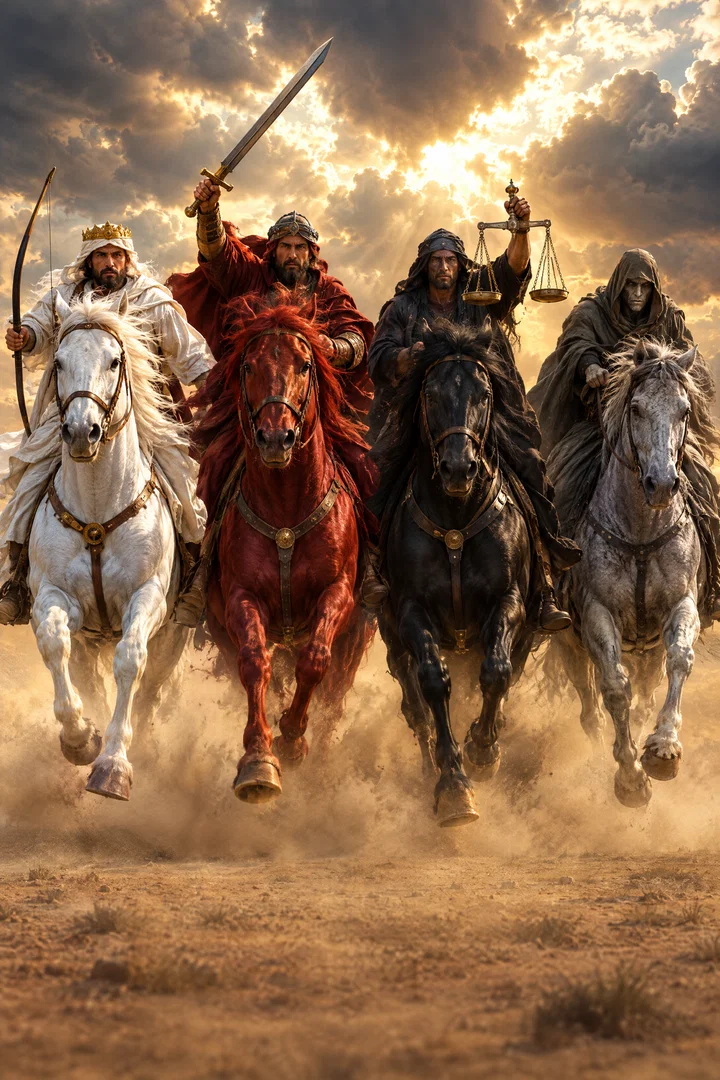
The vision of the four horses repeats Zechariah's vision of four chariots and groups of horses in Zechariah 6:1-8, but with important differences in that John's horses each have a rider and no chariot, and John's second horse is red while Zechariah's second group is black. It forms the foundation of Revelation's first great chain of prophecy and gives a connected view of great changes in the affairs of church and nations during the gospel dispensation. The horses are governed by angels who can restrain or release calamities, showing God's oversight of the nations even amid wars and disasters.
The breaking of the seals from the book given by the Father to the Son does not mean future events were wholly undisclosed before John, since Paul and Peter had already written of events extending to Christ's coming and the resurrection, and Peter had described opposers of the truth.RH Mar 19, 1857 The seals present in prophetic language additional events not described as fully in Daniel's prophecies, including events not mentioned there at all. Their events find fulfillment in history through the Christian era and are not confined to the early giving of the gospel, and with the trumpets and other lines they prove fulfilled through that whole era.ST May 7, 1902 In that sequence the white-horse rider is the Lord, and the four living creatures are to be understood in light of Ezekiel's visions.ST Feb 26, 1902
The seals run at the same time as the trumpets and the churches and synchronize with them to the end of time according to the divine plan, forming a basis for the trumpets and helping explain the events they foretell.RH Aug 7, 1900RH Jul 22, 1873 They are one of four leading chains of symbols concerning Rome, tracing down to standing before the judgment of the last day and waiting for the second appearing of Christ, so that following the chain to the seventh seal brings to the scenes of the last judgment.ST Oct 10, 1878 The sequence of Revelation 6-8 fixes the time of the sealing of the servants of God, showing that the 144,000 sealed just before the four winds are loosed belong to the days of the second advent, not the days of the first advent.RH Aug 14, 1856 That sealing continues to the sealing of God's servants in their foreheads, identified with the last great Sabbath reform, and the prophecy is connected throughout with the sealing of God's people.ST Dec 24, 1912ST Apr 13, 1904
The holding back of the winds before the servants are sealed is fulfilled in the present time, understood as a time of comparative peace in the country during which the great sealing work would be accomplished.RH May 23, 1865RH Apr 25, 1865 The present is the day when the servants of God are being sealed in their foreheads with the seal of the living God, whose work is the revival of the fourth commandment and return to the Bible Sabbath as God's invitation to receive His seal in preparation for the day of trouble soon to break upon an impenitent generation. The opening and explaining of the seven seals, portraying the history of the true church in relation to worldly powers, belongs to Christ's ministry in the first apartment of the heavenly sanctuary, introduced by the open door of Revelation 4-5 where Christ carries forward the real work for people on earth, not to the judgment work of deciding cases and blotting out sins.RH Sep 14, 1911RH Nov 6, 1900 That heavenly work enables believers to become the temple of God and be fitted for a habitation of God through the Spirit, while regeneration goes on in their physical and spiritual natures as shadowed by the sanctuary built by Moses, and the seals stand with the sanctuary message of type and antitype, the day of atonement, the judgment and the closing High Priest work as preparation for Christ's coming and part of the last gospel message of Revelation 14.RH Nov 6, 1900ST Aug 16, 1905
Prophecy Fulfilled and Applied
The seven seals trace the experiences and conflicts of the church with wicked nations through the whole gospel age, reaching to the judgment and the day of reward and retribution.ST May 13, 1880ST Jul 8, 1897 They stand as one of the great prophetic lines whose final event is the coronation of Jesus Christ as the coming King and the eternal kingdom of righteousness.ST Jul 8, 1897ST Dec 14, 1904 They belong with twelve symbolic and literal lines whose concurrent agreement and fulfillment prove the world is in the closing years of this dispensation, with the next great event the second coming of Christ.ST Sep 10, 1894ST Dec 14, 1904 They are numbered among the major lines outlining world history that converge on that coming and mark the closing days of earth's history.ST Sep 10, 1894
Under the later seals were foretold the Lisbon earthquake of November 1, 1755, the darkening of the sun and moon on May 19, 1780, and the falling of the stars on November 13, 1833.ST Nov 28, 1895 These signs are followed by the heavens departing as a scroll and the revelation of Christ as Reaper coming to gather the harvest of the earth.ST Nov 28, 1895 Together with the seven churches, the seven trumpets, the two witnesses, the great red dragon, the multi-formed beast, the two-horned beast, and the scarlet beast bearing Babylon, and with the lines of Daniel 11 and Revelation 2-13, the seals show that the coming of the Lord is near.ST Aug 14, 1893 With Daniel's prophecies and John's prophecies unsealed, the signs given of His coming and the judgment enable God's people in the time of the end to know that coming is near.RH Dec 9, 1851
The opening of the seals is presented among the signs that momentous events are beginning and the world is approaching great changes.RH Sep 5, 1865 Their prophetic events traced in history, fulfilled or still being fulfilled, place the present age within the closing period of prophecy.RH Nov 17, 1910 Their events were applied to the affairs of the United States at that time and to the proclamation of present truth there.RH Oct 14, 1862 The close under the sixth seal describes the awful scenes on earth when Christ is revealed at His second coming, with the wicked crying for rocks and mountains to hide them from the wrath of the Lamb.ST Oct 29, 1912RH Dec 13, 1853
The opening of the seventh seal follows in the eighth chapter with silence in heaven for the space of a prophetic half hour, or seven and one-half literal days, when all the angels leave their dwelling around God's throne to accompany Christ to this earth.ST Oct 29, 1912 The seventh chapter is thrown in parenthetically to describe particular things connected with the close of time not already covered.ST Oct 29, 1912 Under the sixth seal the trial of the dead takes place when the servants of God are sealed, followed under the seventh seal by silence in heaven when mediation ceases and the day of grace ends and the trial proceeds upon the living.ST Aug 15, 1878 Afterward Christ appears in the clouds and comes to the Ancient of days to announce the verdict, deliver and raise the declared justified saints to eternal life, and restore them to God's perfect image and glory, with the question raised whether the trial of the dead began to sit in 1798 when the papal dominion was taken away.ST Aug 15, 1878
The prophetic history of the world in the seals proves that the first angel's proclamation of the everlasting gospel, that the hour of God's judgment is come and the coming kingdom is at hand, has already gone through the world as the finishing work of the gospel of the kingdom.RH Aug 14, 1856 The white horse represents truth going forth in battle and march, conquering and continuing to conquer.ST Oct 24, 1911RH Nov 21, 1907 When people reject that white gospel of peace and purity, their rebellious passions bring upon them the red horse of war, strife, and bloodshed, with plague, calamity, and the birth-pangs of nature.ST May 8, 1907ST Oct 24, 1911ST Oct 25, 1905 In this way the gospel brings a sword upon the earth, yet the white-horse rider still conquers in everyone who submits to Christ, even if they die amid human conflict, until He closes His work in the sealing of God's servants, ending with silence in heaven and a song of triumph through all creation that Christ has come as Conqueror.ST Oct 24, 1911ST Oct 25, 1905
The first four seals reveal influences sent to bring people to God, and the red-horse rider exposes the power and harm of sin as the consequence of rejecting Christ.ST Feb 21, 1911 Their effects continue alongside one another until Christ comes, and the living creatures' repeated cry for Christ to come reflects creation's longing for that hope.ST Feb 21, 1911 The fourfold call to come sounds amid the trouble represented by the red horse of war, the black horse of corruption and calamity, and the pale horse of death.ST Apr 8, 1897 That call is merciful and loving, directing people who have no hope in earthly conditions to come to God for rest and peace in Christ.ST Apr 8, 1897
The seals set forth the great controversy between the church and her foes in all its phases from the first advent of Christ to the glorious consummation, as one of seven great time dramas and one of twelve great lines in Daniel, Revelation, Matthew, Mark, and Luke.ST Oct 20, 1909 With the other lines beginning in widely spread periods in the past, their terminal gathers in this day at the metropolis of the ages, the time of the end and the second coming of Jesus the Messiah, showing the transitory nature of earthly dominion and bringing God's children through earthly troubles to His eternal, unchangeable, glorious and happy kingdom of righteousness, with the downfall of the false and the everlasting triumph of the true.ST Oct 20, 1909 The opening of the first four seals marks epochal developments leading to the Reformation, broken over an apostate church that would not hear, though some heard the call, and thus began the progressive work of the open Bible and gospel continuing toward the closing work of God.ST Mar 28, 1911
Sources