Zechariah 6:1
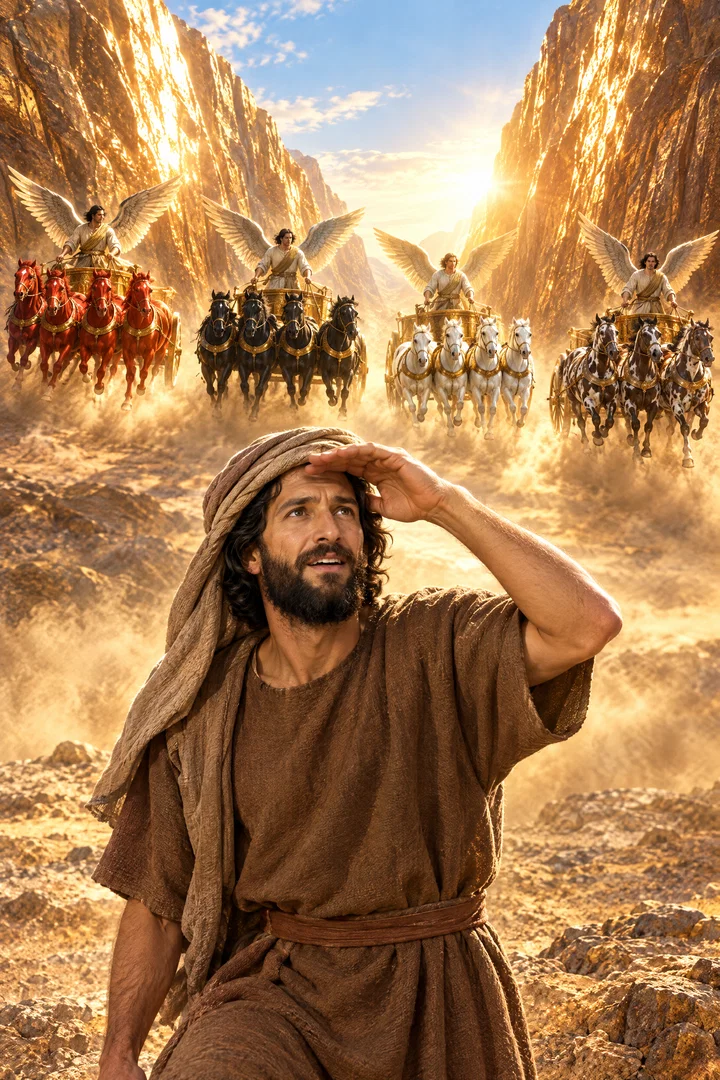
And I turned, and lifted up mine eyes, and looked, and, behold, there came four chariots out from between two mountains; and the mountains were mountains of brass.
Translations
And I turned, and lifted up my eyes, and looked, and, behold, there came four chariots out from between two mountains; and the mountains were mountains of brass.
And I turned, and lifted up mine eyes, and looked, and, behold, there came four chariots out from between two mountains; and the mountains were mountains of brass.
And I turned, and lift up mine eyes, and looked, and behold, there came four chariots out from between two mountains; and the mountains were mountains of brass.
And I turned, and lifted up my eyes, and looked, and behold, there came four chariots out from between two mountains; and the mountains were mountains of brass.
And again I lifted up mine eyes, and saw, and behold, there came four chariots out from between two mountains; and the mountains were mountains of brass.
And again I lifted up mine eyes, and saw, and, behold, there came four chariots out from between two mountains; and the mountains were mountains of brass.
And I turn back, and lift up mine eyes, and look, and lo, four chariots are coming forth from between two of the mountains, and the mountains [are] mountains of brass.
And I lifted up mine eyes again, and saw, and behold, there came four chariots out from between two mountains; and the mountains were mountains of brass.
And once again I lifted mine eyes, and looked, and lo! four chariots, coming forward from between two mountains,—now, the mountains, were mountains of copper.
Berean Standard Bible, Majority Standard Bible
And again I lifted up my eyes and saw four chariots coming out from between two mountains— mountains of bronze.
Again I lifted up my eyes, and saw, and behold, four chariots came out from between two mountains; and the mountains were mountains of bronze.
And again lifting up my eyes I saw four war-carriages coming out from between the two mountains; and the mountains were mountains of brass.
Againe, I turned and lift vp mine eyes, and looked: and beholde, there came foure charets out from betweene two mountaines, and the mountaines were mountaines of brasse.
Douay-Rheims (Challoner revision)
And I turned, and lifted up my eyes, and saw: and behold four chariots came out from the midst of two mountains: and the mountains were mountains of brass.
Pictures
Commentary
Each commentary is drawn from primary sources: the writings of Ellen G. White and Adventist pioneers and periodicals. Each commentary is separate. Its own words are not a quotation; follow the references to read the source passages.
Ellen G. White
3 sources
The verse opens a vision in which four chariots come out from between two mountains of brass.Ms 65a, 1900, par. 15–16 It belongs to a series of symbolic visions given to encourage God's people amid uncertainty about rebuilding Jerusalem and the temple.RH Dec 26, 1907 That revelation discloses God's compassion and love for His people.RH Dec 26, 1907 The mountains of brass signify that God's purposes for His chosen people are firm and immovable.Lt 80, 1900, par. 22 The vision shows the Lord's eyes open to the work of His whole cause.Ms 65a, 1900, par. 15–16 The image assures that apparent weakness or an unpromising beginning cannot thwart the triumph of truth and righteousness.Lt 80, 1900, par. 22
Sources
Pioneers and periodicals
9 sources
The vision opens with four chariots drawn by red, black, white, and grisled-and-bay horses emerging from between two mountains of brass.ST Apr 9, 1902 The black are sent to the north followed by the white, the grisled to the south, and the bay to walk to and fro through the earth in general survey, while the red are not said to go forth and those going north quiet the Lord's spirit over that country.ST Apr 9, 1902 The mountains are not literal but kingdoms, with the brass marking the Greek power, and the ground of the vision is the land between Syria in the north and Egypt in the south, especially Palestine as their battleground after Persia. The chariots are war chariots and heavenly messengers, the four winds under angelic commanders given definite fields to watch, repeating the work of the four horsemen of the first vision but sent to a new work of war and judgment that becomes the foundation of the four horses in Revelation.ST Sep 6, 1910ST Mar 14, 1911ST Feb 14, 1911 What matters most is that God directs the nations through His angels, ordering war, famine, victory, and persecution to chastise or protect His people according to their obedience, to overrule strife for good and encourage them in rebuilding Jerusalem and the temple.RH Dec 26, 1907ST Mar 14, 1911ST Feb 14, 1911
Symbols and Historical Setting
The vision opens with four chariots coming out from between two mountains of brass, each chariot drawn by its own group of horses in red, black, white, and grisled-and-bay.ST Apr 9, 1902 The horses are divided among the four chariots, though their number is not given. Two are dispatched toward the north, one toward the south, and the remaining one goes to and fro through the earth.ST Apr 9, 1902
The black horses go to the north country followed by the white, the grisled horses go to the south, and the bay are commissioned to travel throughout the earth in general survey.ST Apr 9, 1902 The red are not said to be sent out, and those going to the north quiet the Lord's spirit concerning that country.
The mountains are symbolic and not literal, since in prophecy a mountain represents a kingdom. The two mountains of brass therefore represent two earthly kingdoms, and the brass identifies them with the Greek kingdom in Nebuchadnezzar's image. The action of the chariots is placed between those kingdoms.
The theater of the vision is the territory between the Grecian kingdoms of Syria in the north and Egypt in the south, especially Palestine as their battleground. This follows Persian rule and a period of relative peace for the Jews, when Alexander's kingdom arose and then divided. Syria and Egypt then became the chief kingdoms considered in prophecy, and the vision concerns their wars over the Holy Land.
The chariots are war chariots engaged in a work of war and judgment with a definite result to accomplish, going forth not merely to report past work but to a new work.ST Sep 6, 1910ST Mar 14, 1911 They are heavenly messengers and representatives of God, sent to watch over different regions, to wage battle and execute judgment as God works among earthly powers to deliver His people and help Jerusalem.ST Sep 6, 1910ST Mar 14, 1911 Each is given a definite field to watch over while walking to and fro through the earth, and the horses with the four winds are symbols of strife and of forces involved in changes among the church and nations.ST Sep 6, 1910ST Feb 14, 1911 These forces stand under the direction of four angelic commanders who govern when they are restrained or released, while God overrules the strife for good.ST Feb 14, 1911
Their positions answer the conditions in the kingdom of Darius, with two assigned to the north against the rebellions in Babylon and Media, one toward the south concerning war in Egypt, and one in general survey.ST Sep 6, 1910ST Mar 14, 1911 Their work restrained rebellion and war so that the decree of Cyrus to rebuild the temple could be carried out.ST Sep 6, 1910ST Mar 14, 1911 The wars were quieted until by 519 B.C. universal peace reigned to give opportunity as never before to rebuild the city and temple of God.ST Sep 6, 1910 This section concerns the reformation among God's people under Zerubbabel as typifying future reformations, with its figures and symbols indicating nations and God's power to save.ST Sep 6, 1910ST Nov 25, 1908
Prophecy and Scriptural Connections
The four chariots repeat the four horsemen of the first vision, with the drivers now in chariots doing practically the same work.ST Sep 6, 1910 They are war chariots engaged in a work of war and judgment, going forth not to report past work but to a new work with a definite result to accomplish.ST Sep 6, 1910 They walk to and fro through the earth as heavenly messengers and representatives of God, each given a definite field to watch over.ST Sep 6, 1910 Their positions answer the conditions in the kingdom of Darius, with two assigned to the north against the rebellions in Babylon and Media, one toward the south, and one in general survey, until the wars are quieted and by 519 B.C. universal peace reigns to give opportunity as never before to rebuild the city and temple of God.ST Sep 6, 1910
The vision presents four chariots and four groups of horses, each group a different color, with the horses divided among the four chariots though their number is not given. It forms the foundation of the first great chain of prophecy in Revelation, where it is repeated with important changes so that John sees four horses, each with a rider, and no chariots. Its symbols also resemble John's prophecy, which presents important events during the gospel dispensation. The red horse of the second seal recalls this vision of conflict, yet God overrules the strife for good.ST Feb 14, 1911
The vision portrays the coming conflict between Israel and the Greek kingdom under Antiochus through the picture of the chariots and horses.ST Nov 8, 1883 Its theater is the territory between the Grecian kingdoms of Syria in the north and Egypt in the south, especially Palestine, which became their battleground. After Persian rule and a period of relative peace for the Jews, Alexander's kingdom arose and divided, and Syria and Egypt became the chief kingdoms considered in prophecy. The chariot vision concerns the wars between these northern and southern kingdoms over the Holy Land, bringing war, famine, victory, persecution, and distress.
Later in the chapter Christ is shown sitting on the Father's throne and building the temple of the Lord.ST Mar 12, 1912 He reigns now as priest upon the Father's throne as priest-king during the gathering of God's children before the thousand years.ST Mar 13, 1907 When His work of priesthood is finished He will rise from the Father's throne to take His seat upon His own throne and receive His own kingdom.ST Mar 13, 1907 The temple's stones represent the people gathered to form God's kingdom, drawn from every nation and not limited by birth or lineage.ST Mar 12, 1912
Divine Governance and Comfort
The four horses signify shifting conditions among the nations and among God's people, with red denoting war and bloodshed, black denoting famine, white denoting victory and deliverance, and gray or ashy denoting a mingled state connected with terrible persecution. Although no sending forth of the red chariot is stated, its presence in the vision and the order by which famine follows war show that it had already gone out.
God governs the nations by His angels, protecting His people when they obey and permitting chastisement upon them when they rebel. The chariots as His messengers go forth to their appointed regions to watch, to fight, and to execute judgment, working amid earthly powers to deliver His people and to aid Jerusalem.ST Mar 14, 1911 In that work they held back rebellion in Babylon and Media and war in Egypt, so that the decree of Cyrus for rebuilding the temple could be fulfilled.ST Mar 14, 1911 The calamities thus figured would come upon the Jews through the kings of the north and the south in case of sin, while the same strife, recalled by the red horse of the second seal and resembling John's portrayal of the leading events of the gospel dispensation, is overruled for good.ST Mar 14, 1911ST Feb 14, 1911
The angels oversee and restrain such calamities without being their authors, for sin is their source and Satan and his angels are their direct producers. The whole series of symbolic visions to which this vision belongs was given to hearten God's people amid uncertainty over the rebuilding of Jerusalem and the temple, revealing His compassion and love toward them.RH Dec 26, 1907
Sources