Revelation 6:8
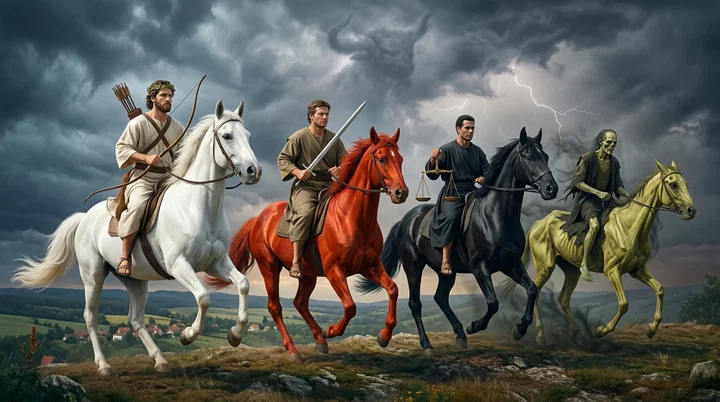
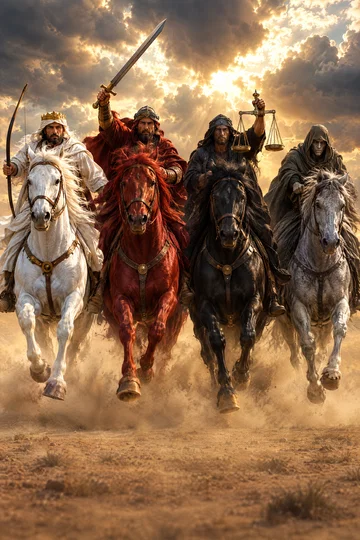
And I looked, and behold a pale horse: and his name that sat on him was Death, and Hell followed with him. And power was given unto them over the fourth part of the earth, to kill with sword, and with hunger, and with death, and with the beasts of the earth.
Translations
And I looked, and behold a pale horse: and his name that sat on him was Death, and Hell followed with him. And power was given to them over the fourth part of the earth, to kill with sword, and with hunger, and with death, and with the beasts of the earth.
King James Version, KJV Cambridge Paragraph Bible
And I looked, and behold a pale horse: and his name that sat on him was Death, and Hell followed with him. And power was given unto them over the fourth part of the earth, to kill with sword, and with hunger, and with death, and with the beasts of the earth.
And I looked, and behold, a pale horse: and his name that sat on him was Death, and hell followed with him. And power was given to them over the fourth part of the earth, to kill with sword, and with hunger, and with death, and with the beasts of the earth.
Revised Version, American Standard Version
And I saw, and behold, a pale horse: and he that sat upon him, his name was Death; and Hades followed with him. And there was given unto them authority over the fourth part of the earth, to kill with sword, and with famine, and with death, and by the wild beasts of the earth.
and I saw, and lo, a pale horse, and he who is sitting upon him — his name is Death, and Hades doth follow with him, and there was given to them authority to kill, (over the fourth part of the land,) with sword, and with hunger, and with death, and by the beasts of the land.
And I saw: and behold, a pale horse, and he that sat upon it, his name [ was] Death, and hades followed with him; and authority was given to him over the fourth of the earth to slay with sword, and with hunger, and with death, and by the beasts of the earth.
And I saw, and lo! a livid horse,—and he that was sitting thereupon had for a name, Death, and, Hades, was following with him; and there was given unto them authority over the fourth of the earth, to slay with sword, and with famine, and with death, and by the wild beasts of the earth.
Then I looked and saw a pale green horse. Its rider’s name was Death, and Hades followed close behind. And they were given authority over a fourth of the earth, to kill by sword, by famine, by plague, and by the beasts of the earth.
Then I saw a pale green horse. Its rider’s name was Death, and Hades followed close behind. And he was given authority over a fourth of the earth, to kill by sword, by famine, by plague, and by the beasts of the earth.
And behold, a pale horse, and the name of he who sat on it was Death. Hades followed with him. Authority over one fourth of the earth, to kill with the sword, with famine, with death, and by the wild animals of the earth was given to him.
And I saw a grey horse, and the name of him who was seated on it was Death; and Hell came after him. And there was given to them authority over the fourth part of the earth, to put to destruction by the sword, and by taking away their food, and by death, and by the beasts of the earth.
And I looked, and beholde, a pale horse, and his name that sate on him was Death, and Hell folowed after him, and power was giuen vnto them ouer the fourth part of the earth, to kill with sworde, and with hunger, and with death, and with beasts of the earth.
Douay-Rheims (Challoner revision)
And behold a pale horse, and he that sat upon him, his name was Death, and hell followed him. And power was given to him over the four parts of the earth, to kill with sword, with famine, and with death, and with the beasts of the earth.
Pictures
Cross-references 20 of 21
- Revelation 20:14
And death and hell were cast into the lake of fire. This is the second death.
Death and Hades are cast into the lake of fire.
- Revelation 1:18
I am he that liveth, and was dead; and, behold, I am alive for evermore, Amen; and have the keys of hell and of death.
Both name Hades and death together.
- 1 Corinthians 15:55
O death, where is thy sting? O grave, where is thy victory?
Hades is rendered “grave,” whose victory is overcome by resurrection.
- Ezekiel 14:21
For thus saith the Lord GOD; How much more when I send my four sore judgments upon Jerusalem, the sword, and the famine, and the noisome beast, and the pestilence, to cut off from it man and beast?
Both name sword, famine, pestilence, and beasts among destructive judgments.
- Revelation 5:1-7
And I saw in the right hand of him that sat on the throne a book written within and on the backside, sealed with seven seals.
The sealed book given to the Son is opened in the vision of Revelation 6.
- Luke 16:23
And in hell he lift up his eyes, being in torments, and seeth Abraham afar off, and Lazarus in his bosom.
Both texts use Hades, rendered “hell.”
- Revelation 6:2
And I saw, and behold a white horse: and he that sat on him had a bow; and a crown was given unto him: and he went forth conquering, and to conquer.
The white-horse conqueror is contrasted with the pale rider in the seal sequence.
- Hosea 13:14
I will ransom them from the power of the grave; I will redeem them from death: O death, I will be thy plagues; O grave, I will be thy destruction: repentance shall be hid from mine eyes.
Both texts personify death and the grave as powers, while Hosea foretells their defeat.
- Acts 2:27
Because thou wilt not leave my soul in hell, neither wilt thou suffer thine Holy One to see corruption.
Both use Hades for the place of the dead.
- Matthew 16:18
And I say also unto thee, That thou art Peter, and upon this rock I will build my church; and the gates of hell shall not prevail against it.
Both texts use Hades, rendered “hell.”
- Revelation 20:13
And the sea gave up the dead which were in it; and death and hell delivered up the dead which were in them: and they were judged every man according to their works.
Death and Hades give up their dead.
- 1 Corinthians 15:26
The last enemy that shall be destroyed is death.
Death is an enemy ultimately to be destroyed.
- Matthew 11:23
And thou, Capernaum, which art exalted unto heaven, shalt be brought down to hell: for if the mighty works, which have been done in thee, had been done in Sodom, it would have remained until this day.
Both use Hades, rendered “hell.”
- Acts 2:31
He seeing this before spake of the resurrection of Christ, that his soul was not left in hell, neither his flesh did see corruption.
Both verses use hades, rendered “hell.”
- Revelation 7:1-3
And after these things I saw four angels standing on the four corners of the earth, holding the four winds of the earth, that the wind should not blow on the earth, nor on the sea, nor on any tree.
The sealing follows the sixth seal and delays harm until God’s servants are sealed.
- Revelation 19:11
And I saw heaven opened, and behold a white horse; and he that sat upon him was called Faithful and True, and in righteousness he doth judge and make war.
The pale-horse rider contrasts with Christ riding a white horse.
- Ezekiel 5:16
When I shall send upon them the evil arrows of famine, which shall be for their destruction, and which I will send to destroy you: and I will increase the famine upon you, and will break your staff of bread:
Famine is described as judgment, matching the horsemen’s calamities.
- Revelation 5:5-6
And one of the elders saith unto me, Weep not: behold, the Lion of the tribe of Juda, the Root of David, hath prevailed to open the book, and to loose the seven seals thereof.
Christ the Lion and sacrificial Lamb opens the seals.
- Luke 12:5
But I will forewarn you whom ye shall fear: Fear him, which after he hath killed hath power to cast into hell; yea, I say unto you, Fear him.
Both describe power over death and the fate beyond it.
- Ezekiel 4:16-17
Moreover he said unto me, Son of man, behold, I will break the staff of bread in Jerusalem: and they shall eat bread by weight, and with care; and they shall drink water by measure, and with astonishment:
Unfaithfulness brings judgment through famine and scarcity of bread.
Commentary
Each commentary is drawn from primary sources: the writings of Ellen G. White and Adventist pioneers and periodicals. Each commentary is separate. Its own words are not a quotation; follow the references to read the source passages.
Ellen G. White
8 sources
What John saw was not taking place in his own day but was shown to him in vision as a coming time of death and ruin, when the pale horse appears with its rider called Death and Hell following after, given authority over the fourth part of the earth to kill with sword and with hunger and with death and with the beasts of the earth.Lt 65, 1898, par. 16–23 It stands as part of the prophetic history of nations and of the church written inside and outside the book sealed with seven seals in God's hand, a book holding God's providences and divine utterances, His authority and commandments and laws, symbolic counsel, and the history of all ruling powers with the influence of every nation and tongue and people from the beginning of earth's history to its close.9MR 7.1–4 It is one of the terrible judgments of God laid open in Revelation 6 and 7.15MR 219.2–220.1Ms 59, 1895, par. 26–30
It means the Lord goes forth to punish the inhabitants of the earth for their iniquity and to dash His enemies in pieces, so that the earth discloses her blood and no longer covers her slain.15MR 219.2–220.1Ms 59, 1895, par. 26–30 Its work of killing belongs to the punishment committed to seven angels who stand before God to receive their commission and are given seven trumpets.15MR 219.2–220.1Ms 59, 1895, par. 26–30 That punishment reaches its climax in plagues upon the wicked who would not care for and obey God but insulted Him and despised His mercies, when hail about the weight of a talent falls upon them.15MR 219.2–220.1 It displays terrible scenes to occur as signs of Christ's coming, with pestilence and famine and death coming upon the inhabitants of the earth when the vials of wrath are opened, along with armies mustering for battle, men's hearts failing for fear, the earth moved out of its place, mountains carried into the midst of the sea, and roaring, troubled waves.Ms 100, 1893, par. 12
It also represents a spirit seen today whose history is to be repeated and reenacted, for that which has been will be again.9MR 7.1–44MR 152.1–2Lt 65, 1898, par. 30–3120MR 199.1–3 That spirit works to confuse and to perplex, bringing dissension in every nation and kindred and tongue and people.4MR 152.1–2Lt 65, 1898, par. 30–3120MR 199.1–3 Those who reject or do not follow the light God has given through His living oracles and appointed agencies become confused and show weakness of judgment.4MR 152.1–2Lt 65, 1898, par. 30–3120MR 199.1–3 Unholy ambition allures and deceives such ones until they act blindly and without regard for consequences.Lt 65, 1898, par. 30–31 From this same spirit come disorder and strife and confusion seen in the church.4MR 152.1–2Lt 65, 1898, par. 30–3120MR 199.1–3
Sources
Pioneers and periodicals
103 sources
The pale horse is sickly yellow and corpse-like, picturing a corrupt and diseased condition in the professed church, and its rider named Death is the papacy in its persecuting reign, with Hell following as hades the grave to receive its victims.RH Apr 25, 1865RH Jul 8, 1862ST Jan 15, 1880RH Nov 19, 1901ST Apr 10, 1879 Power over the fourth part of the earth was the territory under papal jurisdiction, and authority to kill with sword, hunger, death and beasts was war, famine, pestilence and destruction by beasts, the four sore judgments of Ezekiel 14:21 turned into terrible persecution.ST May 8, 1907RH Nov 19, 1901ST Apr 10, 1879ST Jan 27, 1904ST Mar 4, 1903 The seal opened about A.D. 538 when papal supremacy and unrestrained rule began, and continued the 1,260 years to 1798, when tens of thousands suffered by sword, imprisonment, torture, flame, hunger and beasts and on the lowest estimate over fifty million martyrs died.RH Apr 25, 1865RH Jul 8, 1862ST Jan 15, 1880RH Nov 19, 1901ST Apr 10, 1879 As one of the seven seals spanning the gospel age to the second coming, it shows the external history of the church in relation to civil powers, in contrast to the internal history in the seven churches.RH Dec 11, 1900ST Aug 8, 1916ST Nov 25, 1889ST Jan 3, 1878RH Feb 12, 1857 Death and Hades are not living persons but personified powers, for hades is the grave, the general abode of the dead entered by death and left by resurrection, distinct from Gehenna into which death and Hades will at last be destroyed.ST Jun 30, 1881RH Mar 7, 1865ST Aug 18, 1881ST Mar 27, 1879RH Jul 2, 1872
Words and Symbols
The horse is pale, a sickly yellow, an unnatural and corpse-like color unlike the natural white, red and black of the first three horses, picturing a corrupt and diseased condition in the professed church.ST Jan 15, 1880RH Nov 19, 1901ST Apr 10, 1879ST Jan 15, 1880 Its rider is named Death, and Hell follows with him, where Hell means hades, the grave, following to receive victims.RH Apr 25, 1865RH Jul 8, 1862ST Jan 15, 1880RH Nov 19, 1901ST Apr 10, 1879 Mortality under this power was so great that it was as if the pale nations of the dead had come upon the earth in its wake.RH Nov 19, 1901 Hell in the verse belongs to the dark days of papal rule and the Thyatira stage of church history, when loyal believers suffered under apostate influences.ST May 4, 1904
Death and Hades are not living persons but personified powers, lifeless things given the figure and actions of rational beings to picture them cutting down mankind.ST Jun 30, 1881ST Mar 27, 1879ST Mar 15, 1877RH Mar 28, 1865RH May 12, 1874 The same personification continues when they are treated as living enemies and cast into the fire of Gehenna.ST Jun 30, 1881ST Mar 27, 1879RH Mar 28, 1865RH May 12, 1874 Their portrayal as acting and speaking figures does not mean the dead are conscious, for hades is a place of darkness and silence.ST Mar 15, 1877RH May 12, 1874 This figure of Death is distinct from Jesus, who rides the white horse as Faithful and True, crowned and followed by heaven's armies, for death is humanity's foe, not Christ's coming to believers when they die.ST Aug 12, 1886
Hell is the English rendering of the Greek hades, the New Testament word for the Old Testament sheol, meaning the grave.ST Aug 18, 1881ST Nov 16, 1876ST Mar 15, 1877RH Mar 28, 1865ST Nov 16, 1876 It is the general receptacle, abode, place or condition of the dead, righteous or wicked, entered through death and left through resurrection, where those inside are called dead.ST Nov 16, 1876ST Dec 17, 1902ST Nov 16, 1876 Hades is used eleven times in the New Testament, ten times rendered hell including this verse and once rendered grave.ST Aug 18, 1881ST Mar 15, 1877RH Mar 28, 1865 It is distinct from Gehenna and Tartarus, though all three are rendered hell in English.RH Mar 7, 1865RH May 23, 1865RH Jul 2, 1872 Hell here is not a paradise of conscious happiness and bliss nor a halfway house to heaven, and in the end both death and Hades will be destroyed in Gehenna in the purifying fires of the last day.ST Aug 18, 1881ST Dec 17, 1902
The rider Death represents the papacy and its persecuting reign, bringing death with the grave following after.ST Apr 10, 1879ST Oct 24, 1900RH Feb 4, 1909ST Jan 3, 1878ST Apr 3, 1879 Power given unto them means given to him, the power personified by Death on the pale horse.RH Nov 19, 1901 Power over the fourth part of the earth is the territory over which this power had sway, under papal jurisdiction, indicating the reach of this judgment.RH Nov 19, 1901ST Apr 10, 1879ST Feb 14, 1911 Authority to kill with sword, hunger, death and beasts of the earth means killing by exposure or torture causing death, where death means pestilence and death-causing hardships.RH Nov 19, 1901ST Apr 10, 1879ST Jan 27, 1904 Together they are war, famine, pestilence and destruction by beasts, the four sore judgments named in Ezekiel 14:21, and their killing represents terrible persecution rather than war alone.ST May 8, 1907ST Mar 4, 1903ST Oct 25, 1905ST Feb 14, 1911
The red, black and pale horses are war, corruption and calamity, and death in its many terrible forms, with the pale horse as death as part of the world's suffering.ST May 8, 1907ST Apr 8, 1897 War, scarcity and want from the preceding riders culminate in widespread death, and the calamities associated with the third rider are used to kill by sword, famine, pestilence and wild beasts.ST Oct 25, 1905ST Feb 14, 1911 Beasts of the earth are literal agents of death whose toll is not too small to fit the prophecy.ST Jan 27, 1904ST Jan 27, 1904 They include wild animals and snake bites as illustrated in India, where false worship including treating snakes as sacred brings disaster, and they encompass deaths from ptomaine poisoning and diseases associated with a flesh-eating diet, while deadly animals cause substantial loss of human and animal life.RH Feb 12, 1857ST Oct 10, 1906ST Nov 14, 1906ST Jan 27, 1904 They may also symbolize persecuting church-and-state governments as in Revelation 13 and 17.ST Feb 14, 1911
Historical Setting
The fourth seal opened about A.D. 538, when the man of sin was revealed and papal supremacy began, commencing the long period of unrestrained persecuting rule and the Thyatira stage of church history.RH Apr 25, 1865RH Jul 8, 1862RH May 22, 1913RH Nov 19, 1901ST Apr 10, 1879 It portrays the pale horse and its rider Death with the grave following as severe persecution and martyrdom of the church under the Papacy during that supremacy.RH Apr 25, 1865RH Jul 8, 1862ST Jan 15, 1880RH May 22, 1913ST Apr 10, 1879 The power given to kill was the papacy's persecuting power held in its hands over the territory under its jurisdiction.RH Nov 19, 1901ST Apr 10, 1879ST Jan 3, 1878 That unrestrained sway over Christendom, in which death rode prosperously, was checked when the Great Reformation of the sixteenth century began and reformers began exposing papal corruptions.RH Apr 25, 1865RH Jul 8, 1862ST Jan 15, 1880ST Apr 10, 1879ST Jan 3, 1878 By 1798, when that work of exposure was well established, the period closed.RH Nov 19, 1901ST Jan 15, 1880
The period is the 1,260 years, three and one-half prophetic years reckoned each day for a year, from 538 to 1798.RH Nov 19, 1901ST Jul 8, 1897ST Oct 24, 1900ST Oct 25, 1905ST Apr 21, 1909 It is the same great tribulation in which saints suffered persecution from the wicked, shortened by God's interposition and now past, closing with the Dark Ages in 1798 and marking the beginning of the time of the end.ST Jul 8, 1897ST Oct 24, 1900ST May 7, 1902 Persecutions themselves ceased in 1776, though the prophetic period extended to 1798.ST Apr 21, 1909 During it the pale horse's killing by sword, hunger, death, and beasts was carried out by flame, captivity, and plunder against those faithful to God, slain for God's word and their testimony.ST Oct 24, 1900ST Oct 25, 1905
The fourth seal thus follows the church's history through falling away into apostasy allied with the world, in contrast to the apostolic purity of the first seal.ST May 4, 1904ST Jan 3, 1878RH Mar 19, 1867 The true church still appears within this time in its martyrs, joined with the martyrs of the fifth seal, distinct from the apostate church that continues to the wrath of Christ's coming.ST Jan 3, 1878RH Feb 12, 1857RH Mar 19, 1867 Together the first four seals with the living beings and churches cover nearly 1,800 years, with the fourth living being representing the true church during the 1,260 years of papal supremacy.RH Feb 12, 1857 After beginning in purity and descending in the great apostasy, the church passed through a long, bloody persecution before the final triumph of the sealed remnant.RH Mar 19, 1867
The symbols describe loyal believers suffering under apostate influences when the church became a destroyer.RH Apr 25, 1865RH Jul 8, 1862RH Feb 2, 1864ST Mar 5, 1894RH Jul 18, 1912 The Crusades illustrate that fanatical age, when millions died trying to drive Muslims from the Holy Land under promise that those dying in the war would escape purgatory.RH Feb 2, 1864 That harvest of death in the Dark Ages followed the early church's adoption of human schemes and traditions, compromise with the world, and replacement of Christ's work and spiritual weapons with carnal ones.ST Mar 5, 1894 The awful persecutions by Romanism in the Dark Ages are the application of the prophecy.RH Jul 18, 1912
Christians were killed by the sword, imprisonment, stoning, torture to death, flame, captivity, plunder, hunger, and exposure, and in some cases thrown to ferocious beasts, with tens of thousands dying under the Inquisition's torments.RH Nov 19, 1901ST Apr 10, 1879RH Feb 12, 1857ST Oct 25, 1905 Those means of exposure or torture causing death are the sword, hunger, death-causing hardships, and beasts by which the papacy killed its martyrs.RH Nov 19, 1901ST Apr 10, 1879 Those seen slain under the fifth seal were killed under this fourth seal by the papal power commissioned to kill.RH Apr 22, 1858 On the lowest estimate over fifty million martyrs died through the means named in the prophecy and cry for vengeance from under the bloody altars, with one estimate placing sixty to one hundred million killed for faith.ST Jan 15, 1880RH Nov 19, 1901ST Nov 28, 1895RH Nov 20, 1900ST Jan 15, 1880 Condemned as heretics at the time, they were later recognized as martyrs for God receiving white robes of Christ's righteousness, though they had not gone to heaven, since the altar and crying blood were on earth.ST Nov 28, 1895RH Nov 20, 1900
The Dark Ages saw war, famine, and pestilence in cumulative force while the professed church persecuted those who accepted the message of life.ST May 8, 1907 Apostasy and union of church and state brought persecution and war, while pestilence followed, as consequences of rejecting the gospel and reaping what was chosen.ST May 8, 1907ST Oct 25, 1905ST Feb 14, 1911 War, scarcity, and want from the preceding riders culminated in widespread death by sword, famine, pestilence, and wild beasts, the four sore judgments named in Ezekiel 14:21, and in that time the pale rider did his fiercest work.ST Oct 25, 1905ST Feb 14, 1911ST Oct 25, 1905 One reading identifies this fourth act with the darkening of the political heavens, a pagan theocratic pantheon and a deified state.ST Nov 1, 1910
Prophetic Place
Revelation 6:8 belongs to the seven seals, the second sevenfold prophecy of the seven-sealed book in Revelation 6 to 8:1, opened by the prevailing power of Jesus Christ.ST Oct 24, 1911ST Aug 8, 1916ST Jan 3, 1878RH Mar 26, 1872 The seals were introduced in Revelation 4 to 6 and are concluded in Revelation 8:1.ST Jan 3, 1878RH Nov 6, 1900 Through an open door John was brought into the heavenly sanctuary, where Christ's voice as of a trumpet called him to come up to be shown things which must be hereafter.RH Nov 6, 1900 Revelation 6 presents the vision of the seals being opened and future events disclosed, which does not mean no future events had been revealed before, since earlier Scriptures had already described events reaching to Christ's coming and the resurrection.RH Mar 19, 1857 Christ opens and explains the seals, and this work unfolds through nearly nineteen centuries as part of His ministry in the first apartment of the heavenly sanctuary, not the judgment work in the most holy place.RH Sep 14, 1911
The seven seals span from Christ's first advent to His second coming and the beginning of restoration.ST Aug 8, 1916ST Mar 22, 1883 They trace the church's experiences and conflicts with wicked nations and outside agents through the gospel age and gospel dispensation to judgment, the day of wrath, and the end of probationary time.ST Nov 25, 1889ST May 13, 1880ST Jan 3, 1878ST Feb 5, 1880 They present a consecutive history of events between Christ's first and second advents and cover events with which the church is connected from the opening of this dispensation to the coming of Christ.ST Mar 22, 1883ST Jan 3, 1878 The first six seals cover probationary time, ending at the period of the wrath of the Lamb.ST Feb 5, 1880 While the seven churches present the internal history of the church, the seven seals bring to view the great events of its external history, especially the church's relation to civil governments.RH Dec 11, 1900ST Jan 3, 1878 The first four seals portray the powers and kings of the earth acting toward the church while God protects His people during the Christian age.RH Feb 12, 1857 The seals and the first four churches cover corresponding historical periods, extending for nearly 1,800 years.RH Feb 12, 1857RH Feb 12, 1857 The six seals portray the church's experiences in its relation to the world.RH Apr 14, 1903 The fourth seal corresponds in time with the fourth living being and the fourth church, and the fourth living being represents the true church during the period of papal supremacy, identified as 1,260 years.RH Feb 12, 1857
The breaking of the first four seals marked successive epochs leading to the Reformation.ST Mar 28, 1911 These seals were broken over an apostate church, but in the darkness some heard the gospel voice, and the Reformation's open Bible began a progressive work of gospel preaching and prophetic study.ST Mar 28, 1911 The first four seals portray influences and powers at work in the world, and the pale-horse seal, like the other three seals after the white horse, shows the consequences of rejecting Christ and reveals the evil of sin and humanity's hopelessness without Him.ST Feb 21, 1911 The effects of each seal continue after the next opens and remain at work until Jesus comes, revealing a fourfold train of influences that, once introduced, continued to the end.ST Feb 21, 1911ST Mar 14, 1911 The opening of the various seals is the development of the work of the gospel in the world.ST Nov 23, 1915 The opening of the fourth seal brought a fearful work of killing that answers to a special era in history.ST May 4, 1904 Revelation 6:7-11 describes the great tribulation in which the saints suffer persecution from the wicked, entirely distinct from the time of trouble that comes upon the wicked while everyone written in the book of life is delivered.ST May 7, 1902 It belongs to the same period of persecution against the loyal that God shortened by His interposition so they would not all be destroyed, and it is past, closing with the Dark Ages in 1798.ST May 7, 1902
The four-horse vision repeats Zechariah's vision of four chariots and groups of horses, with important variations. Unlike Zechariah's vision, John's has one horse for each rider and no chariots, and its horse colors are white, red, black, and pale. This vision forms the foundation of Revelation's first great chain of prophecy and gives a connected view of important events during the gospel dispensation. The horses are instruments God uses to carry out judgments in the world, including war, pestilence, and death.RH Nov 20, 1856 Their destructive movements remain under God's control: He limits, restrains, directs, and determines when these forces are restrained or allowed to act, even when sin and death seem to hold terrible sway.RH Nov 20, 1856 The horses are governed by angels who can restrain or release calamities, while other angels carry out the work directed to them. The four winds represent wars among nations as kingdoms rise and fall, and their movements bring great changes in the affairs of church and nations while God governs the nations.
Through all these judgments of war, plague, calamity, strife, and the very birth-pangs of nature following Christ going forth on the white horse conquering and to conquer, the white-horse rider still goes forth for God, closing His work in the sealing of God's servants.ST Oct 24, 1911 Meanwhile the four living creatures look forward to the glorious triumph and cry Come to Him whose right it is to reign.ST Oct 24, 1911 The fourfold cry Come spoken by the living creatures in Revelation 6:1-8 is an appeal for Christ the King to come to His own made ever since sin entered, and that cry is finally answered when Christ who sits on the cloud is loudly called to send forth His sickle and reap because the hour to reap is come and the harvest of the earth is ripe.ST Aug 22, 1911 The series ends with the last seal closing in silence in heaven and a song of triumph throughout all creation that Christ has come, Christ the Conqueror.ST Oct 24, 1911 The rider of the pale horse as Death, with Hades following him to bring death by sword, famine, death, and wild beasts, is distinct from Jesus, who rides the white horse as Faithful and True, crowned and followed by heaven's armies; death is humanity's foe, not Christ's coming to believers when they die.ST Aug 12, 1886
Each opened seal discloses a new phase of the world's disease of sin, a new manifestation of God's remedy in the gospel, and a way God makes the wrath of men praise Him.ST Mar 4, 1903 The opening of the great plan of redemption is shown in a world cursed by sin and groaning and travailing for deliverance.ST Mar 4, 1903 The killing with sword and hunger and death and beasts is the four sore judgments under which the groaning earth lifts the fourfold cry Come, and the course of the seals moves toward the Lord's response in the sixth seal and His coming again.ST Mar 4, 1903 The seven seals set forth the agonies of the earth and the repeated cry of creation for Christ the Redeemer to come.ST Nov 8, 1905 The series continues through the heavenly signs of the sixth seal, which precede the great day of God's wrath.ST Dec 16, 1908RH Jul 28, 1859 The darkening of the sun and moon and the falling of the stars could not have foretold the destruction of Jerusalem in A.D. 70, since John wrote Revelation in A.D. 96.ST Dec 16, 1908 The seals include the great Lisbon earthquake of November 1, 1755, the darkening of the sun and moon on May 19, 1780, and the falling of the stars on November 13, 1833; after these signs come the heavens rolling back like a scroll and the revelation of Christ as the Reaper of earth's harvest.ST Nov 28, 1895
The sixth seal approaches the day of wrath when the wicked call for the rocks and mountains to hide them from the Lamb's wrath.RH Jul 28, 1859RH Dec 13, 1853 The signs in the heavens that precede Christ's second coming mark the beginning of that period, when people ask who can stand.RH Jul 28, 1859 The sealing of God's servants in Revelation 7 follows, while the winds and the outpouring of wrath are held until they are sealed.RH Jul 28, 1859 Revelation 6:8 belongs to the same age as the sealing work of Revelation 7 and the beast and mark warnings of Revelation 13-14.RH Feb 20, 1866 The angel having the seal of God and the angel warning against the mark of the beast synchronize in time and are succeeded by the same events, standing related to each other by contrast.RH Feb 20, 1866 The close of the sixth chapter describes the awful scenes on earth at Christ's revelation at His second coming under the sixth seal, coming before the parenthetical sealing work of the seventh chapter and before the opening of the seventh seal in the eighth chapter with silence in heaven for a prophetic half hour, seven and one-half literal days, when all the angels leave heaven to accompany Christ to earth.ST Oct 29, 1912 The sequence of Revelation 6-8 fixes the time of the sealing in Revelation 7, for the 144,000 seen on Mount Zion are the same company seen in the seventh chapter in the present state, sealed just before the four winds are loosed, showing they comprise the servants of God at a certain period, and that period is the days of the second advent, not the days of the first advent.RH Aug 14, 1856 The events of the seals occur in succession, and the seventh seal follows only after the sixth seal's events have taken place.RH Dec 18, 1856
The seven seals present prophetic events that add to the events described in Daniel's prophecies, including some events Daniel does not mention. With the seven churches, the seven trumpets, the two witnesses, and the beasts and dragon of Revelation 12, 13, and 17, the seals form one of seven great time dramas in Revelation and one of twelve great lines of prophecy from Daniel and Revelation and the Gospels whose terminals gather at the time of the end and the second coming of Jesus the Messiah.ST Oct 20, 1909 They set forth the great controversy between the church and her foes from the first advent of Christ to the glorious consummation of earth's travail, showing the transitory nature of earthly dominion and bringing God's children through all earthly troubles to His eternal, unchangeable, ever glorious and supremely happy kingdom of righteousness, closing with the downfall of the false and the everlasting triumph of the true.ST Oct 20, 1909 The line of the seven seals forms part of the prophetic foundation for the seven trumpets, and the events foretold by the trumpets occur because of things shown in the preceding lines of prophecy, including the seals.RH Apr 14, 1904RH Aug 7, 1900 The seals trace the apostasy that developed the papacy in the Roman Empire, and war, symbolized by the trumpets, brought floods of northern barbarians that swept away the corruption produced by the empire's union with the apostate church.RH Aug 7, 1900
Doctrinal Lessons
Death rides the pale horse and Hades follows to receive victims, together cutting down mankind as personified powers rather than living persons, lifeless things given the figure and actions of rational beings to picture death and the grave at work.ST Mar 27, 1879ST Mar 15, 1877RH Mar 28, 1865RH May 12, 1874 Their portrayal as acting and speaking enemies does not mean the dead are conscious persons in Hades, for Hades is a place of darkness and silence, and the figure is like other biblical descriptions that make inanimate things speak.ST Mar 27, 1879ST Mar 15, 1877RH Mar 28, 1865RH May 12, 1874 The same personification continues when Death and Hades are finally treated as living enemies and cast into the fire of Gehenna.ST Mar 27, 1879RH Mar 28, 1865RH May 12, 1874
The pale-horse vision belongs to prophetic signs that bear witness to the warning of impending judgment and the nearness of the end.RH Feb 6, 1855RH Dec 9, 1851 Together with Daniel and John being unsealed, the signs in Revelation 6 enable the generation living at the time of fulfillment to know that Christ's coming is near.RH Feb 6, 1855RH Dec 9, 1851 The seals, together with the beasts, trumpets, and woes, mark the nearness of the close of probation and Christ's coming.RH Feb 6, 1855RH Dec 9, 1851RH Mar 18, 1858
Seven is the perfect number denoting completeness and fullness in the events of the Christian age, as the seven churches give its condensed and entire history to the end and the seven trumpets and seven last plagues give the fullness of the woes and plagues upon the earth.ST Oct 22, 1902ST May 12, 1881 The seven seals are the second of seven lines of prophecy spanning the Christian era from the first advent of Christ to the consummation of the gospel message and the glorious consummation of earth's travail, setting forth the great controversy between the church and her foes.ST Oct 20, 1909ST Oct 22, 1902 They reveal the gospel working through the events of earth to a triumphant end in the triumph of its Author.ST Oct 20, 1909ST Oct 22, 1902 With the seven churches, the seven trumpets, the two witnesses, and the beasts and dragon of Revelation 12, 13, and 17, they form one of seven great time dramas and one of twelve great lines from Daniel, Revelation, and the Gospels whose terminals gather at the time of the end and the second coming of Jesus the Messiah, showing the transitory nature of earthly dominion and closing with the downfall of the false and the everlasting triumph of the true in God's eternal, unchangeable, ever glorious and supremely happy kingdom of righteousness.ST Oct 20, 1909ST Oct 22, 1902ST May 12, 1881
The seven seals are an important line of prophecy and present truth, one of the long-range prophecies outlining world history and pointing toward Christ's second coming.RH Jul 9, 1914 Their fulfilled and still unfolding events are part of the closing events of the prophetic timeline and make them evidence that the world has reached the closing days of its history and that Christ's appearing is imminent.RH Jul 9, 1914RH Nov 17, 1910 The series portrays the giving of the gospel, its unfolding among the nations, and events connected with it, continuing to the closing work of sealing God's servants, identified with the final great Sabbath reform in the world.ST Dec 24, 1912RH Nov 17, 1910 Discourse on the seals is joined to warning about the beast, its image, and its mark.ST Dec 24, 1912RH Jul 9, 1914
Practical Applications
The pale horse is death and the calamities that follow when people reject the gospel of Christ, with war, famine, pestilence and destruction by beasts falling because of transgression of God's law and rejection of His means of grace.ST May 8, 1907ST Feb 21, 1911ST Mar 14, 1911 The riders of the red, black and pale horses are war, famine and death in its many forms, and these consequences grow as people persist in rebellion and reap what they have chosen.ST May 8, 1907 The Dark Ages felt war, famine and pestilence in cumulative force, while the professed church persecuted those who accepted the message of life.ST May 8, 1907 The first four seals portray influences and powers at work in the world, showing the evil of sin and humanity's hopelessness without Christ, and their effects continue after the next seal opens and remain at work until Jesus comes.ST Feb 21, 1911 These judgments fall upon the peoples of nations, though the nations themselves are not the prophetic subject of the seals.ST Mar 14, 1911
Death in its many forms, presented as a pale reaper, came into the world through sin, for breaking God's law damaged human character and constitution and left people vulnerable to disease.RH Jan 17, 1907 Yet sword, hunger, death and beasts could not stop the early church's gospel work, for despite these threats it advanced through the Roman Empire and carried the gospel throughout the world.RH Sep 10, 1903 The verse also supplies fitting language for describing widespread human suffering — deadly disease, famine, pestilence, ruined homes, flight for refuge, and especially the extraordinary bloodshed of war — invoked as description of such horrors and not always as a claim of fulfillment.
Its imagery is applied to particular destructions: Death riding the pale horse and laying waste to what is fair and lovely pictures alcohol's ruin of homes and lives.ST Nov 16, 1882 The pale horse and its rider Death picture cholera spreading rapidly across countries and cities and threatening to reach America.RH Aug 29, 1865 Death riding as war's victor, with Satan associated with his destructive power, pictures a coming worldwide final war in which young men from every nation are sent to die and families are left desolate.RH Oct 22, 1914 Deaths from snakes and wild animals in India illustrate killing by the beasts of the earth, warning that false worship, including treating snakes as sacred, brings disaster.ST Oct 10, 1906 Deadly animals under that power to kill by beasts cause substantial loss of human and animal life.ST Nov 14, 1906
The horse symbols, including the black horse, give Bible signs of the end of the world whose meaning had long been set forth, and they are not newly interpreted from the horse-like mark left by fire and smoke on the ruins of the Battle Creek Sanitarium nor fulfilled by that incident.RH Mar 18, 1902 The line of prophecy covered by the seven seals reaches to the present day, when the servants of God are being sealed in their foreheads with the seal of the living God. The work of reviving the fourth commandment belongs to that sealing work, and return to the Bible Sabbath is God's invitation to receive His seal in preparation for the day of trouble soon to break upon an impenitent and unprepared generation. Revelation 6:1-8 is one of the lines of prophecy describing coming calamities and lessons, forming part of the prophetic warnings of judgments and dangers for God's people.ST Nov 1, 1910
Sources