Revelation 8:10
And the third angel sounded, and there fell a great star from heaven, burning as it were a lamp, and it fell upon the third part of the rivers, and upon the fountains of waters;
Translations
And the third angel sounded, and there fell a great star from heaven, burning as it were a lamp, and it fell on the third part of the rivers, and on the fountains of waters;
King James Version, KJV Cambridge Paragraph Bible, Webster Bible
And the third angel sounded, and there fell a great star from heaven, burning as it were a lamp, and it fell upon the third part of the rivers, and upon the fountains of waters;
Revised Version, American Standard Version
And the third angel sounded, and there fell from heaven a great star, burning as a torch, and it fell upon the third part of the rivers, and upon the fountains of the waters;
And the third messenger did sound, and there fell out of the heaven a great star, burning as a lamp, and it did fall upon the third of the rivers, and upon the fountains of waters,
And the third angel sounded [ his] trumpet: and there fell out of the heaven a great star, burning as a torch, and it fell upon the third part of the rivers, and upon the fountains of waters.
And, the third messenger, sounded; and there fell, out of heaven, a great star, burning as a torch, and it fell upon the third of the rivers, and upon the fountains of waters.
Berean Standard Bible, Majority Standard Bible
Then the third angel sounded his trumpet, and a great star burning like a torch fell from heaven and landed on a third of the rivers and on the springs of water.
The third angel sounded, and a great star fell from the sky, burning like a torch, and it fell on one third of the rivers, and on the springs of water.
And at the sounding of the third angel, there went down from heaven a great star, burning like a flame, and it came on a third part of the rivers, and on the fountains of water.
Then the thirde Angel blew the trumpet, and there fell a great starre from heauen, burning like a torche, and it fell into the thirde part of the riuers, and into the fountaines of waters.
Douay-Rheims (Challoner revision)
And the third angel sounded the trumpet, and a great star fell from heaven, burning as it were a torch, and it fell on the third part of the rivers, and upon the fountains of waters:
Pictures
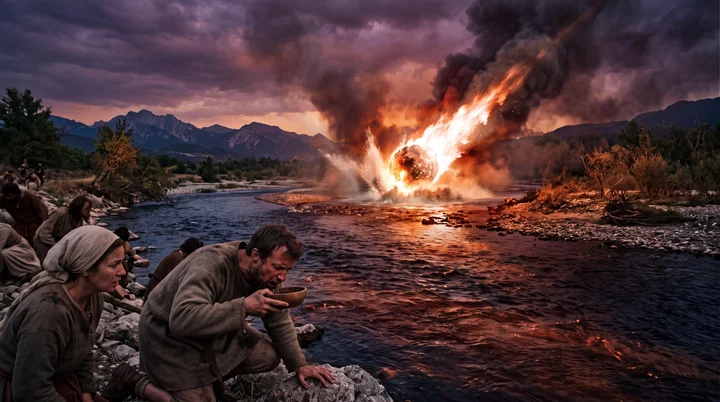
Cross-references
- Revelation 9
And the fifth angel sounded, and I saw a star fall from heaven unto the earth: and to him was given the key of the bottomless pit.
Continues the sequence of trumpet judgments begun in Revelation 8.
- Revelation 8:2
And I saw the seven angels which stood before God; and to them were given seven trumpets.
The seventh seal introduces the trumpets that include this verse.
- Revelation 8:6
And the seven angels which had the seven trumpets prepared themselves to sound.
The seven angels prepare to sound their trumpets in turn.
- Matthew 24:29
Immediately after the tribulation of those days shall the sun be darkened, and the moon shall not give her light, and the stars shall fall from heaven, and the powers of the heavens shall be shaken:
Both texts describe stars falling from heaven.
- Revelation 6:13
And the stars of heaven fell unto the earth, even as a fig tree casteth her untimely figs, when she is shaken of a mighty wind.
Both describe stars falling from heaven, associated with meteor showers.
Commentary
Each commentary is drawn from primary sources: the writings of Ellen G. White and Adventist pioneers and periodicals. Each commentary is separate. Its own words are not a quotation; follow the references to read the source passages.
Pioneers and periodicals
64 sources
The sounding marks the third stage in the successive judgments upon Rome, following Visigoth and Vandal invasions and striking the western division of the empire.ST Oct 31, 1916RH Jul 15, 1858ST May 18, 1904 The great burning star is Attila with his Huns, called the scourge of God, whose warfare was brilliant, swift and fierce but soon quenched like a meteor.ST Nov 7, 1916ST Oct 31, 1916RH Jul 15, 1858RH Aug 21, 1900 Its fall upon the rivers and fountains denotes his land invasion of the river country of the Alps and the valleys of the Rhine, Danube, Moselle, Seine, Loire and Po, bringing desolation, famine and death.RH Aug 21, 1900RH Jan 8, 1875 After scorching part of Italy he made peace, died, and his power vanished without founding a lasting kingdom, giving Rome its death blow before its fall and division into the nations of western Europe.ST May 18, 1904RH Aug 21, 1900RH Jul 15, 1858 These partial judgments warn that earthly rule is nearly over and Christ's coming is near, calling for watching and prayer.ST Jul 8, 1897ST Aug 14, 1893ST Nov 28, 1900RH Dec 29, 1868
Seven Trumpet Setting
Revelation 8:10 is the sounding of the third of the seven trumpets found in Revelation 8 and 9 and continued in Revelation 11.ST Oct 31, 1916ST Mar 14, 1911ST May 18, 1904ST Dec 17, 1896ST May 2, 1916 It belongs to the seven trumpets brought into view under the seventh seal, which look back over the period covered by the seven seals and present it in greater detail with other events included.ST May 13, 1880ST Aug 8, 1916RH Jul 3, 1879 The seven-trumpet prophecy portrays conflict and upheaval in the world in highly symbolic language, presenting a successive outline of political events from the breakup of the Roman Empire through the darkening of the political heavens by Saracens and Turks to the kingdoms of the earth becoming Christ's kingdom.ST Oct 24, 1911ST Feb 7, 1906ST Jan 10, 1878 The third trumpet stands as one of the first four trumpet attacks associated with the downfall of the Western Empire, which was shattered by four attacks, and within the sequence effecting the division of the Roman kingdom into ten parts.ST May 18, 1904RH Jul 8, 1858ST Jan 10, 1878
The trumpets are symbols of war and political commotion among nations, portraying the breaking up of the Roman Empire, the rise and fall of Mohammedan power, and the prediction and time of God's judgment.ST Oct 31, 1916ST Jan 10, 1878 They symbolize the great wars of the Christian era that disintegrated the world's empires and the political events of this dispensation, marking major events in the fall of Rome and what follows to the end of the world.ST May 13, 1880ST Dec 17, 1896RH Dec 21, 1869ST Jan 10, 1878 These trumpet blasts sounded by angels are not literally heard by earth's inhabitants, but their sounding marks events that distinguish one angel's period from another.RH Dec 21, 1869RH May 19, 1851RH Nov 26, 1861 Each sounding marks successive periods in consecutive order across the gospel dispensation, forming one event in chronological succession leading to the Lord's coming, resurrection, judgment, and kingdom.ST May 13, 1880RH Jul 3, 1879RH May 19, 1851RH Nov 26, 1861RH Apr 7, 1863
The seven soundings follow one after another in ordered sequence rather than simultaneously or all at once, covering about the same period as the gospel dispensation and presenting the history of nations in conflict with one another.ST May 13, 1880RH Jul 3, 1879RH May 19, 1851RH Nov 26, 1861RH Apr 7, 1863 They mark periods overlapping the periods of the seals, symbolizing events taking place during those periods, and run alongside the seals and churches rather than waiting for one line to finish.ST May 13, 1880ST Aug 8, 1916RH Jul 3, 1879 The vision continues to the seventh trumpet, which announces Christ's reign and the time when the dead are judged, the servants are rewarded, and those who destroy the earth are destroyed.ST May 13, 1880RH Jul 3, 1879RH Apr 7, 1863 The book's symbolic disclosure of earth's history in this series reaches the judgment, or the beginning of the day of wrath.ST May 13, 1880ST May 2, 1916RH Apr 7, 1863
The chapter stands under the opening of the seventh seal with a silence in heaven lasting a prophetic half hour, understood as seven and one-half literal days, while angels leave their place around God's throne to accompany Christ to earth.ST Oct 29, 1912ST May 6, 1913 It is part of the visions of the heavenly sanctuary where Christ ministers, the sanctuary service having moved from the earthly to the heavenly while its continuing substance remains faith in divine redemption and obedience to God.ST Oct 29, 1912ST May 6, 1913 The vision of seven angels with seven trumpets denotes a series of events taking place from the close of the fourth century onward to the time when the wicked are finally destroyed.ST Oct 29, 1912ST May 6, 1913 Many treatments handle the verse only as part of that sequence and give no separate explanation of its star, rivers, or fountains of waters, applying it generally to the means by which Rome was overthrown and finally ruined within that prophetic course.ST Oct 24, 1911ST Feb 7, 1906RH Jul 8, 1858ST Dec 17, 1896RH Sep 29, 1874
Star and Burning
The great fallen star is Attila, called the scourge of God, at the head of his Hunnish hordes with allied tribes.ST Nov 7, 1916ST Oct 31, 1916ST Jan 15, 1880ST Nov 28, 1895 He stands third after Alaric of the Goths and Genseric of the Vandals and before the breaking of Western Rome that planted the modern nations of western Europe.RH Jul 15, 1858ST Nov 28, 1895 His greatness is shown by the greatness of the star, and the trumpet marks when his invasions began, with entry into the eastern empire in 441 and later attack upon the western empire in a portion distinct from the land and sea of the first two trumpets.RH Jul 15, 1858RH Jul 15, 1858 Like the sudden sinking of the western sun into the ocean he flashed forth at first like a brilliant meteor in swift conquest and then passed from the stage almost as suddenly as he had appeared.ST Nov 28, 1895
Burning as a lamp or torch like a blazing meteor or comet describes the character of his warfare as singularly brilliant, fierce and swift, yet of short duration and soon quenched.RH Jul 15, 1858RH Aug 21, 1900ST Nov 28, 1895RH Aug 21, 1900 The brief period runs from 441 to 453, with the campaign in the middle division lasting about a year, appearing suddenly like a blazing star and then disappearing like a star whose light is quenched in the waters.RH Aug 21, 1900RH Jan 8, 1875RH Aug 21, 1900 Unlike the great mountain burning with fire, which continued, the great star after suddenly scorching part of Italy rapidly disappeared, giving peace to the Romans when Attila made peace in 452 and died in 453, followed without interval by the destruction of his empire.RH Aug 21, 1900RH Jul 15, 1858 His course as a fiery meteor touched Italy for the first time in 452, advancing no farther than the plains of Lombardy and the banks of the Po, reducing the cities on that river and its tributaries to heaps of stones and ashes, where his ravages ceased and the star was extinguished.RH Aug 21, 1900RH Jul 15, 1858
Its fall from heaven denotes coming from beyond the empire with a fearful shock like a heavenly body striking the earth upon the fruitful valleys and river country.RH Jul 15, 1858 This was fulfilled when the Huns, a nation unknown in Europe, left the borders of China toward the end of the fourth century, crossed nearly four thousand miles over northern Asia to the Black Sea, and dashed suddenly upon the Goths, burning villages and harvests and killing men, women and children so that the Goths fled in terror. Attila then crossed the Danube at every point to punish Theodosius II, defeated the Romans three times, took and razed seventy cities, and forced Constantinople to pay ransom gold with yearly tribute in 447, followed in 451 by a march of seven or eight hundred miles from Hungary toward the west across the Rhine and Moselle to plunder the cities of lower Germany, Belgium and Gaul. In one reading the fall also represents the sudden extraordinary check to his advance, when Rome's former enemies — the Visigoths, Franks and Burgundians — joined Roman forces to oppose him and he halted his devastation near the Alps.RH Jan 8, 1875 His work was not to establish the Huns anywhere on the ruins of the empire but only to give Rome its death blow and then to vanish in the night, his power and the nations gathered under him disappearing like a broken meteor, which distinguishes this short concentrated devastation from the longer-lasting destruction of the burning mountain.RH Jul 15, 1858
The name Wormwood given to the star in the next verse describes the bitter consequences, terrors, miseries and death brought by the invasion, as the waters become bitter and many perish.ST Mar 14, 1911ST Nov 28, 1895ST Jan 10, 1878RH Jul 15, 1858 His cruel raids, in which he called himself the scourge of God and boasted that grass never grew where his horse had trod, brought bitterness to those he vanquished in the river country where the rivers have their sources.ST Nov 28, 1895 The trumpet is thus associated on the chart with bitterness and death, recalling the misery and terror that preceded the extinction of the Western Empire.ST Nov 1, 1910RH Jul 15, 1858 The star is also taken in one reading as a general term for a blazing meteorite or aerolite entering the atmosphere and falling burning like a lamp to the ground, not a metaphorical event.RH May 16, 1871 In one portrayal this judgment comes upon Rome from the East under Attila, described as probably a Turk, where the rivers represent the Roman Empire and its waters are made bitter through devastation, famine, treachery, fear and death.ST Mar 14, 1911
Rivers and Third Part
The third part of the rivers and fountains of waters is the river country where streams have their sources, especially the Alps and the fruitful valleys watered by the Rhine, the Danube, the Moselle, the Seine, the Loire, and the Po.RH Aug 21, 1900 The desolating course falls mainly on those portions of the world that abound with springs of water and running streams, upon the peoples of the Roman Empire in that region.RH Aug 21, 1900 In Italy this meant advancing no farther than the plains of Lombardy and the banks of the Po, while in the wider west it meant a march of seven or eight hundred miles from Hungary across the Rhine and the Moselle through lower Germany, Belgium, and Gaul toward the Atlantic.RH Aug 21, 1900 The rivers and fountains represent the streams and river sources of that middle division, especially the Alps where the devastation was halted when Visigoths, Franks, and Burgundians joined Roman forces to oppose it.RH Jan 8, 1875RH Dec 18, 1900RH Aug 21, 1900
Falling upon them means a land invasion along inland rivers and tributaries, striking the Roman power by land rather than by sea.RH Aug 21, 1900RH Jul 15, 1858RH Aug 21, 1900 Cities situated on the Po and its tributary streams were reduced to heaps of stones and ashes, as at Aquileia besieged with an innumerable host until its ruins could scarcely be found, and at Altinum, Concordia, and Padua on the march.RH Aug 21, 1900RH Jul 15, 1858RH Aug 21, 1900 The effect was as if those streams and fountains were made bitter, as if a baleful star had fallen into the waters, so that wild desolation was caused in their vicinity and death spread over the lands adjacent to them and watered by them.RH Aug 21, 1900RH Aug 21, 1900ST Mar 14, 1911 That bitterness came through devastation, famine, treachery, fear, and death, drying up the rivers and fountains of the West.RH Aug 21, 1900ST Mar 14, 1911 Its fulfillment was seen in plundered and wrecked cities such as Besançon, Metz, Auxerre, Rheims, Langres, Toul, Laon, Tongres, and Arras, left filled with corpses, in Metz burned with all killed, in children hung by the leg from trees, in two hundred maidens torn by horses and chariots, and in famine so severe that fathers and mothers ate their own children.RH Aug 21, 1900
The repeated third part points to one of the three divisions of the Roman Empire, taken by Constantine's three sons in 337, with the western division chiefly in view in this trumpet.RH Dec 18, 1900ST Nov 28, 1895RH Mar 5, 1901 It locates the attacks in a portion of the remaining empire distinct from the territory and sea associated with the first two trumpets, marking the part in which this trumpet's events took place.RH Jul 15, 1858RH Jul 8, 1858ST Jan 10, 1878 After Alaric and Genseric, this third invader scourged that third part in the course by which the empire was overthrown and finally ruined.RH Jul 15, 1858RH Jul 8, 1858ST Jan 10, 1878 In one of eleven repetitions of the phrase the third part, the fall marks the extent of that devastation, when the third, perhaps the half, of the population of Europe and of part of Africa was mown down by war, pestilence, and famine.RH Dec 18, 1900ST Jan 10, 1878
The trumpet sequence marks when these events began, not how long they lasted, with invasion of the eastern empire in 441 and later attack upon the western empire.RH Jul 15, 1858RH Aug 21, 1900RH Jul 15, 1858 The inquiry belonging to the verse is which tribe and leader carried it out and how long its effects continued, treating the third part as a part of Europe affected by the raid under this trumpet.RH Jul 15, 1858RH Dec 18, 1900
Attila's Hunnic Invasion
The Huns were a nation unknown in Europe who left the borders of China toward the end of the fourth century, crossed nearly four thousand miles over the northern portion of Asia to the northern shores of the Black Sea, and burned the villages and harvests of the Goths who lived there peacefully and killed men, women, and children so that the Goths fled in terror. Attila stands third after Alaric of the Goths and Genseric of the Vandals and before the planting of the modern nations of western Europe and the breaking of Western Rome.RH Jul 15, 1858ST May 18, 1904 He invaded the eastern empire in 441, then crossed the Danube at every point, defeated the Romans three times, took and razed seventy cities, burned villages and harvests and killed or captured the inhabitants, and forced Constantinople to pay a ransom of gold with yearly tribute in 447.RH Jul 15, 1858 He then struck the west from A.D. 451 to 453, after ravaging the eastern provinces attacking the western empire.RH Jul 15, 1858RH Jul 15, 1858ST May 18, 1904
His western march ran seven or eight hundred miles from Hungary toward the west across the Rhine and the Moselle to plunder and wreck the cities of lower Germany, Belgium, and Gaul to the Atlantic coast. After the repulse at Chalons on the plain where the nations from the Volga to the Atlantic assembled and 162,000 to 300,000 were slain, his course was changed but not stayed, and with spirit, forces, and reputation unimpaired he passed the Alps and touched Italy for the first time.RH Aug 21, 1900 He besieged Aquileia with an innumerable host until the succeeding generation could scarcely discover its ruins, and on his march reduced Altinum, Concordia, Padua, and the cities of Lombardy situated on the Po and its tributary streams to heaps of stones and ashes, advancing no farther into Italy than the plains of Lombardy and the banks of the Po.RH Aug 21, 1900RH Jul 15, 1858RH Aug 21, 1900 The sudden extraordinary check to his advance near the Alps came when Rome's former enemies — the Visigoths, Franks, and Burgundians — joined Roman forces to oppose him.RH Jan 8, 1875
The invasion spread as a vast army plundering and destroying everything, an unequalled scourge that lived on cruelty and dried up the rivers and fountains of waters of the West. Cities such as Besancon, Metz, Auxerre, Rheims, Langres, Toul, Laon, Tongres and Arras were ruined and filled with corpses with only dogs and birds of prey left living, Metz was burned with all killed including children just baptized, children were hung by the leg from trees, two hundred young maidens were torn apart by horses and run over with chariots, and famine where the Huns passed was so severe that fathers and mothers ate their own children. Attila called himself the scourge of God and the hammer of the universe and boasted that grass no longer grew where his horse had trodden. Short, large-headed, with small round sunken eyes and a flat nose, horrible to behold and glorying in terror, he disdained royal pomp and lived in a large wooden house eating and drinking from wooden vessels while kings around him used silver and gold. Kings and nations of Germany and Scythia from the Volga to the Danube obeyed his summons to war, leading a host greater than any since Xerxes against the Greeks, and the Huns lived day and night on horseback, there buying and selling, eating, drinking, sleeping and holding council, charging or escaping with the speed of lightning and spreading death all around, knowing nothing of plowing and roaming without home or hearth, the last great nation summoned for the destruction of Rome.RH Aug 21, 1900
Unlike the great mountain burning with fire which continued, the great star after suddenly scorching a part of Italy rapidly disappeared and was extinguished, giving peace to the Romans.RH Aug 21, 1900RH Jul 15, 1858 He made peace with the Romans in 452, died in 453, and his empire was destroyed without interval and soon collapsed.RH Aug 21, 1900RH Jul 15, 1858RH Jul 15, 1858 His work was not to establish the Huns anywhere on the ruins of the Roman Empire but only to give the empire its death blow and then to vanish in the night, with his power and the nations gathered under him disappearing like a broken meteor. The Huns weakened the empire and invaded its territories, yet they did not divide off territory and establish a lasting kingdom there, and after Attila's death they were driven back across the Danube, so though assigned an important prophetic place in the events that hastened Rome's ruin they are not counted among the ten kingdoms into which the Western Roman Empire was divided. The name Wormwood tied to this star recalls the misery and terror Attila caused, and his destruction with the wider decline of Roman government preceded the extinction of the Western Roman Empire.RH Jul 15, 1858 Those who held the differing identification make the third trumpet the devastation caused by the Vandals and their persecutions in A.D. 439.RH Feb 9, 1864
Rome's Breakup and End
The first four trumpets shattered the Western Empire by four successive attacks, Visigothic attack from 395, Vandal attack from North Africa from 428 to 476, Hunnic attack, and then downfall as one empire in 476 under Odoacer of the Heruli.ST May 18, 1904ST Feb 7, 1884RH Aug 7, 1900RH Apr 14, 1903 Those first trumpet judgments were fulfilled through the incursions of northern European barbarian tribes into the Roman Empire over many centuries, and the first six together also through the Turks and Saracens.RH May 4, 1869RH Aug 7, 1900 They symbolize the great wars of the Christian era that disintegrated the world's empires, the armies of northern peoples by which the Roman Empire was ruined and the old Roman Empire was dissolved through invasions by northern barbarians, completed near the end of the fifth century.RH May 4, 1869RH Aug 7, 1900 That fall of the Western Roman Empire was followed by the setting up of ten kingdoms that remained and gave rise to the nations dominating later history, the ten fragments that became the nations of western Europe, together with the rise and establishment of an apostasy from genuine Christianity that opposed the setting up of God's kingdom on earth.ST May 18, 1904ST Feb 7, 1884RH Apr 14, 1903
The seven-trumpet outline runs from that breakup through the darkening of the political heavens by the Saracens and Turks to the kingdoms of the earth becoming Christ's kingdom, a successive outline of political events from the breakup of the Roman Empire to Christ's coming in glory.ST Oct 24, 1911ST Feb 7, 1906ST Nov 8, 1905 It outlines the kingdoms formed by the division of the fourth universal empire, includes the plague of Mohammedanism, portrays the breaking up of the Roman kingdom, the period of the Mohammedan powers, and the closing work of God's judgment, and carries the prophetic account toward eternity.ST Oct 24, 1911ST Nov 8, 1905 That prophecy contains the 1,260 years of persecution from A.D. 538 to 1798, the five months of Ottoman persecution beginning July 27, 1299 and reaching to 1449 when Constantinople became subject to the Turks, and the 391 years and 15 days from thence to August 11, 1840 when Turkey lost independence by surrender to the great powers of Europe.ST Nov 28, 1895 It is one of the great highways of prophecy given as evidence that Christ's coming is near, and the last and next event in that prophetic line is the coronation of Jesus Christ as coming King, with the next great events the judgment, the day of God's wrath, and the coming of Christ.ST Feb 7, 1906ST Jul 8, 1897ST Nov 28, 1895
The trumpet sequence reaches to the end of the age, one of eleven prophetic chains that span the Christian dispensation and bring their readers to the final period on the eve of Christ's coming.RH Jun 2, 1874ST Sep 14, 1882ST Aug 14, 1893RH Mar 11, 1875 Its successive sounds mark periods overlapping the periods of the seals, and its final three trumpets bring woes rather than blessing, continuing to the seventh trumpet which announces Christ's reign and the time when the dead are judged, the Lord's servants are rewarded, and those who destroy the earth are destroyed.RH Jun 2, 1874ST Sep 14, 1882RH Jul 3, 1879 With the other converging highways of time it brings us almost to the focal center, the second coming of Christ, and proves that the end of earthly rule is nearly over and Christ's coming is near.ST Aug 14, 1893RH Mar 11, 1875ST Nov 28, 1900 Six trumpets are past and the seventh, begun in 1844, is now sounding as present truth, showing the Lord's coming is near.RH Jun 2, 1874ST Aug 14, 1893RH Jul 3, 1879RH Mar 11, 1875ST Nov 28, 1900
The trumpet judgments are a series of partial judgments on the wicked that precedes the seven last plagues and does not exhaust God's wrath.RH Dec 29, 1868ST Nov 1, 1910 They form one of seven great time dramas setting forth the great controversy between the church and her foes from the first advent of Christ to the glorious consummation, showing God's means of arousing mankind and the breaking up of the nations.RH Dec 29, 1868ST Oct 20, 1909 With the prophetic dramas in Daniel 2 and 7 and 8 and 9 and 10 and 11, the seven churches, the seven seals, the two witnesses, the dragon, the beasts, and the time-tables in Matthew 24 and Mark 13 and Luke 21, the trumpets make twelve great lines of prophecy that begin in different and widespread periods in the past but gather in this day, the time of the end and the second coming of Jesus the Messiah, and their last scene closes with the downfall of the false and the everlasting triumph of the true.ST Oct 20, 1909
The four trumpets in Revelation 8 describe judgments on the Roman Empire as it broke apart, because it rejected light and put the Son of God to death, showing the results of governments that reject great light.RH Mar 5, 1901RH May 21, 1901 The repeated third part is explained by the empire's division into three portions, which were taken by Constantine's three sons in 337.RH Mar 5, 1901 The trumpet symbolizes war, and the trumpet prophecies portray the wars of barbarian peoples pouring in from the north, which swept away the corruption the Roman Empire had accumulated through its union with the apostate church in the making of the papacy, so that this ruin of the Roman Empire was the effect of that apostasy.RH Apr 14, 1904RH Aug 7, 1900RH Aug 7, 1900 The seven trumpets are a consequence that occurs because certain things have been done before, shown in the first three steps of the seven churches and the seven seals, so the basis of the third trumpet must be found by studying those causes, and the line of prophecy from beginning to end is connected with the Third Angel's Message.RH Apr 14, 1904RH Aug 7, 1900 That exposition embodies every phase of the Third Angel's Message and is the key to the modern history of the great nations of today, revealing their origin, course, and destiny, including the origin of the Eastern question, tracing it to its centering in China and to Japan and Russia in the present war.RH Apr 14, 1904RH Aug 7, 1900
Connections and Warning
The third trumpet belongs to the seven trumpets of Revelation 8 to 11, one of about twelve great lines of prophecy and one of seven great time dramas in Revelation setting forth the controversy between the church and her foes from the first advent to the consummation.ST Nov 28, 1900ST Dec 14, 1904ST Oct 20, 1909 With the seven churches showing the internal history, the seven seals showing the church acted upon by outside agents, the visions of Daniel 2 and 7 and 8 and 9 and 10 and 11, the two witnesses, the dragon, the beasts, and the timetables in Matthew 24 and Mark 13 and Luke 21, it forms converging highways of time that begin in different and widespread periods but gather at the time of the end and the second coming of Jesus the Messiah.ST Oct 20, 1909RH Apr 14, 1904RH Aug 7, 1900 Those sevenfold series denote completeness, and together they bring the reader almost to the focal center, the second coming of Christ.ST Nov 28, 1895ST Nov 28, 1900ST Dec 14, 1904 That trumpet line contains the 1,260 years of persecution from A.D. 538 to 1798, the five months of Ottoman oppression beginning July 27, 1299 and reaching to 1449 when Constantinople became subject to the Turks, and the 391 years and 15 days from thence to August 11, 1840 when Turkey lost independence by surrender to the great powers of Europe, with the next great events in the line being the judgment, the day of wrath, and the coming of Christ.ST Jul 8, 1897ST Nov 28, 1895ST Nov 28, 1900
The trumpets occur as a consequence of what was done before, so their basis and the basis of the third trumpet must be found in the first three steps of the churches and the seals.RH Apr 14, 1904RH Aug 7, 1900 From beginning to end they are connected with the Third Angel's Message, embodying every phase of it and establishing when the messages they represent were given, including the place of all nations in that message.RH Dec 2, 1873RH Apr 14, 1904RH Aug 7, 1900 They are the key to the modern history of the great nations of today, revealing their origin, course, and destiny and the breaking up of the nations as God's means of arousing mankind.ST Oct 20, 1909RH Apr 14, 1904 In particular they concern the Eastern Question and what its solution means to all the world, giving its origin and tracing its centering to China and to Japan and Russia in the present war, with the rise of Turkish power fulfilled to the very day and leading to the world's crisis and to the king of the north.RH Apr 14, 1904ST Aug 26, 1897ST Aug 19, 1897
The verse more exactly and fully sets forth Christ's own predictions of evil, belonging to prophecies of events in human history meant to have a practical effect as a foreshadowing of what will occur at the revelation of Jesus Christ.RH Feb 11, 1873 It shows severe and terrible judgments coming upon the world before the second advent, as in the days of Noah when the flood destroyed the world of the ungodly and as in the days of Lot when fire and brimstone destroyed Sodom.RH Feb 11, 1873 It points to a great catastrophe coming upon human society in the nature of a judgment for which men will be unprepared, attending the coming of the Son of man with both salvation and judgment, introducing great and important changes and removing all things that hinder the kingdom of the Son.RH Feb 11, 1873
Its fulfillment in the trumpet history proves that the end of earthly rule is nearly over, that the world is in the closing years of this age, and that Christ's coming is near, with the last and next event in that prophetic line being the coronation of Jesus Christ as coming King.ST Jul 8, 1897ST Aug 14, 1893ST Nov 28, 1900ST Sep 10, 1894ST Dec 14, 1904 Together with the third angel's call and other prophetic signs, the trumpet signs show that probation is nearing its close.ST Sep 10, 1894RH Mar 18, 1858 They are given as evidence to this time calling for watching and praying in view of the approaching second coming.ST Jul 8, 1897ST Aug 14, 1893ST Sep 10, 1894
Sources