Revelation 8:11
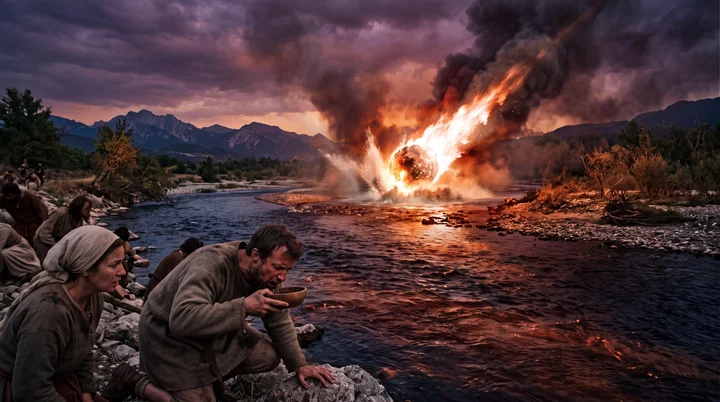
And the name of the star is called Wormwood: and the third part of the waters became wormwood; and many men died of the waters, because they were made bitter.
Translations
American King James Version, King James Version
And the name of the star is called Wormwood: and the third part of the waters became wormwood; and many men died of the waters, because they were made bitter.
KJV Cambridge Paragraph Bible, Revised Version, American Standard Version
and the name of the star is called Wormwood: and the third part of the waters became wormwood; and many men died of the waters, because they were made bitter.
And the name of the star is called Wormwood: and the third part of the waters became wormwood; and many men died by the waters, because they were made bitter.
and the name of the star is called Wormwood, and the third of the waters doth become wormwood, and many of the men did die of the waters, because they were made bitter.
And the name of the star is called Wormwood; and the third part of the waters became wormwood, and many of the men died of the waters because they were made bitter.
And, the name of the star, is called Wormwood; and the third of the waters became wormwood, and many of the men died of the waters, because they were made bitter.
Berean Standard Bible, Majority Standard Bible
The name of the star is Wormwood. A third of the waters turned bitter like wormwood oil, and many people died from the bitter waters.
The name of the star is “ Wormwood.” One third of the waters became wormwood. Many people died from the waters, because they were made bitter.
And the name of the star is Wormwood: and a third part of the waters became bitter; and a number of men came to their end because of the waters, for they were made bitter.
And the name of the starre is called wormewood: therefore the thirde part of the waters became wormewood, and many men died of the waters, because they were made bitter.
Douay-Rheims (Challoner revision)
And the name of the star is called Wormwood. And the third part of the waters became wormwood; and many men died of the waters, because they were made bitter.
Pictures
Cross-references
- Revelation 9:1-11
And the fifth angel sounded, and I saw a star fall from heaven unto the earth: and to him was given the key of the bottomless pit.
Continues the series of angelic trumpets, introducing the fifth trumpet.
- Revelation 16
And I heard a great voice out of the temple saying to the seven angels, Go your ways, and pour out the vials of the wrath of God upon the earth.
The seven vials echo the trumpet judgments as the final, unrestricted plagues.
- Revelation 8:1-2
And when he had opened the seventh seal, there was silence in heaven about the space of half an hour.
The seventh seal introduces the trumpet visions that include the bitter waters.
Commentary
Each commentary is drawn from primary sources: the writings of Ellen G. White and Adventist pioneers and periodicals. Each commentary is separate. Its own words are not a quotation; follow the references to read the source passages.
Pioneers and periodicals
64 sources
The great star falling burning like a lamp was a chieftain and warrior, Attila, whose fiery course was singularly brilliant and sudden like a blazing meteor and then quenched like a star falling into water, falling upon the rivers and fountains of waters which were the inland river country of the empire's remains, especially the Alpine fountains and the rivers of Italy such as the Po, as distinguished from the sea of the second trumpet.RH Jul 15, 1858RH Aug 21, 1900RH Jan 8, 1875 The name Wormwood means the bitterness, grief, terror and misery of that invasion, in despoliation and burning of lands, cities, homes and crops, with famine, torture, massacre and disease, so that many men died and wild desolation spread over the lands watered by those streams with cities left in ruins and a third and perhaps half the population mown down.RH Aug 21, 1900RH Jan 8, 1875ST Mar 14, 1911ST May 18, 1904 The third part is one of the three divisions of the Roman Empire, especially its western division, and the trumpet was fulfilled by the Huns under Attila, called the scourge of God, in a bloody land attack about a year in that section within 441-453 and especially A.D. 451-453 with the invasion of Italy in 452, before he was checked, withdrew, died in 453 and his power vanished in the night without settlement anywhere.RH Jul 15, 1858RH Aug 21, 1900RH Dec 18, 1900RH Jul 8, 1858 It belongs to the seven trumpets sounded one after another in fixed consecutive order, which are symbols of war and political commotions from the breakup of the Roman Empire to Christ's coming, the first four marking the fall of the Western Roman Empire by northern barbarians beginning with Alaric in A.D. 395 and closing with its downfall in 476, partial judgments on wicked apostate persecuting power unlike the seven last plagues.ST May 18, 1904ST Dec 17, 1896RH Jun 2, 1874RH Dec 15, 1863RH Dec 29, 1868 Those who held the differing application identified the third trumpet with the devastation caused by the Vandals under Genseric in A.D. 439.RH Feb 9, 1864
Symbols and Meaning
The great falling star burning like a lamp is a chieftain or warrior, Attila, and its burning describes the character of his warfare.RH Jul 15, 1858RH Aug 21, 1900RH Jul 15, 1858 His course was singularly brilliant, sudden like a blazing meteor or comet and then disappearing like a star whose light is quenched in the waters or like a candle snuffed out.RH Aug 21, 1900ST May 18, 1904 The judgment was of short duration like a meteor burning as a torch, yet it brought untold suffering upon the populations of the empire. He was a terrific meteor fallen on the West to give the Roman Empire its death blow, his brief career in the West running from A.D. 451 to 453 within the wider period 441-453.RH Aug 21, 1900ST May 18, 1904 He came with the Huns, a nation unknown in Europe whose language no one understood and whose name had never been pronounced there, who left the borders of China, crossed nearly four thousand miles of northern Asia to the northern shores of the Black Sea, and spread terror among the peacefully living Goths by burning villages and harvests and killing men, women and children.
The rivers and fountains of waters are distinguished from the sea of the second trumpet with its African and naval power, being the inland river country of a portion of the empire's remains.RH Jul 15, 1858RH Aug 21, 1900 They are especially the Alpine regions called the fountains of waters and the rivers and tributary streams of Italy such as the Po.RH Jan 8, 1875RH Dec 18, 1900RH Jul 15, 1858 The desolating course falls mainly on those portions of the world abounding with springs of water and running streams, striking the middle division around the headwaters and sources of the empire's main rivers.RH Aug 21, 1900RH Jan 8, 1875ST May 18, 1904 The trumpet sequence marks when the scourge began rather than how long it lasted, Attila's invasion following the events of the second trumpet.RH Jul 15, 1858 His advance came from beyond the empire's bounds, but his devastation in Italy was sudden and limited, reducing cities to ruins before he made peace with the Romans, withdrew, and died the following year.RH Jul 15, 1858
The name Wormwood means the bitterness, grief, terror and misery of the invasion.RH Jul 15, 1858ST Jan 10, 1878RH Jul 15, 1858 It signifies despoliation, burning of lands, cities, homes and crops, famine, treachery, fear, torture, massacre, disease and other deadly effects by which many perished and thousands suffered under these judgments.RH Jan 8, 1875ST Mar 14, 1911RH Jan 8, 1875 He was called the scourge of God, and his name inspired terror, marking the calamities associated with the decline that preceded the extinction of the Western Roman Empire.RH Jul 15, 1858 The suffering of the inhabitants around the headwaters of the empire's main rivers was made bitter by this affliction.ST May 18, 1904
The third part is one of the three divisions of the Roman Empire, taken by Constantine's three sons in 337, and especially its western division.RH Dec 18, 1900RH Mar 5, 1901ST Mar 14, 1911 The repeated reference to a third part points to the portion of the empire suffering the scourge and to the division in which the events of this trumpet took place.RH Jul 8, 1858ST Jan 10, 1878 The first four trumpets describe that division being broken, humbled and abolished, bringing the power and empire of imperial Rome to an end.ST Mar 14, 1911
Many men dying of the bitter waters means wild desolation and death spread over the lands adjacent to and watered by those streams, as if a baleful star fell into the waters.RH Aug 21, 1900 Cities were left in ruins and filled with corpses, with cruel devastation, massacre and famine wherever the Huns passed, children and women tortured and killed, and hunger so severe that fathers and mothers ate their own children. Homes and crops were destroyed and cities in northern Italy burned, bringing grief to the people, while many died from disease and other consequences of the invasion.RH Jan 8, 1875RH Jan 8, 1875 The repetition of third part eleven times over earth, grass, trees, sea, ships, rivers, creatures in the sea and waters measures the extent of the desolations, when a third and perhaps half the population of Europe and part of Africa was mown down by war, pestilence and famine. The burning comet fallen on the West is thus pictured as drying up its beautiful rivers and fountains of waters, with nothing in that century equalling this scourge.
Historical Fulfillment in Attila
The third trumpet was fulfilled by the Huns under Attila, called the scourge of God and the hammer of the universe, in a confederate land attack and bloody war against the Roman Empire in the Christian era.ST Nov 7, 1916ST Oct 31, 1916ST Jan 15, 1880RH Oct 1, 1914 The seven trumpets are symbols of war pointing to the mighty irruptions of barbarian hordes that swept over the empire and dethroned her as proud mistress of nations, and the first four trumpets refer to the dissolution of the old Roman Empire through invasions by northern barbarians completed near the end of the fifth century.RH Oct 1, 1914 Together they represent the attacks upon the Western Roman Empire, giving the history of political powers used as a scourge against the church because of apostasy, beginning with the Visigoths under Alaric in A.D. 395 and including the Vandals from North Africa under Genseric from 428 to 476 and the Huns under Attila, and closing with the downfall of Western Rome in 476 under Odoacer of the Heruli.RH Oct 1, 1914
The Huns were a nation unknown in Europe whose language no one understood and whose name had never been pronounced there, who left the borders of China and crossed nearly four thousand miles of northern Asia to dash toward the northern shores of the Black Sea. There the Goths were living peacefully, and the Huns spread terror by burning villages and harvests and killing men, women and children. Under Attila the Huns, obeyed by kings and nations from the Volga to the Danube, living on horseback day and night and moving with the speed of lightning to spread death all around, were the last great nation summoned for the destruction of Rome, glorying in inspiring terror by horrible appearance and by frightful rumors that scattered dismay, boasting that grass no longer grew where his horse had trodden. His fiery course turned from Gaul to Italy no farther than the plains of Lombardy and the banks of the Po and its tributary streams, reducing the cities situated there to heaps of stones and ashes and to ruins.RH Jul 15, 1858RH Aug 21, 1900 He fulfilled the prophecy in his own boast, The star is falling, the earth is trembling, I am the hammer of the universe.
His operations struck the middle division around the headwaters and sources of the empire's main rivers, including the Alpine region called the fountain of waters, and the suffering of the inhabitants was bitter.RH Jan 8, 1875ST May 18, 1904 The bitter waters represent the invasion's deadly effects in northern Italy, with grief to the people, destruction of homes and crops, burning of cities and lands, and many dying from disease and other consequences.RH Jan 8, 1875RH Jan 8, 1875 After the waters were made bitter even Ravenna's marshes no longer protected it, belonging to the stage when Rome had been confined to Italy and its last barrier was broken.RH Jul 15, 1858
His campaign was brief, covering 441-453 as a burning star, and especially A.D. 451-453 with the invasion of Italy in A.D. 452, lasting about a year in that section before his advance was checked.RH Aug 21, 1900RH Jan 8, 1875ST May 18, 1904RH Aug 21, 1900RH Jan 8, 1875 Unlike the great mountain burning with fire that long destroyed Roman power by sea, the star was extinguished almost as soon as it fell, suddenly scorching part of Italy and then rapidly disappearing.RH Aug 21, 1900 He made peace with the Romans and soon withdrew, died in A.D. 453 the following year, and his empire was destroyed without interval so that his power vanished in the night and the nations he had gathered disappeared with him.RH Jul 15, 1858RH Aug 21, 1900 His desolating course fell mainly on those portions abounding with springs of water and running streams, producing an effect as if those streams and fountains were made bitter and causing wild desolation in the vicinity of those rivers and the lands adjacent to and watered by them.RH Aug 21, 1900
His reign was only an invasion and not a settlement anywhere on the ruins of Rome, so after his sudden death his power vanished in the night. Alaric, Attila and Genseric have an important prophetic place in the events that hastened Rome's ruin, but not in Daniel's prophecy of the ten kingdoms, because the ten kingdoms are those that divided Western Rome by taking territory and establishing lasting kingdoms, which the Huns did not do. Those who held a differing application identified the third trumpet with the devastation and persecutions caused by the Vandals under Genseric in A.D. 439.RH Feb 9, 1864
Place in Trumpet Prophecy
The verse stands in the seven trumpets of Revelation 8 and 9, resumed in Revelation 11:19.RH Jun 2, 1874RH Dec 15, 1863ST Dec 8, 1909 They are a connected series of seven angels sounding one after another in fixed consecutive order and not all at once.RH Dec 15, 1863RH Dec 21, 1869 The first four have sounded before the three woe trumpets began.ST May 18, 1904 The seven trumpets are symbols of war and political commotions among the nations.ST Feb 7, 1906ST Oct 31, 1916 They present successive events from the breakup of the Roman Empire to Christ's coming, with the number seven signifying completeness and fullness.ST Feb 7, 1906ST Oct 24, 1911ST May 13, 1880
The trumpets revisit the period covered by the seven seals and seven churches in greater detail, spanning the whole gospel dispensation from the first advent to the second advent and final restoration.ST May 13, 1880ST Aug 8, 1916ST Nov 25, 1889 They cover about the same period as the other Revelation series and give a history of nations in conflict with one another.ST May 13, 1880RH Sep 29, 1874ST Nov 25, 1889 They are synchronous with other prophetic lines rather than waiting for them to finish, symbolizing events occurring during periods also covered by the seals.RH Apr 29, 1875RH Jul 3, 1879 Their fulfillment shows the world in the closing years of the present age with Christ's second coming approaching, reaching to the coming day of judgment and retribution and to the end of the age.RH Jun 2, 1874ST Nov 25, 1889ST Sep 10, 1894
The first four trumpets, including this verse, mark the fall and complete disappearance of the Western Roman Empire.ST Dec 17, 1896ST Feb 7, 1884 They portray terrible invasions by northern barbarians, Goths, Vandals, Huns and others that brought ruin to the Roman Empire.RH May 4, 1869RH Aug 7, 1900RH Aug 14, 1900 The work began with Alaric in A.D. 395 and the Vandals from 428 to 476.RH May 4, 1869 It closed with its downfall in 476 under Odoacer of the Heruli and the planting of the ten kingdoms that divided its territory.RH Aug 14, 1900 The first six trumpet judgments were fulfilled through incursions over many centuries by northern European barbarian tribes and by Turks and Saracens, with the dissolution of the old Roman Empire completed near the end of the fifth century.RH May 4, 1869
The trumpet line contains prophetic dates from A.D. 538 to 1798, from July 27, 1299 to 1449, and 391 years and 15 days to August 11, 1840.ST Nov 28, 1895 After those dates the next great events in this prophecy are the judgment, the day of God's wrath, and the coming of Christ.ST Nov 28, 1895RH Dec 13, 1853 The historical fulfillment places the present age near the close of the sixth trumpet, with the seventh trumpet expected to sound soon as the next prophetic event.RH Dec 13, 1853RH May 6, 1873 The first six trumpets are past and the seventh trumpet began sounding in 1844, spanning from the first advent to the final restoration.RH May 6, 1873 The connected sequence of Revelation 6, 7 and 8 shows that the sealing of the 144,000 servants of God just before the loosing of the four winds occurs in the days of the second advent, not the days of the first advent.RH Dec 9, 1851
Judgment on Apostate Rome
The trumpets are judgments, called plagues, falling on wicked men and on persecuting apostate powers and their adherents, and they span the Christian dispensation to the glory of Christ's coming.RH Dec 29, 1868RH May 4, 1869ST Oct 14, 1889 These trumpet judgments are partial, whereas the seven last plagues make no exemption, follow the trumpets, and complete God's wrath.RH Dec 29, 1868RH May 4, 1869 The first six trumpet judgments were fulfilled through the incursions of northern European barbarian tribes and of Turks and Saracens into the Roman Empire over many centuries.RH May 4, 1869
The trumpet judgments fell on the Roman Empire for rejecting great light and putting the Son of God to death, and they give the political history of powers used as a scourge against the church because of apostasy.RH Mar 5, 1901RH May 21, 1901RH Oct 1, 1914 While the seven churches give the spiritual side of the church and the seven seals give the history of the church under oppression, covering the same time from the first advent to the second advent, the trumpets give the history of political powers so used.RH Oct 1, 1914 The corruption produced by the union of the Roman Empire with the apostate church, which developed the papacy and opposed God's kingdom, was swept away by floods of northern barbarians, and the trumpet judgments mark the complete ruin of the Roman Empire as an effect of that apostasy.RH Aug 7, 1900 The third part struck is one of three portions of the empire, taken by Constantine's three sons in 337.RH Mar 5, 1901 The four trumpets together are the attacks of the barbarians upon the Western Roman Empire, beginning with the Visigoths under Alaric in A.D. 395, including the Vandals from North Africa under Genseric from 428 to 476 and the Huns under Attila, who called himself the Scourge of God, and closing with the downfall of Western Rome in 476 under Odoacer of the Heruli.RH Oct 1, 1914
The third trumpet is a judgment upon Christendom of short duration like a meteor burning as a torch, yet bringing untold suffering upon the populations of the empire. As the third act's call to battle it is marked by bitterness and death.ST Nov 1, 1910 Its bitterness was the sudden invasion of the Huns toward the end of the fourth century, a nation unknown in Europe whose language no one understood and whose name had never been pronounced there, who left the borders of China and crossed nearly four thousand miles of northern Asia to dash toward the northern shores of the Black Sea where the Goths were living peacefully, spreading terror by burning villages and harvests and killing men, women, and children.
The visions more fully show what was foretold about the end, foreshadowing what will happen at the revelation of Jesus Christ at His second advent.RH Feb 11, 1873 They point to severe and terrible judgments and a great catastrophe of judgment coming upon human society and Christian nations before the coming of the Son of man, which brings both salvation and judgment with great and important changes and the removal of all things that hinder its progress.RH Feb 11, 1873 The seven trumpets represent the fullness of woes upon the earth.ST May 12, 1881 These events belong to the course of human history, are literally true, are meant to have a practical effect, and show that probation is nearing its close, though most men, even professing Christians, will not receive them and will no more be prepared for them than men were for the flood and the destruction of Sodom.RH Feb 11, 1873RH Mar 18, 1858
Study and Present Application
The seven trumpets form a basis for the third angel's message, which is held in view from the first trumpet to the last.RH Aug 7, 1900 The trumpet events are consequences of prior steps shown in the opening of the seven churches and the seven seals.RH Aug 7, 1900 Proper understanding of that history establishes the date when the trumpets were given.RH Dec 2, 1873 Their fulfillment traced through history shows the world to be in the closing years of the present age with Christ's second coming approaching, among prophetic lines reaching their closing events.ST Sep 10, 1894RH Nov 17, 1910
The seven trumpets give the Biblical standpoint on the Eastern Question and show what its solution means to all the world.ST Aug 19, 1897ST Aug 5, 1897 They are studied together with the rise of the Turkish power in prophecy and history fulfilled to the very day, the world's crisis, Daniel's visions at the time of the end, the king of the north and his end, and the plagues of God's wrath.ST Feb 24, 1898ST Aug 5, 1897ST Feb 17, 1898 That connection bears on crisis for all the world and shows the end is at hand, calling for watching and praying.ST Feb 24, 1898ST Aug 26, 1897ST Feb 17, 1898
Together with the seven churches, the seven seals, the two witnesses, the dragon and the beasts, the seven trumpets are one of twelve great lines of prophecy in Daniel, Revelation and the Gospels, presenting additional events and evidence by which the approach of the end can be known.ST Oct 20, 1909ST Aug 7, 1901 They set forth the great controversy between the church and her foes from the first advent of Christ to the glorious consummation, including the internal condition of the church through the ages, God's means of arousing mankind, the breaking up of the nations, His mighty witnesses, and the great foes of Christ and His church to the end.ST Oct 20, 1909 They portray the means by which the Roman Empire was to be overthrown and finally ruined, give details about the kingdoms formed from the division of the fourth universal empire, and describe the plague of Mohammedanism.RH Jul 8, 1858 They form seven great time dramas whose last scene closes with the downfall of the false and the everlasting triumph of the true, beginning in the past but focusing in the time of the end and the second coming of Jesus the Messiah to show the transitory nature of earthly dominion, bring distant future events near in vivid detail to show Christ, bring God's children to His eternal kingdom of righteousness, and bless readers who read and hear and keep the prophecy, with the significance of Turkey's downfall indicating that the final crisis and Christ's return are near.ST Dec 24, 1896ST Oct 20, 1909
The wormwood bitterness also supplies a devotional lesson for painful experiences of life, likened to wormwood mixed with wine and received as portions allowed by a wiser, loving Father.ST Jul 30, 1885
Sources