Revelation 9:2
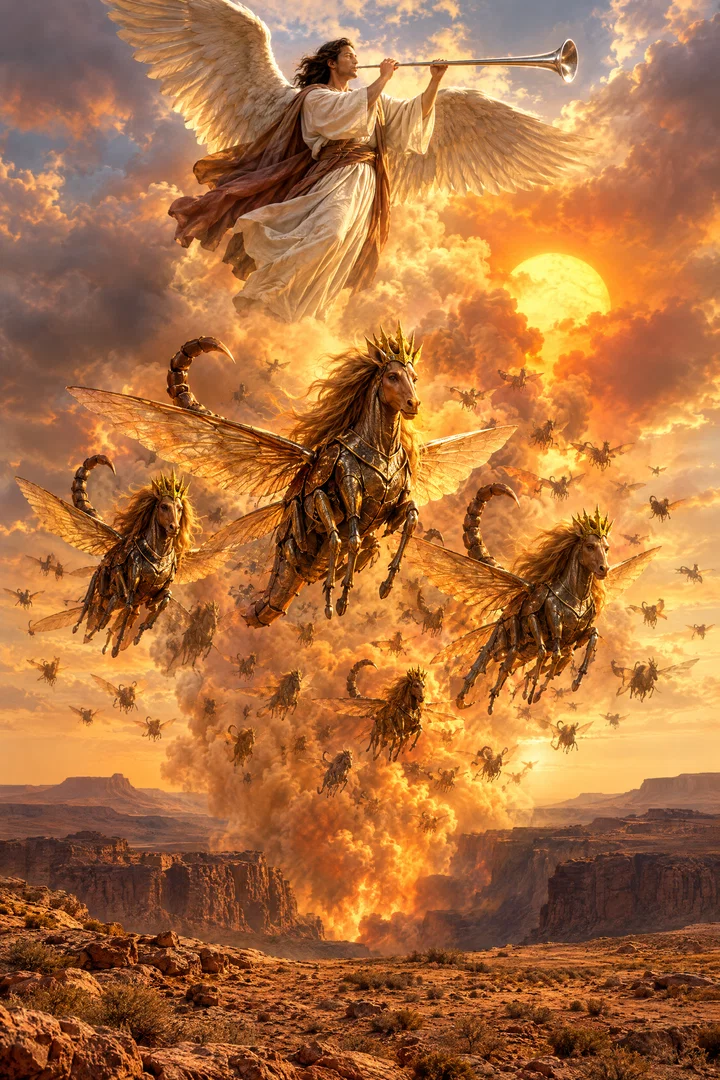
And he opened the bottomless pit; and there arose a smoke out of the pit, as the smoke of a great furnace; and the sun and the air were darkened by reason of the smoke of the pit.
Translations
American King James Version, King James Version, KJV Cambridge Paragraph Bible, Webster Bible
And he opened the bottomless pit; and there arose a smoke out of the pit, as the smoke of a great furnace; and the sun and the air were darkened by reason of the smoke of the pit.
Revised Version, American Standard Version
And he opened the pit of the abyss; and there went up a smoke out of the pit, as the smoke of a great furnace; and the sun and the air were darkened by reason of the smoke of the pit.
and he did open the pit of the abyss, and there came up a smoke out of the pit as smoke of a great furnace, and darkened was the sun and the air, from the smoke of the pit.
And it opened the pit of the abyss; and there went up smoke out of the pit as [ the] smoke of a great furnace; and the sun and the air were darkened with the smoke of the pit.
And he opened the shaft of the abyss; and there came up a smoke out of the shaft, as the smoke of a great furnace, and the sun and the air were darkened, by reason of the smoke of the shaft.
The star opened the pit of the Abyss, and smoke rose out of it like the smoke of a great furnace, and the sun and the air were darkened by the smoke from the pit.
The star opened the pit of the Abyss, and smoke rose out of it like the smoke of a burning furnace, and the sun and the air were darkened by the smoke from the pit.
He opened the pit of the abyss, and smoke went up out of the pit, like the smoke from a burning furnace. The sun and the air were darkened because of the smoke from the pit.
And he made the great deep open and a smoke went up from it, like the smoke of a great oven; and the sun and the air were made dark because of the smoke.
And he opened the bottomlesse pit, and there arose the smoke of the pit, as the smoke of a great fornace, and the sunne, and the ayre were darkened by the smoke of the pit.
Douay-Rheims (Challoner revision)
And he opened the bottomless pit: and the smoke of the pit arose, as the smoke of a great furnace; and the sun and the air were darkened with the smoke of the pit.
Pictures
Cross-references
- Revelation 8
And when he had opened the seventh seal, there was silence in heaven about the space of half an hour.
Linked with Revelation 9 as part of the seven-trumpet series.
- Revelation 20:3
And cast him into the bottomless pit, and shut him up, and set a seal upon him, that he should deceive the nations no more, till the thousand years should be fulfilled: and after that he must be loosed a little season.
Both describe the bottomless pit as the place of Satan’s confinement.
- Revelation 9:11
And they had a king over them, which is the angel of the bottomless pit, whose name in the Hebrew tongue is Abaddon, but in the Greek tongue hath his name Apollyon.
Identifies the bottomless pit’s king as the destroyer leading the host.
- Revelation 11:7
And when they shall have finished their testimony, the beast that ascendeth out of the bottomless pit shall make war against them, and shall overcome them, and kill them.
Both texts describe the abyss as the source of what ascends from it.
- Revelation 17:8
The beast that thou sawest was, and is not; and shall ascend out of the bottomless pit, and go into perdition: and they that dwell on the earth shall wonder, whose names were not written in the book of life from the foundation of the world, when they behold the beast that was, and is not, and yet is.
Both texts describe the bottomless pit and what rises from it.
- Revelation 8:13
And I beheld, and heard an angel flying through the midst of heaven, saying with a loud voice, Woe, woe, woe, to the inhabiters of the earth by reason of the other voices of the trumpet of the three angels, which are yet to sound!
Introduces the three woe trumpets, beginning with the fifth trumpet.
- Luke 8:31
And they besought him that he would not command them to go out into the deep.
Renders the abyss as “the deep.”
- Revelation 20:1
And I saw an angel come down from heaven, having the key of the bottomless pit and a great chain in his hand.
Describes an angel holding the key to the bottomless pit.
- Revelation 8:2
And I saw the seven angels which stood before God; and to them were given seven trumpets.
Introduces the trumpet sequence that includes Revelation 9.
- Romans 10:7
Or, Who shall descend into the deep? ( that is, to bring up Christ again from the dead.)
Uses the same Greek word, translated “deep”.
- Revelation 19
And after these things I heard a great voice of much people in heaven, saying, Alleluia; Salvation, and glory, and honour, and power, unto the Lord our God:
The events following this chapter lead to the desolate-earth setting described as the pit.
Commentary
Each commentary is drawn from primary sources: the writings of Ellen G. White and Adventist pioneers and periodicals. Each commentary is separate. Its own words are not a quotation; follow the references to read the source passages.
Ellen G. White
2 sources
Revelation 9, including the opening of the bottomless pit and the rising smoke, foretells the history and overthrow of the Ottoman Empire.GC 334.4–335.1GC88 334.4–5 The prophecy works through measured prophetic time periods, a first period of 150 years followed by 391 years and fifteen days, ending on 11 August 1840 when Ottoman power in Constantinople would be broken.GC 334.4–335.1 On that date the prediction was fulfilled when Turkey surrendered its independence and Ottoman power was broken.GC 334.4–335.1GC88 334.4–5
This took place when Turkey through its ambassadors accepted the protection of the allied powers of Europe and placed itself under the control of Christian nations.GC 334.4–335.1 Fulfillment at the specified time confirmed the correctness of the principles of prophetic interpretation.GC 334.4–335.1
Sources
Pioneers and periodicals
113 sources
The pit is opened to release a vast smoke like that of a great furnace that darkens the sun and the air, from which locust armies come forth upon the earth.ST Mar 21, 1911ST May 25, 1904ST Feb 18, 1886 It belongs to the fifth trumpet, the first woe, which foretells the rise, conquests and spread of Mohammed and his followers as Saracens and Ottoman Turks.RH Dec 25, 1900ST Jul 13, 1915RH Dec 25, 1900 The smoke is Mohammedanism and Islam spreading suddenly and widely from the waste desolate region of Arabia like a noxious pestilential vapor, and its darkening of the sun and air is its deadly error obscuring the gospel and bringing religious darkness and delusion.RH Dec 25, 1900RH Sep 4, 1900RH Jul 22, 1858ST Jan 10, 1878RH Mar 26, 1867 Its five months are 150 years from July 27, 1299, when Othman invaded Nicomedia, to July 27, 1449, when the Turks attacked Constantinople, ending the first woe before the sixth-trumpet period of 391 years and 15 days ended August 11, 1840 with the loss of Turkish independence.RH Jul 23, 1914ST Oct 29, 1912RH Sep 28, 1869RH Aug 2, 1864RH Dec 21, 1869 The pit is a dark desolate earthly place or condition, not an eternal burning hell beyond the earth, through which a false religion became a scourge permitted to punish an apostate church for idolatry.RH Jul 22, 1858ST Aug 2, 1877RH Oct 18, 1864ST Mar 11, 1875
Words and Imagery
The phrase bottomless pit renders the Greek abussos, or abyss, which is also rendered deep elsewhere as in Luke 8:31 and Romans 10:7.RH Jul 30, 1861RH Jan 9, 1855 It signifies an abyss that is bottomless, deep and profound, meaning an unmeasured depth.RH Dec 30, 1862ST Mar 21, 1911 In this verse it is applied to the wastes and deserts of Arabia, from which the doctrines of Mohammed issued, describing the geographical source of those doctrines.RH Jul 30, 1861RH Dec 30, 1862
The pit denotes a waste, desert or desolate region, and any place of darkness, desolation and death.ST May 25, 1904RH Dec 30, 1862ST Mar 18, 1886 It is identified as the wild, barren wastes and regions of the Arabian desert, where the tribes had been disorganized and dormant.ST Jan 10, 1878ST Jul 6, 1915 The same word for abyss applied to that place of darkness and desolation is applied to the barren wastes of the Arabian desert.ST Mar 18, 1886RH Sep 4, 1900 Under the fifth trumpet it brings Mohammedanism as a scourge upon the eastern division of Rome after the extinction of Western Rome under the first four trumpets.ST May 25, 1904RH Sep 4, 1900
The verse pictures the pit opened with smoke arising out of it as the smoke of a great furnace, darkening the sun and the air.ST Mar 21, 1911ST May 25, 1904ST Feb 18, 1886 That darkening portrays the spread of dark and delusive doctrines by Mohammed and his fanatical followers rising to supremacy and spreading over the earth.ST Jan 10, 1878ST Jul 6, 1915 The smoke rising represents Islam, whose teachings and power and movement darken the sun and air, and the Mohammedan forces swarm forth like clouds of locusts from the Arabian desert darkening the sky.ST May 25, 1904RH Sep 4, 1900 This darkness accompanies the locusts that come out of the smoke upon the earth.ST Mar 21, 1911ST May 25, 1904
The word rendered arose illustrates the Greek anabaino, meaning to arise, ascend, climb or grow, as smoke ascends from a pit and as the beast rising from the earth is compared to tumultuous smoke rising from the bottomless pit.ST Feb 9, 1915 The opening of the abyss is a symbolic picture of a great depth permitted to open, releasing smoke like that of a great furnace.ST Mar 21, 1911 Like later delusions that sweep over the world, it produces spiritual obscurity.ST Mar 21, 1911
The darkened sun represents Jesus Christ as the Sun of Righteousness and the Light of the world, and the darkened air represents the Spirit by whom people live and receive light and regenerating power.ST Mar 21, 1911ST Mar 21, 1911 The smoke therefore hides Christ from people and shuts them away from the Spirit's light and regenerating power, darkening without removing sun and air.ST Mar 21, 1911ST Mar 21, 1911 It does this by denying Christ His place as the object of worship, love and hope, putting Mohammed in Christ's place, leaving the world without a Saviour, and knowing no Holy Spirit or renewing power.ST Mar 21, 1911ST Mar 21, 1911 The smoke from the bottomless pit represents an influence coming from Satan, the prince who rules in the hearts of the disobedient.RH Sep 22, 1859
Trumpet Context
The verse belongs to the sounding of the seven trumpets in Revelation 8 and 9, continued in part of 11, unfolding in consecutive historic sequence across the gospel dispensation.RH Dec 2, 1862ST Aug 14, 1893ST May 13, 1880 The seven-trumpet visions are mostly fulfilled in the past and signify political events interpreted in light of historical records, using both literal and figurative language.RH Sep 29, 1874 They belong to the prophetic outline in Revelation 8-11 which gives details about the kingdoms formed from the divided fourth universal empire, describes the plague of Mohammedanism, and carries the prophecy forward to the gates of eternity. They describe additional events in prophetic language and provide further evidence for recognizing when the end of the world's history is approaching and declaring that the coming of the Lord is near.ST Aug 14, 1893 The series covers roughly the same period as the church's history from the first century to Christ's coming, describing the nations of the earth in conflict with one another, and reaches the judgment and the day of wrath.ST May 13, 1880
The seven trumpets show successive political events from the breaking up of the Roman Empire to the coming of the Lord in glory, and the number seven means completeness to the end of the prophetic story.STST Feb 7, 1906 They set forth the political events of this dispensation as heralds of war and revolution, specifically the incursions of barbarian hordes that swept over the Roman Empire, and stand as the counterpart of the prophecy of Daniel 2.ST Jan 10, 1878 They show the means by which the Roman empire was to be overthrown and subverted and finally ruined, and set forth God's means of arousing mankind and the breaking up of the nations as part of the great controversy between the church and her foes from the first advent of Christ to the glorious consummation.RH Jul 8, 1858ST Oct 20, 1909 They form one of seven great time dramas in Revelation that close with the downfall of the false and the everlasting triumph of the true, and one of twelve great lines of prophecy in Daniel, Revelation, Matthew 24, Mark 13 and Luke 21 that begin in the past and focus in the time of the end and the second coming of Jesus the Messiah.ST Oct 20, 1909
The verse belongs to the fifth trumpet, the first woe trumpet, applied to the rise, conquests and spread of Mohammed and his followers as Saracens and Ottoman Turks.RH Dec 25, 1900ST Jul 13, 1915RH Sep 4, 1900RH Jul 22, 1858ST Oct 24, 1911 The whole chapter is divided between the fifth and sixth trumpets as the first and second woes, with the smoke rising from the pit and darkening the sun and air belonging to the fifth, which represents the Saracens, while the sixth represents the Turks.RH Jul 22, 1858 In the fifth trumpet this marks the rise of a power from a desolate region and its darkening influence after the restored Persian Empire fell to the Mohammedan hordes, portraying the political heavens as darkened by the Saracens and Turks in a period of strife in which God's Word bears a double witness and the final phase of the gospel goes forth.RH Dec 25, 1900RH Sep 4, 1900ST Oct 24, 1911 Those who held the verse for the sixth trumpet taught that it belongs to the sixth trumpet, which ends with the ninth chapter and closed in 1840 with the loss of Turkish independence and the passing of the Turkish Empire under the control of the European allied powers on August 11, 1840.STST Feb 7, 1906ST Feb 23, 1915RH Oct 21, 1862RH Aug 13, 1861 Its historical course is thus traced to the downfall of Eastern Rome and its sounding is said to have ceased in 1840, standing just before the great advent movement foretold in chapter 10 and chapter 11 to verse 14 and before the seventh trumpet announcement of the kingdom of Christ.STST Feb 7, 1884
The fifth and sixth trumpets are one of the last three woe trumpets, which extend to the end of the age and mark a time of peril and spiritual decline, not blessing or peace, opposing the claim that a peaceful millennium comes before Christ's return.ST Apr 8, 1886ST Sep 14, 1882 They are trumpet judgments bringing partial judgments upon the wicked, preceding the seven last plagues which complete God's wrath and make no exemption and constitute the third and final woe, while the second woe's prophetic period ending on August 11, 1840 with the overthrow of the Ottoman Empire's political power strengthened the 1840-44 Advent proclamation of the judgment hour.RH Dec 29, 1868RH Dec 29, 1868ST Jun 15, 1915 Rome was the fourth and last of the four great governments beginning with Babylon and ending with Rome in its papal form, the universal monarchy in power in its glory when John was in banishment on Patmos, and the prophecy gives the history of its fall beginning with removal of the seat of empire from west to east and continued division and subdivision until final ruin.RH Jul 8, 1858 After Constantine the empire was divided into three parts, explaining the frequent mention of a third part under the scourge, and under the first four trumpets the two western divisions fell through incursions of northern European barbarian tribes, while under the fifth and sixth trumpets the eastern empire was crushed by Turks and Saracens over many centuries.RH Jul 8, 1858RH May 4, 1869 Their historical setting follows the extinction of the Western Empire, when the imperial office, consulship, and senate disappeared and the way was opened for the papacy's rise with the pope's spiritual supremacy acknowledged and maintained by Justinian and papal political supremacy established in the former Western territory by 538, but under the seventh trumpet great Babylon entire will sink to rise no more.RH Jul 8, 1858RH Jul 22, 1858ST May 18, 1904 The verse belongs to the absorbing prophecy recorded in Revelation 8 to 10 that concludes with the shipwreck of all nations.ST Aug 22, 1916
Historic Fulfillment Identified
The opening of the pit is the release on earth of a deceptive, fanatical power from Arabia as the Roman Empire was weakened.RH Jul 22, 1858ST Mar 2, 1904 Its commencement is marked by the fall of the Persian king Chosroes by defeat and death in 628, followed by the conquest of Arabia and the first Mohammedan war against Rome in 629.RH Jul 22, 1858RH Jun 25, 1872 It includes the first incursions of the followers of Mohammed after his death in 622, when wild barbarian hordes were under no general civil government until Osman, afterward called Othman, organized them into a government and empire.ST Mar 2, 1904 In few words the prophecy thus gives the fall of modern Persia and the rise and work of Mohammedanism, with the most exact dates of any prophecy.RH May 21, 1901
The smoke rising like that of a great furnace is Mohammedanism and Islam spreading suddenly and widely from Arabia like a noxious, pestilential vapor.RH Jul 22, 1858ST Jan 10, 1878RH Jul 22, 1858 Compared with the pure light of the gospel of Jesus it is smoke from the pit rather than light from heaven.RH Jul 22, 1858RH Jul 22, 1858 The pit is the wastes of the Arabian desert, and the smoke is its dark and delusive doctrines spread by Mohammed and his fanatical followers.ST Jan 10, 1878RH Mar 26, 1867ST Jul 6, 1915 Othman who organized the tribes is the angel or messenger of that pit, and the smoke is the power and movement of the vast Mohammedan forces further pictured as locusts against the Eastern Roman Empire.RH Sep 4, 1900
The darkening of the sun and air portrays the deadly influence of the Mohammedan system of error darkening the moral atmosphere after the restored Persian Empire fell to the Mohammedan hordes.RH Dec 25, 1900RH Sep 4, 1900 It is the pestilential influence of Mohammedan error obscuring the gospel and bringing religious darkness, delusion and confusion, applied to the age of Mahomet.RH Mar 26, 1867RH Sep 4, 1860ST Aug 26, 1897 From the obscurity of the desert the Arabs issued forth as locusts from smoke, conquered Persia and scourged the apostate church of Rome, directing their work against the priests and followers of Rome while those having God's seal were not made the purposeful object of destruction. Lands once illuminated by the gospel became obscured by the smoke of darkness from the Mohammedan pit of error.ST Aug 26, 1897
This dark period spread across much of Asia, crossed the Bosporus and captured Constantinople in 1453, then advanced toward Italy and Vienna and influenced European affairs through the end of the seventeenth century.ST Dec 24, 1912 It spread from Arabia across much of Asia, Africa and Europe, and its prevalence is shown by the extent of its conquests.RH Jul 22, 1858 It is applied to the Arab conquests and the spread of the religion founded by Mohammed across three continents, from the Persian Gulf to the Atlantic, portrayed as locust-like swarms rising from Arabia and Egypt bringing destruction upon professing Christians.ST Jan 2, 1912 It spread across Jerusalem, Palestine, and the lands where Abraham and the apostles first proclaimed the gospel, resisting attempts at Christianization and civilization.ST Dec 24, 1912
The locusts coming out of the smoke upon the earth are the vast Mohammedan forces and Saracen and Turkish armies swarming forth like clouds of locusts.RH May 19, 1851RH Sep 4, 1900 As winged and flying symbols they denote devastating armies and earthly governments, like unto horses, and have no reference to the United States.ST Feb 12, 1885ST Sep 4, 1879ST Sep 23, 1913 Its power ended with the second woe.RH May 19, 1851
In a different application the abyss is chaos and disorder, as the earth was before God brought it into order.ST Dec 17, 1896ST Jul 25, 1911 Its smoke-darkened atmosphere depicts French infidelity and Red-Republican revolution and the confusion and upheaval arising from that condition.ST Dec 17, 1896ST Jul 25, 1911 It also depicts the period when Constantine called himself a Christian and riches, honor and power flooded the church, especially its clergy, bringing Satan a grave advantage over the church of Christ.ST In the same manner it portrays the corruption and immorality associated with papal history.ST Apr 4, 1906
Prophetic Time Periods
The trumpet time periods are reckoned by the year-day rule, with prophetic days read as literal years.RH May 2, 1907RH Sep 28, 1869RH Dec 21, 1869ST Apr 18, 1878RH Feb 6, 1855 The five months of the fifth trumpet are 150 literal years, running from July 27, 1299, when Othman invaded Nicomedia, to July 27, 1449, when the Turks attacked Constantinople with gunpowder and great cannon.GSAM 128.2 That fulfilled time is proved by the events predicted to take place at its close having taken place, ending the first woe so that the second woe under the sixth trumpet began.RH Aug 2, 1864GSAM 128.2 The periods of the fifth and sixth angels thus mark measured years devoted to their work, a precedent for reading the days of the seventh angel's voice in Revelation 10:7 as years for finishing the gospel work and human probation.RH Dec 21, 1869ST Apr 18, 1878RH Feb 6, 1855
The sixth-trumpet period of 391 years and 15 days ended August 11, 1840, when the Turkish Sultan surrendered independence and the Ottoman Empire passed under control of the European allied powers.RH Aug 4, 1904RH May 2, 1907RH Sep 28, 1869ST Jun 15, 1915 Its later existence as a government was only an outward appearance after its political power was overthrown.ST Oct 29, 1912 The fulfillment to the day was treated as striking evidence of prophetic accuracy that led many skeptics to embrace Christianity.ST Oct 29, 1912 This loss of Turkish independence in 1840 marked the departure of Ottoman supremacy foretold in the chapter.RH Jul 23, 1914
The chapter foretells Turkey's rise and development as a world power and the king of the North, presenting its triumphs, character and methods of action.RH Nov 14, 1912ST Jan 7, 1913 It singles out Turkey because it represented a major false religion, whose Saracen invasions served as a chastening scourge against apostate Christianity and whose calamities many Protestants regarded as raised against a fallen church in the Dark Ages.ST Jul 21, 1914 The same prophecy supports the expectation that the Ottoman Empire would weaken through disintegration, move its capital from Constantinople to Jerusalem, and finally come to its end.RH Jan 2, 1913 Turkey's downfall shows the final crisis is near, pointing toward Christ's second coming, the resurrection of the dead and the reward of the saints.ST Dec 24, 1896
The sixth trumpet ends with chapter 9, and the seven trumpets show successive political events from the breaking up of the Roman Empire to the coming of the Lord, the number seven meaning completeness to the end.ST The verse therefore stands just before the great advent movement foretold in chapter 10 and chapter 11 to verse 14 and before the seventh trumpet announcement of the kingdom of Christ.ST That kingdom announcement commenced in 1844 at the end of the 2300 days.ST The 1840 fulfillment strengthened the 1840-44 proclamation of the judgment hour, establishing with other prophetic periods and signs that the proclamation of Christ's coming kingdom had gone throughout the world.RH Dec 9, 1851ST Jun 15, 1915
Doctrinal Lessons Taught
The bottomless pit is on the earth and confined to the earth, for smoke rises from it and darkens the sun and the air, so the pit is the source of smoke ascending from the earth.ST Aug 2, 1877RH Oct 18, 1864ST Mar 11, 1875 The air extends about 45 miles above the earth, and the locusts that emerge from the smoke come upon the earth, further locating the pit there.RH Oct 18, 1864ST Mar 11, 1875 It is therefore a dark, desolate earthly place or condition, literally a desert waste, void or uninhabited land, not an eternal burning hell beyond the earth.ST Mar 11, 1875RH Aug 30, 1864RH Jul 7, 1874ST Feb 28, 1884 This supports the identification of the abyss in Revelation 20 with the earth made desolate and its connection with the earthly place of the wicked's final punishment in the lake of fire.ST Aug 2, 1877RH Oct 18, 1864ST Mar 11, 1875 The abyss opened at the sounding of the fifth trumpet, with smoke rising and darkening the sun and air and locusts coming out, describes the action of the Mahometan power.RH Aug 30, 1864RH Jul 7, 1874ST Feb 28, 1884
The whole chapter is divided between the fifth and sixth trumpets as the first and second woes, the fifth representing the Saracens and the sixth the Turks.RH Jul 22, 1858 Together they are instruments through which a false religion became a scourge on an apostate church, bringing judgments because God's laws were transgressed, His ordinances changed, and the everlasting covenant broken.RH Jul 22, 1858 The Lord permitted the Mohammedans to fall as a scourge upon the professed Christians of Europe to punish them for their idolatry. This judgment explains Europe's continuing horror of the Turk, whom many Protestants regarded as a scourge raised by God against a fallen church in the oppression and troubles of the Dark Ages.ST Jul 21, 1914
The sounding of the trumpets in Revelation 8 to 11 is a work given to angels, showing one class of work angels do in Revelation alongside having charge over the seven churches and pouring out the vials of the seven last plagues.ST Jun 9, 1914 This trumpet work agrees with the Bible teaching that angels are ministering spirits sent to minister for those who shall inherit salvation and that the angel of the Lord encamps around those who fear Him and delivers them.ST Jun 9, 1914
John saw in vision on the isle of Patmos, as an example of God communicating through visions.RH Jun 26, 1855 The chapter connects a mark on the foreheads of God's people, as a sign or seal and token that identifies and preserves them, with protection from the great slaughter that follows.RH Mar 29, 1870 Its message in Revelation 9-12 calls out the true believers loyal in heart to the King of kings from churches now mixed with good and bad and with hypocrites having the form and not the power of godliness, separating them out from the Babel of confusion before a sham union of denominations independent of the word of the Lord is consummated.RH Oct 22, 1872 After that separation the salt of the earth is removed and the Spirit of God is totally withdrawn, and adherence to the truth and non-conformity to the union and keeping of the commandments marks the separated as objects of persecution by civil law at the control of the united bodies, repeating the crucifixion of Christ and crucifying the truth.RH Oct 22, 1872
Links to Other Scriptures
The seven trumpets found in Revelation 8, 9 and part of 11 set forth the political events of this dispensation as heralds of war and revolution and stand as the counterpart of the prophecy of Daniel 2.ST Jan 10, 1878 That outline gives details about the kingdoms formed from the divided fourth universal empire, describes the plague of Mohammedanism, and carries the prophecy forward to the gates of eternity. It sets forth God's means of arousing mankind and the breaking up of the nations as part of the great controversy between the church and her foes from the first advent of Christ to the glorious consummation.ST Oct 20, 1909 It forms one of seven great time dramas in Revelation that close with the downfall of the false and the everlasting triumph of the true, and one of about twelve great symbolic and literal lines of prophecy in Daniel, Revelation, Matthew 24, Mark 13 and Luke 21 that begin in the past and focus in the time of the end and the second coming of Jesus the Messiah.ST Oct 20, 1909ST Dec 14, 1904 Together these lines show the end of earthly rule is nearly over and Christ's coming is near, converging upon the second coming of Christ, and blessed is he that reads and they that hear and keep the words of this prophecy.ST Oct 20, 1909ST Dec 14, 1904
The fifth and sixth trumpets are connected with the period of Turkish power discussed in Daniel 11.ST Jan 7, 1913 The locusts of Revelation 9 are symbols of armies of men in a highly symbolic prophecy, answering to Joel's army.ST Sep 23, 1913ST Jan 7, 1913
Bottomless pit translates the Greek word abussos, which is also rendered deep in Luke 8:31 and Romans 10:7.RH Jan 9, 1855 The pit is located on the earth, because smoke from it darkens the sun and the air and therefore must rise from the earth, and the following verse places the locusts on the earth.ST Mar 11, 1875 It is therefore a dark, desolate earthly place or condition, literally a desert waste and place of darkness and desolation, not an eternal burning hell beyond the earth.ST Mar 11, 1875ST Mar 18, 1886 This supports the identification of the abyss in Revelation 20 with the earth made desolate, the same word for abyss being applied to the barren wastes of the Arabian desert.ST Mar 11, 1875ST Mar 18, 1886
Practical Moral Applications
The opening of the pit shows how a single wrong act releases darkness over the future, and the smoke darkening the sun and the air pictures the loss of peace, spiritual joy and hope that follows sin, leaving painful memories and regrets behind.RH Feb 17, 1863 Tobacco smoke is like that black, stinking, horrible smoke rising from the pit and darkening sun and air, a sign of pollution on earth.RH Jan 1, 1861RH May 6, 1873ST Sep 16, 1880 It is black stinking horrible stygian smoke like hell itself in substance, and the black stinking fumes of tobacco nearest resemble it, marking tobacco as loathsome to the eye, hateful to the nose, harmful to the brain, dangerous to the lungs, and a lively image and pattern of hell to be forborne.RH May 6, 1873 The smoker's nauseous breath and foul fumes pollute the air like smoke rising from a bottomless pit and suggest descent into corruption.RH Jan 1, 1861ST Sep 16, 1880
The imagery of the bottomless pit exposes the hellish source of alcoholic drink, whose demons delight in the lie that a saloon is a life-saving station while its drinks lead into degradation and despair.ST May 24, 1905 The smoke of the pit leaves ugly soot, and that soot is deceit in every form, even falsity thought harmless, slight or unintended, which comes from that smoke and mingles with and darkens the current of life.ST Feb 10, 1904 No lie is to be kept, and watch must be set most scrupulously against the darker and the unregarded kinds alike, with the heart swept clean of them all without ranking which is largest or blackest.ST Feb 10, 1904 The powers of the bottomless pit stir people to madness and war, appearing in the drive to invent ever more destructive weapons.ST Nov 8, 1910 From the same pit the spirit of anarchy breaks out with new virulence, fostering deliberate murder in the name and behalf of anarchy as a crime against humanity, against liberty, against society and against humanity itself, leaving society nowhere safe while it rules, striking the nation in profound peace and unprecedented prosperity without personal grievance or fear of injustice as a sign of evil times that will grow worse unless eradicated.RH Oct 22, 1901 The opening of the pit is also spiritualism opening a bottomless pit of corruption that leads to the wildest anarchy.RH Jun 20, 1871
The bottomless pit is the dwelling place of demons who come out to deceive through modern spiritualism, taking advantage of the erroneous belief that the dead are conscious and coming in guise of spirits of the dead through mediums to reveal true facts about the past and things unknown to living mortals in order to win belief in existence after death and bring nearer the states before and after death.ST Nov 8, 1899 This work rears a superstructure on the foundation laid in the beginning with the lie that the dead do not die, which is also the base of all idolatry, transmigration of soul, purgatory, mariolatry and adoration of saints, and the only escape from the delusion is God's Word.ST Nov 8, 1899 Mesmerism is a satanic influence arising from the pit and will soon go there along with those who continue to practice it.RH Jul 21, 1851 Smoke from the pit pictures satanic deception blinding people to the danger of occult phenomena, where curiosity about the mysterious can draw toward such experiences, though encountering temptation involuntarily is not itself sin.ST Apr 30, 1902
Priestcraft in the rise of Ritualism and Anglican Popery is pictured as locusts ascending from the smoke of the pit and spreading across the land while evangelical truth makes little progress.RH Feb 5, 1867 A corrupt minister sinks into the pit and drags many with him through sinful example and teaching.RH Jan 13, 1859 A vast cloud of superstition about the origin of Sunday observance has arisen like smoke from the pit darkening the land and obscuring truth, until the historical record of how Sunday observance developed disperses the darkness as light. The pit represents terrible ruin and peril into which children may wander and fall when parents are spiritually asleep and fail to watch over them.ST May 18, 1904RH May 17, 1906 In Sumatra superstition and practices associated with Mohammedanism are smoke blinding people to the light of life, though some have found and serve Christ despite that darkness.RH Jul 16, 1914 Smoke rising and darkening sun and air illustrates how infidelity can obscure the truth of God for a time as smoke can eclipse the sun, even though the gospel itself remains secure.ST Oct 21, 1880
The pit opened before sinners with its eternal fires makes plain a place of torment and punishment to be faced for sin, guilt and failure to keep God's law.RH May 15, 1855ST Aug 14, 1884 It underscores the reality and depth of sin and future punishment.ST Feb 3, 1881 Its horrors and threatenings belong with the gospel's promises and show the gospel founded on law, offering salvation from sin through faith in Christ while warning of eternal death for rejecting Christ.ST Aug 14, 1884RH Feb 14, 1854 When the door of opportunity for everlasting life is shut, the other door that opens is the door of hell, whose horrors are concealed from the eyes of angels.RH May 15, 1900
Sources